Socket Connector Market Insights
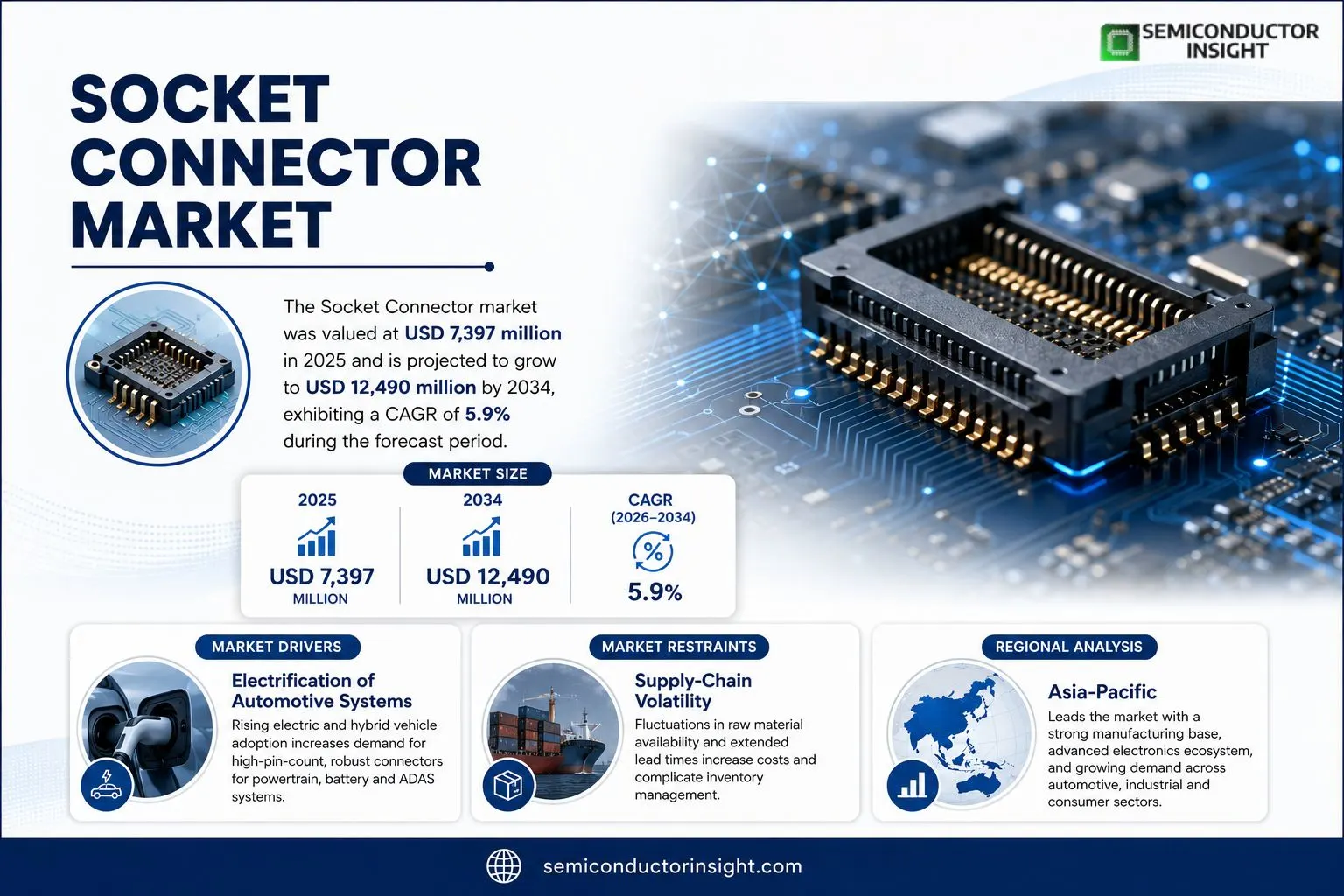
Socket Connector market was valued at USD 7,397 million in 2025. The market forecasts indicate growth from USD 7,397 million in 2025 to USD 12,490 million by 2034, exhibiting a CAGR of 5.9%.
A Socket Connector is the female or receptacle component of a connector system that mates with a plug connector to create a detachable electrical or signal link. It typically contains multiple contacts made from plated copper alloys housed within an insulating polymer shell. These connectors serve power‑distribution, signal‑routing and data‑transfer roles across PCB mounting, cable‑to‑board interconnects and device interfaces used
MARKET DRIVERS
Electrification of Automotive Systems
The shift toward electric and hybrid vehicles mandates a higher pin count and more robust interconnect solutions. As manufacturers integrate power‐train controllers, battery management units, and advanced driver‑assistance sensors, the Socket Connector Market experiences a clear uptick in component demand. This migration is not merely a regulatory response; it reflects a cost‑effective strategy to consolidate wiring harnesses while preserving signal integrity.
Growth of IoT‑Enabled Industrial Equipment
Factories embracing Industry 4.0 deploy modular sensors, edge processors, and smart actuators that rely on compact yet high‑performing socket interfaces. The proliferation of ruggedized connectors, designed to withstand vibration and temperature extremes, directly fuels revenue streams for vendors targeting the Socket Connector Market. Companies that can deliver both miniaturization and durability gain a competitive edge in this segment.
➤ “Standardization of connector dimensions across OEMs reduces engineering cycles and accelerates time‑to‑market.”
Regulatory harmonization, particularly in North America and Europe, encourages manufacturers to adopt unified connector families. This convergence trims inventory complexity and lowers per‑unit costs, reinforcing the market’s momentum.
MARKET CHALLENGES
Supply‑Chain Volatility
Recent disruptions in raw‑material sourcing, especially for copper and high‑performance polymers, have inflated lead times for socket components. Tier‑1 assemblers confront the dilemma of securing volume discounts while avoiding overstock, a balancing act that strains budgeting and forecasting practices.
Other Challenges
Design Compatibility
Legacy equipment often mandates older connector profiles, forcing manufacturers to maintain dual inventories. This backward compatibility pressure can dilute investment in newer, higher‑efficiency designs, slowing the overall adoption rate within the Socket Connector Market.
MARKET RESTRAINTS
Cost Sensitivity in Commodity Segments
In mass‑production environments such as consumer electronics, price pressure eclipses performance differentials. Even modest cost escalations in socket assemblies can erode profit margins, prompting OEMs to postpone upgrades to higher‑spec connectors.Furthermore, the reliance on extensive testing regimes to certify connectors for safety and electromagnetic compatibility adds to the total cost of ownership, discouraging rapid specification changes.
MARKET OPPORTUNITIES
Customization for Emerging 5G Infrastructure
The rollout of 5G networks drives the need for dense, high‑frequency interconnects in base stations and small cells. Vendors that engineer socket solutions with low insertion loss and enhanced shielding stand to capture a growing slice of the Socket Connector Market. Tailored designs that address space constraints in edge‑computing modules further expand the addressable market.Strategic partnerships with semiconductor designers enable early‑stage integration of socket technology, shortening development cycles and opening revenue streams tied to next‑generation communication hardware.
Socket Connector Market Trends
Rise of High‑Reliability Modular Interconnects
System designers across industrial automation, power distribution, and advanced communications are increasingly embracing modular architectures that demand socket connectors capable of repeated mating cycles without performance loss. This shift is rooted in the need to shorten equipment downtime, simplify field upgrades, and accommodate ever‑more complex circuit topologies. Suppliers that combine low contact resistance with robust mechanical retention are winning long‑term contracts, especially where safety certifications and environmental sealing are non‑negotiable. The trend forces manufacturers to align product roadmaps with engineering standards set by leading equipment makers, turning socket connector engineering into a strategic differentiator rather than a commodity offering.
Other Trends
Material Innovation and Miniaturization
Recent progress in plated copper alloys and high‑performance engineering plastics enables contact densities that were unattainable a decade ago. These materials support tighter pitch arrangements while preserving insertion force tolerances, allowing designers to pack more functionality into smaller enclosures. Miniaturized socket solutions are especially valuable in automotive electronics and emerging edge‑computing devices, where board real‑estate is at a premium. Companies that have integrated automated plating and precision molding into their production lines are able to guarantee repeatable performance, thereby attracting OEMs that cannot tolerate variance in signal integrity.
Regional Shifts Toward Localized Production
Supply‑chain volatility has prompted a re‑evaluation of manufacturing footprints. In North America and Europe, regulators emphasize traceability and compliance, encouraging manufacturers to locate assembly facilities closer to end‑users. Meanwhile, the Asia‑Pacific ecosystem benefits from a dense network of component suppliers, which accelerates design iterations and reduces time‑to‑market for new connector formats. This regional divergence creates a bifurcated market: high‑margin, specification‑driven production in mature economies, and volume‑focused, cost‑optimized output in regions with expansive manufacturing capacity. Enterprises that can flexibly shift production between these hubs while maintaining consistent quality standards are positioned to capture growth across the full geographic spectrum.
COMPETITIVE LANDSCAPE
Key Industry Players
Socket Connector Market – Competitive Overview
TE Connectivity remains the dominant force in socket‑connector arena, leveraging a comprehensive portfolio that spans high‑reliability industrial interfaces to high‑speed data links. Its extensive R&D network and vertically integrated manufacturing grant it a decisive edge in meeting the stringent certifications demanded by aerospace, energy and automotive OEMs. The company’s scale allows for aggressive pricing in commoditized segments while preserving premium margins on specialized products, a duality that shapes the overall market structure and forces rivals to differentiate through niche expertise or regional focus.Beyond the market leader, a constellation of midsize and specialist firms sustains competitive pressure. Molex, Amphenol and Phoenix Contact excel in modular system solutions, targeting industrial automation and telecommunications. Japanese innovators such as Hirose Electric, Omron and JAE Electronics inject high‑density, miniaturized designs that cater to compact consumer electronics and emerging 5G infrastructure. European playersincluding LAPP Group, Harwin and Fischer Connectorsconcentrate on ruggedized, safety‑critical connectors for rail, medical and defense applications. These companies collectively broaden the value chain, ensuring that customers can source bespoke configurations without relying solely on the largest suppliers.
List of Key Socket Connector Companies Profiled
- TE Connectivity
- Molex
- Amphenol
- Hirose Electric
- Phoenix Contact
- Omron
- Panasonic
- Murata Manufacturing
- JAE Electronics
- LAPP Group
- Harwin
- Preci‑Dip
- Fischer Connectors
- Bulgin Ltd
- LEMO
Segment Analysis:
| Segment Category | Sub-Segments | Key Insights |
| By Type |
|
DIMM Socket continues to dominate due to its alignment with high‑density memory modules in computing platforms.
SIMM and DIP sockets retain niche relevance in legacy equipment and specific control modules, ensuring backward compatibility and longer product lifecycles.
Overall, product‑type diversity allows OEMs to select configurations that balance performance, space constraints, and serviceability. |
| By Application |
|
Industrial Automation emerges as the leading application segment, driven by the need for modular, service‑oriented designs in factories and process plants.
Energy and Power applications prioritize safety certifications and resistance to electrical surges, influencing material selection and plating processes.
The aerospace and automotive domains value high‑speed data transmission and weight reduction, pushing manufacturers toward miniaturized, high‑frequency socket solutions that still meet stringent reliability criteria. |
| By End User |
|
Industrial Automation End Users demand connectors that facilitate rapid maintenance and modular upgrades, reinforcing the market’s focus on durability and repeatable mating performance.
Communications Infrastructure End Users emphasize high‑frequency signal integrity, prompting the adoption of precision‑plated contacts and low‑loss dielectric materials.
Across computing, automotive, and consumer electronics, the trend toward compact, service‑oriented products drives a preference for socket connectors that combine miniaturization with robust mechanical retention, fostering long‑term supplier relationships. |
| By Environment |
|
Harsh Industrial Settings drive the adoption of connectors with reinforced housings and corrosion‑resistant plating.
High‑Temperature Operations require alloys and thermoset plastics that retain electrical performance above typical ambient ranges.
Moisture‑resistant variants leverage gel‑filled or O‑ring sealed designs, ensuring reliable connectivity in outdoor and marine environments while maintaining low contact resistance. |
| By Performance |
|
High‑Speed Data Transmission is a critical performance driver for communications and computing sectors.
High‑Reliability connectors are specified for mission‑critical systems where downtime is unacceptable.
Miniaturized form factors respond to space constraints in automotive electronics and portable devices, encouraging innovative stacking and surface‑mount techniques that retain mechanical strength despite reduced footprint. |
Regional Analysis: Socket Connector Market
Asia‑Pacific
The concentration of circuit‑board fab facilities in coastal zones creates economies of scale that lower unit costs, yet also amplifies exposure to labor‑rate inflation as wages rise in primary hubs.
Regional engineering clusters are pioneering miniaturized pin configurations, spurred by smartphone manufacturers demanding higher pin density within constrained board real estate.
Multi‑sourcing strategies, coupled with strategic stockpiles of raw polymer, have insulated the market from recent logistics bottlenecks, sustaining steady component availability.
Emerging safety certifications across the region are harmonizing testing protocols, which reduces time spent on compliance validation for multinational product launches.
North America
North America retains a strong design‑lead position in the Socket Connector Market, with R&D centers in the United States and Canada pushing the envelope on high‑frequency performance. The focus on advanced automotive and aerospace applications fuels demand for connectors with tighter impedance tolerances, prompting domestic firms to cultivate niche expertise that offsets the region’s higher labor costs. Strategic alliances with Asian manufacturers are increasingly common, allowing North American designers to leverage cost efficiencies while preserving intellectual property control.
Europe
European activity centers on premium‑grade connectors for medical devices and industrial automation, where regulatory rigor drives a culture of meticulous quality assurance. The market benefits from a dense network of standards organizations that facilitate cross‑border component certification, reducing time‑to‑market for multinational projects. However, the region’s emphasis on sustainability is reshaping material selection, with several firms transitioning to recyclable polymers to meet EU environmental directives.
South America
In South America, the Socket Connector Market is shaped by a growing electronics assembly sector in Brazil and Mexico, where manufacturers are upgrading from legacy through‑hole designs to surface‑mount technologies. The regional push for local content, spurred by government incentives, encourages the establishment of modest‑scale production lines that serve domestic automotive and telecommunications firms. While the market remains price‑sensitive, incremental improvements in process automation are beginning to narrow the quality gap with more established regions.
Middle East & Africa
The Middle East & Africa region is witnessing nascent but steady adoption of high‑reliability connectors, driven by expanding data‑center deployments and oil‑field instrumentation projects. Investments in regional logistics hubs are reducing lead times, while partnerships with European OEMs introduce advanced design methodologies. Although overall market size remains modest, the focus on infrastructure resilience creates a fertile environment for specialized connector solutions that can endure harsh climatic conditions.
Report Scope
This market research report provides a comprehensive analysis of the Socket Connector Market , covering the forecast period 2026–2034. It offers detailed insights into market dynamics, technological advancements, competitive landscape, and key trends shaping the industry.
Key focus areas of the report include:
- Market Overview: The report begins with an overview outlining its current market scenario, key growth indicators, and industry transformation drivers. It discusses macroeconomic factors, demand–supply balance, regulatory landscape, and the strategic role of semiconductors in powering advancements across industries such as automotive, telecommunications, consumer electronics, and industrial automation.
- Market Size & Forecast: Historical data and future projections for revenue, unit shipments, and market value across major regions and segments.
- Segmentation Analysis: Detailed breakdown by product type, technology, application, and end-user industry to identify high‑growth segments and investment opportunities.
- Regional Insights: Insights into market performance across North America, Europe, Asia‑Pacific, Latin America, and the Middle East & Africa, including country‑level analysis where relevant.
- Competitive Landscape: Profiles of leading market participants, including their product offerings, R&D focus, manufacturing capacity, pricing strategies, and recent developments such as mergers, acquisitions, and partnerships.
- Technology Trends & Innovation: Assessment of emerging technologies, integration of AI/IoT, semiconductor design trends, fabrication techniques, and evolving industry standards.
- Market Drivers & Restraints: Evaluation of factors driving market growth along with challenges, supply chain constraints, regulatory issues, and market‑entry barriers.
- Stakeholder Insights: Insights for component suppliers, OEMs, system integrators, investors, and policymakers regarding the evolving ecosystem and strategic opportunities.
Primary and secondary research methods are employed, including interviews with industry experts, data from verified sources, and real‑time market intelligence to ensure the accuracy and reliability of the insights presented.
FREQUENTLY ASKED QUESTIONS:
What is the current market size of Socket Connector Market?
-> Socket Connector market was valued at USD 7,397 million in 2025 and is expected to reach USD 10,983 million by 2032, growing at a CAGR of 6.0% during the forecast period.
Which key companies operate in Socket Connector Market?
-> Key players include ABB, Schneider Electric, Omron, Panasonic, Phoenix Contact, TE Connectivity, Amphenol, Molex, Samtec, Hirose Electric, JAE Electronics, among others.
What are the key growth drivers?
-> Key growth drivers include increasing system complexity, demand for modular and maintainable designs, expansion of industrial automation, growth of power and high‑reliability communications, and advancements in material science and precision manufacturing.
Which region dominates the market?
-> Asia‑Pacific holds the largest share, driven by extensive manufacturing ecosystems in China, Japan, and South Korea, while North America and Europe remain important high‑reliability markets.
What are the emerging trends?
-> Emerging trends include miniaturization, high‑speed/high‑frequency interconnects, increased connector density, and the shift toward modular electronic architectures supporting rapid upgrade cycles.
Get Sample Report PDF for Exclusive Insights
Report Sample Includes
- Table of Contents
- List of Tables & Figures
- Charts, Research Methodology, and more...
 Download Sample Report PDF