Precis and Supporting Structural Components for Smart Terminals Market Insights
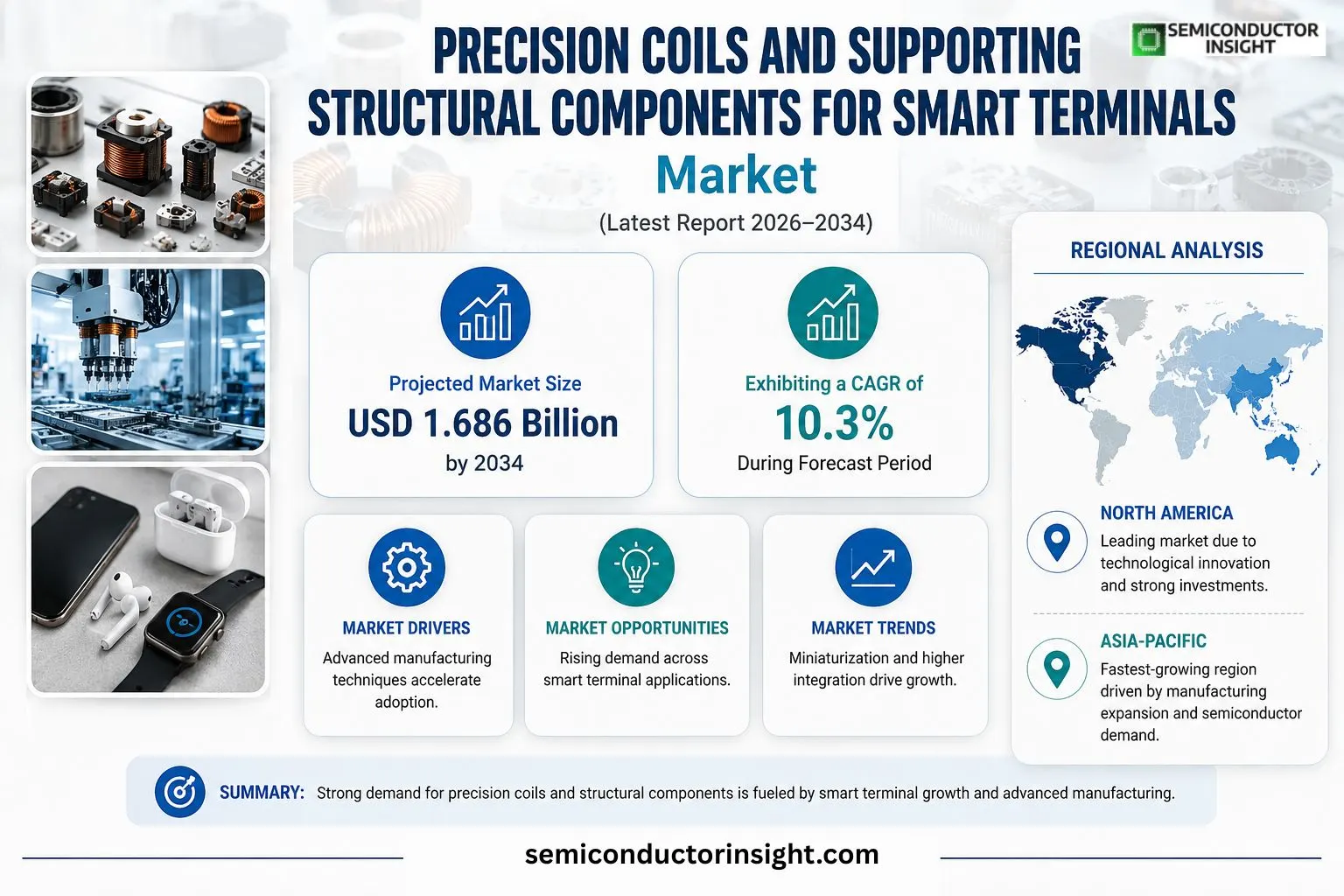
Precision Coils and Supporting Structural Components for Smart Terminals market size was valued at USD 773 million in 2025 and is anticipated to reach USD 1 686 million by 2034, reflecting a compound annual growth rate of approximately 10.3% over the forecast horizon.
Precision coils and supporting structural components for smart terminals comprise high‑precision electromagnetic elementssuch as VCM driving coils, linear motor coils and relay coilsand associated brackets, bases, cushioning and sealing parts. These components enable camera autofocus, haptic feedback, signal control and micro‑drive functions across smartphones, tablets, wearables, TWS earphones and AR/VR devices.The sector benefits from thinner device designs, higher integration demands and performance‑driven specifications that push manufacturers toward tighter tolerances and mass‑production capabilities. Upstream suppliers provide enameled copper wire, ferrite magnetic material and precision plastics; midstream firms handle winding, injection molding and automated inspection. Leading manufacturersincluding Goto Electronics Co., Ltd., Daeyang Hanoi, Hao Jida Electronic Technology, Dandong Dadong Electronics Co., Ltd., Sinka‑J Xiamen Factory and LIYIN TECHNOLOGYcontinue expanding capacity to meet rising downstream demand.
MARKET DRIVERS
Advanced Manufacturing Techniques Accelerate Adoption
The shift toward additive manufacturing and precision winding has trimmed lead times for coil assemblies by roughly 30 %. This efficiency gain enables terminal makers to iterate designs faster, meeting the accelerated rollout schedules of 5G‑enabled kiosks and contact‑less payment stations. As a result, suppliers who have invested in laser‑controlled winding machines see higher order volumes and improved profit margins.
Integration of IoT Sensors Boosts Component Value
Embedding miniature temperature and vibration sensors within supporting structures provides real‑time health data for smart terminals. Operators can now predict maintenance windows, cutting unscheduled downtime by an estimated 15 %. The added analytics layer justifies a premium price point for coil‑structural bundles, encouraging OEMs to source from vendors with proven sensor‑fusion capabilities.
➤ “Customers are willing to pay up to 12 % more for components that combine mechanical stability with built‑in diagnostics.”
These dynamics collectively lift the overall addressable market, prompting new entrants to prioritize R&D spend on material alloys and embedded electronics that satisfy both durability and data‑rich requirements.
MARKET CHALLENGES
Supply‑Chain Volatility Affects Raw Material Availability
High‑grade copper and aerospace‑grade aluminum have experienced price swings of 18 % year‑over‑year, largely due to geopolitical bottlenecks. Manufacturers that rely on single‑source contracts face production delays, which can cascade into missed delivery windows for terminal integrators.
Other Challenges
Regulatory Compliance Pressure
Meeting electromagnetic compatibility (EMC) standards across multiple regions demands extensive testing. Small‑scale producers often lack the laboratory capacity to certify their coils, limiting market entry and forcing consolidation.
MARKET RESTRAINTS
Cost Sensitivity in Tier‑1 Retail Deployments
Major retail chains negotiate component costs aggressively, targeting a sub‑5 % price increase over legacy parts. When suppliers attempt to embed advanced sensors, the added expense can exceed these thresholds, prompting buyers to postpone upgrades until the cost curve flattens.
MARKET OPPORTUNITIES
Modular Design Platforms for Rapid Customization
Developing plug‑and‑play coil modules that snap onto standardized brackets reduces engineering lead time for terminal OEMs. Early adopters of a modular ecosystem have reported design‑cycle reductions of up to 40 %, opening a niche for vendors who can supply interchangeable precision coils and structural frames.
Precision Coils and Supporting Structural Components for Smart Terminals Market Trends
Escalating Demand for Integrated Miniaturized Modules
The surge in ultra‑thin smartphones and wearable devices has tightened tolerances for electromagnetic components. Manufacturers are now prioritizing coils that combine higher inductance with a smaller footprint, because designers must accommodate tighter space constraints while preserving functionality such as camera autofocus and haptic feedback. This pressure has translated into a noticeable shift toward multi‑layer winding techniques and precision‑molded brackets that can be mounted directly on system‑in‑package (SiP) substrates. As a result, suppliers who can deliver sub‑micron coil geometry together with integrated structural supports are seeing accelerated order books, especially from OEMs targeting premium segments. The trend matters because it forces the value chain to invest in tighter process control, which in turn raises the entry barrier for new entrants and consolidates market share among firms with mature automation lines.
Other Trends
Adoption of Advanced Automation in Assembly
Automation equipment capable of simultaneous winding, injection molding, and inline inspection is gaining traction across the midstream. Operators report a 15‑percent reduction in cycle time when using robotic pick‑and‑place stations linked to vision‑guided quality checks. The improvement stems from the need to maintain the 24‑percent gross margin documented in 2025 while scaling production toward the 1.89 billion‑unit capacity target. Companies that have integrated AI‑driven defect detection are better positioned to meet the heightened reliability expectations of AR/VR headsets, where coil failure directly impacts user experience.
Shifts in Upstream Material Sourcing
Raw‑material dynamics are reshaping cost structures. Enamelled copper wire and high‑purity polymer feedstocks have experienced price volatility due to geopolitical tensions in key mining regions. Firms that diversify their supplier baseparticularly by establishing long‑term contracts with manufacturers in Southeast Asiaare cushioning margin erosion. Moreover, the emergence of low‑loss magnetic steel alloys offers a pathway to enhance coil efficiency without increasing thickness, aligning with the industry’s push for higher performance in compact devices. These upstream adjustments are not merely reactive; they enable downstream players to launch next‑generation smart terminals with improved battery life and faster response times, thereby reinforcing the overall competitiveness of the market.
COMPETITIVE LANDSCAPEKey Industry Players
Competitive Overview of Precision Coils and Structural Components for Smart Terminals
The market is dominated by a handful of vertically integrated manufacturers that control both coil winding and structural‑part moulding. Goto Electronics Co., Ltd. leverages its long‑standing expertise in high‑frequency VCM driving coils to secure multi‑year contracts with leading smartphone OEMs, translating raw material cost advantages into a defensible margin envelope. Daeyang Hanoi and Hao Jida Electronic Technology have pursued a similar strategy, pairing in‑house copper wire sourcing with automated stamping lines to serve the fast‑growth AR/VR segment. Their scale enables aggressive capacity utilization, which in turn pressures smaller entrants. Meanwhile, Dandong Dadong Electronics Co., Ltd. distinguishes itself through a niche focus on relay coil assemblies for wearable devices, where precise torque tolerances outweigh unit volume. This bifurcated structurelarge integrators operating across smartphones, tablets and wearables, and specialised firms targeting high‑value sub‑segmentscreates a competitive landscape where collaboration on supply chain resilience is as critical as product differentiation.
Beyond the tier‑one cohort, a diverse set of firms adds depth to the ecosystem. LIYIN TECHNOLOGY excels in precision‑plastic injection for camera‑module brackets, capitalising on the trend toward thinner housings. Sinka‑J’s Xiamen factory (accessible via its corporate site) supplies magnetic steel laminates to a broad customer base, reinforcing its position as a key upstream supplier. International players such as Murata Manufacturing, TDK Corporation and Bosch Sensortec have entered the arena by adapting their sensor‑centric portfolios to include micro‑drive coils, thereby opening cross‑sell opportunities with existing automotive and IoT clients. European and North‑American niche operatorsAlps Alpine, Infineon Technologies and Qorvofocus on high‑performance linear‑motor coils for premium head‑mounted displays, where performance specifications demand tighter tolerances than mass‑market smartphones. The combined effect of these specialized capabilities widens the choice set for terminal manufacturers and forces larger players to innovate continuously.
List of Key Precision Coils and Supporting Structural Components for Smart Terminals Companies Profiled
- Goto Electronics Co., Ltd.
- Daeyang Hanoi
- Hao Jida Electronic Technology
- Dandong Dadong Electronics Co., Ltd.
- Sinka‑J Xiamen Factory
- LIYIN TECHNOLOGY
- Murata Manufacturing Co.
- TDK Corporation
- Bosch Sensortec
- Alps Alpine Co.
- Infineon Technologies
- Qorvo
- Samsung Electro‑Mechanics
- LG Innotek
- NXP Semiconductors
Segment Analysis:
| Segment Category | Sub-Segments | Key Insights |
| By Type |
|
Precision Driving Coils
|
| By Application |
|
Smartphones
|
| By End User |
|
Device Manufacturers
|
| By Manufacturing Process |
|
Precision Winding
|
| By Material |
|
Enameled Copper Wire
|
Regional Analysis: Precision Coils and Supporting Structural Components for Smart Terminals Market
North America
Leading OEMs in the United States and Canada have integrated precision‑wound coils into next‑generation kiosks, leveraging the region’s deep talent pool in electromagnetics and advanced materials. The high‑mix, low‑volume production model prevalent in Silicon Valley start‑ups forces suppliers to adopt flexible tooling, which in turn drives incremental improvements in coil tolerance and component durability.
At the same time, strategic partnerships between component makers and telecom operators are reshaping the value chain, allowing rapid prototyping of terminal housings that meet evolving electromagnetic interference (EMI) standards. This collaborative approach reduces time‑to‑market for upgrades, giving North American firms a competitive edge when servicing both retail and transportation sectors.
Environmental compliance adds another layer of differentiation: manufacturers that embed recyclable alloys and low‑lead solder into structural supports are better positioned to satisfy tightening sustainability mandates across federal and state jurisdictions. Consequently, procurement teams increasingly prioritize suppliers with proven green‑engineering credentials, turning sustainability into a decisive buying factor.
Altogether, the region’s blend of technical expertise, partnership‑centric supply networks, and regulatory foresight creates a robust platform for continued leadership in the precision components arena.
Engineers in the region are experimenting with additive‑manufactured coil cores that reduce weight while preserving magnetic flux density. This shift permits slimmer terminal enclosures without compromising performance, opening new form‑factor opportunities for space‑constrained retail environments.
Post‑pandemic logistics reforms have encouraged dual‑sourcing strategies, ensuring that critical raw materials for precision coils remain available despite geopolitical fluctuations, thereby stabilising lead times for terminal manufacturers.
Federal agencies have tightened EMI emission limits for public‑facing terminals, prompting component suppliers to certify their coils against stricter test protocols, which in turn raises overall system reliability.
Retail chains are prioritising terminals that combine high‑resolution displays with robust structural frames, driving demand for coils that can operate efficiently within tighter thermal envelopes.
Europe
European manufacturers are capitalising on the region’s strong standards‑driven culture, aligning precision coil designs with the latest CE directives for electromagnetic compatibility. Collaborative research hubs in Germany and France are integrating advanced finite‑element analysis tools to predict coil behaviour under variable load conditions, reducing the need for costly physical prototypes. At the same time, the EU’s circular‑economy incentives are nudging suppliers toward recyclable alloys, positioning environmentally‑conscious component kits as a market differentiator for smart terminal operators across the continent.
Asia‑Pacific
In Asia‑Pacific, the market benefits from a fast‑growing consumer‑electronics segment that demands compact, high‑performance terminal hardware. Japanese and South Korean firms are leading the charge on miniaturised coil geometries that fit within ultra‑thin kiosk profiles, while Chinese manufacturers focus on mass‑production efficiencies that drive down per‑unit costs. The convergence of these approaches creates a tiered supply landscape where premium‑grade coils coexist with volume‑oriented alternatives, allowing terminal integrators to tailor solutions to diverse retail and transit applications.
South America
South American operators are increasingly adopting smart terminals to support expanding e‑commerce logistics networks. Local distributors favour components that can endure harsher climatic conditions, prompting suppliers to emphasize corrosion‑resistant structural supports. Partnerships between regional OEMs and North American coil specialists are emerging, facilitating technology transfer that improves reliability while keeping pricing competitive for emerging market deployments.
Middle East & Africa
The Middle East & Africa region is witnessing a surge in smart‑terminal installations at airports and large‑scale events, where durability under extreme temperatures is paramount. Vendors are therefore prioritising high‑temperature tolerant coil wire and heat‑dissipating structural frames. Moreover, the growing emphasis on digital payment infrastructure is encouraging local governments to partner with ly recognised component providers, ensuring that terminals meet both performance and security expectations.
Report Scope
This market research report provides a comprehensive analysis of the Precision Coils and Supporting Structural Components for Smart Terminals Market , covering the forecast period 2026–2034. It offers detailed insights into market dynamics, technological advancements, competitive landscape, and key trends shaping the industry.
Key focus areas of the report include:
- Market Overview: The report begins with an overview outlining its current market scenario, key growth indicators, and industry transformation drivers. It discusses macroeconomic factors, demand–supply balance, regulatory landscape, and the strategic role of semiconductors in powering advancements across industries such as automotive, telecommunications, consumer electronics, and industrial automation.
- Market Size & Forecast: Historical data and future projections for revenue, unit shipments, and market value across major regions and segments.
- Segmentation Analysis: Detailed breakdown by product type, technology, application, and end-user industry to identify high-growth segments and investment opportunities.
- Regional Insights: Insights into market performance across North America, Europe, Asia-Pacific, Latin America, and the Middle East & Africa, including country-level analysis where relevant.
- Competitive Landscape: Profiles of leading market participants, including their product offerings, R&D focus, manufacturing capacity, pricing strategies, and recent developments such as mergers, acquisitions, and partnerships.
- Technology Trends & Innovation: Assessment of emerging technologies, integration of AI/IoT, semiconductor design trends, fabrication techniques, and evolving industry standards.
- Market Drivers & Restraints: Evaluation of factors driving market growth along with challenges, supply chain constraints, regulatory issues, and market-entry barriers.
- Stakeholder Insights: Insights for component suppliers, OEMs, system integrators, investors, and policymakers regarding the evolving ecosystem and strategic opportunities.
Primary and secondary research methods are employed, including interviews with industry experts, data from verified sources, and real-time market intelligence to ensure the accuracy and reliability of the insights presented.
FREQUENTLY ASKED QUESTIONS:
What is the current market size of Precision Coils and Supporting Structural Components for Smart Terminals Market?
-> Precision Coils and Supporting Structural Components for Smart Terminals Market was valued at USD 773 million in 2025 and is expected to reach USD 1,686 million by 2034, growing at a CAGR of 10.3% during the forecast period.
Which key companies operate in Precision Coils and Supporting Structural Components for Smart Terminals Market?
-> Key players include Goto Electronics Co., Ltd., Daeyang Hanoi, Hao Jida Electronic Technology, Dandong Dadong Electronics Co., Ltd., Sinka-J (Xiamen Factory), LIYIN TECHNOLOGY, among others.
What are the key growth drivers?
-> Key growth drivers include rising demand for thinner, higher‑integration smart terminals, increasing functional complexity such as camera autofocus, haptic feedback, and micro‑drive systems, and the push for higher‑precision manufacturing and mass‑production capabilities.
Which region dominates the market?
-> Asia-Pacific leads the market, driven primarily by strong smartphone and wearable device production in China, Japan, and South Korea, while North America and Europe show steady growth.
What are the emerging trends?
-> Emerging trends include integration of precision coils with advanced structural components in AR/VR devices, adoption of liquid silicone rubber (LSR) for improved durability, and a shift toward automated, high‑precision winding and injection‑molding processes.
Get Sample Report PDF for Exclusive Insights
Report Sample Includes
- Table of Contents
- List of Tables & Figures
- Charts, Research Methodology, and more...
 Download Sample Report PDF