Robot Arm Harnesses and Cables Market Insights
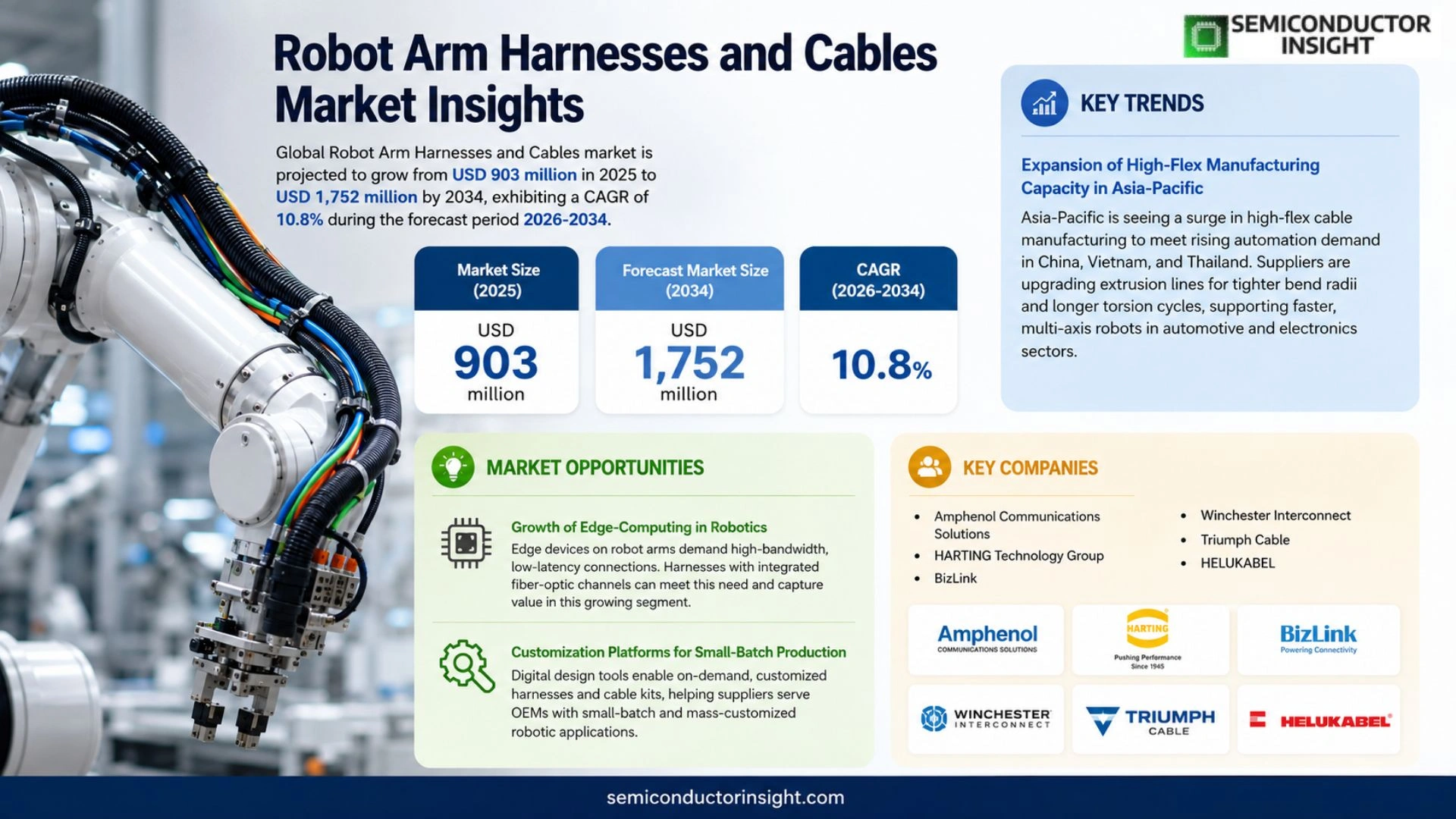
Global Robot Arm Harnesses and Cables market size was valued at USD 903 million in 2025. The market is projected to grow from USD 903 million in 2025 to USD 1 752 million by 2034, exhibiting a CAGR of 10.8% during the forecast period.
Robot Arm Harnesses and Cables refer to specialized integrated wiring systems used in industrial robotic arms; they combine multiple electrical conductors, connectors and protective polymers into a structured assembly that carries power, control signals and data between controllers, motors and sensors while tolerating continuous bending and torsion under harsh factory conditions.
The market is experiencing rapid growth because automation investment across automotive, electronics and logistics sectors continues unabated. Rising demand for high‑flexibility cables in collaborative robots (cobots) adds pressure on suppliers to deliver lighter, modular solutions. At the same time, expansion of high‑flex cable plants in Asia‑Pacific, reshoring of production lines in North America and Europe, and the emergence of smart cables equipped with embedded sensors for predictive maintenance are accelerating adoption. Leading firms such as Amphenol Communications Solutions, BizLink, Winchester Interconnect, HARTING Technology Group, Triumph Cable, HELUKABEL, DYDEN CORPORATION, NISSEI, KURAMO ELECTRIC and TAIYO CABLETEC have announced joint projects with robot OEMs to co‑develop next‑generation harness architectures optimized for speed and reliability.
MARKET DRIVERS
Automation Penetration in Manufacturing
The surge in automation across automotive, electronics, and consumer‑goods assembly lines has heightened demand for reliable interconnect solutions. Robot Arm Harnesses and Cables Market participants are benefiting from factories that replace manual stations with articulated robots, because high‑speed data and power transfer are prerequisites for maintaining cycle times.
Electrification of Industrial Robotics
Modern robots increasingly rely on electric actuation rather than hydraulic systems, which shifts the payload to sophisticated cable assemblies. This transition drives engineers to select harnesses that can sustain higher voltage levels while remaining lightweight, a combination that directly fuels sales growth.
➤ Customers are prioritising modular cable systems that can be re‑configured as production lines evolve, shortening engineering lead‑times and reducing downtime.
In parallel, the rise of collaborative robots (cobots) introduces new safety standards that demand fault‑tolerant wiring. Suppliers that embed diagnostic feedback into harnesses gain a competitive edge, prompting manufacturers to allocate larger budgets toward intelligent connectivity solutions.
MARKET CHALLENGES
Stringent Compliance Requirements
Regulatory bodies across Europe and North America impose rigorous EMI shielding and temperature‑rating criteria on equipment used in hazardous environments. Failure to certify harnesses against these standards can halt plant commissioning, forcing OEMs to allocate additional engineering resources to achieve compliance.
Other Challenges
Supply‑Chain Volatility
The reliance on specialty copper alloys and high‑temperature polymer coatings makes the sector vulnerable to raw‑material price swings. Shortages of these inputs translate into longer lead times, compelling buyers to maintain strategic inventory buffers.
MARKET RESTRAINTS
Capital Intensity of Retrofit Projects
Upgrading legacy robotic cells often requires complete rewiring, a process that can consume up to 25 % of a plant’s capital expenditure budget. When firms face tight financial constraints, they may postpone such upgrades, thereby limiting near‑term demand for new harnesses.
Complex Integration with Existing Control Systems
Integrators must ensure that new cable assemblies interface seamlessly with proprietary PLCs and fieldbus architectures. The technical effort involved can deter smaller manufacturers from pursuing extensive retrofits, curbing market expansion in the lower‑tier segment.
MARKET OPPORTUNITIES
Growth of Edge‑Computing in Robotics
Edge devices placed on robot arms require high‑bandwidth, low‑latency connections to support real‑time analytics. Companies that design harnesses with integrated fiber‑optic channels can capture a share of this emerging niche, as manufacturers seek to process sensor data locally rather than rely on centralized servers.
Customization Platforms for Small‑Batch Production
The shift toward mass‑customization has created demand for rapidly configurable cable kits. Leveraging digital design tools to produce on‑demand, customized harnesses enables suppliers to serve OEMs that produce limited‑run products, expanding the addressable market beyond high‑volume sectors.
Robot Arm Harnesses and Cables Market Trends
Expansion of High‑Flex Manufacturing Capacity in Asia‑Pacific
The Asia‑Pacific region is witnessing a surge in dedicated high‑flex cable factories, primarily to satisfy the automation push in China, Vietnam and Thailand. Suppliers are re‑tooling extrusion lines to accommodate tighter bend radii and longer torsion cycles, a response to the adoption of faster, multi‑axis robots on automotive assembly lines. This shift reduces lead times for system integrators and lowers inventory pressure for OEMs, creating a more responsive supply chain that can adapt to short‑run product variations typical in consumer‑electronics manufacturing.
Other Trends
Smart Cable Integration for Predictive Maintenance
Manufacturers are embedding miniature strain‑gauges and temperature sensors within the conductor bundles, allowing real‑time health monitoring of the harnesses. The data stream feeds machine‑learning models that flag early signs of insulation fatigue or connector wear before a failure manifests on the shop floor. End users report a measurable drop in unplanned downtime, while service contracts evolve from reactive repairs to condition‑based service plans, reshaping the economics of after‑sales support.
Localized Production and Reshoring Initiatives
In North America and Europe, leading cable producers are establishing assembly hubs close to major robot manufacturers. This geographic alignment mitigates the risk of cross‑border logistics disruptions and aligns with regulatory trends encouraging domestic sourcing of critical components. The proximity also facilitates collaborative engineering projects, where OEMs and cable makers co‑design modular harness architectures tailored to collaborative robots (cobots). The resulting solutions are lighter, easier to install, and support rapid change‑over of production cells, thereby enhancing overall plant agility.
COMPETITIVE LANDSCAPE
Key Industry Players
Robotic arm harnesses and cables – a fragmented field dominated by a few global integrators
Amphenol Communications Solutions continues to capture the lion’s share of high‑flex cable contracts with major robot OEMs in North America and Europe, leveraging its extensive connector portfolio and advanced extrusion capabilities. HARTING Technology Group follows closely, differentiating through modular harness architectures that cater to collaborative‑robot specifications. Both firms have invested heavily in regional assembly lines, reducing lead times for automotive and electronics customers and reinforcing their positions as preferred suppliers for large‑scale automation projects. The market structure reflects a clear tiered hierarchy: a handful of multinational manufacturers dominate volume sales, while mid‑size specialists such as Triumph Cable and HELUKABEL focus on niche applications requiring extreme torsion resistance or custom shielding. This concentration has prompted strategic joint‑ventures, especially in the Asia‑Pacific corridor, where demand growth is fueling capacity expansions and technology transfers.
Beyond the primary tier, a roster of niche innovators is reshaping value chains through bespoke solutions. BizLink and Winchester Interconnect have carved out reputations for rapid‑prototype harnesses that support short‑run robot deployments in the food‑processing sector. Companies like DYDEN CORPORATION and NISSEI excel in integrating sensor‑embedded conductors that enable predictive maintenance, a capability increasingly demanded by logistics providers seeking uptime guarantees. Smaller Asian players,including KURAMO ELECTRIC, TAIYO CABLETEC, and the Chinese firms Hebei Kuomu Electronic Technology Co., Ltd. and Suzhou Kaibaile Electronics,are leveraging lower‑cost material sourcing to compete on price while progressively upgrading their product durability to meet European safety standards. Their collective impact lies in widening the supplier base, giving system integrators more flexibility to negotiate terms and driving incremental innovation across the value chain.
List of Key Robot Arm Harnesses and Cables Companies Profiled
- Amphenol Communications Solutions
- HARTING Technology Group
- BizLink
- Winchester Interconnect
- Triumph Cable
- HELUKABEL
- DYDEN CORPORATION
- NISSEI
- KURAMO ELECTRIC
- TAIYO CABLETEC
- Yaskawa
- Dot Robot
- TSP
- Romtronic
- Hebei Kuomu Electronic Technology Co., Ltd.
- Suzhou Kaibaile Electronics
- Yanagawa Electronics
- Hangzhou DELRUN Technology Co., Ltd.
Segment Analysis:
| Segment Category | Sub-Segments | Key Insights |
| By Type |
|
Flexibility drives design choices for high‑speed collaborative robots and environments requiring frequent re‑routing.
|
| By Application |
|
6‑Axis Robot Arm remains the primary driver for advanced manufacturing automation.
|
| By End User |
|
Automotive end users prioritize durability and compliance with harsh shop‑floor conditions.
|
| By Product Function |
|
Power transmission is the cornerstone of robot arm reliability.
|
| By Material Composition |
|
High‑Performance Polymers enable the flexibility and chemical resistance demanded by modern robots.
|
Regional Analysis: Robot Arm Harnesses and Cables Market
North America
Proximity to major component fabs and a network of certified cable fabricators enables rapid iteration cycles. This logistical edge shortens the time from prototype to production, a decisive factor for OEMs racing to launch next‑generation robot arms.
Stringent UL and CSA certifications shape design parameters, pushing suppliers toward higher reliability standards. Companies that embed compliance early avoid costly redesigns when entering regulated markets like medical robotics.
Strategic alliances between cable manufacturers and leading robot builders create joint‑development programs, aligning product roadmaps and ensuring that harnesses meet the specific torque and vibration profiles of next‑gen arms.
Concentrations of research institutions in Silicon Valley and the Great Lakes region feed a pipeline of advanced materials, such as flexible polymers, that enhance cable durability without adding bulk.
Europe
European manufacturers benefit from harmonized standards across the EU, which streamline cross‑border component sourcing for robot arm harnesses. Countries like Germany and Sweden lead in precision engineering, delivering cable assemblies that satisfy demanding motion‑control tolerances. The region’s push toward Industry 4.0 creates demand for modular, plug‑and‑play harness solutions that can be retrofitted into legacy equipment, allowing factories to upgrade incrementally. Meanwhile, sustainability mandates encourage the use of recyclable insulation materials, prompting suppliers to differentiate through eco‑friendly designs. The combined effect of regulatory clarity and a mature automation culture sustains Europe’s strong foothold in the market.
Asia‑Pacific
Asia‑Pacific’s rapid industrialization fuels a surge in robot arm deployments, especially in China, Japan, and South Korea. While cost sensitivity dominates, the shift toward higher‑value applications,such as electronics assembly and pharmaceutical logistics,requires harnesses with tighter electromagnetic shielding. Local cable producers are increasingly adopting advanced extrusion techniques to meet these specifications, yet they still contend with fragmented quality controls across the region. Investment in regional testing labs is gradually lifting the overall reliability bar, positioning the market to transition from pure volume‑driven growth to a more nuanced value proposition.
South America
In South America, Brazil’s expanding automotive and food‑processing sectors are the primary catalysts for robot arm harness demand. Market participants note a gradual move away from imported cables toward domestically assembled solutions, driven by import‑tariff pressures and a desire for faster after‑sales support. However, limited skilled labor in high‑precision cable fabrication hampers scaling, prompting joint ventures with North American firms to transfer know‑how. The region’s trajectory hinges on the ability to build a competent workforce that can sustain the quality expectations of sophisticated robotic systems.
Middle East & Africa
The Middle East & Africa region is witnessing early‑stage adoption of robotic automation, led by oil‑and‑gas service firms seeking to improve safety through remote manipulation. Harnesses must endure harsh environmental conditions, prompting a niche market for ruggedized cables with temperature‑resistant jackets. In South Africa, a fledgling electronics assembly base is experimenting with modular harness kits to reduce engineering overhead. Although overall market size remains modest, the strategic importance of reliable cable solutions for critical infrastructure projects creates a runway for specialized suppliers.
Report Scope
This market research report provides a comprehensive analysis of the Robot Arm Harnesses and Cables Market , covering the forecast period 2026–2034. It offers detailed insights into market dynamics, technological advancements, competitive landscape, and key trends shaping the industry.
Key focus areas of the report include:
- Market Overview: The report begins with an overview outlining its current market scenario, key growth indicators, and industry transformation drivers. It discusses macroeconomic factors, demand–supply balance, regulatory landscape, and the strategic role of semiconductors in powering advancements across industries such as automotive, telecommunications, consumer electronics, and industrial automation.
- Market Size & Forecast: Historical data and future projections for revenue, unit shipments, and market value across major regions and segments.
- Segmentation Analysis: Detailed breakdown by product type, technology, application, and end-user industry to identify high-growth segments and investment opportunities.
- Regional Insights: Insights into market performance across North America, Europe, Asia-Pacific, Latin America, and the Middle East & Africa, including country-level analysis where relevant.
- Competitive Landscape: Profiles of leading market participants, including their product offerings, R&D focus, manufacturing capacity, pricing strategies, and recent developments such as mergers, acquisitions, and partnerships.
- Technology Trends & Innovation: Assessment of emerging technologies, integration of AI/IoT, semiconductor design trends, fabrication techniques, and evolving industry standards.
- Market Drivers & Restraints: Evaluation of factors driving market growth along with challenges, supply chain constraints, regulatory issues, and market-entry barriers.
- Stakeholder Insights: Insights for component suppliers, OEMs, system integrators, investors, and policymakers regarding the evolving ecosystem and strategic opportunities.
Primary and secondary research methods are employed, including interviews with industry experts, data from verified sources, and real-time market intelligence to ensure the accuracy and reliability of the insights presented.
FREQUENTLY ASKED QUESTIONS:
What is the current market size of Robot Arm Harnesses and Cables Market?
-> Robot Arm Harnesses and Cables Market was valued at USD 903 million in 2025 and is expected to reach USD 1752 million by 2032, growing at a CAGR of 10.8% during the forecast period.
Which key companies operate in Robot Arm Harnesses and Cables Market?
-> Key players include Amphenol Communications Solutions, BizLink, Winchester Interconnect, HARTING Technology Group, Triumph Cable, HELUKABEL, DYDEN CORPORATION, NISSEI, KURAMO ELECTRIC, TAIYO CABLETEC, among others.
What are the key growth drivers?
-> Key growth drivers include expansion of high‑flex cable manufacturing facilities in Asia‑Pacific, establishment of localized production bases in North America and Europe to support reshoring, development of smart cable systems with embedded sensors for predictive maintenance, and investments in automation‑ready harness assembly lines.
Which region dominates the market?
-> Asia‑Pacific is the leading region, driven by rapid automation adoption in China and Southeast Asia, while also witnessing significant investments in advanced harness technologies.
What are the emerging trends?
-> Emerging trends include smart cable solutions with embedded IoT sensors, lightweight and modular harness designs for collaborative robots, and high‑flex, torsion‑resistant cable technologies to support next‑generation high‑speed industrial automation.

Get Sample Report PDF for Exclusive Insights
Report Sample Includes
- Table of Contents
- List of Tables & Figures
- Charts, Research Methodology, and more...
 Download Sample Report PDF