LCP Millimeter-Wave Antenna Module Market Insights
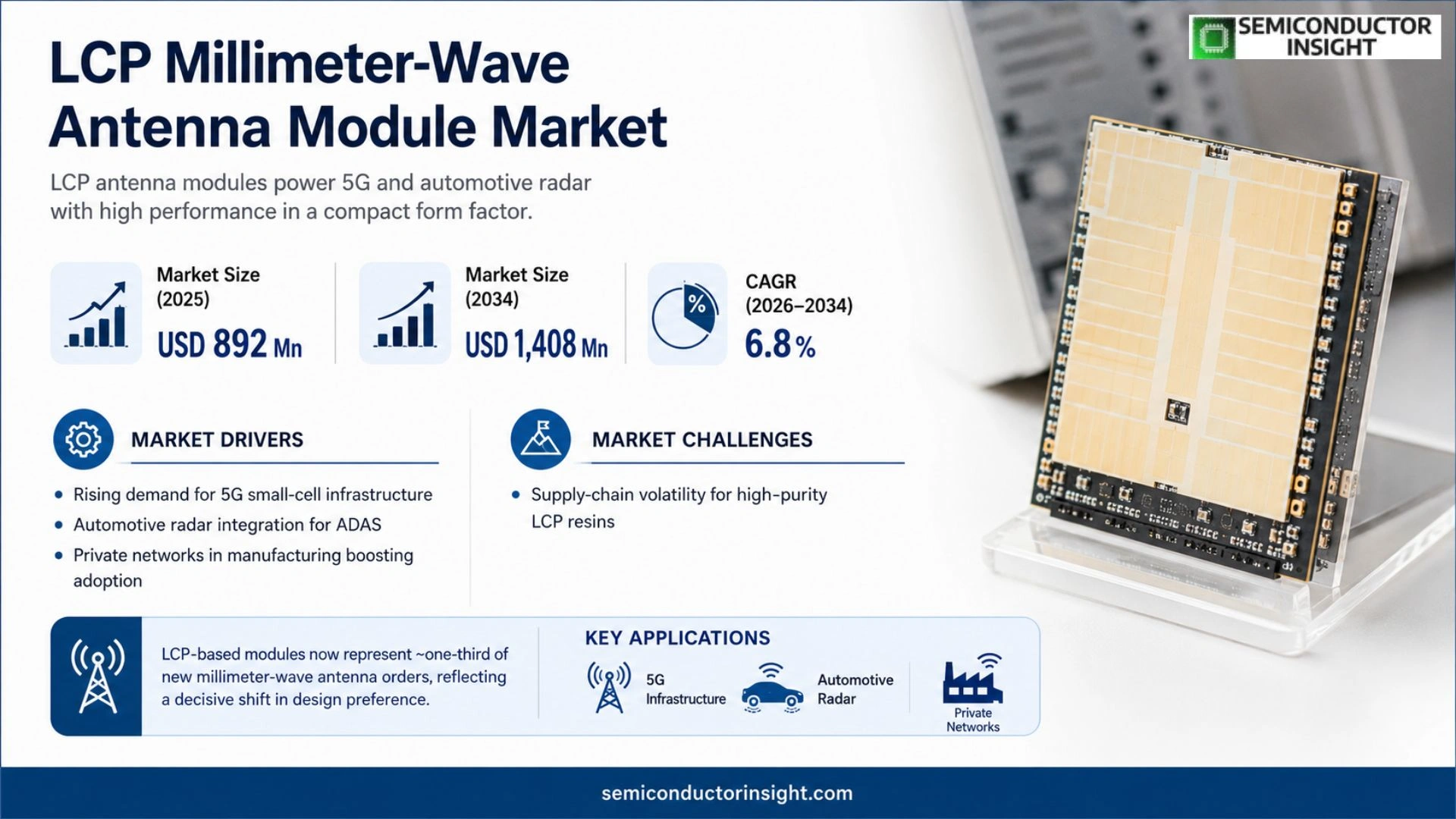
Global LCP Millimeter-Wave Antenna Module market size was valued at USD 892 million in 2025 and is forecasted to reach USD 1,408 million by 2032, delivering a compound annual growth rate of 6.8% throughout the forecast horizon.
LCP millimeter‑wave antenna modules employ liquid crystal polymer (LCP) thin‑film or copper‑clad laminates as both dielectric and carrier, enabling integration of array antennas, feed lines and RF interconnects on a flexible or semi‑flexible substrate. When combined with phased‑array or AiP transceiver packages they provide low dielectric loss, minimal moisture absorption and dimensional stability,attributes essential for 5G/6G millimeter‑wave terminals and compact base stations.
The expansion of high‑frequency connectivity solutions fuels demand for these modules; operators are rolling out dense small‑cell networks while automotive manufacturers seek reliable radar components. Recent activity includes Murata’s launch of a new phase‑array module for automotive radar in March 2024 and Luxshare Precision’s partnership with Qualcomm to co‑develop integrated antenna‑in‑package solutions for next‑generation smartphones. Suppliers that can guarantee material batch consistency, tight process windows and end‑to‑end design support are increasingly favored in procurement decisions.
MARKET DRIVERS
Rising Demand for 5G Small‑Cell Infrastructure
The rollout of 5G networks is compelling operators to densify their deployments, and LCP Millimeter-Wave Antenna Module Market offerings are uniquely suited to the compact form‑factor required for small‑cell sites. Thin‑film LCP substrates reduce weight while preserving high‑frequency performance, enabling faster installation and lower site‑rent costs. This technical advantage translates into a measurable shift toward LCP‑based solutions in urban corridors.
Automotive Radar Integration
Advanced driver‑assistance systems (ADAS) increasingly rely on millimeter‑wave radar to achieve precise object detection. Manufacturers are gravitating toward LCP antenna modules because the material tolerates the automotive temperature envelope and supports batch printing, which drives economies of scale. Higher reliability under vibration and thermal cycling further cements this preference.
➤ LCP‑based modules now account for roughly one‑third of new millimeter‑wave antenna orders in the first‑half of the year, highlighting a decisive shift in design philosophy.
Beyond telecom and automotive, emerging private‑network deployments in manufacturing plants are leveraging LCP’s low dielectric loss to deliver consistent throughput in congested spectrum environments. The convergence of these use cases creates a reinforcing loop that accelerates adoption across multiple verticals.
MARKET CHALLENGES
Supply‑Chain Volatility for High‑Purity LCP Resins
While demand is climbing, the availability of premium‑grade LCP resin remains erratic. Production facilities in East Asia face capacity constraints, and any delay cascades through the antenna‑module assembly line, inflating lead times. Manufacturers must therefore hedge inventory, a practice that squeezes cash flow, especially for mid‑size players.
Other Challenges
Regulatory Compliance Hurdles
Regulators in Europe and North America are tightening electromagnetic‑emission standards for millimeter‑wave devices. Vendors that cannot certify their LCP modules quickly risk exclusion from key markets, forcing costly redesign cycles.
MARKET RESTRAINTS
Cost Parity with Conventional Materials
Although LCP delivers superior performance at high frequencies, its unit cost remains higher than that of traditional FR‑4 or ceramic substrates. For price‑sensitive applications,such as low‑end consumer IoT devices,buyers continue to default to cheaper alternatives. The price gap narrows only as volume ramps, but current production runs are insufficient to generate a meaningful cost advantage.
MARKET OPPORTUNITIES
Emergence of Edge‑Computing Nodes
Edge‑computing installations are demanding antenna modules that combine high gain with minimal footprint. LCP’s ability to integrate feed networks directly onto the substrate opens pathways for compact, high‑performance edge radios. Early adopters are piloting these solutions in smart‑city projects, suggesting a runway for accelerated market penetration.
Strategic Partnerships with Foundries
Several global semiconductor foundries have announced joint programs to co‑develop LCP antenna‑module libraries compatible with their mmWave transceivers. Such collaborations reduce time‑to‑market for OEMs and create a co‑innovation ecosystem that can offset current cost disadvantages while expanding the addressable client base.
LCP Millimeter-Wave Antenna Module Market Trends
Performance‑Driven Design Imperatives
LCP Millimeter-Wave Antenna Module Market’s revenue reached $892 million in 2025, as a result of strong demand from 5G and early 6G development programs. In the same year, 65.1 million units were sold at an average price of $15, delivering a profit margin of 20‑25 %. This financial cushion enables firms to invest in low‑loss laminate research, targeting dielectric constants below 3.0 to push operation into the 57‑71 GHz band without sacrificing yield. Manufacturers now face intense pressure to meet the tight beam‑steering specifications required by next‑generation terminals, and variability in dielectric loss or humidity‑induced drift is quickly identified as a barrier to product launch. Suppliers that can guarantee material batch stability and close the loop between electromagnetic simulation and high‑volume production are therefore gaining preferential treatment in procurement lists.
Other Trends
Regional Supply‑Chain Competition
North America leverages a mature communications‑chip ecosystem and early operator trials, raising expectations for certification speed and array uniformity. Europe’s automotive radar segment stresses temperature resilience and long‑term supply reliability, prompting OEMs to lock in partners with proven lifecycle support. In Asia‑Pacific, the focus narrows to squeezing yield improvements while keeping unit costs under control; the dense supply chain,from LCP resin producers to module assemblers,allows rapid iteration but also amplifies margin pressure. Emerging markets, although slower to roll out millimeter‑wave infrastructure, create niche opportunities in fixed‑wireless CPE and private‑network deployments, where cost‑effective performance fuels adoption.
Integration of Design, Test and Compliance
A second wave of evolution centers on the convergence of antenna design, packaging and test automation. Companies are abandoning the sequential “fabricate‑then‑assemble” mindset in favor of an integrated approach that embeds feed‑line routing and heat‑spreading structures directly within the LCP substrate. Real‑time online testing and automated calibration reduce rework cycles and improve batch‑to‑batch repeatability, turning data‑driven process control into a competitive advantage. When FCC/CE and RoHS/REACH compliance is baked into the production flow, manufacturers shorten time‑to‑market and lower engineering overhead, positioning themselves as preferred partners for the upcoming surge in high‑frequency terminals.
COMPETITIVE LANDSCAPE
Key Industry Players
Competitive dynamics shaping the global LCP Millimeter‑Wave Antenna Module market
Murata Corporation dominates the upper tier of the market, leveraging its deep RF heritage and extensive global manufacturing footprint to deliver fully integrated antenna‑module solutions for flagship 5G/6G smartphones and automotive radar. Its ability to align material sourcing, precision etching and automated test flows under a single design‑for‑manufacturing (DFM) framework translates into tighter yield control and lower total cost of ownership for Tier‑1 OEMs. This vertical integration has forced competitors to either specialize in niche performance attributes,such as ultra‑low loss dielectric stacks,or to adopt a “design‑plus‑service” model that bundles simulation libraries, rapid prototyping and volume ramp‑up support.
Beyond Murata, the competitive set includes a mix of traditional RF vendors and emerging Asian manufacturers. Luxshare Precision and Sunway Technology (Shenzhen) have accelerated their market share by coupling high‑volume LCP‑film capacity with aggressive pricing, targeting mid‑range handset and small‑cell segments. Qualcomm’s antenna‑module division focuses on co‑design with its silicon‑RF platforms, while Fujikura provides premium interconnect solutions for automotive radar. Wistron NeWeb (WNC) and Auden Technology differentiate through advanced laser‑drilled micro‑hole processes that improve array uniformity. USI, Amkor and ASE supply comprehensive backend services that appeal to companies lacking in‑house packaging expertise. TSMC’s foray into LCP‑based packaging, Panasonic’s material‑science legacy, Taiflex’s high‑temperature LCP foils, Zhen Ding Tech’s large‑scale FCCL lines and Avary’s niche smart‑cockpit modules round out a fragmented landscape where the decisive factor is the ability to synchronize material stability, process tolerances and certification speed.
List of Key LCP Millimeter-Wave Antenna Module Companies Profiled
- Murata Corporation
- Luxshare Precision
- Sunway Technology
- Qualcomm
- Fujikura Ltd.
- Wistron NeWeb (WNC)
- Auden Technology
- USI (Universal Scientific Industrial)
- Amkor Technology
- ASE Technology
- TSMC
- Panasonic
- Taiflex
- Zhen Ding Tech Group
- Avary
Segment Analysis:
| Segment Category | Sub-Segments | Key Insights |
| By Type |
|
Phase Array
|
| By Application |
|
Automotive Radar & Smart Cockpit
|
| By End User |
|
Infrastructure Providers
|
| By Integration Approach |
|
Integrated Antenna‑in‑Package (AiP)
|
| By Performance Drivers |
|
Low Dielectric Loss
|
Regional Analysis: LCP Millimeter-Wave Antenna Module Market
North America
The United States, in particular, has become a testing ground for next‑generation 5G and early 6G deployments, prompting device manufacturers to adopt LCP‑based antenna modules for their superior thermal performance and low‑profile form factor.
A cluster of semiconductor fabs and advanced packaging facilities in the Midwest and Southwest supplies the critical thin‑film processes that keep production costs competitive, while a network of design houses provides rapid prototyping services that shorten time‑to‑market.
Mobile‑backhaul operators are also leveraging the high‑frequency capabilities of these modules to densify networks in urban corridors, where bandwidth pressure is most acute.
At the same time, the automotive sector is beginning to integrate millimeter‑wave solutions for in‑vehicle radar and V2X communications, creating a secondary demand driver that complements the consumer handset segment.
Industry observers note that the region’s rigorous electromagnetic‑compatibility standards raise the entry barrier for new entrants, yet they also guarantee a higher level of product reliability that end‑users have come to expect.
Companies that can align their R&D roadmaps with the evolving spectrum allocations and that maintain close ties with OEMs are likely to capture a disproportionate share of the upside.
The region’s vertically integrated ecosystem shields manufacturers from the raw‑material volatility that affects other continents. Local access to liquid crystal polymer suppliers and precision die‑bonding equipment enables rapid capacity adjustments when demand spikes, reinforcing confidence among downstream OEMs.
Consumer‑device makers prioritize antenna modules that can be tucked behind slim bezels, a design imperative that aligns with the LCP architecture’s thinness. This preference accelerates adoption in flagship smartphones and emerging wearable platforms.
Federal communications authorities have opened additional spectrum bands for millimeter‑wave services, prompting manufacturers to certify LCP modules across a broader frequency range. Compliance with these rules enhances market credibility.
Established players leverage deep IP portfolios around low‑loss transmission lines, while niche innovators focus on ultra‑compact packaging solutions. The resulting competitive mix pushes overall technology performance upward.
Europe
European manufacturers benefit from a strong tradition of high‑frequency RF research, particularly in Germany and the United Kingdom. Collaborative projects funded by the European Union encourage cross‑border development of LCP antenna technologies, aligning academic breakthroughs with industrial scale‑up. Automotive OEMs in the region are early adopters, embedding millimeter‑wave modules in driver‑assistance systems that require precise beam steering. Telecom operators, meanwhile, are expanding dense urban networks, creating a steady pipeline for high‑performance antenna solutions. The regulatory environment, shaped by the European Telecommunications Standards Institute, emphasizes stringent testing, which reassures enterprise customers but also adds a layer of complexity for new market entrants.
Asia‑Pacific
The Asia‑Pacific landscape is defined by rapid rollout of 5G infrastructure across China, South Korea, Japan, and emerging markets such as India and Vietnam. Domestic semiconductor foundries are increasingly offering LCP‑compatible processes, which shortens the design‑to‑production loop for local handset makers. Consumer demand for ultra‑thin devices dovetails with the material’s inherent flexibility, fostering a robust handset segment. Simultaneously, governments are investing in smart‑city initiatives that call for high‑frequency backhaul, providing a complementary demand stream. The region’s cost‑sensitive environment forces manufacturers to balance performance with price, driving innovation in low‑cost fabrication techniques.
South America
In South America, market growth is anchored by Brazil’s aggressive 5G spectrum auction and Mexico’s recent network upgrades. Local device assemblers are beginning to source LCP antenna modules to meet the design constraints of mid‑range smartphones that dominate the market. Although the supply chain is still reliant on imports, regional trade agreements are easing tariff barriers, allowing faster integration of advanced components. The automotive sector, particularly in Brazil, is exploring millimeter‑wave radar for both safety and autonomous‑driving pilots, hinting at a secondary growth avenue for the LCP module ecosystem.
Middle East & Africa
The Middle East & Africa segment displays a patchwork of adoption speeds. Gulf Cooperation Council countries are investing heavily in high‑capacity broadband, which creates a niche for millimeter‑wave antenna modules in fixed wireless access. Meanwhile, South Africa’s telecom operators are piloting next‑generation networks in urban corridors, stimulating early demand. Limited local manufacturing capacity means most LCP components are imported, but strategic partnerships with Asian suppliers are beginning to take shape, laying the groundwork for a more self‑sufficient supply chain in the coming years.
Report Scope
This market research report provides a comprehensive analysis of the LCP Millimeter-Wave Antenna Module Market , covering the forecast period 2026–2034. It offers detailed insights into market dynamics, technological advancements, competitive landscape, and key trends shaping the industry.
Key focus areas of the report include:
- Market Overview: The report begins with an overview outlining its current market scenario, key growth indicators, and industry transformation drivers. It discusses macroeconomic factors, demand–supply balance, regulatory landscape, and the strategic role of semiconductors in powering advancements across industries such as automotive, telecommunications, consumer electronics, and industrial automation.
- Market Size & Forecast: Historical data and future projections for revenue, unit shipments, and market value across major regions and segments.
- Segmentation Analysis: Detailed breakdown by product type, technology, application, and end-user industry to identify high-growth segments and investment opportunities.
- Regional Insights: Insights into market performance across North America, Europe, Asia-Pacific, Latin America, and the Middle East & Africa, including country-level analysis where relevant.
- Competitive Landscape: Profiles of leading market participants, including their product offerings, R&D focus, manufacturing capacity, pricing strategies, and recent developments such as mergers, acquisitions, and partnerships.
- Technology Trends & Innovation: Assessment of emerging technologies, integration of AI/IoT, semiconductor design trends, fabrication techniques, and evolving industry standards.
- Market Drivers & Restraints: Evaluation of factors driving market growth along with challenges, supply chain constraints, regulatory issues, and market-entry barriers.
- Stakeholder Insights: Insights for component suppliers, OEMs, system integrators, investors, and policymakers regarding the evolving ecosystem and strategic opportunities.
Primary and secondary research methods are employed, including interviews with industry experts, data from verified sources, and real-time market intelligence to ensure the accuracy and reliability of the insights presented.
FREQUENTLY ASKED QUESTIONS:
What is the current market size of LCP Millimeter-Wave Antenna Module Market?
-> LCP Millimeter-Wave Antenna Module market is forecasted to reach USD 1,408 million by 2034, delivering a compound annual growth rate of 6.8%
Which key companies operate in LCP Millimeter-Wave Antenna Module Market?
-> Key players include Murata, Sunway, Luxshare Precision, Qualcomm, Fujikura, WNC (Wistron NeWeb), Auden Techno, USI (Universal Scientific Industrial), Amkor Technology, ASE Technology, TSMC, Panasonic, Taiflex, Zhen Ding Tech. Group, Avary.
What are the key growth drivers?
-> Key growth drivers include rising demand for 5G/6G millimeter‑wave terminals, expansion of small‑cell and base‑station deployments, growth of automotive millimeter‑wave radar and smart‑cockpit applications, and increasing adoption of high‑frequency modules in XR and IoT devices.
Which region dominates the market?
-> Asia‑Pacific is the fastest‑growing region and currently holds the largest market share, driven by strong industrial chains in China, Japan, and South Korea.
What are the emerging trends?
-> Emerging trends include lower‑loss and thinner stacking designs, tighter array‑and‑packaging integration (AiP), and increased automation with online testing and data‑driven manufacturing processes.

Get Sample Report PDF for Exclusive Insights
Report Sample Includes
- Table of Contents
- List of Tables & Figures
- Charts, Research Methodology, and more...
 Download Sample Report PDF