High Speed Data Connector Market Insights
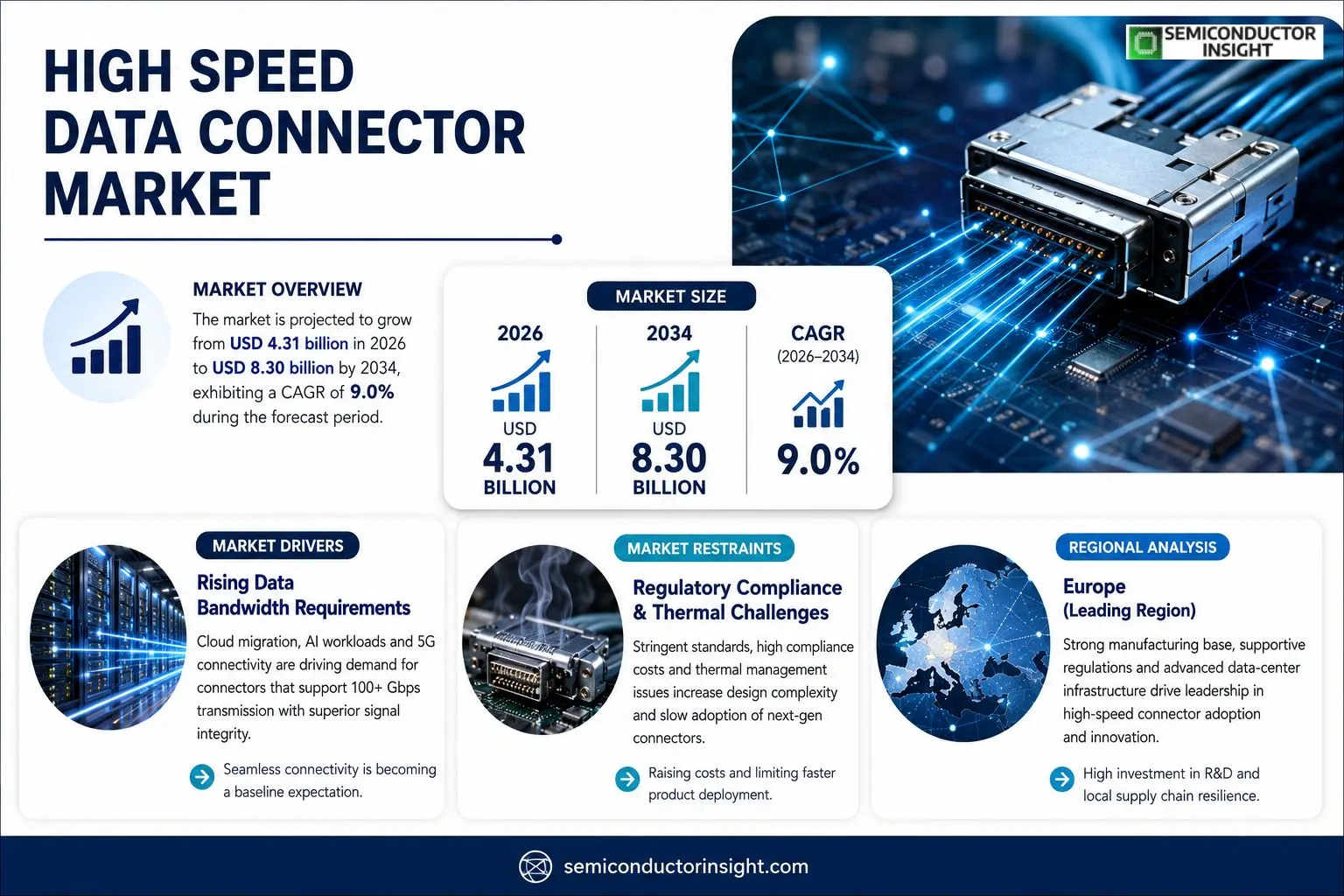
High Speed Data Connector market size was USD 4.31 billion in 2025; forecasts indicate it will climb to roughly USD 8.3 billion by 2034, implying an average annual growth rate of about 9 percent over the period.
High Speed Data Connector refers to a precision‑connecting component featuring impedance matching and shielding against interference, engineered for high‑speed differential digital signal transmission. Its low attenuation, minimal crosstalk and strong electromagnetic compatibility enable gigabit‑plus bandwidth data transfer across automotive Ethernet, high‑definition video, data communication, intelligent vehicles and high‑performance computing applications.
MARKET DRIVERS
Rising Data Bandwidth Requirements
Enterprises are migrating to cloud‑centric architectures, and High Speed Data Connector Market is responding to a surge in traffic that exceeds 100 Gbps per lane. This shift forces OEMs to prioritize connectors that sustain signal integrity across longer trace lengths, otherwise latency penalties will erode competitive advantage.
Adoption of Advanced Automotive Systems
Modern vehicles integrate lidar, radar, and high‑resolution infotainment platforms, each demanding connectors capable of handling multi‑gigabit streams. Manufacturers that embed these connectors can differentiate their platforms by offering over‑the‑air updates and real‑time sensor fusion without compromising safety standards.
➤ Seamless connectivity is becoming a baseline expectation for next‑gen devices.
In parallel, data‑center operators are densifying racks, forcing a redesign of backplane solutions where high‑speed connectors must occupy smaller footprints yet deliver the same performance. Companies that innovate in miniaturization stand to capture a larger share of the expanding infrastructure spend.
MARKET CHALLENGES
Manufacturing Complexity
Fabricating connectors that meet sub‑nanometer tolerance levels demands advanced lithography and rigorous inspection regimes. The capital outlay required to retrofit existing lines often outweighs short‑term revenue gains, prompting some players to delay product launches.
Other Challenges
Supply Chain Volatility
The reliance on rare‑earth alloys and high‑purity polymers subjects the sector to geopolitical risk. Sudden tariff adjustments or export restrictions can inflate bill‑of‑materials costs, squeezing margins for firms unable to diversify their supplier base.
MARKET RESTRAINTS
Regulatory Compliance Costs
Standards such as IEC 61754 and upcoming AI‑driven safety protocols impose rigorous testing cycles. Compliance expenses, including certification fees and documentation audits, raise the entry barrier for smaller innovators.
Legacy Infrastructure Constraints
Many data‑center operators continue to rely on legacy backplane designs that cannot accommodate the newest connector geometries. Retrofitting these environments requires coordinated downtime, a factor that slows adoption of newer, faster solutions.
Thermal Management Issues
High‑frequency signaling generates localized heating, and inadequate heat dissipation can degrade connector lifespan. Designers must integrate enhanced cooling mechanisms, which adds to overall system cost and complexity.
MARKET OPPORTUNITIES
Emerging 5G Infrastructure
The rollout of 5G macro‑cells and small‑cell densification calls for connectors that can support millimeter‑wave transceivers. Companies that engineer solutions with ultra‑low insertion loss are well positioned to serve telecom operators expanding their back‑haul networks.
Growth in Edge Computing
Edge nodes are being deployed in manufacturing floors, retail kiosks, and autonomous vehicles, all of which demand compact, high‑throughput interconnects. Modular connector platforms that enable rapid upgrades can capture a niche within this dispersed computing landscape.
Modular Design Platforms
Standardizing a family of interchangeable high‑speed connectors allows system integrators to mix and match modules without redesigning the entire chassis. This flexibility reduces time‑to‑market for new products and opens revenue streams through aftermarket upgrades.
High Speed Data Connector Market Trends
AI‑Driven Performance Requirements
The surge in artificial‑intelligence workloads is reshaping High Speed Data Connector Market. Large‑scale AI servers, GPU farms and emerging supercomputing platforms now routinely operate at transmission rates above 100 Gbps. Such speeds demand connectors that preserve signal fidelity while minimizing attenuation and crosstalk. Manufacturers that can integrate precise impedance matching and robust shielding into compact packages are capturing premium contracts from cloud providers and research institutions. The competitive advantage lies not only in raw performance but also in reliability under continuous high‑temperature operation, a factor that drives higher‑margin pricing for advanced connector families.
Other Trends
Automotive Electrification and Autonomous Systems
Electrified powertrains and self‑driving technologies are expanding the data conduit needs inside vehicles. Modern electric models embed dozens of high‑resolution cameras, lidar units and radar modules, each producing gigabit‑level streams that must be routed reliably across the chassis. As vehicle architectures evolve toward centralized domain controllers, the per‑vehicle count of board‑to‑board and wire‑to‑board high‑speed connectors is climbing steadily. Suppliers that can certify their products against automotive vibration, temperature cycling and electromagnetic immunity standards are positioning themselves as indispensable partners for OEMs targeting mass‑market autonomous features.
Data‑Center Infrastructure Refresh
Cloud operators are migrating from 400 Gbps to 800 Gbps and beyond, prompting a wholesale replacement of backplane and inter‑module interconnects. High Speed Data Connector Market is responding with designs that support higher pin densities and tighter form factors, enabling equipment manufacturers to achieve the required bandwidth without enlarging board real estate. Concurrently, the push for energy‑efficient data centers is encouraging the use of low‑loss dielectric materials, which reduce heat generation and lower cooling costs. Companies that streamline the qualification cycle for these next‑gen connectors are gaining faster market entry and stronger supplier relationships.
Standardization and Local Market Substitution
Fragmented interface specifications have historically limited cross‑industry adoption, but recent collaborative efforts among standards bodies are yielding more unified connector profiles. This convergence eases the design burden for system integrators and opens pathways for domestic manufacturers to replace imported solutions. Policy incentives in several regions now favor locally produced high‑performance components, accelerating technology transfer and reducing reliance on overseas supply chains. As local firms bridge the gap in materials expertise and testing capability, High Speed Data Connector Market is witnessing a gradual shift toward cost‑effective, regionally sourced offerings without compromising the rigorous performance demanded by AI, automotive and data‑center applications.
COMPETITIVE LANDSCAPE
Key Industry Players
High Speed Data Connector Market – Competitive Overview
The market is dominated by a handful of multinational firms that combine deep R&D budgets with extensive IP portfolios. TE Connectivity remains the benchmark, leveraging its broad automotive and data‑center client base to secure multi‑year supply agreements that lock in recurring revenue streams. Its ability to integrate advanced impedance‑matching techniques with proprietary shielding alloys gives it a technical edge that translates into premium pricing power. Recent strategic moves, such as the acquisition of a boutique LCP‑material supplier, have widened its upstream control, reducing exposure to raw‑material volatility and reinforcing its position in the ultra‑high‑speed segment where reliability thresholds are unforgiving.A second tier of competitors provides differentiated value through specialization or nimble cost structures. Amphenol and Molex, both with legacy connector lines, have repurposed their manufacturing footprints to serve emerging AI‑server clusters, offering modular board‑to‑board solutions that balance performance with volume pricing. Meanwhile, firms like Aptiv, Yamaichi, and JAE focus on automotive electrification, supplying ruggedized interfaces that meet stringent vibration and temperature specifications. Regional challengers such as Luxshare Precision and Hosiden have accelerated product‑development cycles, capitalising on local policy incentives to capture market share from imported units. The collective effect is a fragmented mid‑market where price competition coexists with technology‑driven differentiation.
List of Key High Speed Data Connector Companies Profiled
- TE Connectivity
- Amphenol
- Molex
- Aptiv
- Yamaichi
- Luxshare Precision
- Samtec
- JAE
- Hosiden
- Rosenberger
- JONHON
- IMS Connector Systems
- SMK
- Raydiall Automotive
- Mitsumi
Segment Analysis:
| Segment Category | Sub-Segments | Key Insights |
| By Type |
|
Ultra‑High Speed connectors are becoming the cornerstone for next‑generation AI servers and autonomous vehicle platforms. They deliver superior signal integrity, minimal crosstalk, and robust EMI shielding, enabling stable gigabit‑plus data flows.
|
| By Application |
|
Automotive applications dominate the narrative as vehicles evolve into data‑rich platforms. High‑speed connectors support real‑time camera feeds, radar data, and cockpit infotainment streams, all of which demand ultra‑reliable transmission.
|
| By End User |
|
Vehicle Manufacturers prioritize connectors that sustain high data rates while meeting stringent automotive qualification standards. Their focus on reliability and cost‑efficiency drives a shift toward locally sourced, high‑performance solutions.
|
| By Structure |
|
Board‑to‑Board solutions lead due to their ability to sustain high‑density routing in compact form factors, essential for both data‑center backplanes and automotive electronic control units.
|
| By Transmission Method |
|
Differential Signal connectors dominate because they inherently cancel noise and preserve signal fidelity, a critical advantage for AI‑driven workloads and autonomous driving data streams.
|
Regional Analysis: High Speed Data Connector Market
Europe
Germany and the Benelux corridor host a dense network of precision‑engineering firms that specialize in sub‑millimeter connector fabrication. Their ability to integrate automated optical inspection with lean‑production principles shortens lead times, giving European customers a reliable source of high‑performance interconnects that meet emerging data‑throughput requirements.
The EU’s harmonized certification regime, notably the CE marking for electromagnetic compatibility, streamlines market entry for new connector designs. This regulatory clarity reduces time‑to‑market for innovators and assures downstream users of consistent safety and performance standards.
Post‑Brexit logistics reshaping and the adoption of near‑shoring strategies have prompted European firms to diversify component sourcing across Eastern Europe and the Nordics, mitigating geopolitical risk while maintaining high‑volume production capabilities.
Collaborative research hubs, such as the European Research Cluster on Data‑Center Connectivity, bring together universities, startups, and established OEMs, accelerating breakthroughs in materials that lower insertion loss and boost thermal stability for next‑generation connectors.
North America
North America remains a formidable secondary market, driven by the aggressive rollout of cloud infrastructure across the United States and Canada. While the region benefits from deep pockets of venture capital that nurture connector‑focused startups, it also contends with a fragmented standards landscape that can delay product uniformity. End‑users prioritize low‑latency solutions for edge‑computing nodes, prompting OEMs to tailor high‑speed families for rugged environments. The competitive pressure from Asian manufacturers forces North American suppliers to differentiate through integrated testing services and rapid prototyping capabilities, ensuring they retain design‑win status in major data‑center projects.
Asia‑Pacific
Asia‑Pacific exhibits rapid adoption of high‑bandwidth networking, fueled by the expansion of 5G backhaul and hyperscale data‑centers in China, Japan, and South Korea. Local manufacturers leverage economies of scale to produce cost‑effective connector assemblies, yet they often face challenges in meeting the stringent reliability metrics demanded by Western enterprises. Government‑backed initiatives on smart manufacturing are encouraging the integration of AI‑driven quality control, which could narrow the gap in performance perception and open new avenues for collaborative R&D with European partners.
South America
South America’s high‑speed connector market is anchored by Brazil’s burgeoning fintech sector and Argentina’s push toward digital public services. The region’s growth is tempered by infrastructure bottlenecks and currency volatility, prompting many distributors to adopt inventory‑financing models to keep shelves stocked. Companies that can offer robust warranty terms and localized technical support are gaining traction, as enterprises increasingly view connector reliability as a prerequisite for mission‑critical applications.
Middle East & Africa
The Middle East & Africa region shows a measured rise in demand, primarily driven by sovereign wealth fund investments in data‑center capacity across the United Arab Emirates and South Africa’s telecom upgrades. While the market is still nascent, customers exhibit a strong preference for connectors that satisfy both high‑speed performance and harsh‑environment durability, reflecting the region’s extreme temperature swings. Partnerships with European OEMs are becoming a strategic pathway for local integrators to import proven designs while tailoring them to regional compliance and service‑level expectations.
Report Scope
This market research report provides a comprehensive analysis of the High Speed Data Connector Market , covering the forecast period 2026–2034. It offers detailed insights into market dynamics, technological advancements, competitive landscape, and key trends shaping the industry.
Key focus areas of the report include:
- Market Overview: The report begins with an overview outlining its current market scenario, key growth indicators, and industry transformation drivers. It discusses macroeconomic factors, demand–supply balance, regulatory landscape, and the strategic role of semiconductors in powering advancements across industries such as automotive, telecommunications, consumer electronics, and industrial automation.
- Market Size & Forecast: Historical data and future projections for revenue, unit shipments, and market value across major regions and segments.
- Segmentation Analysis: Detailed breakdown by product type, technology, application, and end-user industry to identify high-growth segments and investment opportunities.
- Regional Insights: Insights into market performance across North America, Europe, Asia-Pacific, Latin America, and the Middle East & Africa, including country-level analysis where relevant.
- Competitive Landscape: Profiles of leading market participants, including their product offerings, R&D focus, manufacturing capacity, pricing strategies, and recent developments such as mergers, acquisitions, and partnerships.
- Technology Trends & Innovation: Assessment of emerging technologies, integration of AI/IoT, semiconductor design trends, fabrication techniques, and evolving industry standards.
- Market Drivers & Restraints: Evaluation of factors driving market growth along with challenges, supply chain constraints, regulatory issues, and market-entry barriers.
- Stakeholder Insights: Insights for component suppliers, OEMs, system integrators, investors, and policymakers regarding the evolving ecosystem and strategic opportunities.
Primary and secondary research methods are employed, including interviews with industry experts, data from verified sources, and real-time market intelligence to ensure the accuracy and reliability of the insights presented.
FREQUENTLY ASKED QUESTIONS:
What is the current market size of High Speed Data Connector Market?
-> High Speed Data Connector Market was valued at USD 4,310 million in 2025 and is expected to reach USD 8,287 million by 2032.
Which key companies operate in High Speed Data Connector Market?
-> Key players include TE Connectivity, Amphenol, Aptiv, Molex, Yamaichi, ECT, Luxshare Precision, Samtec, JAE, Hosiden, HRS, Rosenberger, JONHON, Recodeal Interconnect System, IMS Connector Systems, SMK, Raydiall Automotive, Yihua, Adam Tech, Mitsumi, JST, among others.
What are the key growth drivers?
-> Key growth drivers include rapid advancement of artificial intelligence and high‑performance computing, intelligent and electrified transformation of the automotive industry, continuous expansion of data‑center infrastructure, development of 5G‑A/6G communication technologies, and acceleration of localized substitution supported by policy initiatives.
Which region dominates the market?
-> Asia-Pacific is the fastest‑growing region, while Europe remains a dominant market.
What are the emerging trends?
-> Emerging trends include upgrading transmission rates to 112 Gbps and 224 Gbps, integration of high‑speed connectors in autonomous vehicles, expanding use in 5G‑A and future 6G networks, and increased localized substitution of imported components.
Get Sample Report PDF for Exclusive Insights
Report Sample Includes
- Table of Contents
- List of Tables & Figures
- Charts, Research Methodology, and more...
 Download Sample Report PDF