SCSI Connectors Market Insights
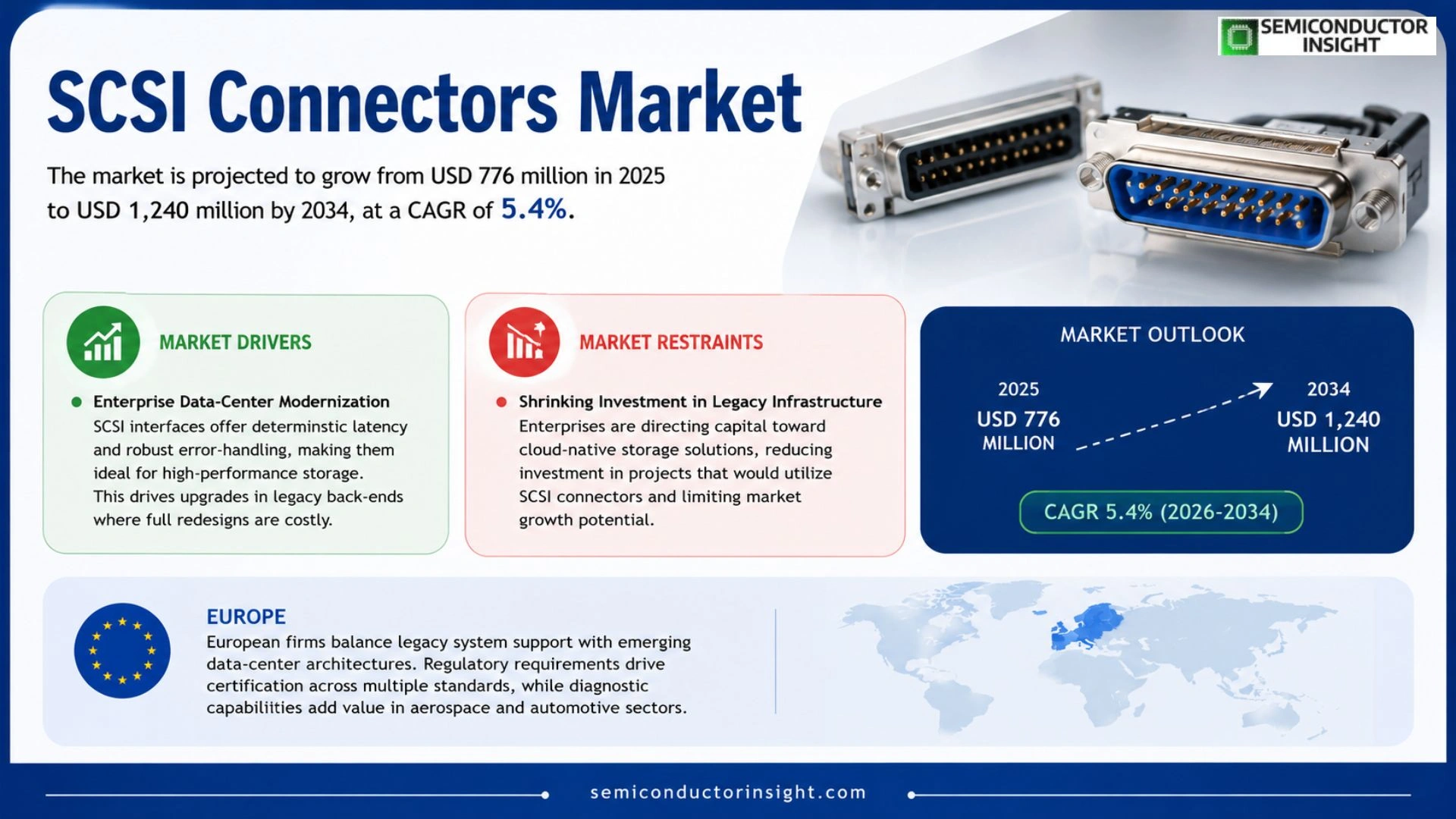
Global SCSI Connectors market size was valued at USD 776 million in 2025 and is expected to reach USD 1,240 million by 2034, reflecting a CAGR of 5.4 % over the period.
A SCSI Connector is a hardware interface that implements the Small Computer System Interface standard for transmitting data and control signals between a host system and peripherals such as hard drives, tape drives, optical drives, and storage arrays. Variants include parallel connectors with pin counts ranging from 50‑pin to high‑density 68‑pin formats, as well as Serial Attached SCSI (SAS) connectors widely adopted in modern enterprise storage solutions.
The connector’s design incorporates male and female contacts, shielding or metal housings for signal integrity, and robust plating materials tailored to meet the electrical and mechanical requirements of successive SCSI generations, making them essential components in servers, RAID systems, NAS devices, and high‑performance computing environments.
MARKET DRIVERS
Enterprise Data‑Center Modernization
Operators of mission‑critical storage continue to rely on the proven resilience of SCSI interfaces. The architecture’s deterministic latency and robust error‑handling make it attractive for high‑performance arrays that cannot tolerate the occasional packet loss seen in newer protocols. Consequently, SCSI Connectors Market benefits from ongoing upgrades of legacy back‑ends where a complete redesign would be financially prohibitive.
Legacy System Migration Strategies
Many OEMs choose a phased migration path, retaining existing SCSI fabric while overlaying modern Ethernet or Fibre Channel layers. This hybrid approach preserves uptime and extends the useful life of costly storage racks. Vendors that provide adapter kits and certified cabling solutions see a steady influx of orders as end‑users prioritize operational continuity over wholesale replacement.
➤ “When reliability outweighs raw speed, SCSI remains the connector of choice for high‑density storage deployments.”
In addition, regulatory environments that mandate data integrity,such as those governing financial and healthcare records,frequently reference standards where SCSI’s error‑correction features are explicitly recognized. This compliance pressure reinforces demand for validated connectors and supports a niche yet resilient revenue stream.
MARKET CHALLENGES
Incompatibility with Emerging Interfaces
New storage architectures increasingly adopt NVMe over PCIe or Ethernet, which bypass the parallel signaling model that defines SCSI. Integrating legacy SCSI connectors into these environments often requires complex bridging hardware, adding cost and latency that some customers deem unacceptable. This technical friction curtails the appeal of SCSI in greenfield projects.
Other Challenges
Supply Chain Constraints
Component shortages that affect high‑precision pin‑contact manufacturing have become more acute following recent global disruptions. Lead times for SCSI‑specific connectors now exceed those for more commoditized cable families, prompting some system integrators to postpone upgrades or seek alternative interconnects.
The combination of integration overhead and component scarcity creates a decision matrix where cost‑sensitive buyers weigh the expense of maintaining SCSI against the perceived benefits of newer standards.
MARKET RESTRAINTS
Shrinking Investment in Legacy Infrastructure
Enterprises that have completed major data‑center refresh cycles are redirecting capital toward cloud‑native storage solutions. This shift reduces the capital pool available for projects that would otherwise incorporate SCSI connectors, limiting the market’s expansion potential.
Manufacturers face diminishing economies of scale as order volumes decline, prompting some to rationalize product lines and discontinue lower‑margin connector SKUs. The resulting gap in product availability can discourage prospective buyers who fear future obsolescence.
Furthermore, the training ecosystem for technicians specializing in SCSI cabling is contracting, leading to a talent shortage that raises service costs and slows deployment timelines.
MARKET OPPORTUNITIES
Niche Segments Requiring Ultra‑High Throughput
Scientific research facilities and high‑frequency trading platforms demand deterministic performance that SCSI’s parallel bus can still deliver. Targeted marketing of ruggedized, high‑frequency connectors to these verticals offers a clear pathway to revenue growth.
Retrofit services that replace aging SCSI cables with enhanced shielding and improved contact materials present an ancillary market. System integrators can monetize these upgrades by bundling them with warranty extensions and performance certification.
Geographically, regions with extensive legacy manufacturing footprints,particularly in parts of Asia and Eastern Europe,still maintain active SCSI‑based production lines. Local distributors that stock certified connectors stand to capture a share of ongoing maintenance spend.
SCSI Connectors Market Trends
Shift Toward Serial Attached SCSI (SAS) Connectors
The enterprise storage segment is prioritizing SAS‑based interconnects because they deliver higher data‑rate capability, hot‑swap functionality, and a reduced physical footprint compared with legacy parallel designs. As server backplanes and high‑density RAID enclosures seek to squeeze more I/O pathways into limited board real estate, manufacturers are introducing lower‑profile SAS housings that retain robust shielding to guard against crosstalk. This design direction satisfies data‑center operators who must balance performance upgrades with the need for uninterrupted service, prompting a steady uptick in orders for SAS‑compatible SCSI Connectors Market components across new storage arrays and retro‑fit projects.
Other Trends
Materials Innovation and Manufacturing Costs
Advanced copper alloys, selective gold plating, and high‑temperature‑resistant polymers are becoming standard in connector construction, reflecting a push to improve signal integrity and extend service life under demanding thermal cycles. While these material upgrades enhance reliability for mission‑critical environments, they also raise bill‑of‑materials expenses and tighten tolerances during assembly. Suppliers that have invested in precision tooling and automated inspection are better positioned to absorb the cost pressure, whereas smaller players may face margin compression unless they specialize in niche, low‑volume applications where premium pricing is defensible.
Regional Demand Patterns and Legacy Support
North America continues to anchor demand because its dense concentration of hyperscale data centers relies on high‑reliability interconnects, reinforcing a supply chain that blends domestic fabrication with global component sourcing. Europe’s industrial automation and scientific instrumentation sectors maintain a steady need for both SAS and legacy parallel pins, driving manufacturers to keep legacy SKUs in production for long‑term service agreements. In the Asia‑Pacific, rapid cloud rollout and the coexistence of older storage infrastructure create a mixed‑technology market; local OEMs are increasingly customizing connector housings to match regional cost targets while still meeting the mechanical robustness required by SCSI Connectors Market’s enterprise customers. These geographic dynamics compel vendors to adopt flexible product roadmaps that support both cutting‑edge SAS solutions and the maintenance of older parallel standards.
COMPETITIVE LANDSCAPE
Key Industry Players
SCSI Connectors Market: Competitive Overview
The market is anchored by a handful of large‑scale manufacturers whose breadth of catalogues and global supply chains give them leverage over pricing and component qualification. TE Connectivity and Amphenol together account for a sizable share of volume shipments, especially in the SAS segment where high‑speed, hot‑swap capable designs are mission‑critical for data‑center backplanes. Their engineering resources enable rapid iteration on shielding techniques and contact plating, which translates into lower failure rates for enterprise storage arrays. Both firms have cultivated long‑term OEM relationships, allowing them to embed customized connector families directly into server chassis programs and thereby sustain recurring revenue streams.
Beyond the dominant duopoly, a diverse set of specialists occupies niche corridors that are essential for legacy system support and high‑density implementations. Hirose Electric, Kyocera, and Molex focus on compact, high‑pin‑count formats such as VHDCI, serving tier‑1 storage vendors that require maximal port density. Smaller European and Asian players,including Harting, Samtec, ASSMANN Electronic, CONEC Elektronische Bauelemente, Fujitsu, WCON Electronics, Denetech Electronic Technology, and LXW,excel at bespoke solutions for tape‑library equipment, industrial automation, and aerospace test rigs. Their agility in addressing low‑volume, specification‑driven orders ensures a steady flow of revenue despite the overall market’s tilt toward serial interfaces.
List of Key SCSI Connectors Companies Profiled
- TE Connectivity, Amphenol, Molex, Hirose Electric, Kyocera, Harting, Samtec, ASSMANN Electronic, CONEC Elektronische Bauelemente, Fujitsu, WCON Electronics, Denetech Electronic Technology, LXW
- 3M, Amphenol, Hirose Electric
- Kyocera, TE Connectivity, Harting, Samtec, ASSMANN Electronic, CONEC Elektronische Bauelemente, Fujitsu, WCON Electronics, Denetech Electronic Technology, LXW
Segment Analysis:
| Segment Category | Sub-Segments | Key Insights |
| By Type |
|
Parallel SCSI
SAS Connectors
|
| By Application |
|
Enterprise Storage
Tape Backup
Industrial Automation
|
| By End User |
|
Server OEMs
Storage Integrators
Data Center Operators
|
| By Pin Density |
|
VHDCI (Very High‑Density)
High‑Density (68‑pin)
Low‑Density (50‑pin)
|
| By Manufacturing Process |
|
Surface Mount
Through‑Hole
Hybrid
|
Regional Analysis: SCSI Connectors Market
North America
Leading server manufacturers are streamlining their component portfolios, prompting a wave of partnership agreements with connector specialists. The shift toward fewer, deeper relationships encourages co‑development of custom‑fit interfaces that reduce board space and simplify assembly, ultimately enhancing product differentiation.
Recent disruptions have underscored the importance of diversified sourcing. Companies are reassessing tier‑1 supplier dependencies, implementing dual‑sourcing strategies, and investing in inventory buffers to insure against component shortages that could jeopardize rollout schedules.
The persistence of legacy SCSI standards coexists with a demand for higher data rates. Vendors that embed incremental signaling enhancements within the same mechanical envelope help clients avoid costly redesigns while still capturing performance gains.
Technical support, field‑level repair programs, and rapid‑response logistics are increasingly viewed as core value propositions. Suppliers that can promise swift issue resolution tend to secure longer contract lifetimes with enterprise customers.
Europe
European firms exhibit a cautious approach, balancing legacy system support with emerging data‑center architectures. The region’s fragmented regulatory landscape pushes manufacturers to certify connectors across multiple standards bodies, creating an environment where compliance expertise becomes a competitive lever. Service‑oriented business models, especially in the aerospace and automotive sectors, reward suppliers that can embed diagnostic capabilities into their offerings, allowing customers to pre‑empt failures in mission‑critical applications.
Asia‑Pacific
In Asia‑Pacific, rapid expansion of hyperscale facilities fuels a steady appetite for SCSI Connectors that can be integrated into high‑density rack designs. Local assemblers benefit from proximity to component foundries, yet they must navigate a price‑sensitive market where cost efficiency is paramount. Companies that blend volume discounts with robust warranty packages tend to capture the bulk of procurement spend, while those focusing solely on low‑cost production risk losing premium accounts that demand longer product lifecycles.
South America
South American data‑center operators are modernizing legacy estates, often opting for hybrid solutions that retain SCSI interfaces alongside newer protocols. Limited access to advanced testing infrastructure drives a preference for connectors with proven field records and comprehensive technical documentation. Vendors that provide localized training and on‑site engineering support find themselves favored in negotiations, as clients seek to mitigate integration risks.
Middle East & Africa
The Middle East & Africa region demonstrates a pragmatic stance, with many enterprises extending the life of existing storage arrays. Harsh environmental conditions elevate the importance of connector durability, prompting a shift toward robust housings and corrosion‑resistant contacts. Suppliers that can guarantee extended temperature tolerance and offer field‑replaceable modules often secure long‑term contracts, particularly in the oil‑and‑gas and telecom sectors that dominate regional spending.
Report Scope
This market research report provides a comprehensive analysis of the SCSI Connectors Market , covering the forecast period 2026–2034. It offers detailed insights into market dynamics, technological advancements, competitive landscape, and key trends shaping the industry.
Key focus areas of the report include:
- Market Overview: The report begins with an overview outlining its current market scenario, key growth indicators, and industry transformation drivers. It discusses macroeconomic factors, demand–supply balance, regulatory landscape, and the strategic role of semiconductors in powering advancements across industries such as automotive, telecommunications, consumer electronics, and industrial automation.
- Market Size & Forecast: Historical data and future projections for revenue, unit shipments, and market value across major regions and segments.
- Segmentation Analysis: Detailed breakdown by product type, technology, application, and end-user industry to identify high-growth segments and investment opportunities.
- Regional Insights: Insights into market performance across North America, Europe, Asia-Pacific, Latin America, and the Middle East & Africa, including country-level analysis where relevant.
- Competitive Landscape: Profiles of leading market participants, including their product offerings, R&D focus, manufacturing capacity, pricing strategies, and recent developments such as mergers, acquisitions, and partnerships.
- Technology Trends & Innovation: Assessment of emerging technologies, integration of AI/IoT, semiconductor design trends, fabrication techniques, and evolving industry standards.
- Market Drivers & Restraints: Evaluation of factors driving market growth along with challenges, supply chain constraints, regulatory issues, and market-entry barriers.
- Stakeholder Insights: Insights for component suppliers, OEMs, system integrators, investors, and policymakers regarding the evolving ecosystem and strategic opportunities.
Primary and secondary research methods are employed, including interviews with industry experts, data from verified sources, and real-time market intelligence to ensure the accuracy and reliability of the insights presented.
FREQUENTLY ASKED QUESTIONS:
What is the current market size of SCSI Connectors Market?
-> SCSI Connectors market size was is expected to reach USD 1,240 million by 2034, reflecting a CAGR of 5.4 % over the period.
Which key companies operate in SCSI Connectors Market?
-> Key players include 3M, Amphenol, Molex, TE Connectivity, Hirose Electric, Kyocera, Harting, ASSMANN Electronic, CONEC Elektronische Bauelemente, Fujitsu, Samtec, among others.
What are the key growth drivers?
-> Key growth drivers include increasing demand from enterprise data‑storage systems, migration toward Serial Attached SCSI (SAS) technology, need for high‑reliability and hot‑swap capable connectors, and advancements in materials that improve signal integrity.
Which region dominates the market?
-> Asia‑Pacific is the fastest‑growing region, while North America remains the dominant market owing to its concentration of data‑center infrastructure and early‑stage adoption of advanced SAS connectors.
What are the emerging trends?
-> Emerging trends include the shift from parallel SCSI to high‑density SAS and VHDCI connectors, integration of mini‑D ribbon formats for legacy support, and increasing focus on connector miniaturization and enhanced shielding for high‑speed data transmission.
Get Sample Report PDF for Exclusive Insights
Report Sample Includes
- Table of Contents
- List of Tables & Figures
- Charts, Research Methodology, and more...
 Download Sample Report PDF