Rectangular Connector Insert Market Insights
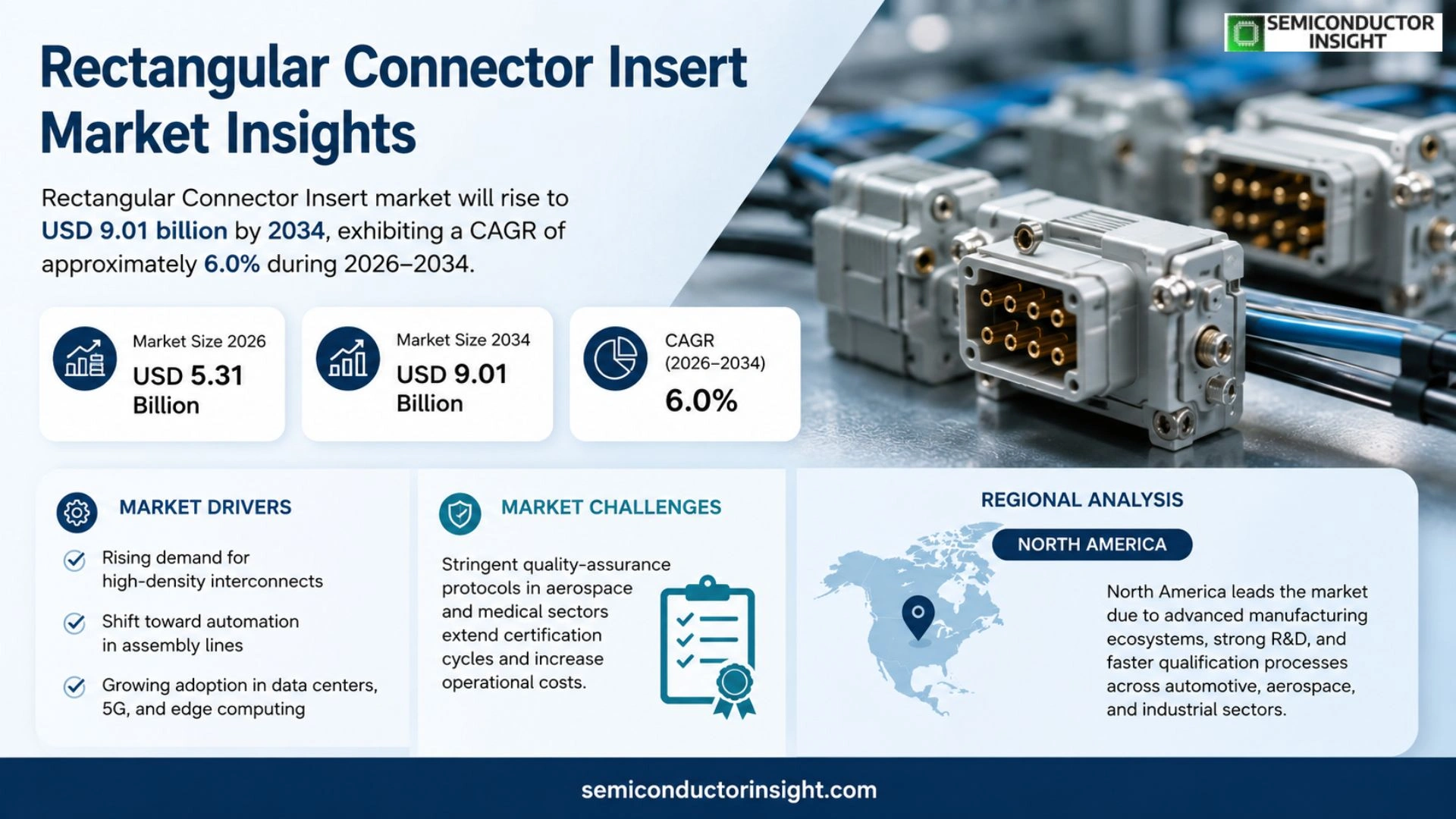
Rectangular Connector Insert market will rise from USD 5.33 billion in 2025 to USD 9.01 billion by 2034, exhibiting a CAGR of approximately 6.0 % during the forecast period.
A Rectangular Connector Insert is a critical internal component of a rectangular connector system, housing conductive contact elements that enable electrical connections between mating parts. Typically installed within a rectangular connector housing, it contains multiple contacts arranged in defined configurations to transmit power, signal or data. The inserts support termination methods such as crimp, screw, push‑in, cage‑spring or solder, and must meet precise mechanical and electrical specifications,including contact spacing, rated current and material conductivity,to comply with standards for industrial, energy, transportation and communication applications.
The upward trajectory reflects sustained demand from industrial equipment and communication electronics sectors together with material‑innovation advances that improve reliability and enable higher‑density interfaces. Regulatory requirements for high‑reliability applications in aerospace, military and medical fields reinforce quality standards, while growth opportunities arise from industrial automation, electric‑vehicle adoption and data‑center expansion. Nevertheless, raw‑material price volatility and stringent quality‑control mandates pose challenges that manufacturers must manage through robust supply‑chain strategies.
MARKET DRIVERS
Rising Demand for High‑Density Interconnects
The surge in data‑center capacity and edge‑computing deployments has forced system designers to seek interconnect solutions that maximize board real‑estate. Rectangular connector inserts, with their compact footprint and robust mechanical retention, enable engineers to pack more I/O channels into limited panel space. Manufacturers are therefore prioritizing these parts to meet the bandwidth expectations of 5G‑enabled services.
Shift Toward Automation in Assembly Lines
Robotic pick‑and‑place equipment now incorporates vision‑guided feeding of rectangular connector inserts, reducing cycle times and minimizing human error. The automation trend cuts production costs by up to 15 % while improving yield consistency. Suppliers that offer inserts compatible with standard automation heads are gaining a competitive edge.
➤ “The convergence of higher data rates and automated assembly is reshaping the component hierarchy, placing rectangular connector inserts at the core of next‑generation platforms.”
Beyond pure performance, the environmental push for recyclable materials is influencing material choices. Engineers are specifying lead‑free, thermoplastic‑based inserts that meet stringent RoHS mandates without sacrificing durability, reinforcing market traction.
MARKET CHALLENGES
Stringent Quality‑Assurance Protocols
The aerospace and medical device sectors demand extensive qualification testing for every batch of connector inserts. Certification cycles can exceed six months, inflating overhead for OEMs and limiting the speed at which new designs reach market. Companies lacking in‑house test labs must rely on third‑party labs, adding cost layers.
Other Challenges
Supply‑Chain Volatility
Fluctuations in polymer resin prices and periodic shortages of high‑precision machining tools create lead‑time uncertainty. While some firms mitigate risk through dual‑sourcing, the added logistical overhead can erode margins.
MARKET RESTRAINTS
Cost Sensitivity in Consumer Electronics
Consumer‑grade devices operate under razor‑thin profit margins, compelling manufacturers to scrutinize every component cost. Although rectangular connector inserts deliver performance benefits, their relatively higher material and machining expenses compared with traditional pin‑type contacts can deter adoption in price‑driven segments. Design teams often resort to less expensive alternatives when cost constraints dominate.
MARKET OPPORTUNITIES
Emergence of Modular Robotics Platforms
Modular robotic systems require plug‑and‑play connectivity that can be repeatedly engaged and disengaged without wear. The geometry of rectangular connector inserts aligns with the stacking architecture of these platforms, opening a niche where OEMs can command premium pricing for reliability and ease of service.
Another avenue lies in the growing adoption of electric‑vehicle (EV) power‑distribution modules. High‑current, low‑profile connectors are essential to meet the thermal and spacing constraints inside EV chassis. Aligning insert designs with emerging ISO standards for EV modules could unlock a multi‑billion‑dollar segment for early movers.
Rectangular Connector Insert Market Trends
Shift Toward High‑Density Modular Inserts
Rectangular Connector Insert Market is feeling the pressure of escalating integration requirements across industrial automation, data‑center servers, and electric‑vehicle platforms. Manufacturers are prioritising compact pin layouts that accommodate higher pin counts without sacrificing mechanical robustness. This shift mirrors the broader move toward modular system architectures, where replaceable inserts allow quick re‑configuration and reduced downtime. Suppliers that can guarantee tight tolerance control while offering a diverse catalog of contact configurations are positioned to capture design‑engineers’ attention, translating into longer product lifecycles and premium pricing opportunities. Furthermore, the adoption of automated test equipment accelerates qualification cycles, allowing OEMs to bring products to market faster. Companies that integrate digital twins for insert design can anticipate mechanical stress points early, reducing engineering iterations. The competitive edge also derives from rapid prototyping capabilities, enabling manufacturers to respond to bespoke customer specifications within weeks rather than months.
Other Trends
Material Innovations Elevate Reliability
Advances in high‑performance plastics, ceramic insulators, and copper‑alloy formulations are reshaping the reliability calculus for rectangular connector inserts. New polymer blends provide superior thermal stability, enabling inserts to operate in environments where temperature swings exceed traditional limits. Concurrently, surface‑treatment techniques such as nanocoating reduce oxidation risk, extending contact life in harsh aerospace and military applications. These material upgrades not only satisfy tighter certification regimes but also lower total‑cost‑of‑ownership for downstream equipment makers, who can defer maintenance intervals and avoid unexpected failures. The shift toward greener manufacturing is prompting producers to explore recyclable polymer cores and low‑lead alloys, aligning product portfolios with stricter environmental directives. Cost‑benefit analyses show that the modest price premium for these advanced materials is offset by longer service intervals, a factor increasingly valued by end‑users in the data‑center and aerospace sectors. Overall, the convergence of material science and sustainability imperatives creates a compelling value proposition that convinces OEMs to upgrade legacy inserts despite the associated redesign effort.
Regional Demand Divergence
Geography now dictates product emphasis within Rectangular Connector Insert Market. North America continues to concentrate on defense‑grade, high‑reliability inserts for aerospace and military programs, prompting suppliers to maintain rigorous compliance pipelines. In contrast, the Asia‑Pacific region is scaling production to meet the surge in communication‑equipment and electric‑vehicle assembly lines, driving demand for cost‑effective, high‑density solutions. European customers exhibit a balanced appetite, favoring inserts that combine stringent environmental certifications with modular flexibility. Latin American and Middle‑East markets are beginning to invest in smart‑factory initiatives, which will likely spark a secondary wave of demand for adaptable connector solutions. Vendors that establish localized component stocking and provide region‑specific certification support are likely to secure early footholds as these economies mature. Anticipating these regional trajectories enables suppliers to allocate R&D resources strategically, ensuring that product roadmaps reflect both high‑volume demand and niche compliance requirements.
COMPETITIVE LANDSCAPE
Key Industry Players
Competitive Overview of Rectangular Connector Insert Market
The market is anchored by a handful of multinational manufacturers that command the bulk of revenue through extensive product portfolios and deep relationships with tier‑one equipment makers. TE Connectivity, for instance, leverages its global engineering network to deliver high‑density inserts for data‑center and industrial‑automation platforms, while Amphenol’s aerospace‑certified line meets stringent vibration and temperature requirements. Molex and LAPP complement these giants by offering modular families that address both mass‑production and custom‑configurable applications, creating a tiered structure where the largest players focus on volume contracts and the mid‑size firms capture specialty orders. This concentration of scale confers pricing power and accelerates technology diffusion, yet it also forces newcomers to differentiate through niche compliance, rapid‑change tooling, or proprietary termination methods.
Beyond the headline names, a diverse set of specialist firms sustains competition in high‑reliability and region‑specific segments. Harting and Samtec provide rugged Ethernet‑compatible inserts tailored for factory‑floor deployments, whereas Hirose Electric and Harwin excel in miniaturized, high‑frequency configurations for communications gear. European groups such as Phoenix Contact, Weidmüller, and WAGO focus on industrial‑grade solutions that meet IEC and CE standards, while German‑based CONEC and ASSMANN address custom‑pin layouts for defense contracts. Asian manufacturers,including Luxshare, Shenzhen Deren, and AVIC Jonhon Optronic,capture cost‑sensitive demand in automotive and electric‑vehicle supply chains, often collaborating with local system integrators. Collectively, these players enrich the ecosystem with a spectrum of material choices, termination technologies, and certification pathways, ensuring that end‑users can source inserts that align with both performance criteria and regulatory expectations.
List of Key Rectangular Connector Insert Companies Profiled
- TE Connectivity
- Amphenol Corporation
- Molex LLC
- LAPP Group
- Harting Technology Group
- Samtec, Inc.
- Hirose Electric Co., Ltd.
- Harwin plc
- Phoenix Contact GmbH & Co. KG
- Weidmüller Interface GmbH
- WAGO Kontakttechnik GmbH
- CONEC Elektronische Bauelemente GmbH
- ASSMANN Electronic GmbH
- ILME S.p.A.
- Luxshare Precision Industry Co., Ltd.
Segment Analysis:
| Segment Category | Sub-Segments | Key Insights |
| By Type |
|
High‑Density Insert
|
| By Application |
|
Industrial Automation
|
| By End User |
|
Equipment Manufacturers
|
| By Material |
|
Stainless Steel
|
| By Termination Method |
|
Crimp
|
Regional Analysis: Rectangular Connector Insert Market
Vehicle electrification drives a surge in high‑density wiring, prompting automakers to embrace rectangular connector inserts that accommodate tighter packaging. The demand for reliable, low‑profile solutions is amplified by stringent safety standards, pushing suppliers toward materials that balance durability with lightweight performance.
Defense contracts increasingly specify modular connector architectures to simplify maintenance in harsh environments. Aerospace manufacturers value the thermal stability of rectangular inserts, which support higher power densities and reduce the risk of signal loss during altitude‑induced temperature fluctuations.
Factories adopting Industry 4.0 standards rely on compact connector solutions that can be integrated into robotic arms and sensor networks. Rectangular inserts meet the need for rapid reconfiguration, enabling production lines to pivot quickly without extensive rewiring.
Data‑center architects and renewable‑energy installations are turning to rectangular connector inserts to manage the growing density of high‑speed interconnects. Their form factor suits blade‑type servers and modular inverter assemblies, where space conservation is paramount.
Europe
Europe’s mature industrial base fuels a steady stream of demand for Rectangular Connector Insert Market, particularly within precision engineering and rail‑transport sectors. Regulatory frameworks emphasizing energy efficiency compel manufacturers to adopt lighter, more compact wiring solutions. German and French OEMs, in particular, have pioneered the use of advanced polymer composites that extend the service life of inserts under cyclic loads. Cross‑border supply chains within the EU enable rapid diffusion of design innovations, while collaborative research programs across Germany, Sweden, and the Netherlands accelerate material‑science breakthroughs that enhance electrical performance. The region’s focus on sustainability also encourages designers to favor inserts that enable easier disassembly and recycling, aligning product development with circular‑economy goals.
Asia‑Pacific
The Asia‑Pacific arena offers a dynamic blend of high‑volume manufacturing and rapid technology adoption that shapes Rectangular Connector Insert Market. China’s expansive consumer‑electronics production lines, coupled with Vietnam’s emerging automotive assembly hubs, create a landscape where cost‑effective yet reliable connector solutions are prized. Local standards bodies have begun harmonizing specifications with global norms, reducing barriers for multinational firms seeking to supply inserts across multiple markets. Furthermore, India’s push toward electrified rail networks introduces new specifications for high‑temperature tolerance, prompting suppliers to innovate around ceramic‑based insulators. The region’s talent pool in electrical engineering and material sciences provides a fertile ground for iterative product development, enabling quick response to shifting design requirements.
South America
South America, led by Brazil and Argentina, reflects a market that is transitioning from reliance on imported components toward localized production of Rectangular Connector Insert Market. Infrastructure projects in the energy sector, such as wind‑farm installations and hydroelectric upgrades, demand connectors that can withstand harsh environmental exposure while maintaining signal fidelity. Regional manufacturers are leveraging partnerships with North American firms to acquire tooling expertise, gradually reducing lead times for custom insert designs. Moreover, the rise of automotive assembly plants focused on flexible‑fuel vehicles encourages adoption of modular connector architectures that can be reconfigured for varying powertrain layouts, underscoring the importance of adaptability in product portfolios.
Middle East & Africa
In the Middle East & Africa, oil‑and‑gas installations and emerging smart‑city initiatives drive niche demand for Rectangular Connector Insert Market. Harsh desert climates impose strict requirements on thermal stability and corrosion resistance, prompting suppliers to prioritize metal‑clad inserts with advanced sealing technologies. The United Arab Emirates’ investment in data‑center capacity highlights a need for high‑density interconnects that align with space‑constrained designs. Meanwhile, South Africa’s industrial diversification towards renewable‑energy projects introduces a new set of performance criteria, such as vibration tolerance for offshore wind turbines. These diverse applications compel manufacturers to develop region‑specific solutions that balance durability with cost considerations, shaping a market segment that values both resilience and adaptability.
Report Scope
This market research report provides a comprehensive analysis of the Rectangular Connector Insert Market , covering the forecast period 2026–2034. It offers detailed insights into market dynamics, technological advancements, competitive landscape, and key trends shaping the industry.
Key focus areas of the report include:
- Market Overview: The report begins with an overview outlining its current market scenario, key growth indicators, and industry transformation drivers. It discusses macroeconomic factors, demand–supply balance, regulatory landscape, and the strategic role of semiconductors in powering advancements across industries such as automotive, telecommunications, consumer electronics, and industrial automation.
- Market Size & Forecast: Historical data and future projections for revenue, unit shipments, and market value across major regions and segments.
- Segmentation Analysis: Detailed breakdown by product type, technology, application, and end-user industry to identify high-growth segments and investment opportunities.
- Regional Insights: Insights into market performance across North America, Europe, Asia-Pacific, Latin America, and the Middle East & Africa, including country-level analysis where relevant.
- Competitive Landscape: Profiles of leading market participants, including their product offerings, R&D focus, manufacturing capacity, pricing strategies, and recent developments such as mergers, acquisitions, and partnerships.
- Technology Trends & Innovation: Assessment of emerging technologies, integration of AI/IoT, semiconductor design trends, fabrication techniques, and evolving industry standards.
- Market Drivers & Restraints: Evaluation of factors driving market growth along with challenges, supply chain constraints, regulatory issues, and market-entry barriers.
- Stakeholder Insights: Insights for component suppliers, OEMs, system integrators, investors, and policymakers regarding the evolving ecosystem and strategic opportunities.
Primary and secondary research methods are employed, including interviews with industry experts, data from verified sources, and real-time market intelligence to ensure the accuracy and reliability of the insights presented.
FREQUENTLY ASKED QUESTIONS:
What is the current market size of Rectangular Connector Insert Market?
-> Rectangular Connector Insert market will rise from USD 5.33 billion in 2025 to USD 9.01 billion by 2034, exhibiting a CAGR of approximately 6.0 %
Which key companies operate in Rectangular Connector Insert Market?
-> Key players include LAPP, TE Connectivity, Amphenol, Molex, ITT Interconnect Solutions, LEMO, Harting, Samtec, Hirose Electric, Harwin, among others.
What are the key growth drivers?
-> Key growth drivers include sustained demand from industrial equipment and communication electronics, reliability improvements through materials and manufacturing innovations, and the need for high‑density, high‑performance interfaces.
Which region dominates the market?
-> North America dominates the market, while Asia‑Pacific shows rapid growth.
What are the emerging trends?
-> Emerging trends include high‑density modular inserts for data centers, aerospace‑certified high‑temperature inserts, and industrial Ethernet modular connectors.
Get Sample Report PDF for Exclusive Insights
Report Sample Includes
- Table of Contents
- List of Tables & Figures
- Charts, Research Methodology, and more...
 Download Sample Report PDF