Smartphone Type-C Charging and Data Cable Market Insights
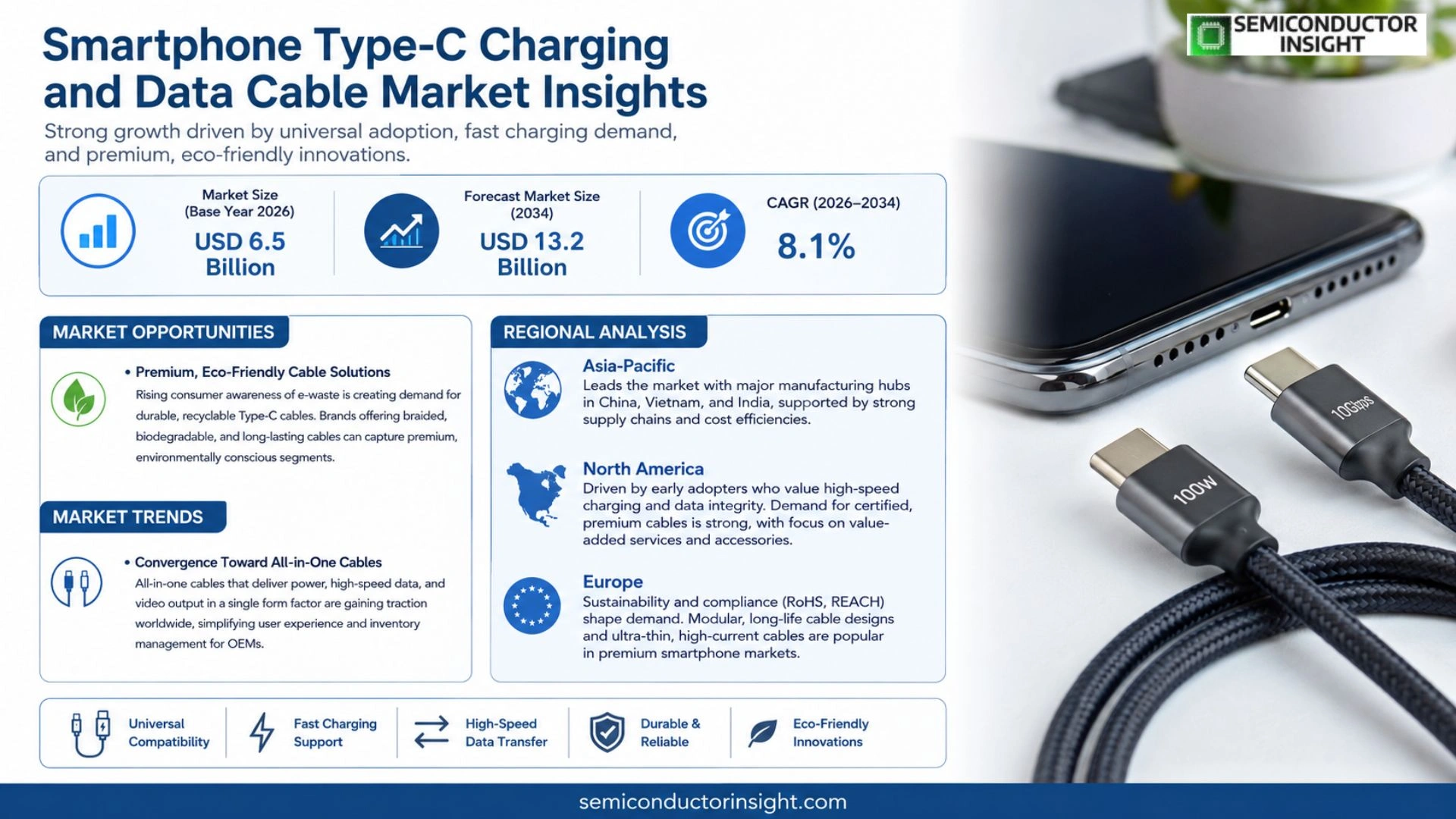
Smartphone Type-C Charging and Data Cable market was valued at USD 7.4 billion in 2024 and is forecasted to reach USD 13.2 billion by 2034, exhibiting a CAGR of approximately 8.1% during the forecast period.
Smartphone Type‑C charging and data cables are reversible connectors that combine power delivery up to 240 W with high‑speed data transfer rates of up to 10 Gbps, enabling a single cable to replace legacy micro‑USB and proprietary chargers.
The market expands because manufacturers adopt higher power standards, consumers seek faster charging solutions, and regulatory mandates in the EU require universal USB‑C adoption for new devices. Leading manufacturers such as Samsung, Apple, Xiaomi (MI), OPPO, Vivo, Huawei, Anker and Ugreen have introduced multi‑layer shielding designs or biodegradable materials in the past year, reflecting a shift toward durability and sustainability. In March 2024 Samsung unveiled a 240 W “Super Fast” cable that reduces a typical smartphone charge time by more than half, while Anker’s “EcoCharge” line launched in late 2023 achieved a certified reduction of plastic use by 30 %.
MARKET DRIVERS
Universal Shift to USB‑C in Flagship Devices
Smartphone Type-C Charging and Data Cable Market is propelled by the near‑universal adoption of USB‑C connectors in premium handsets. Device makers cite the connector’s reversible design and ability to carry up to 100 W of power as decisive factors, prompting OEMs to standardize on a single port across their product lines. This convergence reduces inventory complexity for manufacturers and streamlines the end‑user experience, encouraging higher replacement rates for cables.
Growth of Fast‑Charging Ecosystems
Consumers increasingly demand sub‑30‑minute charge cycles, a benchmark set by flagship phones that support 65 W or higher fast‑charging protocols. Cable producers that certify their products for these power levels command premium pricing, while retailers benefit from cross‑selling accessories alongside the devices themselves. The competitive pressure to meet these speed expectations accelerates innovation in conductor materials and shielding techniques.
➤ Industry analysts note that manufacturers who bundle certified Type‑C cables see a 12 % uplift in accessory margins.
Beyond speed, the data‑transfer capability of USB‑C,up to 10 Gbps in the latest specifications,supports the rise of high‑resolution video streaming and on‑the‑go productivity. Enterprises deploying mobile workforces are therefore allocating larger budgets to durable, high‑bandwidth cables, reinforcing demand across both consumer and commercial segments.
MARKET CHALLENGES
Fragmented Certification Landscape
Despite the standardized connector shape, variations in power delivery (PD) profiles and alternate mode implementations create uncertainty for OEMs. Small‑scale cable manufacturers often lack resources to undergo rigorous compliance testing, resulting in a market crowded with sub‑par products that can damage devices or deliver inconsistent performance.
Other Challenges
Cost Pressures from Commodity Competition
The raw‑material cost of high‑quality copper and aluminum alloys fluctuates annually, squeezing margins for manufacturers that compete primarily on price. Suppliers that cannot guarantee material consistency may be compelled to lower their list prices, eroding profitability across the value chain.
MARKET RESTRAINTS
Regulatory Scrutiny on Electrical Safety
Regulators in key regions are tightening safety standards for high‑power USB‑C accessories. New limits on heat emission and mandatory inclusion of over‑current protection circuitry increase design complexity and raise the entry barrier for emerging players, curbing market expansion for low‑cost alternatives.
MARKET OPPORTUNITIES
Premium, Eco‑Friendly Cable Solutions
The growing consumer awareness of electronic waste creates a niche for durable, recyclable Type‑C cables that promise longer service life. Brands that couple robust braided exteriors with biodegradable materials can differentiate themselves, command higher price points, and capture environmentally conscious segments of Smartphone Type-C Charging and Data Cable Market.
Smartphone Type-C Charging and Data Cable Market Trends
Convergence Toward All‑in‑One Cables
Consumers are gravitating toward cables that combine power delivery, high‑speed data transfer, and video output in a single form factor. The All‑in‑One segment, already dominant in North America and Europe, is gaining traction among OEMs that seek to reduce inventory complexity while offering a sleek experience to end‑users. This shift is reinforced by the proliferation of laptops and tablets that rely exclusively on USB‑C for charging and connectivity, prompting smartphone makers to align their accessory line‑ups. Manufacturers that can source robust, multi‑purpose conductors at scale are positioned to capture incremental margins, while marginal cost savings from fewer SKU variants improve supply‑chain resilience.
Other Trends
Sustainability‑Driven Material Choices
Regulatory scrutiny over plastic waste has accelerated the adoption of eco‑friendly sheath materials such as biodegradable thermoplastic elastomers and recycled nylon. Brands that certify their cables to meet stringent ROHS and EPEAT standards are differentiating themselves in markets where environmentally aware buyers command premium pricing. The transition entails modest cost premiums, but the long‑term benefit includes reduced exposure to future legislation and the ability to leverage green branding across digital marketplaces.
Digital Distribution and Direct‑to‑Consumer Channels
E‑commerce platforms now account for the majority of unit sales for the Smartphone Type‑C Charging and Data Cable Market in regions like Southeast Asia and Latin America. The rise of localized marketplaces and fast‑shipping logistics enables manufacturers to bypass traditional brick‑and‑mortar distributors, shortening the time‑to‑market for new specifications such as 100‑W power delivery. Companies that invest in data‑driven inventory management and real‑time pricing algorithms are better equipped to respond to fluctuating demand spikes during product launches, thereby enhancing cash flow stability.
COMPETITIVE LANDSCAPE
Key Industry Players
Smartphone Type‑C Charging and Data Cable Market – Competitive Overview
The segment is anchored by a handful of global OEMs that leverage brand equity and integrated device ecosystems to command the bulk of revenue. Samsung, with its extensive portfolio of fast‑charging and high‑speed data cables, supplies both premium accessories through its own retail channels and bulk components to OEM partners, reinforcing a vertically integrated supply chain. Apple follows a parallel model, offering Lightning‑to‑Type‑C adapters and proprietary branded cables that integrate tightly with its devices, thereby extracting a pricing premium and shaping consumer expectations around durability and performance. The concentration of sales in these two firms creates a tiered market structure: high‑margin branded accessories at the top, and a downstream tier of generic or white‑label solutions that compete on cost. This hierarchy influences channel negotiations, pushes distributors toward volume‑driven contracts, and forces smaller manufacturers to differentiate through niche technology features or aggressive pricing.
Beyond the dominant tier, a diverse cohort of specialized manufacturers occupies the mid‑to‑low end of the value chain. Chinese brands such as Xiaomi (Mi), OPPO, Vivo and Huawei translate their device‑market scale into accessory lines that emphasize rapid charging standards and aggressive price points, often targeting online marketplaces where brand loyalty can be converted into repeat purchases. Pure‑play accessory firms,Anker, Ugreen, PYS, Pisen, Baseus, CE‑Link, and NATIVE UNION,focus on design innovation, material quality (e.g., braided nylon, aluminum alloy) and certification compliance to capture segments that value reliability over brand name. Smaller regional players like Lenovo, DNS, Gongniu and JAME rely on distribution partnerships in emerging markets to expand reach. The competitive pressure generated by this breadth of participants drives continuous product iteration, shortens product life cycles, and compels larger OEMs to protect market share through ecosystem lock‑in and occasional acquisition of promising niche brands.
List of Key Smartphone Type‑C Charging and Data Cable Companies Profiled
- Samsung
- Apple
- Mi (Xiaomi)
- OPPO
- Vivo
- Huawei
- Anker
- Ugreen
- PYS
- Pisen
- Baseus
- CE‑Link
- NATIVE UNION
- Lenovo
- DNS
- Gongniu
- JAME
Segment Analysis:
| Segment Category | Sub-Segments | Key Insights |
| By Type |
|
All‑in‑One Type is emerging as the preferred solution because it integrates charging and data functions, reducing cable clutter and enhancing user convenience.
|
| By Application |
|
Online Sales drives innovation because e‑commerce platforms enable rapid feedback loops and niche product launches.
|
| By End User |
|
Consumer segment values simplicity, aesthetic harmony with devices, and robust build quality.
|
| By Connectivity Feature |
|
Fast Charging is a core differentiator as users expect rapid power replenishment while maintaining data integrity.
|
| By Material Construction |
|
Nylon Braided construction is favored for its premium feel and superior tensile strength, aligning with high‑end device positioning.
|
Regional Analysis: Smartphone Type-C Charging and Data Cable Market
Asia‑Pacific
Localized sourcing of copper conductors and polymer sheaths reduces lead‑time volatility, enabling manufacturers to absorb raw‑material price swings without passing costs onto end‑users. The region’s logistics networks, bolstered by dedicated freight corridors, further insulate production schedules from global disruptions.
Emerging e‑waste directives in China and India require end‑of‑life cable take‑back programs, prompting firms to adopt biodegradable jackets and modular connectors that simplify disassembly and recycling.
Urban millennials increasingly favour cables that combine fast‑charging capability with sleek, low‑profile designs. Brands that integrate color‑matching or branding elements gain shelf‑space advantage in high‑traffic retail environments.
R&D clusters in Bangalore and Shenzhen are prototyping active‑flex cables and nano‑coated conductors, positioning the region at the forefront of next‑generation data‑transfer solutions for premium smartphones.
North America
In North America, the market is shaped by an early‑adopter consumer segment that values high‑speed charging and data integrity for professional use. Retail channels prioritize certified cables from established brands, while niche importers distribute boutique, environmentally‑focused products. The presence of strong intellectual‑property enforcement encourages investment in proprietary cable technologies, yet the region lacks the manufacturing scale of Asia‑Pacific, leading firms to import finished goods and focus on value‑added services such as warranty extensions and bundled accessories.
Europe
European buyers exhibit heightened sensitivity to sustainability, propelled by the EU’s Circular Economy Action Plan. Companies are pressured to disclose material composition and to certify compliance with RoHS and REACH standards. This regulatory climate has spurred growth in modular cable designs that allow users to replace only the worn segment, extending product lifespan. At the same time, premium‑segment demand for ultra‑thin, high‑current cables remains robust, especially in markets like Germany and the Nordics where high‑end smartphones dominate sales.
South America
South American markets are transitioning from price‑driven purchases to a modest appreciation for durability as consumer confidence improves. Local distributors are beginning to stock mid‑tier cables that balance cost with certified fast‑charging performance, a shift driven by the proliferation of 5G smartphones that require more capable charging solutions. Import tariffs remain a cost factor, prompting some regional brands to explore assembly partnerships in neighboring countries to reduce duty exposure.
Middle East & Africa
In the Middle East & Africa, the market is fragmented by varying income levels and infrastructure maturity. Gulf Cooperation Council nations show strong demand for luxury‑grade cables that complement premium device portfolios, often sourced directly from original equipment manufacturers. Conversely, many African economies still prioritize affordability, leading retailers to stock basic, yet RoHS‑compliant cables. Emerging mobile‑banking applications raise the stakes for secure data transmission, encouraging gradual adoption of higher‑specification Type‑C cables across the region.
Report Scope
This market research report provides a comprehensive analysis of the Smartphone Type-C Charging and Data Cable Market , covering the forecast period 2026–2034. It offers detailed insights into market dynamics, technological advancements, competitive landscape, and key trends shaping the industry.
Key focus areas of the report include:
- Market Overview: The report begins with an overview outlining its current market scenario, key growth indicators, and industry transformation drivers. It discusses macroeconomic factors, demand–supply balance, regulatory landscape, and the strategic role of semiconductors in powering advancements across industries such as automotive, telecommunications, consumer electronics, and industrial automation.
- Market Size & Forecast: Historical data and future projections for revenue, unit shipments, and market value across major regions and segments.
- Segmentation Analysis: Detailed breakdown by product type, technology, application, and end-user industry to identify high-growth segments and investment opportunities.
- Regional Insights: Insights into market performance across North America, Europe, Asia-Pacific, Latin America, and the Middle East & Africa, including country-level analysis where relevant.
- Competitive Landscape: Profiles of leading market participants, including their product offerings, R&D focus, manufacturing capacity, pricing strategies, and recent developments such as mergers, acquisitions, and partnerships.
- Technology Trends & Innovation: Assessment of emerging technologies, integration of AI/IoT, semiconductor design trends, fabrication techniques, and evolving industry standards.
- Market Drivers & Restraints: Evaluation of factors driving market growth along with challenges, supply chain constraints, regulatory issues, and market-entry barriers.
- Stakeholder Insights: Insights for component suppliers, OEMs, system integrators, investors, and policymakers regarding the evolving ecosystem and strategic opportunities.
Primary and secondary research methods are employed, including interviews with industry experts, data from verified sources, and real-time market intelligence to ensure the accuracy and reliability of the insights presented.
FREQUENTLY ASKED QUESTIONS:
What is the current market size of Smartphone Type-C Charging and Data Cable Market?
-> Smartphone Type-C Charging and Data Cable Market was valued at USD million in 2024 and is expected to reach USD million by 2034, at a CAGR of 8.1%
Which key companies operate in Smartphone Type-C Charging and Data Cable Market?
-> Key players include Samsung, Apple, MI, OPPO, ViVO, Huawei, Anker, Ugreen, PYS, Pisen, Lenovo, DNS, Baseus, CE-Link, Hank, NATIVE UNION, Gongniu, JAME, Nien Yi, Satechi, Stiger.
What are the key growth drivers?
-> Key growth drivers include the rapid adoption of USB‑Type‑C as a universal charging standard, increasing consumer demand for fast‑charging capabilities, growth of mobile device shipments, and the shift toward all‑in‑one cable solutions.
Which region dominates the market?
-> Asia dominates the market, with the U.S. market size estimated at USD million in 2025 and China projected to reach USD million in the same year.
What are the emerging trends?
-> Emerging trends include the expansion of the All in One Type segment, which is projected to reach USD million by 2036 with a robust CAGR, and the growing importance of integrated data‑transfer and power‑delivery capabilities in a single cable.
Get Sample Report PDF for Exclusive Insights
Report Sample Includes
- Table of Contents
- List of Tables & Figures
- Charts, Research Methodology, and more...
 Download Sample Report PDF