Key Statistics
Key Takeaways
- 5G chipsets are the leading type as modem capability becomes standard across premium and increasingly mid-range smartphones, shifting competition toward power efficiency, AI acceleration, graphics and camera processing.
- Smartphones dominate the application mix, while tablets provide a secondary outlet for platform reuse and can adopt related mobile SoCs with different cellular and thermal configurations.
- Asia Pacific accounts for more than 65% of global smartphone chipset demand in the source report and also concentrates advanced foundry and handset manufacturing capability across Taiwan, South Korea, China and India.
- ARM-based architectures and below-7-nm process technologies define the leading technical direction as vendors seek higher performance per watt and greater integration inside the thermal and battery limits of a handheld device.
- On-device AI is becoming the next differentiation layer. Apple, Samsung, Qualcomm and MediaTek are increasing local neural-processing capability, creating value beyond the basic transition from 4G to 5G.
Smartphone Chipset Market Overview
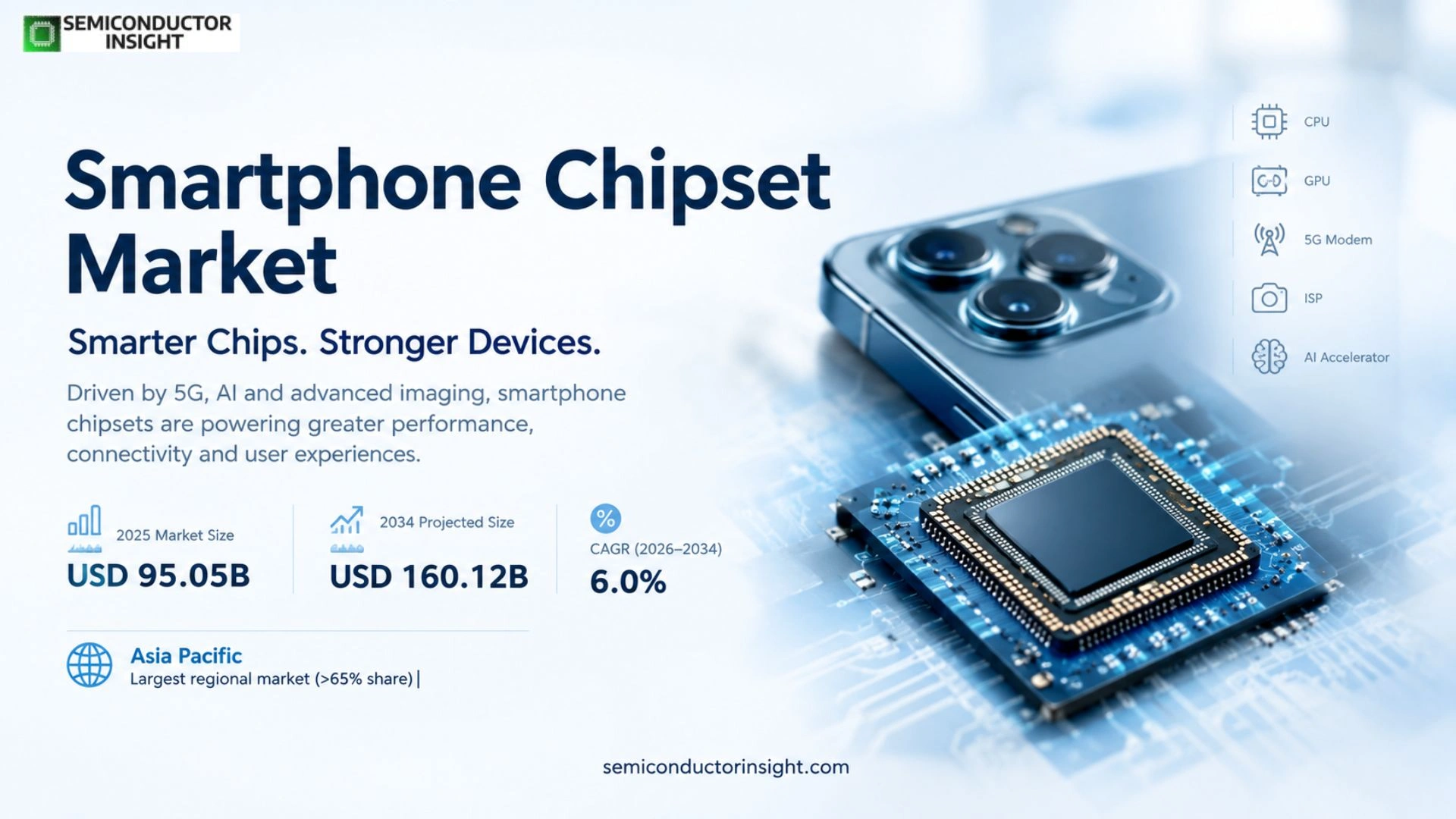
Smartphone Chipset Market was valued at USD 95.05 billion in 2025 and is projected to reach USD 160.12 billion by 2034, representing a 6.0% CAGR during 2026–2034. The 2026 estimated market size is USD 100.72 billion. Asia Pacific is the largest regional market, with the source report assigning it more than 65% of global smartphone chipset demand and identifying it as the center of global chipset production.
A smartphone chipset is a system-on-chip that integrates CPU, GPU, cellular modem, image signal processing, neural acceleration, memory interfaces, security and other control functions needed to operate a modern handset. The device is therefore the central performance and power-management platform for the phone rather than a single-purpose processor, and each generation determines a large share of the user experience.
The market’s growth mechanism is a combination of standards migration and rising functionality per device. The shift from 4G to 5G expands modem and RF requirements, while computational photography, high-refresh displays, gaming and generative AI add specialized processing. Even in a mature smartphone unit market, chipset revenue can grow when silicon content and complexity rise faster than handset shipments.
Advanced process technology is central because smartphone SoCs operate inside strict battery and thermal envelopes. Smaller nodes can improve transistor density and energy efficiency, allowing vendors to integrate larger GPUs, NPUs and modems without exceeding handset power limits. TSMC reported that 3 nm technologies represented 24% of its wafer revenue in 2025 and that 2 nm entered high-volume manufacturing in the fourth quarter.
Commercial competition is split between merchant suppliers and vertically integrated device makers. Qualcomm, MediaTek and UNISOC sell platforms to multiple OEMs, while Apple, Samsung and Huawei can use proprietary silicon to differentiate their own devices. Merchant vendors need broad software and reference-design support; integrated OEMs can optimize chips tightly around one ecosystem but must carry the full cost and manufacturing risk of silicon development.
Segment Analysis: By Type
The source report divides the market into 4G and 5G chipsets. The 5G segment leads because new premium and mid-range handsets increasingly require 5G as a baseline feature, while 4G remains important in entry-price devices and markets where network coverage or consumer affordability slows migration. The competitive frontier has therefore moved from basic 5G availability toward modem efficiency, integrated AI and advanced process technology.
| Type | Technical / purchasing role | Market position |
|---|---|---|
| 4G Chipset | 4G smartphone chipsets remain important in price-sensitive handsets and markets where LTE coverage, device affordability and mature software ecosystems matter more than premium modem capability. Integration of application processor, LTE modem, graphics, imaging and security functions allows vendors to serve entry devices with proven process technologies and lower development cost. The market implication is that performance gains matter most when they can be converted into lower system power, easier integration, higher throughput or reduced deployment risk for the smartphone chipset market. In the smartphone chipset market market, those benefits determine whether OEMs and system builders accept a new supplier, making application engineering, reference designs and dependable manufacturing capacity important parts of the competitive offer. | This segment is mature but resilient because 4G still supports a large installed network base and low-cost smartphone tiers. Revenue growth is constrained as operators and OEMs migrate new designs toward 5G, yet 4G can remain attractive in regions where spectrum, device subsidies and consumer purchasing power slow the replacement cycle. In the smartphone chipset market market, the practical consequence is a stronger link between engineering support and commercial conversion: customers need confidence that a device will remain compatible, available and supportable after launch. That favors suppliers able to pair technical differentiation with qualification data, ecosystem relationships and a credible production roadmap rather than treating the product as a stand-alone catalog part for the smartphone chipset market. |
| 5G Chipset | 5G chipsets integrate application processing with sub-6 GHz and, in some products, millimeter-wave modem capability, while also supporting advanced cameras, AI engines and high-refresh displays. The design challenge is balancing radio throughput and compute performance against battery life, thermals, die area and handset bill-of-material cost. For the smartphone chipset market market, this changes purchasing economics because design qualification, integration effort, lifecycle support and supply continuity influence a customer’s decision alongside headline performance. Suppliers that reduce those risks can defend design wins for multiple product cycles, while vendors that compete only on component price face a narrower route into long-lived platforms for the smartphone chipset market. | Leading type in the source segmentation. 5G chipsets have become standard across premium phones and are moving deeper into mid-range devices, giving the segment both higher value per unit and broader unit coverage. Competition is increasingly defined by modem efficiency, on-device AI, graphics and advanced-node manufacturing rather than connectivity alone. In the smartphone chipset market market, the practical consequence is a stronger link between engineering support and commercial conversion: customers need confidence that a device will remain compatible, available and supportable after launch. That favors suppliers able to pair technical differentiation with qualification data, ecosystem relationships and a credible production roadmap rather than treating the product as a stand-alone catalog part for the smartphone chipset market. |
Architecture and process technology
The source report identifies ARM-based architecture as the prevailing design and segments process technology into above 28 nm, 28–14 nm, 10–7 nm and below 7 nm. Premium mobile SoCs increasingly use advanced nodes because performance per watt is essential to AI, imaging and graphics. Samsung’s Exynos 2500 is built on 3 nm GAA, while TSMC began 2 nm high-volume manufacturing in the fourth quarter of 2025, setting up the next flagship transition.
Segment Analysis: By Application
By application, the source report covers smartphones and tablets, with smartphones clearly dominant. Every smartphone requires a central SoC and modem platform, whereas tablets may use WiFi-only variants or reuse phone-class chips at lower volumes. The smartphone segment therefore sets process-node roadmaps and feature competition, while tablets improve development economics by extending successful silicon into adjacent screen sizes and enterprise or education use cases.
| Application | Demand characteristics |
|---|---|
| Smartphone | Largest application in the source segmentation. Smartphones consume the majority of application processors and modem-integrated SoCs because every device requires compute, graphics, imaging, security and cellular connectivity in a tightly constrained power envelope. Flagship launches pull advanced nodes and AI accelerators forward, while entry and mid-range models determine unit scale and cost-down pressure. |
| Tablet | Tablets use closely related mobile SoCs but have different thermal, display, battery and connectivity requirements. WiFi-only products can omit cellular modem functions, while premium 5G tablets reuse smartphone-class chipsets to accelerate development. The segment is smaller than smartphones, yet it provides suppliers another outlet for platform reuse across consumer, education and enterprise devices. |
Regional Analysis
Asia Pacific is the largest smartphone chipset market, accounting for more than 65% of global demand in the source report and concentrating much of the world’s advanced fabrication and handset production. North America has outsized influence through premium platform design, Europe emphasizes efficiency and lifecycle support, and emerging regions drive the volume transition from 4G to affordable 5G.
How do regional smartphone chipset economics differ?
Regional demand depends on handset price mix, network generation, OEM manufacturing and the location of semiconductor design and fabrication. Asia Pacific combines all four, North America concentrates premium device architecture, Europe is a mature replacement market with long software expectations, and South America and Africa create cost-sensitive migration opportunities. The same chipset vendor can therefore compete on advanced AI in one geography and on integrated low-cost 5G in another.
| Region | Position | Growth outlook | Demand profile | What decides supplier selection |
|---|---|---|---|---|
| North America | Premium design hub | Steady to strong | Flagship smartphone and fabless-design led | Carrier certification, modem performance, AI capability, power efficiency and OEM relationships The market implication is that performance gains matter most when they can be converted into lower system power, easier integration, higher throughput or reduced deployment risk for the smartphone chipset market. In the smartphone chipset market market, those benefits determine whether OEMs and system builders accept a new supplier, making application engineering, reference designs and dependable manufacturing capacity important parts of the competitive offer. |
| Europe | Major established market | Steady | Replacement, efficiency and lifecycle led | Long support, power efficiency, radio compliance and platform stability The market implication is that performance gains matter most when they can be converted into lower system power, easier integration, higher throughput or reduced deployment risk for the smartphone chipset market. In the smartphone chipset market market, those benefits determine whether OEMs and system builders accept a new supplier, making application engineering, reference designs and dependable manufacturing capacity important parts of the competitive offer. |
| Asia Pacific | Largest | Strong | High-volume demand plus foundry and handset concentration | Advanced-node capacity, cost-performance, OEM design access and local ecosystem support In the smartphone chipset market market, the practical consequence is a stronger link between engineering support and commercial conversion: customers need confidence that a device will remain compatible, available and supportable after launch. That favors suppliers able to pair technical differentiation with qualification data, ecosystem relationships and a credible production roadmap rather than treating the product as a stand-alone catalog part for the smartphone chipset market. |
| South America | Emerging | Selective | Affordable 5G transition and value Android led | Chipset cost, reference-design maturity, modem coverage and import economics The market implication is that performance gains matter most when they can be converted into lower system power, easier integration, higher throughput or reduced deployment risk for the smartphone chipset market. In the smartphone chipset market market, those benefits determine whether OEMs and system builders accept a new supplier, making application engineering, reference designs and dependable manufacturing capacity important parts of the competitive offer. |
| Middle East & Africa | Emerging | Selective to strong | Gulf premium plus entry-level mass market | Device affordability, modem band support, carrier qualification and integration The market implication is that performance gains matter most when they can be converted into lower system power, easier integration, higher throughput or reduced deployment risk for the smartphone chipset market. In the smartphone chipset market market, those benefits determine whether OEMs and system builders accept a new supplier, making application engineering, reference designs and dependable manufacturing capacity important parts of the competitive offer. |
Smartphone Chipset Competitive Landscape
Competition is concentrated because a smartphone SoC requires CPU, GPU, modem, ISP, NPU, security and software capability plus access to advanced foundry technology. Qualcomm and MediaTek are the principal merchant-platform competitors, Apple uses proprietary A-series silicon for iPhone, Samsung develops Exynos alongside its handset business, UNISOC focuses on cost-efficient platforms, and HiSilicon remains strategically important to Huawei’s vertical integration.
Merchant suppliers compete on platform completeness. A handset maker wants a validated modem, processor, camera pipeline, AI software, power management and reference design that can be brought to market quickly. Qualcomm and MediaTek therefore create value not only through silicon benchmarks but through software stacks, RF compatibility and relationships with Android OEMs. This scale helps them amortize the cost of advanced-node tape-outs across multiple customers and device models.
Vertical integration changes the competitive logic. Apple designs A-series processors specifically for iPhone and can coordinate silicon, operating system, memory, thermal design and applications without exposing the platform to external OEMs. Samsung can combine Exynos, memory, foundry and handset assets. These models can create tighter optimization, but they also require large internal R&D investment and expose the OEM directly to yield, process and architecture execution risk.
The advanced-node race raises barriers to entry. TSMC’s 3 nm share of wafer revenue and its move into 2 nm high-volume manufacturing show the scale of investment needed to support leading mobile silicon. Smaller chipset firms can remain competitive by using proven 6 nm or 7 nm processes for value 5G designs, where die cost and yield matter more than maximum transistor density. UNISOC’s 6 nm T9100 illustrates that strategy.
On-device AI is creating a new comparison metric across premium platforms. Samsung lists the Exynos 2500 NPU at up to 59 TOPS, while Apple emphasizes local language-model and graphics workloads for A19 Pro. Suppliers must now balance neural throughput with memory bandwidth, power and software frameworks. A high NPU figure has limited commercial value unless OEM applications and developers can use it efficiently within battery and thermal constraints.
Tier structure
| Competitive tier | Representative participants | How suppliers compete |
|---|---|---|
| Merchant platform leaders | Qualcomm Technologies; MediaTek | These suppliers sell complete smartphone platforms to multiple Android OEMs and compete across premium, mid-range and value tiers. Their advantage comes from integrated 5G modems, strong software ecosystems, reference designs and the ability to spread leading-edge development costs across many customers. Winning major OEM platforms creates large volumes but also exposes them to intense annual launch competition. |
| Vertically integrated premium suppliers | Apple; Samsung Electronics; HiSilicon (Huawei) | Vertically integrated suppliers design chipsets primarily to differentiate their own device ecosystems. They can optimize silicon around operating systems, cameras, displays and thermal designs with fewer external compatibility constraints. The tradeoff is higher internal development and manufacturing risk, while regulatory or foundry access can have a direct effect on the OEM’s entire smartphone roadmap. |
| Value and emerging-market platform supplier | UNISOC | UNISOC targets cost-efficient smartphone platforms and can benefit as 5G reaches lower price tiers. Using advanced but not always frontier process nodes allows the company to balance die cost, performance and modem integration. Its commercial opportunity is strongest where OEMs need ready reference designs for affordable devices and where handset volumes justify a standardized platform across multiple brands. |
Key companies profiled
The source report profiles Qualcomm Technologies Inc.; MediaTek Inc.; Apple Inc.; UNISOC (Shanghai); Samsung Electronics; HiSilicon (Huawei). This group includes merchant SoC suppliers and vertically integrated smartphone companies, so competitive share should be interpreted carefully: Apple and Samsung capture chipset value inside their own devices, while Qualcomm, MediaTek and UNISOC sell platforms to third-party OEMs. HiSilicon’s role is also shaped by Huawei’s device strategy and external semiconductor trade restrictions.
Smartphone Chipset Production Capacity Analysis
Production capacity is concentrated in advanced wafer fabs and packaging ecosystems rather than at the chipset brand level. Most merchant smartphone SoC designers are fabless, making access to TSMC, Samsung and other foundries a strategic requirement. Leading nodes require enormous capital and process expertise, while advanced packaging and memory interfaces increasingly influence performance, thermal behavior and time to market alongside the transistor technology itself.
Advanced-node capacity sets the ceiling for premium chipset supply. TSMC reported that 3 nm accounted for 24% of its wafer revenue in 2025 and that 2 nm entered high-volume manufacturing in the fourth quarter of the year. Flagship mobile processors compete with HPC and AI products for leading-edge wafers, so allocation, yield and customer priority can influence smartphone launch timing and silicon cost even when handset demand is healthy.
Mid-range and entry 5G products can use 6 nm and 7 nm technology to balance performance and cost. UNISOC’s T9100 uses 6 nm, showing that a chipset does not need the newest node to offer integrated 5G, imaging and AI. Mature advanced nodes often have better yield and lower wafer cost, allowing suppliers to serve price-sensitive markets while preserving enough efficiency for contemporary smartphone workloads.
Packaging is increasingly part of the performance equation. Samsung states that Exynos 2500 combines 3 nm GAA with fan-out wafer-level packaging to improve power efficiency, heat dissipation and chip thickness. As processors integrate larger GPUs and NPUs, heat density and memory bandwidth can limit real handset performance, making package design and thermal characteristics commercially relevant rather than downstream implementation details.
Software capacity also constrains effective production because a taped-out chip cannot generate revenue without stable Android support, modem certification, camera tuning and OEM integration. Vendors maintain board-support packages and reference designs across multiple handset models, carriers and regions. This recurring engineering load favors scale and creates switching costs for OEMs that have already invested in a supplier’s platform and software ecosystem.
Smartphone Chipset Market Dynamics: Drivers, Restraints and Opportunities
The smartphone chipset market is driven by the migration to 5G, increasing on-device AI, more demanding imaging and graphics, and advanced-node efficiency. Growth is moderated by mature handset replacement cycles, the rising cost of leading-edge design, foundry concentration and vertical integration by large OEMs. The balance favors suppliers that can convert expensive silicon advances into visible user benefits at both flagship and mass-market price points.
MARKET DRIVERS
Drivers Impact Analysis*
| Factor | Relative impact* | Commercial mechanism |
|---|---|---|
| 5G migration into mid-range devices | High | As 5G moves from flagship phones into mainstream price tiers, more handset models require integrated 5G modem capability, broadening the revenue base for modern SoCs while reducing the share of new designs that can remain on 4G-only platforms. The market implication is that performance gains matter most when they can be converted into lower system power, easier integration, higher throughput or reduced deployment risk for the smartphone chipset market. In the smartphone chipset market market, those benefits determine whether OEMs and system builders accept a new supplier, making application engineering, reference designs and dependable manufacturing capacity important parts of the competitive offer. |
| On-device AI and computational imaging | High | Generative AI, camera pipelines and local inference require larger NPUs, GPUs and memory bandwidth, increasing silicon content and giving OEMs a reason to refresh premium chipsets even when basic smartphone unit growth is limited. This is commercially important in the smartphone chipset market market because the value of a design win is realized only after the device survives platform validation, software or system integration and supplier approval. The resulting qualification burden can lengthen sales cycles, but it also makes successful positions durable and raises the cost for customers to switch to an unproven alternative for the smartphone chipset market. |
| Advanced-node energy efficiency | Medium-High | Smaller process nodes can improve performance per watt and transistor density, enabling more compute within handset thermal limits. This supports premium ASPs but also raises design and wafer costs, concentrating the opportunity among suppliers with scale. In the smartphone chipset market market, the practical consequence is a stronger link between engineering support and commercial conversion: customers need confidence that a device will remain compatible, available and supportable after launch. That favors suppliers able to pair technical differentiation with qualification data, ecosystem relationships and a credible production roadmap rather than treating the product as a stand-alone catalog part for the smartphone chipset market. |
| Affordable smartphones in emerging markets | Medium | Cost-optimized 5G SoCs can unlock upgrades in India, Southeast Asia, Latin America and Africa, creating large unit opportunities for platforms that balance modem capability, camera support and power efficiency without flagship process economics. The market implication is that performance gains matter most when they can be converted into lower system power, easier integration, higher throughput or reduced deployment risk for the smartphone chipset market. In the smartphone chipset market market, those benefits determine whether OEMs and system builders accept a new supplier, making application engineering, reference designs and dependable manufacturing capacity important parts of the competitive offer. |
The 5G transition is moving deeper into mainstream smartphones
5G was once a premium feature, but handset makers increasingly treat it as a baseline specification across mid-range products. That expands the addressable market for integrated 5G SoCs while compressing the remaining 4G-only segment. The commercial contest shifts toward delivering modem performance, power efficiency and broad band support at lower cost, which rewards suppliers with scalable platform families spanning several price tiers.
On-device AI raises compute content per handset
Generative AI, language processing, image enhancement and personalized assistants are moving more inference onto the phone to reduce latency and protect data. Apple and Samsung both emphasize local AI capability in current premium processors. This increases demand for NPU throughput, memory bandwidth and efficient scheduling, allowing chipset value to grow even if global smartphone unit shipments expand slowly.
Advanced process nodes support performance within mobile power limits
A smartphone has limited battery capacity and cooling, so raw transistor count is useful only if it improves performance per watt. 3 nm and 2 nm processes can enable denser compute and lower power, creating a premium differentiation path. Foundry technology therefore becomes part of the handset product proposition, while vendors unable to access leading nodes may need to compete through architecture and cost optimization.
Emerging-market upgrades create a large cost-optimized 5G opportunity
Many consumers in India, Southeast Asia, Latin America and Africa are still moving from older LTE devices or lower-end smartphones. They need 5G, better cameras and longer battery life at prices far below flagship phones. Merchant vendors can address this with mature advanced nodes and reusable reference designs, turning cost engineering into a growth driver rather than treating the newest process as the only route to competitiveness.
MARKET RESTRAINTS
Restraints Impact Analysis*
| Factor | Relative impact* | Commercial mechanism |
|---|---|---|
| Longer smartphone replacement cycles | High | High penetration and incremental annual improvements can lengthen the time consumers keep phones, reducing unit growth and forcing chipset vendors to rely more heavily on content gains, premium features and share shifts for revenue expansion. In the smartphone chipset market market, the practical consequence is a stronger link between engineering support and commercial conversion: customers need confidence that a device will remain compatible, available and supportable after launch. That favors suppliers able to pair technical differentiation with qualification data, ecosystem relationships and a credible production roadmap rather than treating the product as a stand-alone catalog part for the smartphone chipset market. |
| Rising leading-edge design and wafer cost | High | 3 nm and 2 nm SoCs require expensive design flows, masks and validation while leading-edge wafer capacity commands premium pricing, creating a barrier that can limit the number of suppliers able to compete at the flagship tier. In the smartphone chipset market market, the practical consequence is a stronger link between engineering support and commercial conversion: customers need confidence that a device will remain compatible, available and supportable after launch. That favors suppliers able to pair technical differentiation with qualification data, ecosystem relationships and a credible production roadmap rather than treating the product as a stand-alone catalog part for the smartphone chipset market. |
| Foundry and geopolitical concentration | Medium-High | Advanced production is concentrated in a small number of Asian foundries, and export controls or trade restrictions can alter who can access certain technologies. OEMs therefore evaluate supply resilience and regulatory exposure alongside technical performance. In the smartphone chipset market market, the practical consequence is a stronger link between engineering support and commercial conversion: customers need confidence that a device will remain compatible, available and supportable after launch. That favors suppliers able to pair technical differentiation with qualification data, ecosystem relationships and a credible production roadmap rather than treating the product as a stand-alone catalog part for the smartphone chipset market. |
| OEM vertical integration | Medium | Apple, Samsung and Huawei can internalize key silicon functions, reducing the merchant addressable market for some platforms. Successful vertical integration also raises customer expectations for system-level optimization that merchant suppliers must match across many OEMs. For the smartphone chipset market market, this changes purchasing economics because design qualification, integration effort, lifecycle support and supply continuity influence a customer’s decision alongside headline performance. Suppliers that reduce those risks can defend design wins for multiple product cycles, while vendors that compete only on component price face a narrower route into long-lived platforms for the smartphone chipset market. |
Mature handset markets limit pure unit-driven growth
Consumers in developed markets already own capable smartphones and can delay replacement when annual improvements feel incremental. This weakens the link between new chipset launches and immediate unit expansion. Vendors therefore need AI, camera, battery or connectivity advances that create a visible reason to upgrade, while also protecting margins in mid-range products where consumers are more price sensitive.
Leading-edge economics raise the minimum scale required for flagship competition
Each transition to a new process node increases design complexity, verification effort and mask expense, while premium wafers remain costly. A supplier must ship enough high-value units to amortize that investment. This favors Qualcomm, Apple, MediaTek and Samsung-scale programs and can push smaller vendors toward mature nodes, narrower geographies or value segments where design economics are more forgiving.
Geopolitics can restrict access to technology and customers
Smartphone chipsets sit at the intersection of advanced semiconductor manufacturing and global trade policy. Export controls can affect foundry access, EDA tools, IP or customer availability, while OEMs may diversify sourcing to reduce risk. These forces can reshape competitive positions independently of technical merit, making supply-chain resilience and regulatory planning an important part of long-term chipset strategy.
Vertical integration reduces merchant sockets at large OEMs
Apple designs its own application processors and is expanding custom connectivity silicon, while Samsung and Huawei maintain internal chipset capabilities. When a major device maker internalizes a function, the merchant supplier loses both unit volume and strategic influence. Merchant vendors must offset this by serving many Android OEMs, moving into adjacent devices or providing integration that is too costly for smaller handset brands to reproduce internally.
MARKET OPPORTUNITIES
On-device generative AI can create a new premium SoC value layer
Local language models, image generation and multimodal assistants require sustained neural compute, memory bandwidth and software frameworks. Chipset suppliers can differentiate through NPU architecture and developer tools while OEMs gain privacy and latency benefits from local processing. The opportunity is not only flagship performance: efficient smaller models can move AI features into mid-range phones, broadening the silicon revenue pool.
2 nm and advanced packaging can improve sustained mobile performance
TSMC’s move into 2 nm high-volume manufacturing and Samsung’s use of 3 nm GAA with fan-out packaging point toward a more integrated performance strategy. Future smartphone SoCs can combine transistor scaling with better thermal and power delivery to sustain AI and graphics workloads. Suppliers that co-optimize package and silicon may capture premium sockets where peak benchmark scores alone no longer differentiate user experience.
Affordable 5G platforms can expand in India, Southeast Asia and Africa
The largest remaining unit opportunity is often below flagship price points. A well-integrated 5G SoC on a cost-effective node can enable OEMs to offer modern connectivity, cameras and AI features without premium BOM. UNISOC and MediaTek are positioned to benefit, while larger vendors can create scaled-down variants that reuse IP and software from high-end platforms.
Specialized camera, gaming and foldable platforms can raise content per device
Smartphone differentiation is moving into computational photography, ray-traced gaming, high-refresh displays and foldable form factors. These features require larger GPUs, ISPs, display engines and AI blocks, creating opportunities for SoC vendors to sell richer platforms even when unit growth is limited. Reference designs that solve thermal and power challenges can help OEMs commercialize these features faster.
Smartphone Chipset Supply Chain Analysis
CPU/GPU/modem IP & SoC design
Value creation starts with processor and modem architecture, but the winning product is a complete SoC platform. Designers integrate CPU, GPU, ISP, NPU, memory controllers, security and cellular functionality, then validate software and power behavior. Merchant vendors must support many OEM configurations, while vertically integrated designers can optimize one device ecosystem more tightly.
Advanced wafer fabrication
Foundry production converts the mobile design into silicon and is one of the most concentrated points in the chain. Premium SoCs depend on leading-edge process capacity, yield and design enablement, while mid-range products use mature advanced nodes to manage cost. Foundry allocation can influence product timing because a chipset launch is tied to a handset generation and cannot easily move to another process.
Packaging, memory & RF integration
The SoC’s real performance depends on memory bandwidth, thermal behavior, package thickness and power delivery. Fan-out and other advanced packaging can reduce size and improve heat dissipation, while memory and RF components must be matched to the platform. OEMs therefore evaluate a broader subsystem than the bare application processor when deciding whether a chipset can meet a device target.
OEM, carrier & software qualification
Revenue is realized after OEM integration and carrier or regional certification. Camera tuning, Android support, modem validation, power optimization and security updates can consume substantial engineering effort after the chip is manufactured. Suppliers with complete reference designs and large software teams can shorten handset development and create switching costs that persist into the OEM’s next generation.
Recent Developments in the Smartphone Chipset Market
Recent official launches show that smartphone chipset differentiation is shifting toward on-device AI, advanced process technology, sustained thermal performance and tighter vertical integration. At the same time, foundry roadmaps are moving into 2 nm while cost-focused 5G platforms remain commercially important on 6 nm. The market therefore supports multiple technology tiers rather than one uniform race to the smallest node.
Apple introduced A19 Pro with iPhone 17 Pro and states that the chip can deliver up to 40% better sustained performance than the previous generation when paired with its new thermal system. The platform includes a 6-core CPU, a 6-core GPU with Neural Accelerators and a 16-core Neural Engine, illustrating how local AI, graphics and sustained thermals are becoming integrated flagship SoC priorities.
Samsung describes Exynos 2500 as a 3 nm GAA mobile processor with a deca-core CPU, NPU performance up to 59 TOPS, 5G capability and fan-out wafer-level packaging. The product demonstrates how process, AI compute and packaging are being co-optimized to improve power efficiency and heat dissipation within the limited thickness and thermal envelope of a smartphone.
TSMC states that its 2 nm process entered high-volume manufacturing in the fourth quarter of 2025 and expects a fast ramp in 2026, while 3 nm represented 24% of total wafer revenue in 2025. The transition expands the technology options available to future flagship mobile SoCs but also raises the importance of early capacity commitments and design co-optimization.
REPORT SCOPE & SEGMENTATION
The report scope covers smartphone chipsets under the type, application, architecture and process-technology categories published on the client page. The standardized market series uses 2025 as the base year, 2026 as the estimated year and 2034 as the forecast endpoint. Competitive analysis distinguishes merchant platform vendors from vertically integrated OEM silicon because the two business models capture value through different customer and manufacturing relationships.
| Report attribute | Coverage |
|---|---|
| Market | Smartphone Chipset |
| Base year | 2025 |
| Estimated year | 2026 |
| Forecast period | 2026–2034 |
| 2025 market size | USD 95.05 billion |
| 2034 forecast size | USD 160.12 billion |
| CAGR | 6.0% during 2026–2034 |
| Largest market in 2025 | Asia Pacific — over 65% of global demand |
| By Type | 4G Chipset; 5G Chipset |
| By Application | Smartphone; Tablet |
| Additional segmentation | By Architecture: ARM-based; x86-based. By Process Technology: Above 28nm; 28nm-14nm; 10nm-7nm; Below 7nm |
| Regions | North America; Europe; Asia Pacific; South America; Middle East & Africa |
| Companies profiled | Qualcomm Technologies Inc.; MediaTek Inc.; Apple Inc.; UNISOC (Shanghai); Samsung Electronics; HiSilicon (Huawei) |
Frequently Asked Questions
What is the smartphone chipset market size in 2025?
The global smartphone chipset market is valued at USD 95.05 billion in 2025 under the standardized series used in this overview. The same series places the estimated 2026 market at USD 100.72 billion, allowing the base year, estimate and forecast to be compared without changing scope. The figure is carried consistently through the statistics, overview and report-scope sections for the smartphone chipset market.
What is the projected smartphone chipset market size by 2034?
The smartphone chipset market is projected to reach USD 160.12 billion by 2034. This endpoint follows the growth path implied by the published market-size anchors and is paired with the 2025 base value rather than an unrelated forecast for the smartphone chipset market. That consistency is important when evaluating segment growth, regional opportunities and supplier strategies across the full 2026–2034 period for the smartphone chipset market.
What CAGR is expected for the smartphone chipset market during 2026–2034?
The standardized outlook corresponds to a 6.0% CAGR during 2026–2034. The rate is the compound annual growth implied by the market-size anchors used for the 2025 and 2034 values, so the percentage and revenue series describe the same trajectory for the smartphone chipset market. It provides the reference against which drivers, restraints and faster-moving subsegments are assessed for the smartphone chipset market.
Which region is the largest smartphone chipset market in 2025?
Asia Pacific is identified as the largest market in 2025. Its position reflects the concentration of relevant device manufacturing, system demand, research activity or customer deployment described in the market evidence for the smartphone chipset market. Suppliers still need local qualification and channel support to convert that structural demand into revenue, so geographic scale alone does not guarantee a durable competitive position for the smartphone chipset market.
Which product type leads the smartphone chipset market?
5G Chipset is the leading product or technology type in the source segmentation. Its position reflects a combination of installed-base relevance, compatibility with current system architectures and breadth of addressable applications for the smartphone chipset market. Newer technologies can grow faster, but the leading type retains a larger revenue base until customers complete qualification and platform migration across multiple product cycles for the smartphone chipset market.
Which application is the most important for the smartphone chipset market?
Smartphone is the principal application identified in the report scope. Demand is created by system-level performance requirements and the need for qualified components that can be integrated without disproportionate redesign, validation or support burden for the smartphone chipset market. This makes application engineering and customer roadmaps important commercial variables alongside the underlying device specifications for the smartphone chipset market. The market implication is that performance gains matter most when they can be converted into lower system power, easier integration, higher throughput or reduced deployment risk for the smartphone chipset market. In the smartphone chipset market market, those benefits determine whether OEMs and system builders accept a new supplier, making application engineering, reference designs and dependable manufacturing capacity important parts of the competitive offer.
Which region has the strongest growth profile in the smartphone chipset market?
Asia Pacific has the strongest growth profile in this overview. Growth is tied to new manufacturing capacity, infrastructure, research programs or device adoption depending on the region for the smartphone chipset market. Suppliers benefit most where they can shorten qualification cycles, support customers locally and align product roadmaps with the technical and regulatory conditions shaping deployments for the smartphone chipset market. The market implication is that performance gains matter most when they can be converted into lower system power, easier integration, higher throughput or reduced deployment risk for the smartphone chipset market. In the smartphone chipset market market, those benefits determine whether OEMs and system builders accept a new supplier, making application engineering, reference designs and dependable manufacturing capacity important parts of the competitive offer.
What is the main technology transition shaping the smartphone chipset market?
The main transition is from basic 5G integration toward AI-centric, advanced-node SoCs that combine stronger NPUs, GPUs, camera engines and efficient modems. Premium devices are moving through 3 nm and into 2 nm roadmaps, while mass-market 5G platforms continue to use mature advanced nodes. The result is a tiered market where process choice follows product economics rather than one universal technology path.
What are the principal restraints on the smartphone chipset market?
The principal restraints are mature smartphone replacement cycles, rising leading-edge design and wafer costs, foundry concentration, geopolitical restrictions and vertical integration by large OEMs. These pressures raise the scale needed to compete in flagship silicon and can reduce merchant sockets, while also increasing the value of cost-optimized 5G platforms and resilient manufacturing strategies in mid-range markets.
Who are the key suppliers in the smartphone chipset market?
The competitive landscape includes the companies listed in the report scope together with the qualified ecosystem participants discussed in this overview for the smartphone chipset market. Advantage depends on product performance, manufacturing quality, system integration, reliability evidence and customer support for the smartphone chipset market. In markets with long qualification cycles, production continuity and roadmap credibility can be as important as a single generation’s peak technical specification for the smartphone chipset market.
Research Sources & Evidence Base
Get Sample Report PDF for Exclusive Insights
Report Sample Includes
- Table of Contents
- List of Tables & Figures
- Charts, Research Methodology, and more...
 Download Sample Report PDF