Image Signal Processor (ISP) in Mobile AP Market Insights
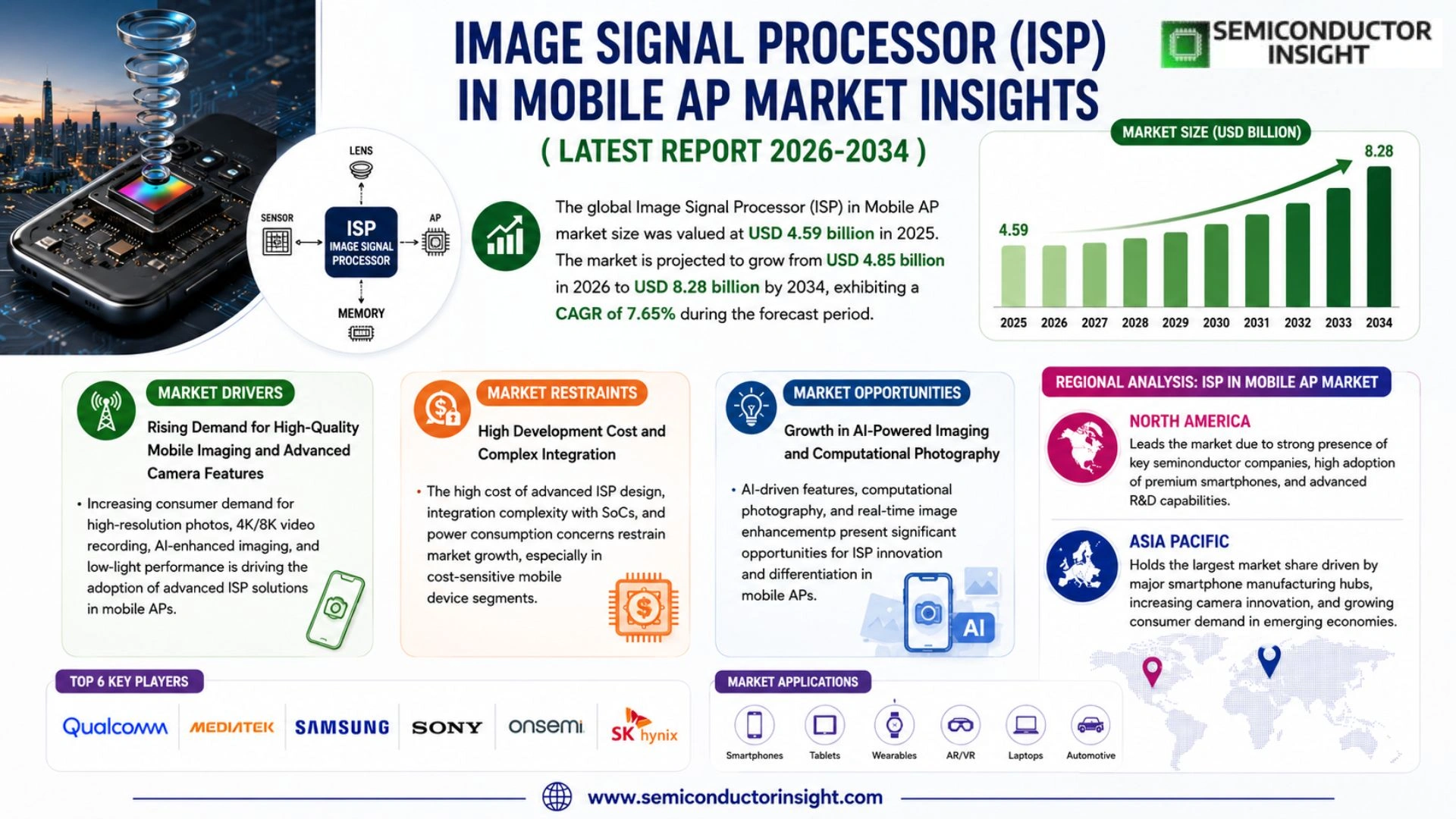
Global Image Signal Processor (ISP) in Mobile AP Market size was valued at USD 4.59 billion in 2025. The market is projected to grow from USD 4.85 billion in 2026 to USD 8.28 billion by 2034, exhibiting a CAGR of 7.65% during the forecast period.
Image Signal Processors (ISP) integrated within Mobile Application Processors (AP) are specialized semiconductor components designed to process raw data from camera sensors into high-quality, viewable images and videos. These processors handle critical tasks such as noise reduction, color correction, white balance, exposure control, and advanced computational photography features. In modern mobile APs, ISPs work seamlessly with CPU, GPU, and NPU units to deliver real-time imaging performance, supporting multi-camera setups, high-resolution sensors, and AI-enhanced features like night mode and portrait effects.
The market is experiencing robust growth due to several factors, including the rising demand for superior camera capabilities in smartphones, increasing adoption of multi-camera systems, and advancements in AI-powered image processing. Furthermore, the proliferation of 5G-enabled devices and the need for better video recording in 4K and 8K resolutions are accelerating expansion. Initiatives by key players continue to drive innovation in this space. For instance, leading companies have enhanced their ISP architectures with greater AI integration for on-device image enhancement and real-time processing. Qualcomm Technologies, MediaTek Inc., and Samsung Electronics are some of the key players that operate in the market with a wide range of portfolios, delivering integrated solutions across flagship and mid-range mobile application processors.
MARKET DRIVERS
Rising Demand for Advanced Multi-Camera Systems in Smartphones
The proliferation of multi-camera setups in mobile devices continues to drive significant demand for sophisticated Image Signal Processor (ISP) capabilities within mobile application processors. Modern flagship smartphones feature triple, quad, and even penta-camera arrays requiring high-throughput ISP pipelines to deliver computational photography features such as multi-frame HDR, semantic segmentation, and real-time image fusion. Integrated ISPs in mobile APs handle the massive data streams from high-resolution sensors while maintaining low latency and power efficiency.
Integration of AI and Computational Photography
AI-enhanced ISP architectures are transforming mobile imaging by enabling advanced features like low-light denoising, scene optimization, and adaptive processing directly within the application processor. Leading mobile AP vendors continue to invest in heterogeneous computing that combines traditional ISP pipelines with neural processing units, delivering superior image quality while optimizing for mobile power constraints. This convergence supports the shift toward on-device computational photography that rivals dedicated cameras.
➤ The global image signal processor market is experiencing robust growth driven by increasing adoption in consumer electronics, particularly smartphones, with projections indicating expansion at a CAGR around 7% through the early 2030s.
Expansion of 5G-enabled mobile devices and rising consumer expectations for professional-grade imaging further accelerate the need for more powerful ISPs embedded in mobile application processors, supporting higher frame rates, 8K video, and enhanced AR/VR experiences.
MARKET CHALLENGES
Balancing Performance with Power Efficiency in Mobile Designs
Developing high-performance Image Signal Processor (ISP) solutions for mobile application processors presents significant engineering challenges in managing thermal output and battery consumption. Advanced ISP pipelines processing multi-camera high-resolution data must deliver exceptional image quality without draining device batteries or causing excessive heat, requiring careful optimization of hardware and software co-design.
Other Challenges
Integration Complexity with Advanced Sensors
Mobile AP designers face increasing difficulty integrating ISPs with diverse image sensors while maintaining compatibility across various camera modules and ensuring seamless performance across different lighting conditions and use cases.
Rapid Technological Evolution
The fast pace of innovation in computational photography and AI algorithms demands continuous updates to ISP architectures, pressuring mobile AP manufacturers to iterate designs quickly while controlling development costs and time-to-market.
MARKET RESTRAINTS
High Development Costs and Technical Complexity
The substantial investment required for designing and validating advanced Image Signal Processor (ISP) IP for mobile application processors represents a notable restraint. Creating power-efficient, high-throughput ISP solutions capable of handling complex computational photography tasks involves significant R&D expenditure and specialized engineering expertise, which can limit participation to well-resourced semiconductor companies.
Energy consumption and heat management issues continue to challenge ISP integration in compact mobile form factors. As resolution and frame rate demands increase alongside AI-enhanced processing, maintaining thermal and power budgets within acceptable limits for consumer devices requires ongoing architectural innovations.
MARKET OPPORTUNITIES
AI-Driven ISP Advancements and Edge Computing Integration
Opportunities abound in the development of next-generation AI-ISP solutions that more tightly integrate with neural processing units within mobile application processors. These hybrid architectures promise superior image quality through intelligent, context-aware processing while improving overall system efficiency for computational photography and computer vision tasks. The continued evolution of mobile imaging, including support for higher dynamic range, advanced low-light capabilities, and real-time video enhancement, creates substantial scope for innovation in ISP technology tailored specifically for mobile APs. Emerging applications in augmented reality and on-device AI further expand the addressable market for sophisticated image signal processing solutions.
Trends
Advancements in AI-Powered Image Processing
Image Signal Processors (ISP) integrated within Mobile Application Processors (AP) continue to evolve as critical components for transforming raw camera sensor data into high-quality images and videos. These specialized semiconductor units efficiently manage essential operations including noise reduction, color correction, white balance, exposure control, and sophisticated computational photography features. In contemporary mobile APs, ISPs collaborate closely with CPU, GPU, and NPU units to enable real-time imaging performance that supports complex multi-camera configurations and high-resolution sensors.
Other Trends
Expansion of Multi-Camera Systems and Computational Photography
The increasing adoption of multi-camera setups in smartphones has significantly influenced the development of Image Signal Processor (ISP) in Mobile AP Market solutions. Manufacturers are prioritizing ISP architectures that can seamlessly handle data from multiple sensors simultaneously while delivering advanced features such as night mode and portrait effects. This trend reflects the growing consumer demand for superior camera capabilities across both flagship and mid-range devices.
Support for High-Resolution Video and 5G Integration
Another notable development Image Signal Processor (ISP) in Mobile AP Market involves enhanced capabilities for 4K and 8K video recording. As 5G-enabled devices become more widespread, ISPs are being optimized to manage higher data throughput and deliver improved video quality with real-time processing. Leading companies including Qualcomm Technologies, MediaTek Inc., and Samsung Electronics are actively enhancing their ISP designs with deeper AI integration to support on-device image enhancement and efficient performance across diverse mobile application processors.
These combined advancements in AI integration, multi-camera support, and high-resolution processing capabilities are shaping the ongoing evolution of Image Signal Processor (ISP) technologies within mobile application processors, enabling more immersive and professional-grade imaging experiences for users worldwide.
COMPETITIVE LANDSCAPE
Key Industry Players
Integrated ISP Leadership Driving Smartphone Imaging Innovation
The Image Signal Processor (ISP) in Mobile Application Processor (AP) market is dominated by a few leading semiconductor companies that integrate advanced ISP capabilities directly into their system-on-chip designs. Qualcomm Technologies stands out as a frontrunner with its Spectra ISP architecture embedded in Snapdragon platforms, offering superior multi-camera support, AI-enhanced computational photography, and high-resolution video processing that powers a significant portion of premium Android smartphones. The market structure features high barriers to entry due to the need for seamless integration with CPU, GPU, and NPU units, resulting in a concentrated competitive landscape where innovation in real-time image enhancement and power efficiency determines market positioning.
Other significant players include MediaTek with its Imagiq ISP technology in Dimensity series processors, Samsung Electronics leveraging in-house Exynos ISPs for optimized camera performance in Galaxy devices, and Apple with custom image processing pipelines in its A-series chips. Niche contributors such as HiSilicon (Huawei) and UNISOC also play important roles, particularly in specific regional markets, by delivering cost-effective solutions with growing AI integration for features like night mode and portrait effects.
List of Key Image Signal Processor (ISP) in Mobile AP Companies Profiled
- Qualcomm Technologies
- MediaTek Inc.
- Samsung Electronics
- Apple Inc.
- HiSilicon (Huawei)
- UNISOC Technologies
- Google (Tensor)
- Arm Limited
- Sony Semiconductor Solutions
- STMicroelectronics
- ON Semiconductor
- Texas Instruments Incorporated
- Ambarella Inc.
- Himax Technologies
- OmniVision Technologies
Segment Analysis:
| Segment Category | Sub-Segments | Key Insights |
| By Type |
|
AI-Enhanced ISP leads the segment by enabling sophisticated on-device computational photography that delivers exceptional image quality in challenging conditions. These processors seamlessly integrate with neural processing units to perform real-time scene analysis, object recognition, and adaptive adjustments. Key advantages include superior noise reduction in low-light environments, intelligent color reproduction that preserves natural tones, and advanced features such as multi-frame synthesis for sharper details. Manufacturers prioritize this type for its ability to support complex multi-camera arrays while maintaining power efficiency during intensive imaging tasks. |
| By Application |
|
Video Recording stands out as the dominant application due to the growing consumer expectation for professional-grade video capture directly from mobile devices. ISPs in this category excel at handling high frame rate processing, real-time stabilization, and dynamic range optimization across varying lighting scenarios. They facilitate smooth 4K and higher resolution recording with efficient encoding that balances quality and file size. This segment benefits from continuous innovations in motion detection and focus tracking, allowing users to produce cinema-like footage with minimal post-processing requirements while supporting advanced modes like slow-motion and time-lapse. |
| By End User |
|
Premium Smartphones represent the leading end-user segment where advanced ISP capabilities are most demanded and fully utilized. These high-end devices leverage powerful integrated processors to deliver flagship-level imaging experiences that differentiate products in competitive markets. ISPs here support multiple high-resolution sensors working in tandem, enabling features like seamless zoom transitions, portrait mode with precise depth mapping, and AI-driven enhancements that adapt to user preferences. The focus remains on delivering exceptional performance that justifies premium positioning through superior low-light photography and creative imaging tools. |
| By Technology Integration |
|
Deep Learning Acceleration emerges as the frontrunner in technology integration by fundamentally transforming how raw sensor data is interpreted into refined images. This approach allows for context-aware processing that goes beyond traditional algorithms to understand scenes intelligently. Benefits include automatic subject enhancement, background optimization, and predictive corrections that anticipate movement. Integration with mobile APs creates efficient pipelines where imaging tasks are distributed optimally across specialized units, resulting in faster processing speeds and more natural-looking outputs that closely mimic professional photography standards. |
| By Camera Configuration |
|
Multi-Camera Systems drive innovation in this category through the complex coordination required to switch between wide, ultra-wide, telephoto, and depth sensors. ISPs optimized for these setups excel at real-time data fusion that creates cohesive final images regardless of which lens is active. This configuration supports advanced capabilities such as lossless zoom, panoramic stitching, and bokeh effects with accurate edge detection. The processing demands push development toward more sophisticated architectures capable of handling simultaneous data streams while maintaining low latency and thermal efficiency essential for sustained mobile use. |
Regional Analysis: Image Signal Processor (ISP) in Mobile AP Market
Asia-Pacific
South Korea and Japan excel through pioneering research in pixel-level processing and sensor fusion within Mobile AP platforms. Their focus on energy-efficient ISP designs supports extended battery life while maintaining premium imaging quality, creating competitive advantages for global exports and domestic flagship models.
China’s robust production infrastructure enables cost-effective integration of advanced ISP functionalities into high-volume Mobile AP solutions. This scale supports rapid adoption of multi-frame processing and AI enhancements, driving broader accessibility of sophisticated camera technologies across diverse market segments.
Close partnerships between AP developers, image sensor manufacturers, and software optimizers create tightly integrated ISP solutions. These synergies accelerate feature deployment such as real-time bokeh and night mode capabilities, reinforcing the region’s leadership in consumer-centric imaging advancements.
Ongoing investments in specialized silicon for computational photography ensure sustained momentum. The blend of talent, infrastructure, and market demand positions Asia-Pacific to shape ISP evolution in Mobile AP designs well into the next decade.
North America
North America maintains a strong presence in the Image Signal Processor (ISP) landscape for Mobile AP through emphasis on premium innovation and software-hardware co-design. The region excels in developing sophisticated algorithms that enhance ISP performance for computational photography, leveraging deep expertise in AI integration within application processors. Major technology firms prioritize high-fidelity image processing that supports professional video and photography features demanded by discerning consumers. Strategic focus on power optimization allows ISPs to deliver exceptional results without compromising device efficiency, while collaborations with global partners ensure cutting-edge implementations reach worldwide markets. This environment nurtures advancements in areas like multi-exposure fusion and intelligent scene analysis, keeping the region influential in setting quality benchmarks.
Europe
Europe contributes significantly to Image Signal Processor (ISP) in Mobile AP Market with its focus on privacy-centric design and sustainable technology development. Regional strengths lie in creating efficient ISP architectures that balance performance with regulatory compliance, particularly around data handling in imaging pipelines. European firms drive progress in energy-conscious processing suitable for premium devices, while supporting features that appeal to users valuing authenticity and security. Investments in research foster innovations in color accuracy and dynamic range management within integrated Mobile AP solutions. Collaborative ecosystems across the continent enhance standardization efforts, promoting reliable ISP performance across diverse hardware configurations and supporting steady adoption in high-end segments.
South America
South America shows promising development in adopting Image Signal Processor (ISP) technologies within Mobile AP frameworks, primarily through expanding smartphone penetration and local customization efforts. Growing demand for capable camera systems in daily-use devices encourages integration of capable ISP modules that improve image quality under varied lighting conditions. Regional players focus on adapting global Mobile AP platforms to meet specific consumer preferences, such as enhanced portrait modes and social media-ready outputs. Infrastructure improvements and digital inclusion initiatives further stimulate interest in affordable yet effective ISP solutions. This positions South America as an emerging contributor where practical imaging enhancements drive market expansion and user satisfaction.
Middle East & Africa
The Middle East and Africa region demonstrates increasing engagement with Image Signal Processor (ISP) capabilities in Mobile AP as mobile connectivity expands. Markets prioritize durable and versatile imaging features suited to diverse environments, leading to adoption of robust ISP implementations in mid-tier devices. Local demand emphasizes reliable performance for content creation and communication, encouraging manufacturers to incorporate essential processing enhancements. Strategic partnerships help introduce optimized solutions that address regional needs like bright daylight capture and power efficiency. As digital transformation accelerates, the region is poised to benefit from broader availability of advanced yet accessible ISP-integrated Mobile AP technologies that support economic and social connectivity goals.
Report Scope
This market research report provides a comprehensive analysis of the Image Signal Processor (ISP) in Mobile AP Market , covering the forecast period 2026–2034. It offers detailed insights into market dynamics, technological advancements, competitive landscape, and key trends shaping the industry.
Key focus areas of the report include:
- Market Overview: The report begins with an overview outlining its current market scenario, key growth indicators, and industry transformation drivers. It discusses macroeconomic factors, demand–supply balance, regulatory landscape, and the strategic role of semiconductors in powering advancements across industries such as automotive, telecommunications, consumer electronics, and industrial automation.
- Market Size & Forecast: Historical data and future projections for revenue, unit shipments, and market value across major regions and segments.
- Segmentation Analysis: Detailed breakdown by product type, technology, application, and end-user industry to identify high-growth segments and investment opportunities.
- Regional Insights: Insights into market performance across North America, Europe, Asia-Pacific, Latin America, and the Middle East & Africa, including country-level analysis where relevant.
- Competitive Landscape: Profiles of leading market participants, including their product offerings, R&D focus, manufacturing capacity, pricing strategies, and recent developments such as mergers, acquisitions, and partnerships.
- Technology Trends & Innovation: Assessment of emerging technologies, integration of AI/IoT, semiconductor design trends, fabrication techniques, and evolving industry standards.
- Market Drivers & Restraints: Evaluation of factors driving market growth along with challenges, supply chain constraints, regulatory issues, and market-entry barriers.
- Stakeholder Insights: Insights for component suppliers, OEMs, system integrators, investors, and policymakers regarding the evolving ecosystem and strategic opportunities.
Primary and secondary research methods are employed, including interviews with industry experts, data from verified sources, and real-time market intelligence to ensure the accuracy and reliability of the insights presented.
FREQUENTLY ASKED QUESTIONS:
What is the current market size of Image Signal Processor (ISP) in Mobile AP Market?
-> Image Signal Processor (ISP) in Mobile AP Market was valued at USD 4.59 billion in 2025 and is expected to reach USD 8.28 billion by 2034.
Which key companies operate Image Signal Processor (ISP) in Mobile AP Market?
-> Key players include Qualcomm Technologies, MediaTek Inc., and Samsung Electronics, among others.
What are the key growth drivers?
-> Key growth drivers include rising demand for superior camera capabilities in smartphones, increasing adoption of multi-camera systems, and advancements in AI-powered image processing.
Which region dominates the market?
-> Asia-Pacific is the fastest-growing region with strong presence of key players and semiconductor manufacturing.
What are the emerging trends?
-> Emerging trends include AI integration for computational photography, support for 4K/8K video recording, and enhanced on-device image processing.

Get Sample Report PDF for Exclusive Insights
Report Sample Includes
- Table of Contents
- List of Tables & Figures
- Charts, Research Methodology, and more...
 Download Sample Report PDF