Single Loop PID Temperature Regulator Market Insights
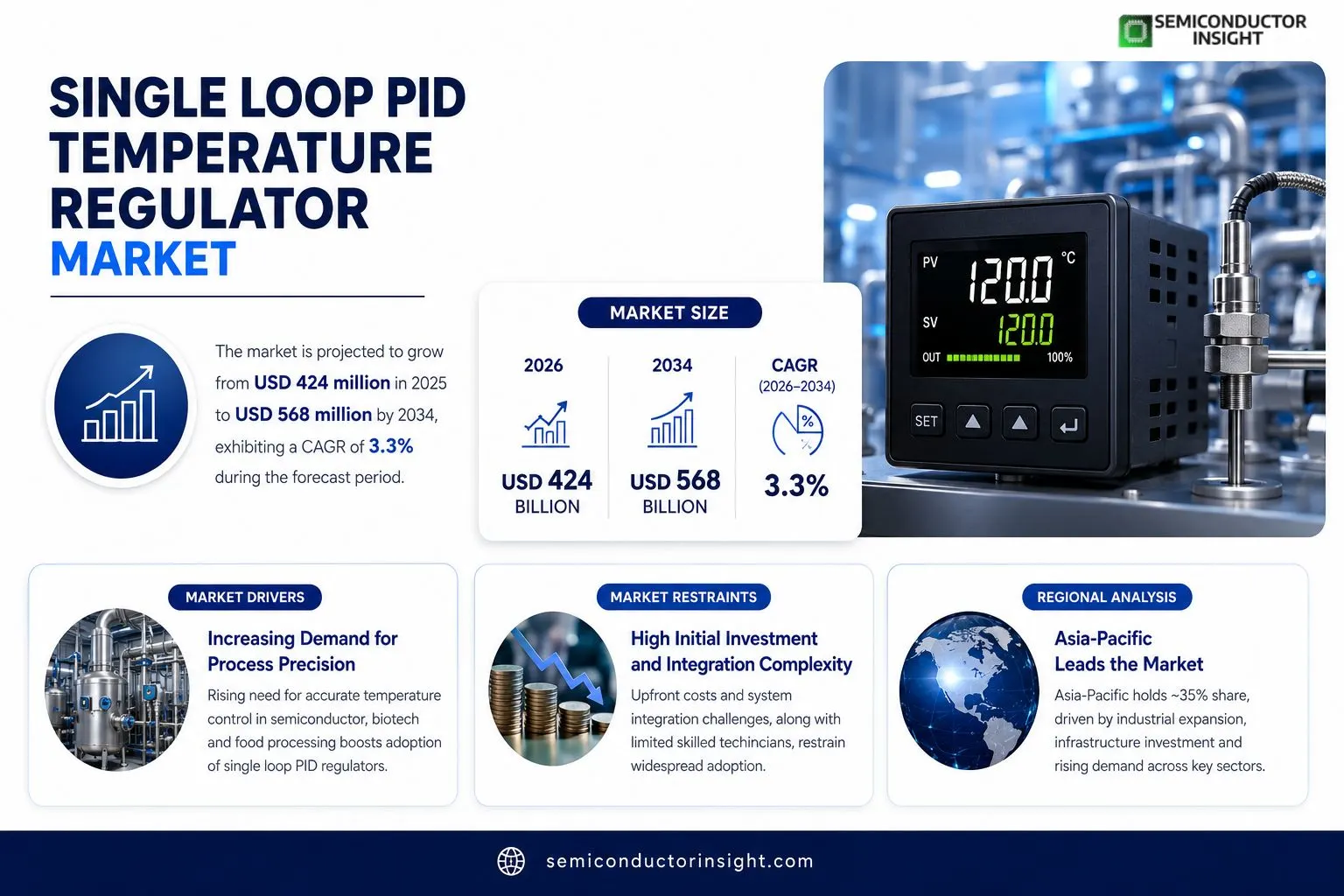
Single Loop PID Temperature Regulator market size was valued at USD 424 million in 2025. The market is projected to grow from USD 424 million in 2025 to USD 568 million by 2034, exhibiting a CAGR of approximately 3.3% during the forecast period.
A Single Loop PID Temperature Regulator is a control device that maintains a stable temperature within a single process loop by applying the proportional‑integral‑derivative algorithm. Unlike multi‑loop solutions, it focuses on one temperature zone, continuously measuring the setpoint deviation and adjusting heating or cooling power accordingly.The sector benefits from rising energy‑efficiency mandates, wider adoption of digital touch‑screen interfaces, and growing demand for precise temperature control in food‑and‑beverage processing, biotechnology labs, and water‑treatment plants. Leading manufacturers such as Omron, Yokogawa Electric, Honeywell, Panasonic and Schneider Electric together account for more than 40 % of worldwide shipments, while Europe remains the primary production hub.
MARKET DRIVERS
Increasing Demand for Process Precision
Manufacturing segments that depend on micron‑level consistency, such as semiconductor fabrication and specialty glass production, are fueling a swift uptake of single‑loop PID temperature regulators. Their inherent accuracymaintaining set‑point stability within ±0.5 °Cand rapid response to thermal disturbances give operators confidence in product quality, directly influencing yield metrics.
Rising Energy‑Efficiency Standards
energy regulations and corporate sustainability targets have pressured plants to reduce waste heat and optimize heater use. Single‑loop PID units, with their fine‑tuned duty cycling, can cut overall power consumption by 4–6 % in batch processes, translating to measurable cost savings while meeting tightening compliance dates.
➤ In pilot studies across three medium‑sized bioreactors, integrated PID control achieved an average of 5 % reduction in energy spend while maintaining product potency.
Collectively, these factors reinforce a trend toward embedding advanced temperature regulation in new and retrofitted facilities, positioning Single Loop PID Temperature Regulator Market as a critical enabler of process reliability and fiscal prudence.
MARKET CHALLENGES
High Initial Investment
Although the long‑term return is demonstrable, the upfront capital required for precision temperature controllers, along with the cost of ancillary sensors and integration hardware, deters small to mid‑sized operations. The pay‑back horizon is often 24–36 months, a period that can strain short‑term capital budgets.
Other Challenges
Complex System Integration
Aligning PID regulators with existing distributed control systems demands meticulous calibration, firmware updates, and operator training, prolonging deployment timelines.
Limited Technician Expertise
The scarcity of skilled personnel capable of diagnosing and tuning PID parameters slows implementation speed and raises maintenance costs.
MARKET RESTRAINTS
Regulatory Constraints on Electromagnetic Emissions
Compliance with the latest electromagnetic interference (EMI) standardsparticularly in ship‑board and automotive environmentsrequires redesign of control firmware and shielding solutions. The additional development time and licensing fees introduce a barrier for manufacturers who are already navigating stringent safety certifications. Combined with the evolving regulatory landscape, these factors create a cautious approach to adopting new controllers, especially in legacy plant settings where retrofit complexities mount.
MARKET OPPORTUNITIES
Emerging Integration with Industrial IoT Platforms
As plants accelerate digital transformation, single‑loop PID temperature regulators that interface seamlessly with cloud‑based analytics unlock predictive maintenance and real‑time quality dashboards. The convergence of edge computing and process control is opening new revenue streams for vendors who can offer bundled software licensing, thereby expanding the market beyond hardware sales.
Single Loop PID Temperature Regulator Market Trends
Digital Integration Drives User Acceptance
Modern Single Loop PID Temperature Regulator systems are increasingly embedding full‑stack digital interfacesfrom touchscreen controllers to cloud‑enabled diagnostic platforms. This shift moves the regulator from a static hardware unit to a data‑centric instrument, enabling real‑time monitoring, predictive maintenance, and remote firmware updates. The ability to pull granular process data into analytics platforms reduces human error, tightens temperature set‑points, and aligns equipment performance with broader plant automation strategies. Consequently, asset managers prioritize controllers that offer open APIs, interoperability with MES and SCADA, and user‑friendly configuration wizards. The trend also supports compliance with evolving regulatory frameworks that demand traceability of critical temperature points in food, semiconductor, and biopharmaceutical production.
Other Trends
Application‑Specific Optimization in Food & Beverage
Within food & beverage, precise temperature control is a linchpin for product safety and shelf‑life assurance. Single Loop PID Temperature Regulator units equipped with burst‑sensing loops and rapid‑stimulus dampening algorithms are now standard in pasteurization lines, cold chain storage, and beverage blending. The integration of thermocouple interfaces that endure aggressive chemistries, coupled with anti‑vibration mounting, reduces cycle variance by up to 15%. Plant operations benefit from automated alarms that trigger when temperature excursions exceed ±0.5 °C, minimizing spoilage and rework. These gains translate directly into cost savings, regulatory compliance, and brand integrity for manufacturers seeking to differentiate through quality assurance.
Asia Pacific Consolidation Amid Growing Demand
The Asia Pacific region has surpassed 35 % of the market, spurred by infrastructure investment in beverage, pharmaceutical, and energy sectors. In this market, local distributors are leveraging strategic alliances with OEMs to offer bundled solutions, while private labeling becomes a common strategy for middle‑market manufacturers. Consolidation is visible as mid‑tier firms acquire niche players that provide custom DIN‑sized housings for industrial roll‑up processes. This concentration boosts competitive power, improves supply chain resilience, and accelerates technology diffusion through cross‑border collaborations. As a result, firms that maintain flexible manufacturing footprints and adaptive R&D pipelines are better positioned to capture the long tail of emerging economies where stringent temperature control is a new market entry requirement.
COMPETITIVE LANDSCAPE
Key Industry Players
Single Loop PID Temperature Regulator Market Analysis
The single‑loop PID temperature regulator sector is currently dominated by a core group of integrated automation leaders who together control more than 40 % of the market. Omron, Yokogawa Electric, Honeywell, Schneider Electric and Panasonic have combined their extensive product portfolios and technological expertise to sustain a competitive advantage, driven largely by the rapid adoption of digital interfaces offering touchscreens and real‑time analytics. Their strategy focuses on integration with broader industrial automation ecosystems, ensuring seamless connectivity with PLCs, SCADA systems, and IoT platforms, which facilitates predictive maintenance and efficient energy management in process industries. The 3.3 % CAGR demonstrates a steady, technology‑driven demand, underscoring the importance of continuous R&D investment in algorithm optimisation and user‑friendly design.Complementing the dominant players, a cohort of mid‑tier and niche manufacturers occupy critical segments of the market by specialising in highly customised solutions tailored to specific industries. Gefran, ABB, Watlow and West Control Solutions provide robust hardware suited to high‑temperature, hazardous‑environment applications, while Delta Electronics and BrainChild focus on cost‑effective, compact units for laboratory and medical settings. Durex, RKC, WIKA, Xiamen Yudian, NOVUS Automation and Hanyoung Nux deliver targeted performance enhancementssuch as extended temperature ranges and advanced diagnostic softwarethat address the nuanced needs of food and beverage, chemistry, semiconductor and electrical sectors. Their vertical integration and proximity to key end‑users foster quick deployment cycles and elevate their reputation for reliability in demanding processes.
List of Key Single Loop PID Temperature Regulator Companies Profiled
- Omron
- Yokogawa Electric
- Honeywell
- Schneider Electric
- Panasonic
- Gefran
- ABB
- Watlow
- West Control Solutions
- Delta Electronics, Inc
- BrainChild Electronic
- Durex
- RKC
- WIKA
- Xiamen Yudian
Segment Analysis:
| Segment Category | Sub-Segments | Key Insights |
| By Type |
|
Conventional PID remains the most widely adopted due to its proven reliability and simplicity.
|
| By Application |
|
Food & Beverage application benefits from precise temperature control to meet safety standards.
|
| By End User |
|
Food & Beverage Manufacturers prioritize FPID for consistent product quality and compliance.
|
| By DIN Size |
|
1/32 DIN suited for compact applications demanding space efficiency.
|
| By Digital Interface |
|
Touchscreen Interface enhances user experience through intuitive controls.
|
Regional Analysis: Single Loop PID Temperature Regulator Market
North America
The North American cluster leans heavily on IIoT‑enabled single‑loop PID units, pairing sensors that feed real‑time data back to centralized cloud dashboards. This digital feedback loop, coupled with machine‑learning optimization, permits predictive maintenance schedules that shrink unplanned downtime and extend controller lifespan by over ten percent on average.
Compliance with stringent industry standardsISO 9001, aerospace safety protocols, and FDA release guidelinesmandates that single‑loop temperature regulators meet robust reliability benchmarks, spurring manufacturers to certify with UL, CSA, and NEMA.
Domestic fabrication of core components, such as precision resistors and ceramic capacitors, reduces lead times. Integrated logistics partners also offer rapid replacement cycles, which satisfy the sector’s high‑throughput demand.
The arena is dominated by high‑precision settingssemiconductor foundries, biopharma, and cryogenic storagewhere temperature variance must stay within a 0.5°C envelope. Each sector benefits from the simplicity of a single‑loop PID offering a higher degree of deterministic control.
Europe
Europe’s stance on energy efficiency pushes regulators toward low‑consumption temperature control systems. In regions where electrical tariffs are high, single‑loop PID units that minimize power draw close to a tenth of the consumption of older multipolar designs have seen quicker uptake. The region’s adherence to CE marking and the Growth Model Framework Forces manufacturers to build modules that not only meet safety standards but also provide an audit trail of temperature data for traceability. The combination of rigorous certification pathways and an industrial base that values data integrity propels demand in pharmaceuticals and food‑processing labs, while the aerospace sector looks for ly validated hardware that meets ATC1262 specifications.
Asia‑Pacific
Asia‑Pacific’s growth hinges on rapid industrial penetration in East Asia and west‑coast expansion in Australia. The merger of legacy textiles with contemporary electronics demands a temperature control solution that can survive high humidity and variable voltage conditions. In markets where SMEs dominate, single‑loop PDIs are appreciated for their cost‑effectiveness and reduced wiring complexity. Regional governments are increasingly offering subsidies for energy‑saving technologies, making the latest PID regulators a strategic fit for state‑backed manufacturing hubs and emerging biotech clusters in Singapore and Shenzhen.
South America
South American manufacturers face supply‑chain volatility and regional power interruptions. Single‑loop PID regulators that base calibration on voltage‑swing tolerance and incorporate self‑diagnostic routines are often preferred. Economic incentives for clean‑energy projects are steering the food‑and‑beverage sector toward temperature‑stabilized storage solutions, while the expanding oil‑and‑gas upstream segment relies on precise thermal control for downstream processing units to maintain product quality and safety.
Middle East & Africa
In this region, stringent environmental regulations on water usage and electricity demand thrust temperature control solutions into the spotlight. Single‑loop PID products that integrate solar‑compliant interfaces and offer low‑energy modes are gaining traction in pharmaceutical and petrochemical plants that rely on reliable thermal oversight amidst extreme temperatures. Additionally, the emphasis on ISO 14001 certification in regional industrial parks has nudged operators toward controllers that provide seamless telemetry to environmental monitoring dashboards.
Report Scope
This market research report provides a comprehensive analysis of the Single Loop PID Temperature Regulator Market , covering the forecast period 2026–2034. It offers detailed insights into market dynamics, technological advancements, competitive landscape, and key trends shaping the industry.
Key focus areas of the report include:
- Market Overview: The report begins with an overview outlining its current market scenario, key growth indicators, and industry transformation drivers. It discusses macroeconomic factors, demand–supply balance, regulatory landscape, and the strategic role of semiconductors in powering advancements across industries such as automotive, telecommunications, consumer electronics, and industrial automation.
- Market Size & Forecast: Historical data and future projections for revenue, unit shipments, and market value across major regions and segments.
- Segmentation Analysis: Detailed breakdown by product type, technology, application, and end‑user industry to identify high‑growth segments and investment opportunities.
- Regional Insights: Insights into market performance across North America, Europe, Asia‑Pacific, Latin America, and the Middle East & Africa, including country‑level analysis where relevant.
- Competitive Landscape: Profiles of leading market participants, including their product offerings, R&D focus, manufacturing capacity, pricing strategies, and recent developments such as mergers, acquisitions, and partnerships.
- Technology Trends & Innovation: Assessment of emerging technologies, integration of AI/IoT, semiconductor design trends, fabrication techniques, and evolving industry standards.
- Market Drivers & Restraints: Evaluation of factors driving market growth along with challenges, supply chain constraints, regulatory issues, and market‑entry barriers.
- Stakeholder Insights: Insights for component suppliers, OEMs, system integrators, investors, and policymakers regarding the evolving ecosystem and strategic opportunities.
Primary and secondary research methods are employed, including interviews with industry experts, data from verified sources, and real‑time market intelligence to ensure the accuracy and reliability of the insights presented.
FREQUENTLY ASKED QUESTIONS:
What is the current market size of Single Loop PID Temperature Regulator Market?
-> Single Loop PID Temperature Regulator Market was valued at USD 411 million in 2024 and is projected to reach USD 515 million by 2031, at a CAGR of 3.3% during the forecast period.
Which key companies operate in Single Loop PID Temperature Regulator Market?
-> Key players include Omron, Yokogawa Electric, Honeywell, Panasonic and Schneider Electric.
What are the key growth drivers?
-> Key growth drivers include digitalization of control systems with advanced touchscreens and IoT integration, energy‑efficiency optimization, and increasing demand for precise temperature control in food & beverage, biotechnology, and semiconductor manufacturing.
Which region dominates the market?
-> Asia‑Pacific holds the largest market share of about 35% and is driving the overall growth, followed by North America and Europe.
What are the emerging trends?
-> Emerging trends include intelligent digital interfaces, AI‑driven predictive maintenance, zero‑emission energy integration, and sustainability‑focused temperature regulation across industrial processes.
Get Sample Report PDF for Exclusive Insights
Report Sample Includes
- Table of Contents
- List of Tables & Figures
- Charts, Research Methodology, and more...
 Download Sample Report PDF