Silicon-on-Sapphire Substrates Market Insights
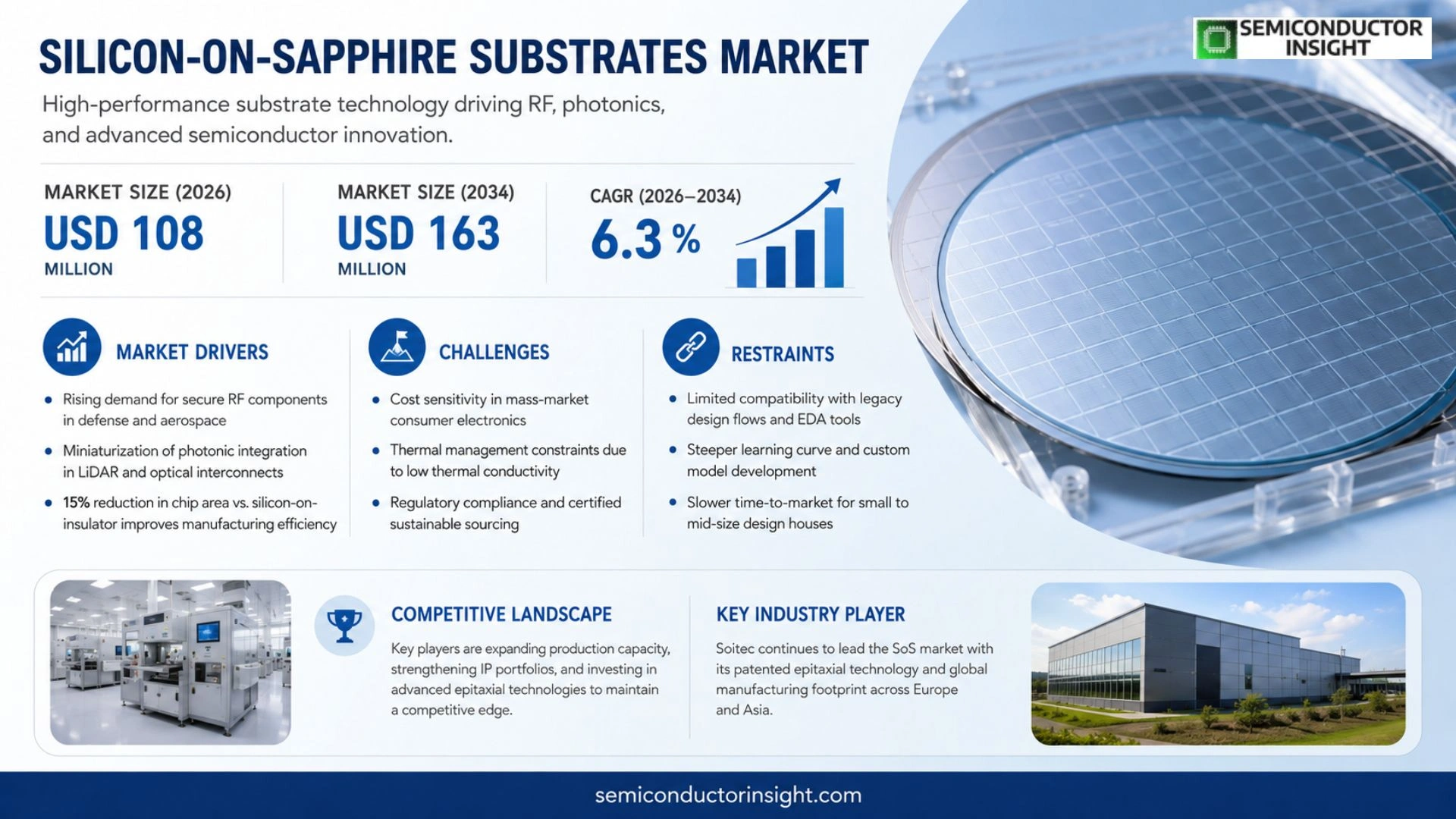
Global Silicon-on-Sapphire Substrates market was valued at USD 108 million in 2026 and will reach USD 163 million by 2034, reflecting a compound annual growth rate of 6.3 %.
The technology involves a hetero‑epitaxial process where silicon layers are grown on sapphire wafers, creating substrates used primarily in sensors, telecommunications equipment and optoelectronic devices.
Growth occurs because of expanding demand for high‑frequency components and low‑loss microwave circuits, while leading suppliers such as Epiel, Cryscore and Soitec broaden their product portfolios to capture emerging applications.
MARKET DRIVERS
Geopolitical Demand for Secure RF Components
The surge in defense and aerospace procurement of radio‑frequency (RF) modules is reshaping procurement strategies worldwide. Engineers favor Silicon-on-Sapphire platforms because the sapphire insulator suppresses parasitic losses, delivering higher isolation at microwave frequencies. This technical advantage translates into lower bill‑of‑materials for high‑frequency transceivers, prompting original equipment manufacturers to standardize on the substrate.
Miniaturization of Photonic Integration
Consumer‑grade LiDAR and on‑chip optical interconnects are being squeezed into ever‑smaller footprints. Sapphire’s high optical transparency combined with silicon’s electronic versatility enables dense photonic‑electronic co‑integration. As automotive OEMs accelerate their adoption of driver‑assistance technologies, the requirement for compact, temperature‑stable photonic circuits fuels orders for high‑purity substrates.
➤ Design houses report a 15 % reduction in chip area when switching from conventional silicon‑on‑insulator to Silicon‑on‑Sapphire, directly impacting manufacturing throughput.
Beyond performance, supply‑chain resilience is becoming a decisive factor. Sapphire wafers are sourced from a limited pool of vendors, yet recent capacity expansions in South‑East Asia have alleviated bottlenecks, allowing tier‑1 manufacturers to lock in multi‑year contracts with confidence.
MARKET CHALLENGES
Cost Sensitivity in Mass‑Market Consumer Electronics
While premium sectors prize the unique attributes of the substrate, mainstream smartphones and wearables remain highly price‑driven. The additional processing steps required for sapphire handling inflate unit costs, creating resistance among volume‑oriented OEMs who prioritize cost per function over marginal performance gains.
Other Challenges
Thermal Management Constraints
The low thermal conductivity of sapphire compared with silicon can hinder heat dissipation in power‑dense designs. System architects must invest in sophisticated thermal pathways, which adds engineering complexity and can offset the substrate’s electrical benefits.
Regulatory scrutiny over rare‑earth mining practices also introduces compliance overhead. Companies must certify that sapphire sources meet environmental and labor standards, a requirement that can delay product roll‑out schedules.
MARKET RESTRAINTS
Limited Compatibility with Legacy Design Flows
Many design houses still rely on legacy electronic design automation (EDA) kits that lack native support for Silicon‑on‑Sapphire process parameters. The learning curve associated with new design rules slows time‑to‑market, particularly for small‑to‑mid‑size firms that cannot justify extensive tool upgrades.
Furthermore, the niche nature of the substrate restricts its presence in standard component libraries, compelling engineers to develop custom models,a resource‑intensive undertaking that discourages broader adoption.
MARKET OPPORTUNITIES
Emerging 5G Infrastructure and Edge Computing
The rollout of 5G small cells and edge‑computing nodes requires RF front‑ends with exceptional linearity and low noise figures. Silicon‑on‑Sapphire substrates meet these specifications, positioning them as a strategic material for the next wave of network densification. Companies that invest in co‑development agreements with telecom equipment manufacturers stand to capture a growing slice of the infrastructure spend.
Parallel to telecom, the quantum‑sensing community is exploring sapphire‑based photonic platforms for stable, room‑temperature operation. Early‑stage collaborations between substrate producers and quantum‑hardware startups could unlock a high‑margin niche, diversifying revenue beyond traditional RF and photonics markets.
Silicon-on-Sapphire Substrates Market Trends
Rising Adoption in High‑Frequency Sensors
Silicon-on-Sapphire Substrates Market recorded activity of roughly $108 million in 2024. Owing to the inherent dielectric loss advantage of sapphire, designers of pressure‑sensor and RF‑front‑end modules have increasingly specified these wafers over conventional silicon. The resulting uptick in bill‑of‑materials has nudged revenue toward $163 million by the end of the forecast horizon, translating to an annual growth rate near 6 percent. This shift matters because sensor manufacturers can now push operating frequencies higher without incurring thermal‑runaway, thereby opening premium product tiers that command higher margins.
Other Trends
Telecommunications Expansion
Mobile‑network infrastructure operators are refreshing base‑station hardware to accommodate 5G‑advanced and early‑stage 6G trials. The low‑parasitic nature of silicon‑on‑sapphire wafers reduces signal attenuation, a quality prized for millimeter‑wave front‑ends. As carriers allocate more spectrum above 24 GHz, equipment vendors are sourcing greater volumes of these substrates, prompting suppliers such as Epiel and Soitec to scale capacity. The business implication is a tighter supply chain that may reward early‑adopters with preferential pricing and faster lead times.
Geographic Shift Towards Asia‑Pacific
While the United States still holds a respectable share, China’s manufacturing momentum is reshaping the regional balance. Domestic demand for IoT sensors and automotive radar has accelerated fab upgrades, nudging Chinese producers toward silicon‑on‑sapphire platforms. This geographic drift introduces competitive pressure on legacy Western players, who must either partner with local fabs or differentiate through advanced epitaxial processes. Companies that realign their go‑to‑market strategy to capture Asian growth pockets are likely to secure a larger slice of the global revenue pie.
COMPETITIVE LANDSCAPE
Key Industry Players
Silicon-on-Sapphire Substrates: Competitive Overview 2024‑2031
Soitec continues to dominate the silicon‑on‑sapphire (SoS) arena, leveraging its patented epitaxial technology and a global production footprint that stretches from France to Singapore. The firm’s ability to integrate high‑volume wafer capacity with aggressive cost‑management has enabled it to command a sizable share of the $108 million market recorded in 2024. Epiel and Cryscore, both headquartered in the United States, occupy the next tier of influence; each offers niche process customization that appeals to aerospace and defense customers requiring radiation‑hard components. Their strategic alliances with equipment suppliers and active R&D pipelines have reinforced a three‑player core that shapes pricing signals and sets technical benchmarks for the broader ecosystem.
Beyond the top three, a constellation of specialized manufacturers sustains market depth. Shin‑Etsu Chemical and Kyocera International provide ultra‑thin sapphire substrates that feed high‑frequency telecom modules, while Sumitomo Electric and JSR Corporation focus on advanced surface treatments that improve device yield. Murata Manufacturing’s foray into sensor‑grade SoS wafers reflects a diversification into the Internet‑of‑Things sector. Mitsubishi Materials and NanoSilicon contribute incremental capacity through boutique facilities that serve regional customers in Asia‑Pacific. GlobalFoundries and Texas Instruments, though primarily fab operators, maintain strategic stockpiles of SoS wafers to secure supply for proprietary designs, underscoring the cross‑industry reliance on this niche substrate class.
List of Key Silicon-on-Sapphire Substrates Companies Profiled
- Soitec
- Epiel
- Cryscore
- Shin‑Etsu Chemical
- Kyocera International
- Sumitomo Electric Industries
- JSR Corporation
- Murata Manufacturing
- Mitsubishi Materials
- NanoSilicon
- GlobalFoundries
- Texas Instruments
Segment Analysis:
| Segment Category | Sub-Segments | Key Insights |
| By Type |
|
Epitaxial Wafer
|
| By Application |
|
Integrated Circuits
|
| By End User |
|
Telecommunications
|
| By Wafer Size |
|
100 mm
|
| By Integration Mode |
|
Monolithic Integration
|
Regional Analysis: Silicon-on-Sapphire Substrates Market
Asia-Pacific
Leading fabs are merging upstream sapphire crystal growers with downstream thin‑film deposition units, shortening logistics and mitigating variability. This vertical integration reduces lead times and aligns quality standards across the substrate value chain, granting customers more predictable performance envelopes.
Chip designers are co‑investing in substrate engineering, tailoring lattice‑match parameters to specific RF architectures. Such collaborations accelerate time‑to‑market for 5G‑compatible modules, offering a differentiated edge in densely populated urban networks.
Regional safety standards for aerospace and defense applications compel suppliers to certify sapphire substrates against stringent radiation‑hardness criteria, driving niche product lines that command premium pricing.
Universities in Singapore and Hong Kong generate a pipeline of materials scientists with expertise in epitaxial growth, feeding local fabs with innovative process know‑how and sustaining the region’s technical lead.
North America
North America retains a strong foothold, largely sustained by defense contractors and aerospace firms that demand ultra‑reliable substrate performance. While domestic wafer capacity lags behind Asia‑Pacific, the region compensates through intensive R&D spending and strategic partnerships with research institutions. Companies are leveraging advanced simulation tools to extract marginal efficiency gains, which, in turn, shape procurement strategies that favor high‑value, low‑volume orders. This environment fosters an ecosystem where niche applications,such as quantum‑sensing platforms,receive disproportionate attention, encouraging suppliers to develop bespoke process windows that meet exacting specification sheets.
Europe
European activity in Silicon-on-Sapphire Substrates Market is anchored by automotive and industrial automation sectors that prioritize thermal stability and long‑term reliability. The regulatory focus on emissions and safety pushes manufacturers toward substrates that can endure high‑temperature operation without degradation. Collaborative clusters in Germany and the Netherlands are experimenting with hybrid integration techniques, blending silicon‑on‑sapphire layers with silicon‑photonic circuits to create compact lidar modules. These efforts underscore a strategic intent to capture emerging mobility markets, prompting a gradual shift of capital toward pilot lines that can demonstrate scalable production.
South America
In South America, market momentum is modest yet increasingly relevant due to burgeoning telecommunications infrastructure projects. Nations such as Brazil are rolling out 5G networks, creating a downstream demand for high‑frequency components that benefit from sapphire’s dielectric properties. Local distributors are beginning to source substrates directly from Asian manufacturers, bypassing traditional intermediaries to reduce cost pressure. This realignment encourages regional players to develop value‑added services, such as testing and packaging, to differentiate themselves in a price‑sensitive market.
Middle East & Africa
The Middle East & Africa region exhibits nascent growth, driven primarily by defense modernization programs and satellite‑communication endeavors. Governments are allocating budgets toward indigenous capabilities, fostering joint ventures with established substrate suppliers. Such collaborations aim to transfer knowledge on sapphire crystal growth and thin‑film deposition, laying groundwork for a localized supply base. Although volumes remain limited, the strategic emphasis on self‑reliance is prompting early‑stage investments that could evolve into a modest but stable demand stream for specialized silicon‑on‑sapphire products.
Report Scope
This market research report provides a comprehensive analysis of the Silicon-on-Sapphire Substrates Market , covering the forecast period 2026–2034. It offers detailed insights into market dynamics, technological advancements, competitive landscape, and key trends shaping the industry.
Key focus areas of the report include:
- Market Overview: The report begins with an overview outlining its current market scenario, key growth indicators, and industry transformation drivers. It discusses macroeconomic factors, demand–supply balance, regulatory landscape, and the strategic role of semiconductors in powering advancements across industries such as automotive, telecommunications, consumer electronics, and industrial automation.
- Market Size & Forecast: Historical data and future projections for revenue, unit shipments, and market value across major regions and segments.
- Segmentation Analysis: Detailed breakdown by product type, technology, application, and end-user industry to identify high-growth segments and investment opportunities.
- Regional Insights: Insights into market performance across North America, Europe, Asia-Pacific, Latin America, and the Middle East & Africa, including country-level analysis where relevant.
- Competitive Landscape: Profiles of leading market participants, including their product offerings, R&D focus, manufacturing capacity, pricing strategies, and recent developments such as mergers, acquisitions, and partnerships.
- Technology Trends & Innovation: Assessment of emerging technologies, integration of AI/IoT, semiconductor design trends, fabrication techniques, and evolving industry standards.
- Market Drivers & Restraints: Evaluation of factors driving market growth along with challenges, supply chain constraints, regulatory issues, and market-entry barriers.
- Stakeholder Insights: Insights for component suppliers, OEMs, system integrators, investors, and policymakers regarding the evolving ecosystem and strategic opportunities.
Primary and secondary research methods are employed, including interviews with industry experts, data from verified sources, and real-time market intelligence to ensure the accuracy and reliability of the insights presented.
FREQUENTLY ASKED QUESTIONS:
What is the current market size of Silicon-on-Sapphire Substrates Market?
-> Global Silicon-on-Sapphire Substrates Market is expected to reach USD 163 million by 2034, at a CAGR of 6.3% during the forecast period.
Which key companies operate in Silicon-on-Sapphire Substrates Market?
-> Key players include Epiel, Cryscore, Soitec, among others.
What are the key growth drivers?
-> Key growth drivers include the hetero‑epitaxial process enabling high‑performance sensors, telecommunications components, and optoelectronic devices, as well as increasing demand for compact, high‑frequency integrated circuits.
Which region dominates the market?
-> Asia is the leading region, driven by strong semiconductor manufacturing bases in China, Japan, and South Korea, while North America and Europe also show significant adoption.
What are the emerging trends?
-> Emerging trends include integration of Silicon‑on‑Sapphire substrates in 5G and IoT platforms, development of advanced optoelectronic sensors, and increased focus on miniaturization of high‑frequency ICs.
Get Sample Report PDF for Exclusive Insights
Report Sample Includes
- Table of Contents
- List of Tables & Figures
- Charts, Research Methodology, and more...
 Download Sample Report PDF