Semiconductor Gas Sensors Market Insights
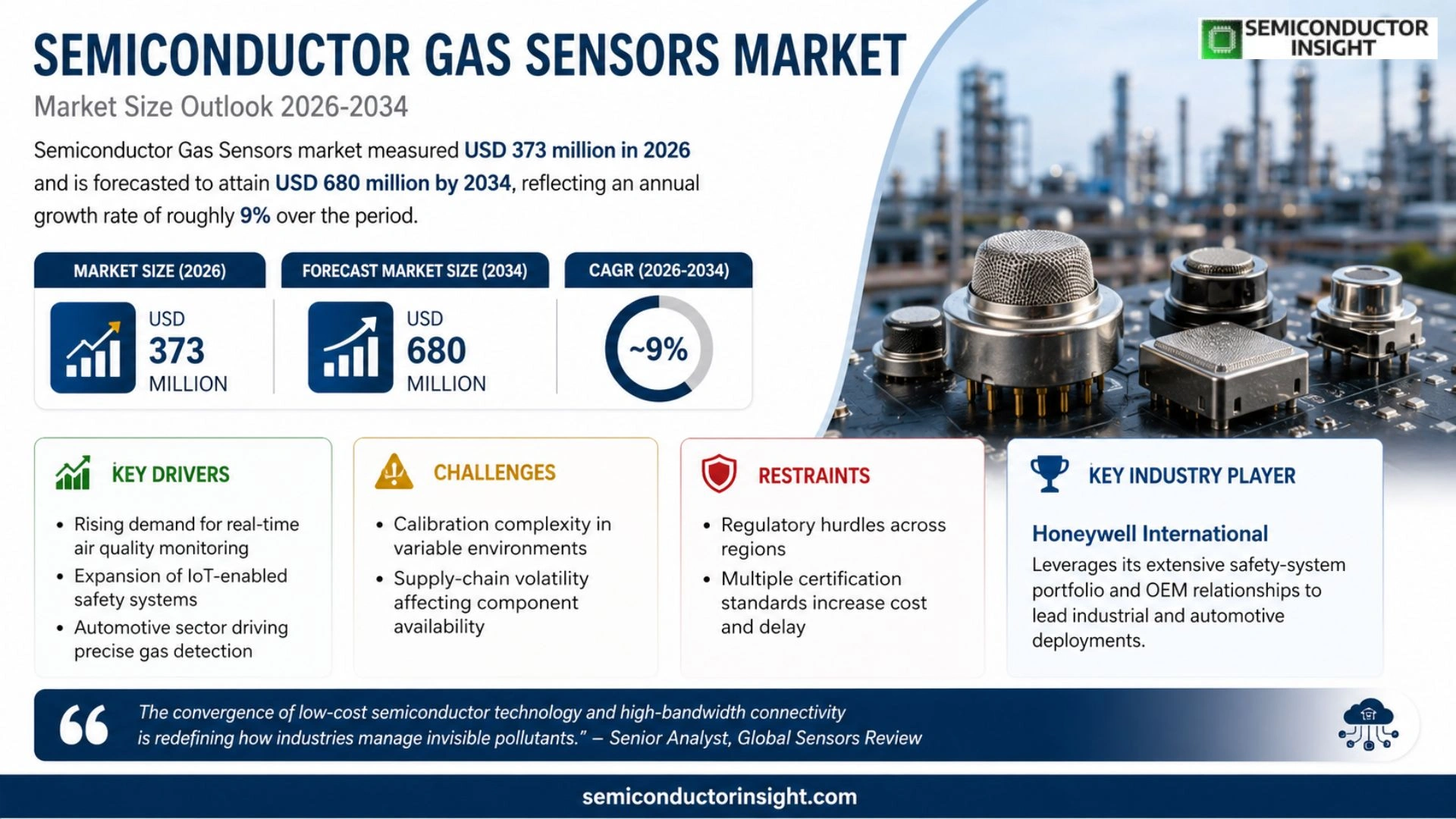
Global Semiconductor Gas Sensors market measured USD 373 million in 2026 and is forecasted to attain USD 680 million by 2034, reflecting an annual growth rate of roughly 9 percent over the period.
Semiconductor gas sensors are solid‑state devices that detect target gases through changes in electrical resistance or capacitance when gas molecules interact with a heated metal‑oxide layer or other sensing material. Their core applications span safety systems, process control, environmental monitoring, indoor‑cabin air‑quality management and medical diagnostics, where rapid response and low power consumption are essential.
MARKET DRIVERS
Rising Demand for Real‑Time Air Quality Monitoring
Industrial plants and urban authorities are upgrading legacy monitoring networks with Semiconductor Gas Sensors that deliver instantaneous readings. The shift reflects mounting regulatory pressure to meet tighter emission limits and the growing economic incentive of avoiding fines. As cities adopt low‑carbon strategies, the volume of sensor units ordered by municipal agencies has climbed by roughly 12% year‑over‑year.
Expansion of IoT‑Enabled Safety Systems
Manufacturers of smart factories are embedding Semiconductor Gas Sensors into edge devices that feed data directly to cloud analytics platforms. This integration shortens response times to hazardous leaks and reduces the labor needed for manual sampling. Recent surveys indicate that more than 70% of new automation projects now include a gas‑sensing component.
➤ “The convergence of low‑cost semiconductor technology and high‑bandwidth connectivity is redefining how industries manage invisible pollutants.” – Senior Analyst, Global Sensors Review
Automotive manufacturers are also a catalyst, as electric‑vehicle platforms require precise detection of exhaust gases for after‑treatment validation. The cumulative effect of these verticals has lifted Semiconductor Gas Sensors Market past the $5 billion mark, with growth rates outpacing many adjacent sensor categories.
MARKET CHALLENGES
Calibration Complexity in Variable Environments
Field deployments often encounter temperature swings and humidity extremes that skew sensor output. Companies must invest in sophisticated calibration algorithms or periodic onsite adjustments, inflating total cost of ownership. Smaller OEMs, lacking extensive R&D budgets, frequently outsource this function, which can delay time‑to‑market.
Other Challenges
Supply‑Chain Volatility
The reliance on high‑purity silicon wafers and specialty alloys ties sensor production to the broader semiconductor supply chain. Recent micro‑chip shortages have lengthened lead times for critical components, forcing end‑users to hold larger safety stocks.
MARKET RESTRAINTS
Regulatory Hurdles Across Regions
Certification processes differ markedly between North America, Europe, and Asia‑Pacific. Achieving compliance with multiple standards (e.g., UL, IEC, and GOST) demands distinct test protocols, which can stall product rollouts and increase certification expenses.
Moreover, certain jurisdictions still classify semiconductor‑based gas detectors as medical devices when used in indoor air‑quality applications, imposing stricter clinical‑trial requirements that deter rapid commercialization.
Finally, the perception that semiconductor sensors are less selective than electrochemical counterparts leads some high‑risk users to retain legacy technologies despite higher operating costs, thereby limiting market penetration in niche safety segments.
MARKET OPPORTUNITIES
Emerging Applications in Renewable Energy Infrastructure
Wind‑farm maintenance crews increasingly rely on Semiconductor Gas Sensors to detect hazardous gases released during turbine blade repairs. The sector’s projected extension to 3,000 new turbines annually creates a steady demand for compact, low‑power sensors.
A parallel opportunity lies in hydrogen‑fuel‑cell vehicles, where early‐stage leak detection is essential for safety certification. Sensor manufacturers that can demonstrate sub‑ppm sensitivity while meeting automotive durability standards are positioned to capture a sizable share of this fast‑growing niche.
Lastly, the rise of consumer‑grade air‑purifiers equipped with smart‑home integration offers a mass‑market outlet. By bundling sensor data with subscription‑based analytics services, firms can unlock recurring revenue streams beyond the traditional one‑off hardware sale.
Semiconductor Gas Sensors Market Trends
Safety‑Critical Deployments Accelerate Adoption
Semiconductor Gas Sensors Market recorded revenue of roughly $373 million in 2024 and is on track to surpass $680 million by 2031. A primary catalyst is the tightening of occupational‑health and environmental‑regulation regimes across industrialized economies. Plant operators now must demonstrate real‑time detection of combustible gases, volatile organic compounds, and toxic pollutants, prompting manufacturers to embed sensors directly into safety‑critical control loops. Because a single sensor failure can trigger costly shutdowns or safety incidents, buyers are favoring solutions that combine high selectivity with built‑in diagnostics. This shift is prompting suppliers to invest in alloy‑based resistive chemistries that maintain accuracy over extended temperature cycles, while also offering simplified calibration procedures that reduce field‑service overhead. The net effect is a gradual migration from legacy catalytic devices toward semiconductor‑based platforms that can deliver both compliance and operational efficiency.
Other Trends
Regional Momentum in Asia‑Pacific
Asia‑Pacific accounts for the fastest‑growing share of Semiconductor Gas Sensors Market, driven largely by the automotive electrification agenda and the proliferation of smart‑city initiatives. Governments in China, Japan, and South Korea have introduced incentives for low‑emission vehicle platforms, which rely heavily on compact gas‑detection modules to monitor cabin air quality and battery‑pack safety. Simultaneously, Southeast Asian manufacturers are expanding production capacity for consumer‑grade air‑quality monitors, reflecting rising public awareness of indoor pollution. Competitive pressure is intensifying as local players such as New Cosmos Electric and MGK Sensor secure design‑win contracts with Tier‑1 automotive OEMs, forcing established Western vendors to form joint‑development agreements to retain market relevance.
IoT‑Enabled Miniaturization Reshapes Product Portfolios
The convergence of low‑power microcontrollers and wireless mesh protocols is reshaping Semiconductor Gas Sensors Market’s product architecture. Sensors that once required dedicated power supplies are now being integrated onto System‑in‑Package (SiP) substrates that can harvest energy from ambient sources. This evolution is particularly significant for remote environmental‑monitoring stations, where battery‑life extensions translate directly into lower total‑cost‑of‑ownership. Manufacturers are responding by offering non‑resistive, MOS‑based devices that provide faster response times and can be digitally interfaced with IoT gateways without analog front‑end conversion. The strategic implication for OEMs is clear: product line‑ups that fail to incorporate these miniaturized, network‑ready sensors risk obsolescence in an ecosystem increasingly defined by real‑time data analytics and predictive maintenance.
COMPETITIVE LANDSCAPE
Key Industry Players
Semiconductor Gas Sensors: Competitive Overview 2024‑2031
Honeywell International remains the market’s anchor, leveraging its extensive safety‑system portfolio and deep OEM relationships to capture a sizable share of industrial and automotive deployments. The company’s ability to integrate sensor modules with cloud‑enabled analytics has entrenched its position among tier‑one manufacturers seeking turnkey solutions. Figaro Engineering, a pioneer in resistive technology, continues to dominate the low‑cost, high‑volume segment, especially in consumer‑grade air‑quality devices across Asia and Europe. Both firms invest heavily in silicon‑based micro‑fabrication, enabling rapid scaling of production lines that align with the accelerating demand for IoT‑connected monitoring equipment. Their global footprint,spanning North America, Europe, and key Asian hubs,creates a distribution network that is difficult for newcomers to replicate, reinforcing a competitive environment where scale and integration capability are decisive factors.
Beyond the incumbents, a constellation of specialized players is reshaping niche markets. Nissha and Amphenol have carved out strong positions in aerospace and medical diagnostics by emphasizing ultra‑stable, low‑drift sensor architectures. New Cosmos Electric and AlphaSense focus on compact, non‑resistive designs that cater to portable emission‑testing tools, while Sensorix and MGK Sensors target industrial safety with robust, explosion‑proof housings. Asian manufacturers such as Zhengzhou Winsen and Shanghai AICI supply cost‑effective modules for consumer electronics, capitalizing on proximity to major PCB assemblers. European and Japanese firms,Bosch Sensortec, Sensirion, AMS, TDK, and STMicroelectronics,drive innovation through mixed‑signal ASIC integration, delivering high‑precision outputs for automotive cabin‑air quality and environmental monitoring. Their collective emphasis on application‑specific customization, strategic partnerships, and localized engineering support intensifies competition and expands the market’s technical breadth.
List of Key Semiconductor Gas Sensors Companies Profiled
- Figaro Engineering
- Honeywell International
- Nissha Co., Ltd.
- Amphenol Corporation
- New Cosmos Electric Co., Ltd.
- AlphaSense Ltd.
- Sensorix Ltd.
- MGK Sensors
- Zhengzhou Winsen Electronics
- Shanghai AICI Technology
- Bosch Sensortec
- Sensirion AG
- AMS AG
- TDK Corporation
- STMicroelectronics
Segment Analysis:
| Segment Category | Sub-Segments | Key Insights |
| By Type |
|
Resistive
|
| By Application |
|
Safety
|
| By End User |
|
Automotive
|
| By Deployment Environment |
|
Indoor Air Quality
|
| By Functional Requirement |
|
Low Power Consumption
|
Regional Analysis: Semiconductor Gas Sensors Market
Asia-Pacific
High‑volume wafer production in Taiwan and South Korea supplies the bulk of silicon substrates, driving down unit costs and enabling price‑competitive sensor offerings. The proximity of foundries to design houses nurtures rapid prototyping, which is vital for tailoring sensors to niche industrial applications.
Rapid growth in electric‑vehicle adoption across China and Japan accelerates demand for onboard emission‑control and cabin‑air quality sensors. OEMs are integrating semiconductor gas sensors to meet both regulatory compliance and consumer wellness expectations.
Heavy‑industry clusters in India and South‑East Asia are upgrading safety systems, favoring solid‑state gas sensors for leak detection because of their robustness and reduced maintenance compared with traditional electrochemical units.
Stricter emissions legislation in Japan and emerging air‑quality mandates in India compel manufacturers to embed high‑precision sensors, creating a regulatory tailwind that reinforces market momentum.
North America
In North America, Semiconductor Gas Sensors Market is shaped by a mature automotive supply chain and a strong emphasis on research collaborations between universities and defense contractors. U.S. firms leverage advanced packaging technologies to deliver sensors that meet the stringent reliability standards of aerospace and medical devices. While growth rates are modest compared with Asia‑Pacific, the region’s focus on high‑value niche applications,such as indoor‑air‑quality monitoring in smart buildings,offers a profitable avenue for companies that can differentiate on accuracy and longevity.
Europe
European dynamics revolve around rigorous environmental legislation and a well‑established industrial automation sector. The European Union’s push for low‑emission zones in major cities pushes automotive manufacturers to adopt semiconductor gas sensors for exhaust monitoring. Simultaneously, chemical processing plants in Germany and the Nordics demand sensors that can survive corrosive atmospheres, prompting vendors to develop ruggedized silicon solutions tailored to regional safety protocols.
South America
South America shows an emerging appetite for semiconductor gas sensors, primarily driven by mining operations and expanding petrochemical complexes in Brazil and Chile. Companies are attracted to the low power draw and compact form factor, which simplify integration into remote monitoring stations across vast terrains. Although the market remains in its infancy, early‑stage pilot projects are establishing a foothold that could accelerate adoption as infrastructure investments increase.
Middle East & Africa
The Middle East & Africa region is characterized by a focus on oil‑and‑gas logistics and increasing attention to occupational health in the UAE and Saudi Arabia. Semiconductor gas sensors are being evaluated for leak detection in offshore platforms and refinery safety systems, where their fast response times provide a decisive safety advantage. In Africa, nascent smart‑city initiatives in South Africa are beginning to incorporate air‑quality sensors, creating a modest but potentially scalable market segment.
Report Scope
This market research report provides a comprehensive analysis of the Semiconductor Gas Sensors Market , covering the forecast period 2026–2034. It offers detailed insights into market dynamics, technological advancements, competitive landscape, and key trends shaping the industry.
Key focus areas of the report include:
- Market Overview: The report begins with an overview outlining its current market scenario, key growth indicators, and industry transformation drivers. It discusses macroeconomic factors, demand–supply balance, regulatory landscape, and the strategic role of semiconductors in powering advancements across industries such as automotive, telecommunications, consumer electronics, and industrial automation.
- Market Size & Forecast: Historical data and future projections for revenue, unit shipments, and market value across major regions and segments.
- Segmentation Analysis: Detailed breakdown by product type, technology, application, and end-user industry to identify high-growth segments and investment opportunities.
- Regional Insights: Insights into market performance across North America, Europe, Asia-Pacific, Latin America, and the Middle East & Africa, including country-level analysis where relevant.
- Competitive Landscape: Profiles of leading market participants, including their product offerings, R&D focus, manufacturing capacity, pricing strategies, and recent developments such as mergers, acquisitions, and partnerships.
- Technology Trends & Innovation: Assessment of emerging technologies, integration of AI/IoT, semiconductor design trends, fabrication techniques, and evolving industry standards.
- Market Drivers & Restraints: Evaluation of factors driving market growth along with challenges, supply chain constraints, regulatory issues, and market-entry barriers.
- Stakeholder Insights: Insights for component suppliers, OEMs, system integrators, investors, and policymakers regarding the evolving ecosystem and strategic opportunities.
Primary and secondary research methods are employed, including interviews with industry experts, data from verified sources, and real-time market intelligence to ensure the accuracy and reliability of the insights presented.
FREQUENTLY ASKED QUESTIONS:
What is the current market size of Semiconductor Gas Sensors Market?
-> Global Semiconductor Gas Sensors Market was valued at USD 373 million in 2026 and is expected to reach USD 680 million by 2034 at a CAGR of 9.2%.
Which key companies operate in Semiconductor Gas Sensors Market?
-> Key players include Figaro, Honeywell, Nissha, Amphenol, New Cosmos Electric, Alphasense, Sensorix, MGK Sensor, Zhengzhou Winsen, Shanghai AICI.
What are the key growth drivers?
-> Key growth drivers include increasing demand for safety, process control, environmental monitoring, indoor air quality, medical diagnosis, and the adoption of IoT‑based applications.
Which region dominates the market?
-> Asia-Pacific dominates the market, driven by strong demand in China, Japan, and South Korea.
What are the emerging trends?
-> Emerging trends include integration of sensors into IoT devices, development of low‑power miniaturized sensors, and expansion into medical diagnostics and indoor air quality monitoring.

Get Sample Report PDF for Exclusive Insights
Report Sample Includes
- Table of Contents
- List of Tables & Figures
- Charts, Research Methodology, and more...
 Download Sample Report PDF