Key Statistics
Key Takeaways
- Satellite iot (ntn) modem chip market was valued at USD 840.0 million in 2025 and is projected to reach USD 3.21 billion by 2034, representing a 16.1% CAGR over 2026–2034.
- SoC-based NTN modem solutions are gaining share because integrating baseband, RF, memory and power management reduces board area and simplifies battery-powered device design.
- Asset tracking and remote industrial monitoring are the strongest commercial applications because satellite coverage solves a clear connectivity gap where terrestrial NB-IoT or LTE-M cannot reach.
- North America leads through a mature commercial-space ecosystem and major satellite-IoT platform providers, while Asia Pacific benefits from large semiconductor and module-manufacturing scale.
- 3GPP Release 17 provides the key interoperability foundation for NB-IoT NTN, allowing vendors such as Qualcomm and MediaTek to build chips that can transition between terrestrial and satellite coverage.
Satellite IoT (NTN) Modem Chip Market Overview
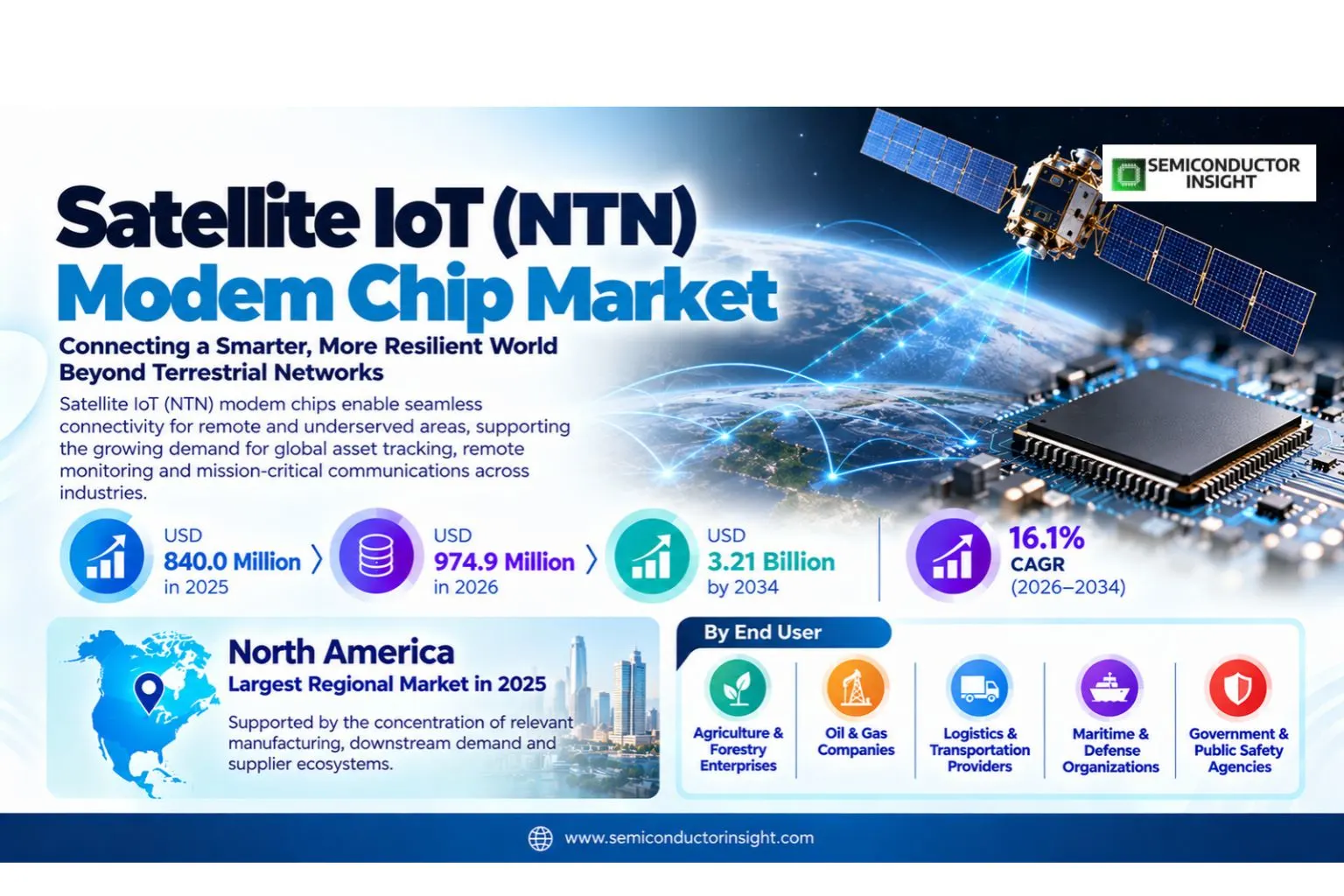
Satellite iot (ntn) modem chip market was valued at USD 840.0 million in 2025, is estimated at USD 974.9 million in 2026, and is projected to reach USD 3.21 billion by 2034, advancing at a 16.1% CAGR during 2026–2034. North America represents the largest regional market in 2025, supported by the concentration of relevant manufacturing, downstream demand and supplier ecosystems.
Satellite IoT non-terrestrial-network modem chips are specialized semiconductors that allow low-power devices to communicate directly with satellites when terrestrial cellular coverage is absent. The market includes standalone modems, highly integrated SoCs and multi-mode devices that support both terrestrial and satellite links, with 3GPP Release 17 providing a common technical framework for standardized IoT-NTN connectivity.
Commercial adoption is strongest where connectivity loss has a direct operational cost, including logistics, remote energy assets, agriculture, maritime monitoring and environmental sensing. The design challenge is to combine satellite link budgets with low power, compact antennas and multi-year battery life, making modem efficiency, RF integration and standards compliance central to supplier differentiation.
The commercial structure of the satellite iot (ntn) modem chip market is shaped by design qualification, production economics and the interaction between component performance and downstream system requirements. Suppliers that can combine consistent manufacturing, application engineering and supply assurance are better positioned to convert technical eligibility into repeat business. Customer decisions increasingly account for lifecycle continuity, geographic resilience and integration cost, which makes proven process control and ecosystem compatibility as important as nominal product capability.
Segment Analysis: By Type
By type, the Satellite IoT (NTN) Modem Chip market is segmented into Standalone Modem ICs, System-on-Chip (SoC) Solutions, Multi-mode NTN Chipsets, Integrated RF + Baseband Chipsets. System-on-chip solutions lead because constrained IoT devices benefit from fewer external components, lower board area and more integrated power management. Standalone modem ICs remain useful where OEMs need architectural flexibility or must combine NTN connectivity with existing application processors. Purchasing decisions vary by performance requirement, qualification burden, integration complexity and lifecycle economics, so suppliers compete on application fit rather than on a single technical specification.
| Type | Role in the market | Demand characteristics |
|---|---|---|
| Standalone Modem ICs | Standalone Modem ICs addresses a distinct part of the product and process mix. Its commercial position depends on technical fit, manufacturing maturity, integration requirements and customer qualification rather than on headline specifications alone. | Demand is strongest where the segment aligns with established customer designs, predictable supply, and measurable system-level performance. Suppliers that can document repeatability, compatibility and lifecycle support are better placed to defend design wins. |
| System-on-Chip (SoC) Solutions | System-on-Chip (SoC) Solutions addresses a distinct part of the product and process mix. Its commercial position depends on technical fit, manufacturing maturity, integration requirements and customer qualification rather than on headline specifications alone. | Demand is strongest where the segment aligns with established customer designs, predictable supply, and measurable system-level performance. Suppliers that can document repeatability, compatibility and lifecycle support are better placed to defend design wins. |
| Multi-mode NTN Chipsets | Multi-mode NTN Chipsets addresses a distinct part of the product and process mix. Its commercial position depends on technical fit, manufacturing maturity, integration requirements and customer qualification rather than on headline specifications alone. | Demand is strongest where the segment aligns with established customer designs, predictable supply, and measurable system-level performance. Suppliers that can document repeatability, compatibility and lifecycle support are better placed to defend design wins. |
| Integrated RF + Baseband Chipsets | Integrated RF + Baseband Chipsets addresses a distinct part of the product and process mix. Its commercial position depends on technical fit, manufacturing maturity, integration requirements and customer qualification rather than on headline specifications alone. | Demand is strongest where the segment aligns with established customer designs, predictable supply, and measurable system-level performance. Suppliers that can document repeatability, compatibility and lifecycle support are better placed to defend design wins. |
Segment Analysis: By End User
By end user, the Satellite IoT (NTN) Modem Chip market is segmented into Agriculture & Forestry Enterprises, Oil & Gas Companies, Logistics & Transportation Providers, Maritime & Defense Organizations, Government & Public Safety Agencies. Oil and gas operators place high value on resilient remote telemetry, logistics providers focus on global asset visibility, and public-safety users prioritize coverage continuity and operational reliability. Purchasing decisions vary by performance requirement, qualification burden, integration complexity and lifecycle economics, so suppliers compete on application fit rather than on a single technical specification.
| End User | Role in the market | Demand characteristics |
|---|---|---|
| Agriculture & Forestry Enterprises | Agriculture & Forestry Enterprises represents a relevant purchasing and deployment pathway within this market. Commercial attractiveness depends on how well it aligns with customer architecture, supply-chain constraints and required performance. | Growth is linked to design-in activity, installed-base transitions and the ability of suppliers to meet qualification, cost and availability requirements over the full product lifecycle. |
| Oil & Gas Companies | Oil & Gas Companies represents a relevant purchasing and deployment pathway within this market. Commercial attractiveness depends on how well it aligns with customer architecture, supply-chain constraints and required performance. | Growth is linked to design-in activity, installed-base transitions and the ability of suppliers to meet qualification, cost and availability requirements over the full product lifecycle. |
| Logistics & Transportation Providers | Logistics & Transportation Providers represents a relevant purchasing and deployment pathway within this market. Commercial attractiveness depends on how well it aligns with customer architecture, supply-chain constraints and required performance. | Growth is linked to design-in activity, installed-base transitions and the ability of suppliers to meet qualification, cost and availability requirements over the full product lifecycle. |
| Maritime & Defense Organizations | Maritime & Defense Organizations represents a relevant purchasing and deployment pathway within this market. Commercial attractiveness depends on how well it aligns with customer architecture, supply-chain constraints and required performance. | Growth is linked to design-in activity, installed-base transitions and the ability of suppliers to meet qualification, cost and availability requirements over the full product lifecycle. |
| Government & Public Safety Agencies | Government & Public Safety Agencies represents a relevant purchasing and deployment pathway within this market. Commercial attractiveness depends on how well it aligns with customer architecture, supply-chain constraints and required performance. | Growth is linked to design-in activity, installed-base transitions and the ability of suppliers to meet qualification, cost and availability requirements over the full product lifecycle. |
Segment Analysis: By Application
By application, the Satellite IoT (NTN) Modem Chip market is segmented into Asset Tracking & Fleet Management, Smart Agriculture, Oil, Gas & Energy Monitoring, Maritime & Aviation Connectivity, Environmental & Weather Monitoring, Others. Asset tracking and fleet management provide the broadest near-term demand because containers, trailers, livestock and remote equipment often move beyond terrestrial network coverage. Oil, gas, agriculture and environmental monitoring offer additional high-value use cases where satellite connectivity reduces manual inspection. Purchasing decisions vary by performance requirement, qualification burden, integration complexity and lifecycle economics, so suppliers compete on application fit rather than on a single technical specification.
| Application | Role in the market | Demand characteristics |
|---|---|---|
| Asset Tracking & Fleet Management | Asset Tracking & Fleet Management creates demand when the underlying system requires the market’s core function at production scale. Procurement is normally tied to platform launches, equipment upgrades, capacity expansion or replacement cycles. | Buyers evaluate reliability, qualification time, integration cost and vendor support alongside unit economics. Adoption accelerates when the solution removes a system bottleneck or supports a new performance tier without creating disproportionate redesign risk. |
| Smart Agriculture | Smart Agriculture creates demand when the underlying system requires the market’s core function at production scale. Procurement is normally tied to platform launches, equipment upgrades, capacity expansion or replacement cycles. | Buyers evaluate reliability, qualification time, integration cost and vendor support alongside unit economics. Adoption accelerates when the solution removes a system bottleneck or supports a new performance tier without creating disproportionate redesign risk. |
| Oil, Gas & Energy Monitoring | Oil, Gas & Energy Monitoring creates demand when the underlying system requires the market’s core function at production scale. Procurement is normally tied to platform launches, equipment upgrades, capacity expansion or replacement cycles. | Buyers evaluate reliability, qualification time, integration cost and vendor support alongside unit economics. Adoption accelerates when the solution removes a system bottleneck or supports a new performance tier without creating disproportionate redesign risk. |
| Maritime & Aviation Connectivity | Maritime & Aviation Connectivity creates demand when the underlying system requires the market’s core function at production scale. Procurement is normally tied to platform launches, equipment upgrades, capacity expansion or replacement cycles. | Buyers evaluate reliability, qualification time, integration cost and vendor support alongside unit economics. Adoption accelerates when the solution removes a system bottleneck or supports a new performance tier without creating disproportionate redesign risk. |
| Environmental & Weather Monitoring | Environmental & Weather Monitoring creates demand when the underlying system requires the market’s core function at production scale. Procurement is normally tied to platform launches, equipment upgrades, capacity expansion or replacement cycles. | Buyers evaluate reliability, qualification time, integration cost and vendor support alongside unit economics. Adoption accelerates when the solution removes a system bottleneck or supports a new performance tier without creating disproportionate redesign risk. |
| Others | Others creates demand when the underlying system requires the market’s core function at production scale. Procurement is normally tied to platform launches, equipment upgrades, capacity expansion or replacement cycles. | Buyers evaluate reliability, qualification time, integration cost and vendor support alongside unit economics. Adoption accelerates when the solution removes a system bottleneck or supports a new performance tier without creating disproportionate redesign risk. |
Segment Analysis: By Connectivity Standard
By connectivity standard, the Satellite IoT (NTN) Modem Chip market is segmented into NB-IoT NTN (3GPP Release 17), LTE-M NTN, Proprietary Satellite IoT Protocols, 5G NTN. NB-IoT NTN is the most mature standardized low-power path under Release 17, while LTE-M NTN and broader 5G NTN expand toward higher mobility and richer data use cases. Purchasing decisions vary by performance requirement, qualification burden, integration complexity and lifecycle economics, so suppliers compete on application fit rather than on a single technical specification.
| Connectivity Standard | Role in the market | Demand characteristics |
|---|---|---|
| NB-IoT NTN (3GPP Release 17) | NB-IoT NTN (3GPP Release 17) represents a relevant purchasing and deployment pathway within this market. Commercial attractiveness depends on how well it aligns with customer architecture, supply-chain constraints and required performance. | Growth is linked to design-in activity, installed-base transitions and the ability of suppliers to meet qualification, cost and availability requirements over the full product lifecycle. |
| LTE-M NTN | LTE-M NTN represents a relevant purchasing and deployment pathway within this market. Commercial attractiveness depends on how well it aligns with customer architecture, supply-chain constraints and required performance. | Growth is linked to design-in activity, installed-base transitions and the ability of suppliers to meet qualification, cost and availability requirements over the full product lifecycle. |
| Proprietary Satellite IoT Protocols | Proprietary Satellite IoT Protocols represents a relevant purchasing and deployment pathway within this market. Commercial attractiveness depends on how well it aligns with customer architecture, supply-chain constraints and required performance. | Growth is linked to design-in activity, installed-base transitions and the ability of suppliers to meet qualification, cost and availability requirements over the full product lifecycle. |
| 5G NTN | 5G NTN represents a relevant purchasing and deployment pathway within this market. Commercial attractiveness depends on how well it aligns with customer architecture, supply-chain constraints and required performance. | Growth is linked to design-in activity, installed-base transitions and the ability of suppliers to meet qualification, cost and availability requirements over the full product lifecycle. |
Segment Analysis: By Orbit Type
By orbit type, the Satellite IoT (NTN) Modem Chip market is segmented into Low Earth Orbit (LEO), Medium Earth Orbit (MEO), Geostationary Orbit (GEO). LEO creates lower latency and lower path loss than GEO and is therefore highly attractive for battery-constrained IoT. GEO remains useful where existing satellite coverage and service continuity are already established. Purchasing decisions vary by performance requirement, qualification burden, integration complexity and lifecycle economics, so suppliers compete on application fit rather than on a single technical specification.
| Orbit Type | Role in the market | Demand characteristics |
|---|---|---|
| Low Earth Orbit (LEO) | Low Earth Orbit (LEO) represents a relevant purchasing and deployment pathway within this market. Commercial attractiveness depends on how well it aligns with customer architecture, supply-chain constraints and required performance. | Growth is linked to design-in activity, installed-base transitions and the ability of suppliers to meet qualification, cost and availability requirements over the full product lifecycle. |
| Medium Earth Orbit (MEO) | Medium Earth Orbit (MEO) represents a relevant purchasing and deployment pathway within this market. Commercial attractiveness depends on how well it aligns with customer architecture, supply-chain constraints and required performance. | Growth is linked to design-in activity, installed-base transitions and the ability of suppliers to meet qualification, cost and availability requirements over the full product lifecycle. |
| Geostationary Orbit (GEO) | Geostationary Orbit (GEO) represents a relevant purchasing and deployment pathway within this market. Commercial attractiveness depends on how well it aligns with customer architecture, supply-chain constraints and required performance. | Growth is linked to design-in activity, installed-base transitions and the ability of suppliers to meet qualification, cost and availability requirements over the full product lifecycle. |
Regional Analysis
North America leads the satellite iot (ntn) modem chip market in 2025, while regional growth patterns differ according to manufacturing concentration, customer investment cycles, regulation, product mix and supply-chain access. The most important regional distinction is not simply market size; it is the mechanism that converts local investment and end-market demand into qualified purchases.
How does regional demand differ across the satellite iot (ntn) modem chip market?
Regional demand for satellite iot (ntn) modem chip is structurally uneven because manufacturing assets, design centers, downstream customers and qualification ecosystems are not distributed evenly. Asia Pacific typically has the deepest electronics manufacturing base, North America combines technology development with capital investment, Europe emphasizes reliability and industrial requirements, and emerging regions are more dependent on imported systems. These differences influence vendor selection, inventory policy, service expectations and the pace at which new technologies are adopted.
| Region | Market position | Growth outlook | Demand profile | Supplier-selection gate |
|---|---|---|---|---|
| North America | Largest | Strong | Commercial-space and platform led | Operator interoperability and certification |
| Europe | Advanced standards market | Strong | Industrial, maritime and regulatory led | Spectrum and standards compliance |
| Asia Pacific | Fast-scaling | Very strong | Semiconductor and device manufacturing led | Cost and module integration |
| South America | Emerging | Strong | Agriculture, mining and logistics led | Service cost and coverage economics |
| Middle East & Africa | Developing | Strong | Energy, logistics and remote-monitoring led | Affordability and service availability |
Detailed Regional Blocks
Competitive Landscape
Competition in the satellite iot (ntn) modem chip market is determined by technical qualification, manufacturing consistency, customer relationships and the ability to support product lifecycles. Price matters, but it rarely overrides reliability, integration effort or switching cost once a supplier has been designed into a production platform.
The competitive field includes Qualcomm Technologies, MediaTek, Semtech, Sequans Communications, Nordic Semiconductor, Sony Semiconductor Solutions, alongside other specialized suppliers. Market share can shift when a vendor gains access to a new platform, expands qualified capacity or introduces a technology that materially improves system performance. Because customer validation can be lengthy, incumbent suppliers often benefit from continuity, while challengers need a clear technical or supply-chain advantage to displace an approved source.
Competitive strategy is increasingly multi-dimensional. Leading suppliers invest in process or product development, application engineering and regional support at the same time, while customers seek second-source options where technically feasible. This creates a market in which differentiation is sustained through documented performance, manufacturing yield, quality systems, responsiveness and the ability to support future roadmap transitions without forcing unnecessary redesigns.
| Company | Competitive position | Primary basis of competition |
|---|---|---|
| Qualcomm Technologies | Established global / strategic supplier | Competes through product capability, qualification, account access and supply execution. |
| MediaTek | Established global / strategic supplier | Competes through product capability, qualification, account access and supply execution. |
| Semtech | Established global / strategic supplier | Competes through product capability, qualification, account access and supply execution. |
| Sequans Communications | Established global / strategic supplier | Competes through product capability, qualification, account access and supply execution. |
| Nordic Semiconductor | Established global / strategic supplier | Competes through product capability, qualification, account access and supply execution. |
| Sony Semiconductor Solutions | Specialist / regional competitor | Competes through product capability, qualification, account access and supply execution. |
| Altair Semiconductor | Specialist / regional competitor | Competes through product capability, qualification, account access and supply execution. |
| u-blox | Specialist / regional competitor | Competes through product capability, qualification, account access and supply execution. |
| Telit Cinterion | Specialist / regional competitor | Competes through product capability, qualification, account access and supply execution. |
| Sierra Wireless | Specialist / regional competitor | Competes through product capability, qualification, account access and supply execution. |
| Skylo Technologies | Focused challenger / niche participant | Competes through product capability, qualification, account access and supply execution. |
| Fibocom Wireless | Focused challenger / niche participant | Competes through product capability, qualification, account access and supply execution. |
| Lantronix | Focused challenger / niche participant | Competes through product capability, qualification, account access and supply execution. |
| Murata Manufacturing | Focused challenger / niche participant | Competes through product capability, qualification, account access and supply execution. |
| Quectel Wireless Solutions | Focused challenger / niche participant | Competes through product capability, qualification, account access and supply execution. |
Production Capacity Analysis
Supply capacity is defined by modem design, advanced-node foundry access, RF front-end availability and module certification rather than by a dedicated manufacturing process. Volumes are still much smaller than terrestrial cellular IoT, so vendors need to amortize protocol development and mask costs across a narrower installed base.
Asia Pacific provides much of the semiconductor and module-manufacturing capacity, while North America has strong satellite-service and platform capability. Commercial scaling therefore depends on cross-regional coordination among chip vendors, satellite operators, module makers and device OEMs.
Capacity should therefore be evaluated on a qualified-output basis rather than as nominal installed capability. A supplier may possess equipment or production lines that appear suitable but still require customer-specific validation, process tuning, test correlation or upstream material qualification. This distinction becomes especially important during demand spikes, when headline capacity can overstate the volume that is immediately available for a particular application, technology generation or reliability class.
Market Dynamics
The satellite iot (ntn) modem chip market is being shaped by rising performance requirements and technology transitions on the demand side, while qualification complexity, supply concentration and cost discipline constrain the pace of adoption. The balance of these forces favors suppliers that can solve a measurable system problem without increasing integration risk.
Demand expansion is not uniform across all product variants or customer groups. New technology creates attractive design opportunities, but buyers typically require a clear economic or performance case before changing a qualified architecture. At the same time, supply-chain localization, capacity investment and tighter quality requirements are changing procurement behavior. As a result, growth is likely to concentrate around applications where performance upgrades, manufacturing scale and lifecycle value reinforce one another.
Market Drivers
Four forces provide the strongest support for demand in the satellite iot (ntn) modem chip market: performance-driven technology upgrades, expansion of relevant downstream applications, investment in manufacturing or infrastructure, and the need for more resilient supply. Their importance varies by segment, but each creates a direct reason for customers to qualify or purchase additional solutions.
| Driver | Impact | Commercial mechanism |
|---|---|---|
| 3GPP NTN standardization reduces ecosystem fragmentation | High | Release 17 gives modem vendors and network operators a common foundation for IoT-NTN interoperability, lowering OEM development risk. |
| LEO satellite coverage improves service economics | High | Denser constellations reduce coverage gaps and can improve latency and link budgets for battery-constrained devices. |
| Remote asset visibility has measurable operational value | Medium-High | Agriculture, energy, mining and logistics can reduce manual inspection and improve response time through persistent telemetry. |
| Hybrid terrestrial-satellite designs simplify deployment | Medium-High | Devices that use cellular coverage when available and satellite only when needed can optimize airtime cost and battery consumption. |
3GPP NTN standardization reduces ecosystem fragmentation
Release 17 gives modem vendors and network operators a common foundation for IoT-NTN interoperability, lowering OEM development risk. The commercial effect is strongest where customers can link the technology change to higher throughput, lower power, improved reliability, reduced lifecycle cost or access to a new end-market requirement.
LEO satellite coverage improves service economics
Denser constellations reduce coverage gaps and can improve latency and link budgets for battery-constrained devices. The commercial effect is strongest where customers can link the technology change to higher throughput, lower power, improved reliability, reduced lifecycle cost or access to a new end-market requirement.
Remote asset visibility has measurable operational value
Agriculture, energy, mining and logistics can reduce manual inspection and improve response time through persistent telemetry. The commercial effect is strongest where customers can link the technology change to higher throughput, lower power, improved reliability, reduced lifecycle cost or access to a new end-market requirement.
Hybrid terrestrial-satellite designs simplify deployment
Devices that use cellular coverage when available and satellite only when needed can optimize airtime cost and battery consumption. The commercial effect is strongest where customers can link the technology change to higher throughput, lower power, improved reliability, reduced lifecycle cost or access to a new end-market requirement.
Market Restraints
Growth is moderated by qualification burden, cyclical purchasing, technology substitution and supply-chain risk. These restraints do not eliminate demand, but they can extend sales cycles, limit supplier switching and reduce the speed at which technically superior solutions convert into production revenue.
| Restraint | Impact | Commercial consequence |
|---|---|---|
| Satellite transmission consumes more energy than terrestrial LPWAN | High | Battery-operated devices must manage higher link budgets and transmission energy, limiting reporting frequency and lifetime. |
| Chip and service costs remain above terrestrial-only alternatives | High | Lower volumes and satellite airtime keep total connectivity cost higher for price-sensitive applications. |
| Certification and spectrum rules are complex | Medium | Cross-border satellite devices must satisfy both telecom and satellite regulations across multiple jurisdictions. |
| Operator and orbit fragmentation increases integration burden | Medium | Different bands, constellations and service models can require additional validation even when the modem follows 3GPP standards. |
Satellite transmission consumes more energy than terrestrial LPWAN
Battery-operated devices must manage higher link budgets and transmission energy, limiting reporting frequency and lifetime. Suppliers can mitigate part of this pressure through stronger qualification support, transparent lifecycle planning, dual-source strategies and better alignment between product roadmaps and customer production schedules.
Chip and service costs remain above terrestrial-only alternatives
Lower volumes and satellite airtime keep total connectivity cost higher for price-sensitive applications. Suppliers can mitigate part of this pressure through stronger qualification support, transparent lifecycle planning, dual-source strategies and better alignment between product roadmaps and customer production schedules.
Certification and spectrum rules are complex
Cross-border satellite devices must satisfy both telecom and satellite regulations across multiple jurisdictions. Suppliers can mitigate part of this pressure through stronger qualification support, transparent lifecycle planning, dual-source strategies and better alignment between product roadmaps and customer production schedules.
Operator and orbit fragmentation increases integration burden
Different bands, constellations and service models can require additional validation even when the modem follows 3GPP standards. Suppliers can mitigate part of this pressure through stronger qualification support, transparent lifecycle planning, dual-source strategies and better alignment between product roadmaps and customer production schedules.
Market Opportunities
The most attractive opportunities in the satellite iot (ntn) modem chip market occur where a technology transition creates measurable value and where suppliers can enter before the customer architecture is locked. Early engagement, application-specific engineering and credible supply planning can convert these windows into durable design positions.
Direct-to-device industrial IoT
Standardized modems can bring satellite coverage into trackers, sensors and gateways without dedicated proprietary terminals. The opportunity is strongest for suppliers that can demonstrate performance with production-relevant data, provide engineering support during qualification and maintain a roadmap that gives customers confidence in long-term availability.
Smart agriculture
Low-rate soil, irrigation and livestock telemetry fits the power and bandwidth profile of IoT-NTN. The opportunity is strongest for suppliers that can demonstrate performance with production-relevant data, provide engineering support during qualification and maintain a roadmap that gives customers confidence in long-term availability.
Maritime and aviation tracking
Persistent connectivity improves visibility for assets that spend long periods outside terrestrial networks. The opportunity is strongest for suppliers that can demonstrate performance with production-relevant data, provide engineering support during qualification and maintain a roadmap that gives customers confidence in long-term availability.
Hybrid cellular-satellite modules
Integrating terrestrial NB-IoT/LTE-M and NTN in one device can reduce BOM, board area and certification complexity. The opportunity is strongest for suppliers that can demonstrate performance with production-relevant data, provide engineering support during qualification and maintain a roadmap that gives customers confidence in long-term availability.
Supply Chain Analysis
Satellite constellations and spectrum
LEO, MEO and GEO operators provide coverage and licensed spectrum needed for NTN links. Value capture at this stage depends on quality consistency, technical differentiation and the difficulty of substitution. Bottlenecks can propagate downstream when qualification or material compatibility prevents customers from shifting quickly to an alternative supplier.
NTN modem and RF silicon
Chip vendors implement Release 17 protocol, RF transceivers, baseband and power management. Value capture at this stage depends on quality consistency, technical differentiation and the difficulty of substitution. Bottlenecks can propagate downstream when qualification or material compatibility prevents customers from shifting quickly to an alternative supplier.
Modules, antennas and device integration
Module vendors combine modem silicon with GNSS, antennas, SIM/eSIM and application processors. Value capture at this stage depends on quality consistency, technical differentiation and the difficulty of substitution. Bottlenecks can propagate downstream when qualification or material compatibility prevents customers from shifting quickly to an alternative supplier.
IoT services and vertical platforms
Tracking, agriculture, energy and maritime platforms turn satellite connectivity into operational workflows. Value capture at this stage depends on quality consistency, technical differentiation and the difficulty of substitution. Bottlenecks can propagate downstream when qualification or material compatibility prevents customers from shifting quickly to an alternative supplier.
Recent Developments
Recent developments show how technology roadmaps, manufacturing investment and standards are changing the competitive requirements of the satellite iot (ntn) modem chip market. The entries below are selected for their direct relevance to product capability, capacity, qualification or downstream adoption rather than for general corporate activity.
Qualcomm continues to offer the 9205S modem as a hybrid terrestrial and satellite IoT platform following 3GPP Release 17, giving device makers a standards-based path to seamless mobility across cellular and NTN coverage. Source
MediaTek continues commercial support for the MT6825, a compact IoT-NTN connectivity solution integrating Cortex-M4F processing, memory, RF and power management with Release 17 support at L-band and S-band. Source
MediaTek’s broader satellite roadmap continued to emphasize standardized NTN interoperability and automatic satellite messaging, reinforcing the move away from isolated proprietary terminals toward integrated mobile and IoT silicon. Source
Report Scope & Segmentation
| Report attribute | Coverage |
|---|---|
| Market | Satellite IoT (NTN) Modem Chip |
| Base Year | 2025 |
| Estimated Year | 2026 |
| Forecast Period | 2026–2034 |
| 2025 Market Size | USD 840.0 million |
| 2026 Estimated Size | USD 974.9 million |
| 2034 Forecast Size | USD 3.21 billion |
| CAGR (2026–2034) | 16.1% |
| Largest Market in 2025 | North America |
| By Type | Standalone Modem ICs, System-on-Chip (SoC) Solutions, Multi-mode NTN Chipsets, Integrated RF + Baseband Chipsets |
| By Application | Asset Tracking & Fleet Management, Smart Agriculture, Oil, Gas & Energy Monitoring, Maritime & Aviation Connectivity, Environmental & Weather Monitoring, Others |
| By End User | Agriculture & Forestry Enterprises, Oil & Gas Companies, Logistics & Transportation Providers, Maritime & Defense Organizations, Government & Public Safety Agencies |
| By Connectivity Standard | NB-IoT NTN (3GPP Release 17), LTE-M NTN, Proprietary Satellite IoT Protocols, 5G NTN |
| By Orbit Type | Low Earth Orbit (LEO), Medium Earth Orbit (MEO), Geostationary Orbit (GEO) |
| Companies Profiled | Qualcomm Technologies, MediaTek, Semtech, Sequans Communications, Nordic Semiconductor, Sony Semiconductor Solutions, Altair Semiconductor, u-blox, Telit Cinterion, Sierra Wireless, Skylo Technologies, Fibocom Wireless, Lantronix, Murata Manufacturing, Quectel Wireless Solutions |
Frequently Asked Questions
What was the satellite iot (ntn) modem chip market size in 2025?
The global satellite iot (ntn) modem chip market was valued at USD 840.0 million in 2025. The 2025 value is the base-year reference used throughout this overview and provides the starting point for comparing the 2026 estimate and the 2034 forecast.
What is the projected satellite iot (ntn) modem chip market size in 2034?
The global market is projected to reach USD 3.21 billion by 2034. The forecast reflects the interaction of downstream adoption, technology transitions, production investment and the qualification requirements that shape commercial conversion across the market.
What is the CAGR of the satellite iot (ntn) modem chip market from 2026 to 2034?
The satellite iot (ntn) modem chip market is expected to expand at a 16.1% CAGR during 2026–2034. Growth will not be uniform across every product or region because customer qualification, capital cycles, supply constraints and application-specific performance requirements differ materially.
Which region is the largest satellite iot (ntn) modem chip market?
North America is the largest regional market in 2025. Its position is supported by the concentration of relevant manufacturing, customers, technology ecosystems and downstream demand, although the precise commercial mechanism differs by country and application.
How is the satellite iot (ntn) modem chip market segmented by type?
By type, the market is segmented into Standalone Modem ICs, System-on-Chip (SoC) Solutions, Multi-mode NTN Chipsets, Integrated RF + Baseband Chipsets. These categories address different performance, cost and integration requirements, so supplier selection depends on application fit, qualification history and lifecycle economics rather than a single specification.
What are the main applications for satellite iot (ntn) modem chip?
By application, the market covers Asset Tracking & Fleet Management, Smart Agriculture, Oil, Gas & Energy Monitoring, Maritime & Aviation Connectivity, Environmental & Weather Monitoring, Others. Demand in each application is linked to platform launches, capacity expansion, equipment replacement and the degree to which the technology improves system performance or manufacturing economics.
What are the principal growth drivers for the satellite iot (ntn) modem chip market?
Key drivers include 3gpp ntn standardization reduces ecosystem fragmentation and leo satellite coverage improves service economics. These forces increase demand when customers can translate technical improvements into higher performance, lower cost, greater reliability or access to new applications.
What are the main restraints in the satellite iot (ntn) modem chip market?
Important restraints include satellite transmission consumes more energy than terrestrial lpwan and chip and service costs remain above terrestrial-only alternatives. The resulting qualification burden, purchasing cyclicality and technology risk can extend sales cycles and limit rapid supplier substitution even when new solutions offer clear technical advantages.
Which companies participate in the satellite iot (ntn) modem chip market?
Companies profiled in this market include Qualcomm Technologies, MediaTek, Semtech, Sequans Communications, Nordic Semiconductor, Sony Semiconductor Solutions, Altair Semiconductor, u-blox. Competition centers on qualification, product or process performance, manufacturing consistency, customer support and the ability to maintain supply across the required product lifecycle.
What should buyers evaluate when selecting a satellite iot (ntn) modem chip supplier?
Buyers should evaluate demonstrated performance, qualification history, manufacturing consistency, lifecycle support, supply resilience and integration cost. A technically strong product can still face adoption barriers if it increases redesign risk, lacks regional support or cannot meet the customer’s production and quality requirements.
Research Sources & Evidence Base
View research sources used for this overview.
- Qualcomm. 9205S Modem — Hybrid terrestrial and satellite IoT modem with 3GPP Release 17 support.
- MediaTek. MT6825 IoT-NTN Connectivity Solution — Release 17 IoT-NTN chipset integration, supported bands and low-power architecture.
- MediaTek. 5G Satellite NTN — Commercial NTN positioning and standardized satellite connectivity roadmap.

Get Sample Report PDF for Exclusive Insights
Report Sample Includes
- Table of Contents
- List of Tables & Figures
- Charts, Research Methodology, and more...
 Download Sample Report PDF