RF Switch (SPDT, SPnT, MIMO) Market Insights
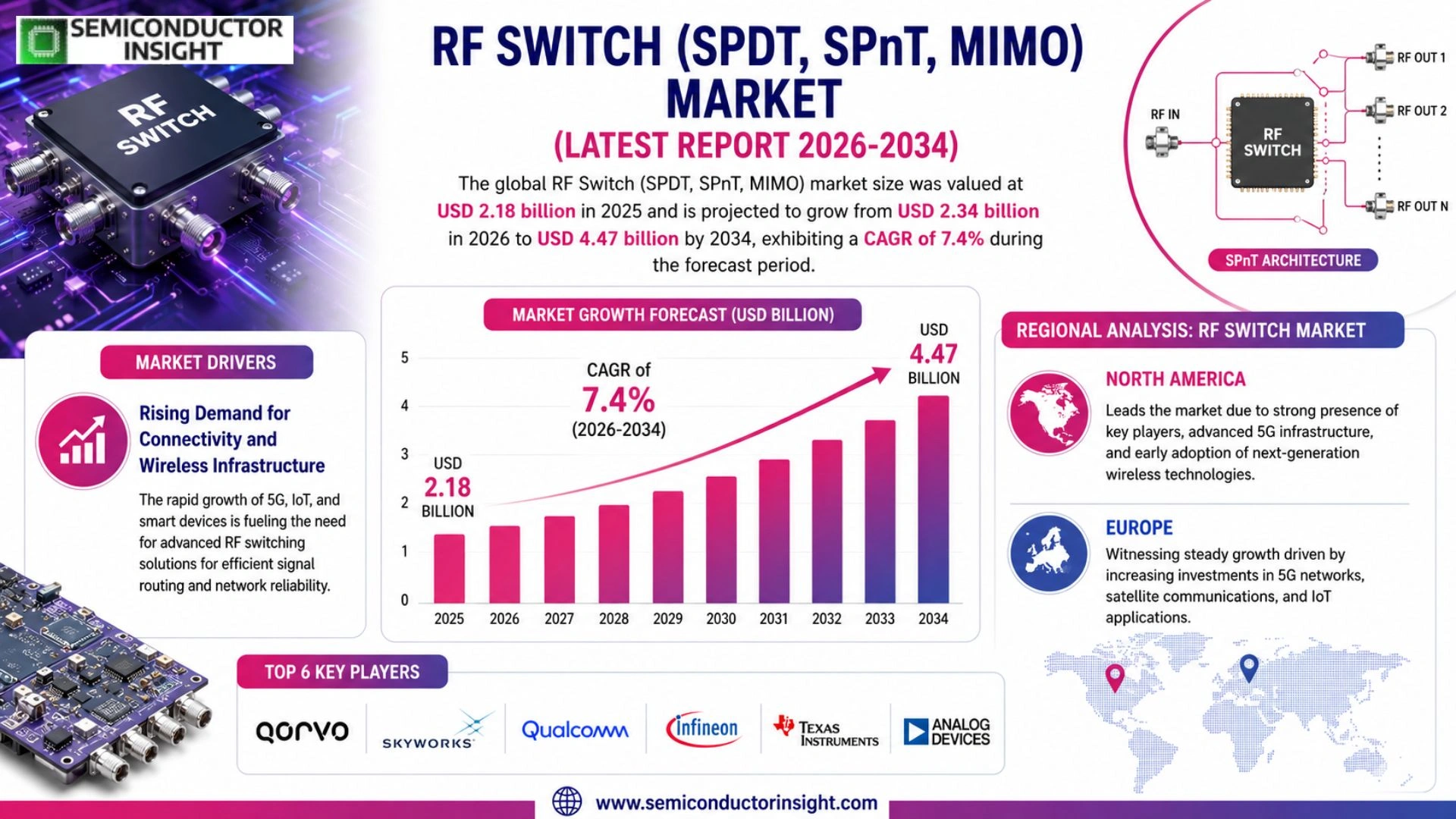
RF Switch (SPDT, SPnT, MIMO) Market size was valued at USD 2.18 billion in 2025. The market is projected to grow from USD 2.34 billion in 2026 to USD 4.47 billion by 2034, exhibiting a CAGR of 7.4% during the forecast period.
RF switches are essential semiconductor components used to route radio frequency signals between multiple ports in wireless communication systems. These devices encompass several configurations, including Single-Pole Double-Throw (SPDT), Single-Pole n-Throw (SPnT), and Multiple-Input Multiple-Output (MIMO) architectures, each serving distinct signal routing and antenna management functions across consumer electronics, telecommunications infrastructure, defense, and aerospace applications.
The market is gaining strong momentum driven by the accelerating global rollout of 5G networks, rising adoption of MIMO antenna systems in modern smartphones, and increasing demand for high-frequency switching solutions in radar and satellite communication systems. Furthermore, the proliferation of connected devices under the Internet of Things (IoT) ecosystem continues to amplify demand for efficient RF signal management. Leading companies such as Skyworks Solutions, Inc., Qorvo, Inc., and Murata Manufacturing Co., Ltd. remain at the forefront of the market, offering broad product portfolios spanning GaAs, CMOS, and SOI-based RF switch technologies.
MARKET DRIVERS
Proliferation of 5G Infrastructure Accelerating Demand for Advanced RF Switching Solutions
The global RF Switch market, encompassing SPDT, SPnT, and MIMO configurations, is experiencing robust growth driven primarily by the rapid worldwide deployment of 5G network infrastructure. As mobile network operators transition from 4G LTE to 5G NR architectures, the complexity of radio front-end designs has increased substantially, necessitating higher-performance switching components capable of operating across wider frequency bands—from sub-6 GHz to mmWave spectrums. SPDT and SPnT RF switches are integral to antenna tuning, band selection, and signal routing in both base stations and user equipment, making them indispensable components in next-generation wireless systems. The sheer density of small cells and massive MIMO base stations required for 5G coverage further amplifies the volume demand for these switching devices.
Massive MIMO Adoption Driving Architectural Complexity and Switch Integration Requirements
Massive MIMO antenna systems, which deploy arrays of 64 to 256 or more antenna elements in advanced base stations, represent one of the most significant architectural shifts driving the RF Switch market. Each antenna element within a MIMO array requires dedicated switching circuitry for transmit/receive signal path management, creating a multiplier effect on RF switch consumption per base station unit. MIMO-capable RF switches with low insertion loss, high isolation, and fast switching speeds are critical to sustaining the spectral efficiency gains that massive MIMO promises. Semiconductor manufacturers are responding with highly integrated switch matrix solutions in CMOS, GaAs, and SOI process technologies, enabling tighter integration with power amplifiers and low-noise amplifiers in the radio front-end module.
➤ The convergence of 5G densification, Wi-Fi 6E/7 adoption, and the Internet of Things ecosystem is creating a multi-vector demand environment for RF Switch (SPDT, SPnT, MIMO) Market participants, with cumulative unit volumes projected to reach tens of billions across consumer, industrial, and infrastructure end-use segments over the coming decade.
Beyond cellular infrastructure, the consumer electronics segment is a powerful and sustained driver of the RF Switch market. Modern smartphones incorporate multiple RF switches to manage simultaneous connectivity across Wi-Fi, Bluetooth, NFC, and cellular bands. The transition to Wi-Fi 6E and the emerging Wi-Fi 7 standard, which extends operation into the 6 GHz band, requires additional switching stages for band routing and interference mitigation. Wearables, smart home devices, and industrial IoT nodes similarly integrate RF switches for multi-protocol operation. This broad-based demand across consumer and enterprise wireless ecosystems ensures consistent volume growth for SPDT and SPnT switch configurations regardless of fluctuations in any single end-market segment.
MARKET CHALLENGES
Thermal Management and Linearity Requirements Posing Design Challenges at mmWave Frequencies
As RF Switch (SPDT, SPnT, MIMO) Market advances into higher frequency bands demanded by 5G mmWave and beyond, engineers face increasingly stringent performance requirements that are difficult to reconcile simultaneously. At frequencies above 24 GHz, maintaining low insertion loss while achieving high port-to-port isolation becomes a fundamental physics challenge, as parasitic capacitances and substrate losses in conventional semiconductor processes degrade switch performance significantly. Furthermore, linearity metrics such as IIP3 and P1dB compression become harder to achieve at elevated power levels, constraining the applicability of certain process technologies in high-power transmit path applications. Thermal dissipation in densely integrated front-end modules also presents reliability concerns that require sophisticated packaging and thermal management solutions, adding cost and design complexity.
Other Challenges
Supply Chain Concentration and Geopolitical Risk
The RF Switch supply chain is heavily dependent on specialized semiconductor fabrication capabilities, particularly GaAs and SOI foundries concentrated in specific geographies. Geopolitical tensions and trade restrictions affecting semiconductor supply chains have introduced procurement uncertainty for original equipment manufacturers relying on single-source or regionally concentrated suppliers. This concentration risk has prompted many OEMs to accelerate dual-sourcing strategies and qualify alternative suppliers, a process that requires significant engineering resources and qualification time, temporarily constraining design cycle velocity RF Switch (SPDT, SPnT, MIMO) Market.
Competitive Pricing Pressure from Integrated SoC Solutions
Increasing levels of radio front-end integration, where RF switches are embedded within larger system-on-chip or front-end module solutions, is compressing the addressable market for discrete RF switch components. As chipset vendors offer bundled front-end modules that include switches, filters, and amplifiers in a single package, discrete switch suppliers face margin pressure and the risk of design-out from flagship smartphone and IoT platform reference designs. Maintaining differentiation through superior isolation, switching speed, or power handling is essential for discrete switch suppliers to retain design wins against highly integrated alternatives.
MARKET RESTRAINTS
Process Technology Limitations Constraining Performance Scaling in High-Frequency RF Switch Designs
A fundamental restraint RF Switch (SPDT, SPnT, MIMO) Market is the inherent performance ceiling imposed by available semiconductor process technologies at progressively higher operating frequencies. While Silicon-on-Insulator (SOI) CMOS has emerged as the dominant process for consumer-grade RF switches due to its cost efficiency and integration density, it faces performance limitations in power handling and insertion loss compared to compound semiconductor alternatives such as GaAs pHEMT. Conversely, GaAs-based switches, while offering superior RF performance, are significantly more expensive to fabricate and less amenable to deep integration with digital control logic. This process technology dichotomy creates a persistent market segmentation that restrains the ability of any single technology platform to simultaneously address cost-sensitive consumer applications and high-performance infrastructure or defense applications within the RF Switch market.
Regulatory and Spectrum Fragmentation Creating Design Proliferation Burden for RF Switch Suppliers
Global spectrum fragmentation across 5G, LTE, and unlicensed bands results in a large number of regional frequency band combinations that handset and infrastructure OEMs must support. This fragmentation forces RF Switch suppliers to maintain extensive product portfolios of SPDT and SPnT variants optimized for specific band combinations, increasing inventory carrying costs, product qualification burdens, and engineering resource allocation. The absence of global spectrum harmonization means that a switch design optimized for North American band combinations may be unsuitable for Asian or European market deployments without modification, limiting economies of scale in production and increasing the total number of stock-keeping units that RF Switch (SPDT, SPnT, MIMO) Market must support. This structural inefficiency acts as a persistent restraint on margin expansion across the value chain.
MARKET OPPORTUNITIES
Expanding Defense and Aerospace Applications Creating High-Value Growth Avenues for RF Switch Technologies
Defense modernization programs globally are generating substantial demand for high-reliability, high-performance RF switches in electronic warfare, radar, satellite communications, and software-defined radio platforms. SPnT and MIMO RF switch configurations are particularly relevant in phased array radar systems and electronic countermeasure platforms, where rapid beam steering and signal path reconfiguration are operationally critical. Unlike commercial consumer markets where cost is the primary purchase criterion, defense procurement prioritizes performance, reliability, and radiation hardness, creating a premium-priced market segment where RF switch suppliers can achieve significantly higher average selling prices. The growing global investment in next-generation defense radar and electronic warfare systems presents a strategically important opportunity for RF Switch (SPDT, SPnT, MIMO) Market to diversify revenue beyond cyclical consumer electronics demand.
Low Earth Orbit Satellite Constellations Emerging as a High-Volume Incremental Demand Source
The rapid commercial development of Low Earth Orbit (LEO) satellite constellations for broadband connectivity is emerging as a structurally new and high-volume demand source for RF switches operating in Ku, Ka, and V-band frequency ranges. Each LEO satellite terminal requires sophisticated antenna switching and beam management circuitry, and the scale of planned constellations—numbering in the thousands of satellites—implies substantial cumulative RF component volumes. Phased array user terminals for LEO broadband services incorporate complex switch matrices that manage signal routing across large antenna apertures, driving demand for highly integrated, low-loss SPDT and SPnT switch arrays. As LEO broadband services expand from enterprise and maritime applications toward residential broadband, the addressable market for RF Switch (SPDT, SPnT, MIMO) Market participants in the satellite segment is expected to expand considerably over the forecast horizon.
Automotive Connectivity and Autonomous Vehicle Radar Systems Unlocking New RF Switch Application Domains
The automotive sector represents a nascent but rapidly growing opportunity for RF switch suppliers, driven by the proliferation of connected vehicle platforms, vehicle-to-everything (V2X) communication systems, and advanced driver assistance systems incorporating multi-band radar. Modern connected vehicles integrate cellular, Wi-Fi, GNSS, and dedicated short-range communication radios simultaneously, each requiring RF switching for antenna sharing and band management in space-constrained vehicle designs. Automotive-grade RF switches must meet stringent reliability and temperature specifications outlined in AEC-Q100 qualification standards, representing a higher-value product category relative to consumer equivalents. As the global vehicle fleet progressively incorporates higher levels of autonomous driving capability and connected services, the automotive end-market is positioned to become a meaningful and structurally growing contributor to overall RF Switch (SPDT, SPnT, MIMO) Market revenue through the next decade.
Trends
5G Network Rollout Accelerating Demand for Advanced RF Switching Solutions
RF Switch (SPDT, SPnT, MIMO) Market is experiencing significant growth momentum, largely propelled by the accelerating global deployment of 5G networks. As telecommunications operators expand their 5G infrastructure across urban and suburban regions, the need for high-performance RF switches capable of managing complex signal routing at millimeter-wave frequencies has intensified. SPDT and SPnT configurations are increasingly integrated into base station front-end modules, enabling seamless signal path management across multiple frequency bands. The transition from 4G LTE to 5G architectures demands switching components with superior isolation, low insertion loss, and high linearity, characteristics that modern GaAs, CMOS, and SOI-based RF switch technologies are specifically engineered to deliver.
Other Trends
MIMO Adoption in Consumer Electronics and Smartphones
The widespread integration of MIMO antenna systems in modern smartphones and consumer wireless devices represents a prominent trend shaping RF Switch (SPDT, SPnT, MIMO) Market. As handset manufacturers incorporate support for multiple frequency bands and carrier aggregation, MIMO-based RF switching architectures have become essential for efficient antenna management. Leading semiconductor companies such as Skyworks Solutions, Inc., Qorvo, Inc., and Murata Manufacturing Co., Ltd. are actively expanding their product portfolios to address the growing demand for compact, multi-throw RF switch solutions optimized for mobile applications.
Rising Demand in Defense, Aerospace, and Radar Systems
Beyond commercial telecommunications, RF Switch (SPDT, SPnT, MIMO) Market is witnessing rising adoption within defense and aerospace sectors. High-frequency switching solutions are increasingly deployed in radar systems, electronic warfare platforms, and satellite communication equipment, where reliable signal routing under demanding operating conditions is critical. SPnT switches, in particular, are valued for their ability to manage multiple signal paths within a single compact package, making them well-suited for phased array radar and electronic countermeasure applications.
IoT Proliferation Expanding RF Switch Applications Across Connected Ecosystems
The rapid proliferation of Internet of Things (IoT) devices is emerging as a sustained long-term driver for RF Switch (SPDT, SPnT, MIMO) Market. As billions of connected devices require efficient RF signal management across diverse wireless protocols including Wi-Fi, Bluetooth, Zigbee, and cellular IoT standards, demand for cost-effective and miniaturized RF switching components continues to rise. This expanding application landscape is encouraging manufacturers to develop switches with broader frequency coverage, lower power consumption, and enhanced integration capabilities, ensuring the market remains on a strong upward trajectory through the coming years.
COMPETITIVE LANDSCAPE
Key Industry Players
RF Switch (SPDT, SPnT, MIMO) Market: Competitive Dynamics and Leading Manufacturer Profiles
RF Switch (SPDT, SPnT, MIMO) Market is characterized by intense competition among a concentrated group of established semiconductor and compound semiconductor manufacturers. Skyworks Solutions, Inc., Qorvo, Inc., and Murata Manufacturing Co., Ltd. collectively command a significant share of the market, leveraging extensive intellectual property portfolios, vertically integrated manufacturing capabilities, and long-standing design-win relationships with tier-one OEMs in the smartphone, telecommunications, and defense sectors. These leading players invest heavily in advancing GaAs, CMOS, and Silicon-on-Insulator (SOI) process technologies to deliver RF switches capable of supporting sub-6 GHz and mmWave 5G frequency bands, high-isolation MIMO antenna switching, and low-insertion-loss SPDT and SPnT configurations demanded by next-generation wireless infrastructure and handset platforms.
Beyond the dominant players, the competitive landscape also features a number of technologically specialized firms that serve niche but rapidly growing segments. Companies such as Broadcom Inc. and NXP Semiconductors supply high-performance RF switching solutions targeting infrastructure base stations and automotive telematics, while MACOM Technology Solutions and Analog Devices focus on defense-grade and high-frequency radar applications. Meanwhile, Asian manufacturers including pSemi Corporation (a Murata company), Taiyo Yuden, and Infineon Technologies AG continue to expand their RF front-end module portfolios to capture growing demand from IoT-connected devices and next-generation wireless LAN platforms. The competitive intensity is further heightened by ongoing consolidation activity and strategic partnerships aimed at accelerating time-to-market for integrated RF switch modules across SPDT, SPnT, and MIMO architectures.
List of Key RF Switch Companies Profiled
- Skyworks Solutions, Inc.
- Qorvo, Inc.
- Murata Manufacturing Co., Ltd.
- Broadcom Inc.
- NXP Semiconductors N.V.
- MACOM Technology Solutions Holdings, Inc.
- Analog Devices, Inc.
- pSemi Corporation (A Murata Company)
- Infineon Technologies AG
- Taiyo Yuden Co., Ltd.
- Mini-Circuits
- Renesas Electronics Corporation
- STMicroelectronics N.V.
- Peregrine Semiconductor Corporation
- Vishay Intertechnology, Inc.
Segment Analysis:
| Segment Category | Sub-Segments | Key Insights |
| By Type |
|
MIMO RF Switches represent the most strategically significant and rapidly advancing type segment, driven by the sweeping global adoption of 5G network infrastructure and the corresponding need for advanced antenna management in multi-band, multi-path communication environments.
|
| By Application |
|
Telecommunications & Wireless Infrastructure stands as the dominant application segment, propelled by the accelerating global deployment of 5G base stations and the growing complexity of network architectures that demand high-performance RF signal routing solutions.
|
| By End User |
|
Telecom Network Operators & OEMs constitute the leading end user segment, as the ongoing infrastructure buildout for 5G networks compels operators and original equipment manufacturers to procure high-performance RF switching components in substantial volumes to support next-generation base station and small cell deployments.
|
| By Technology |
|
SOI (Silicon-on-Insulator) technology is increasingly recognized as the leading and most strategically important process platform for next-generation RF switch development, owing to its superior combination of low insertion loss, high linearity, and compatibility with standard CMOS fabrication processes that enables cost-effective, high-volume manufacturing.
|
| By Frequency Band |
|
Sub-6 GHz RF Switches dominate current market demand as this frequency range underpins the majority of 5G network deployments globally, offering an optimal balance between coverage area, signal penetration, and data throughput that makes it the preferred band for wide-area 5G rollouts in both urban and rural environments.
|
Regional Analysis: RF Switch (SPDT, SPnT, MIMO) Market
Asia-Pacific
Asia-Pacific’s accelerated 5G deployment is a primary catalyst for RF switch demand. Network operators across China, South Korea, and Japan are densifying base station deployments, each requiring advanced SPDT and SPnT switching modules. The sheer scale of tower rollouts and small cell installations positions the region as the single largest end-use market for RF switching components within the telecommunications vertical.
The region’s dominance in smartphone, tablet, and wearable device production fuels consistent demand for MIMO-compatible RF switches. Leading device manufacturers based in China, Taiwan, and South Korea integrate multi-throw switch architectures to support multi-band and carrier aggregation requirements, ensuring that component sourcing remains regionally concentrated and strategically aligned with production timelines.
A mature and vertically integrated semiconductor supply chain gives Asia-Pacific a decisive competitive advantage. Foundries and fabless design firms in Taiwan and South Korea support rapid prototyping and volume production of RF switch ICs. This ecosystem reduces time-to-market for new SPDT and SPnT designs, enabling regional manufacturers to respond swiftly to evolving wireless communication standards and frequency allocation changes.
National defense modernization programs across India, China, and South Korea are generating incremental demand for ruggedized RF switch solutions. Military communication systems, radar platforms, and electronic warfare equipment increasingly rely on high-isolation SPnT and MIMO switch configurations. Regional governments’ commitment to indigenous defense technology development is expected to sustain a parallel and strategically important demand stream through 2034.
North America
North America represents one of the most technologically advanced and innovation-driven regions RF Switch (SPDT, SPnT, MIMO) Market. The United States, in particular, is home to several of the world’s foremost RF semiconductor design companies, whose intellectual property and product portfolios set global benchmarks for insertion loss, isolation, and switching speed. Demand is propelled by the ongoing densification of 5G networks, the proliferation of connected devices, and sustained defense and aerospace spending. The region’s robust research university ecosystem and close collaboration between private industry and government agencies foster a continuous pipeline of next-generation RF switch innovations. Canada contributes meaningfully through its advanced telecommunications research institutions and growing wireless infrastructure investments. The North American RF Switch (SPDT, SPnT, MIMO) market is also shaped by stringent regulatory frameworks that encourage the development of energy-efficient and spectrally optimized switching solutions, ensuring that regional innovation remains aligned with both commercial and national security priorities.
Europe
Europe occupies a strategically significant position RF Switch (SPDT, SPnT, MIMO) Market, underpinned by coordinated 5G spectrum allocation policies, a strong automotive sector, and an expanding industrial IoT landscape. Germany, Sweden, Finland, and the United Kingdom are among the most active contributors to regional RF switch demand, particularly through their leadership in automotive connectivity and smart manufacturing applications. European OEMs integrating vehicle-to-everything communication systems require reliable multi-throw RF switches capable of operating across diverse frequency environments. The European Union’s digital single market strategy and Connected and Automated Mobility initiatives are expected to generate sustained demand for advanced RF switching components. Additionally, Europe’s defense sector, supported by increased NATO member spending commitments, drives procurement of high-reliability SPDT and SPnT switches for radar, communication, and electronic warfare systems, ensuring a diversified and resilient demand structure across the forecast period.
United States
Within the broader North American landscape, the United States commands a uniquely influential role RF Switch (SPDT, SPnT, MIMO) Market by virtue of its concentration of tier-one semiconductor firms, leading wireless network operators, and a well-funded defense industrial base. The transition to sub-6 GHz and mmWave 5G frequencies has intensified requirements for wideband, low-loss RF switches capable of supporting complex MIMO antenna configurations in both handset and base station applications. Major US-based chipmakers continue to advance GaAs and SOI process technologies, delivering RF switch products with superior performance characteristics suited to next-generation wireless standards. The federal government’s ongoing investment in broadband infrastructure expansion, coupled with Department of Defense modernization programs, creates a dual commercial-defense demand engine that is expected to sustain healthy market activity well into 2034, reinforcing the United States as a critical innovation and consumption hub for RF switching technology.
South America
South America presents an emerging opportunity withRF Switch (SPDT, SPnT, MIMO) Market, characterized by gradual but meaningful telecommunications infrastructure development. Brazil leads regional activity, with ongoing 5G spectrum auctions and network deployment programs creating nascent demand for RF switching components at the base station and device level. While the region’s market maturity lags behind North America and Asia-Pacific, improving economic conditions and rising smartphone penetration rates are driving consumer electronics demand that indirectly supports RF switch consumption. Local system integrators and telecommunications operators are increasingly sourcing advanced SPDT and SPnT switch modules to upgrade legacy network infrastructure. The region’s growing interest in digital transformation across mining, agriculture, and logistics sectors further broadens the potential application base for RF switching solutions, suggesting that South America will play an increasingly relevant role in global market dynamics as the forecast period progresses through 2034.
Middle East & Africa
The Middle East and Africa region is an emerging contributor to RF Switch (SPDT, SPnT, MIMO) Market, with growth trajectories shaped by ambitious national digitization agendas, telecom infrastructure investments, and expanding defense modernization budgets. Gulf Cooperation Council nations, led by the United Arab Emirates and Saudi Arabia, are pursuing aggressive 5G deployment timelines as part of broader smart city and economic diversification initiatives, generating demand for high-performance RF switch components in both network infrastructure and end-user devices. Africa’s mobile-first connectivity model, while still evolving, supports demand for cost-effective RF switching solutions in LTE and emerging 5G-compatible handsets. Regional defense spending increases in the Middle East also drive procurement of military-grade SPDT and SPnT switches. Although infrastructure challenges and import dependencies temper near-term growth potential, the long-term outlook for the RF Switch market across the Middle East and Africa remains constructive, supported by sustained policy commitment to digital connectivity and national security modernization.
Report Scope
This market research report provides a comprehensive analysis of the RF Switch (SPDT, SPnT, MIMO) Market , covering the forecast period 2026–2034. It offers detailed insights into market dynamics, technological advancements, competitive landscape, and key trends shaping the industry.
Key focus areas of the report include:
- Market Overview: The report begins with an overview outlining its current market scenario, key growth indicators, and industry transformation drivers. It discusses macroeconomic factors, demand–supply balance, regulatory landscape, and the strategic role of semiconductors in powering advancements across industries such as automotive, telecommunications, consumer electronics, and industrial automation.
- Market Size & Forecast: Historical data and future projections for revenue, unit shipments, and market value across major regions and segments.
- Segmentation Analysis: Detailed breakdown by product type, technology, application, and end-user industry to identify high-growth segments and investment opportunities.
- Regional Insights: Insights into market performance across North America, Europe, Asia-Pacific, Latin America, and the Middle East & Africa, including country-level analysis where relevant.
- Competitive Landscape: Profiles of leading market participants, including their product offerings, R&D focus, manufacturing capacity, pricing strategies, and recent developments such as mergers, acquisitions, and partnerships.
- Technology Trends & Innovation: Assessment of emerging technologies, integration of AI/IoT, semiconductor design trends, fabrication techniques, and evolving industry standards.
- Market Drivers & Restraints: Evaluation of factors driving market growth along with challenges, supply chain constraints, regulatory issues, and market-entry barriers.
- Stakeholder Insights: Insights for component suppliers, OEMs, system integrators, investors, and policymakers regarding the evolving ecosystem and strategic opportunities.
Primary and secondary research methods are employed, including interviews with industry experts, data from verified sources, and real-time market intelligence to ensure the accuracy and reliability of the insights presented.
FREQUENTLY ASKED QUESTIONS:
What is the current market size of RF Switch (SPDT, SPnT, MIMO) Market?
-> RF Switch (SPDT, SPnT, MIMO) Market was valued at USD 2.18 billion in 2025 and is expected to reach USD 4.47 billion by 2034, growing at a CAGR of 7.4% during the forecast period.
Which key companies operate RF Switch (SPDT, SPnT, MIMO) Market?
-> Key players include Skyworks Solutions, Inc., Qorvo, Inc., and Murata Manufacturing Co., Ltd., among others, offering broad product portfolios spanning GaAs, CMOS, and SOI-based RF switch technologies.
What are the key growth drivers?
-> Key growth drivers include the accelerating global rollout of 5G networks, rising adoption of MIMO antenna systems in modern smartphones, increasing demand for high-frequency switching solutions in radar and satellite communication systems, and the proliferation of connected devices under the IoT ecosystem.
Which region dominates the market?
-> Asia-Pacific is a key region in the RF Switch market, driven by strong demand from consumer electronics and telecommunications infrastructure, while North America remains significant owing to defense, aerospace, and advanced wireless communication applications.
What are the emerging trends?
-> Emerging trends include the adoption of MIMO architectures in next-generation wireless systems, growing integration of RF switches in IoT devices, advancements in SOI and GaAs semiconductor fabrication technologies, and expanding use of RF switches in radar and satellite communication systems.

Get Sample Report PDF for Exclusive Insights
Report Sample Includes
- Table of Contents
- List of Tables & Figures
- Charts, Research Methodology, and more...
 Download Sample Report PDF