RF and Microwave Comb Generator Market Insights
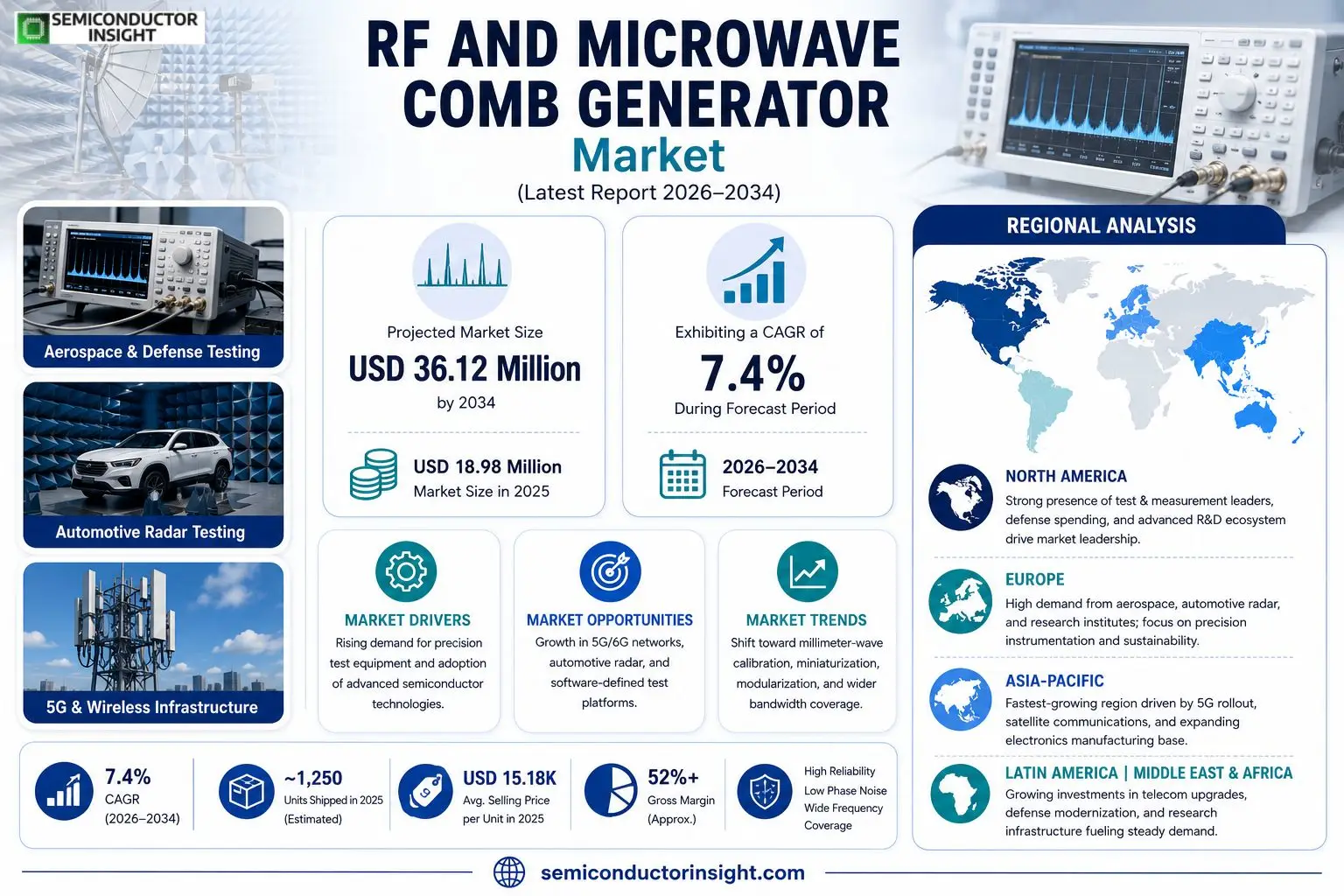
RF and Microwave Comb Generator market was valued at USD 18.98 million in 2025 and is projected to reach USD 36.12 million by 2034, reflecting an implied compound annual growth rate of roughly 7.4%.
RF and Microwave Comb Generators are standardized test‑and‑measurement instruments that generate evenly spaced multi‑tone comb spectra across radio‑frequency, microwave, and millimeter‑wave bands. Product families comprise benchtop units used for broadband phase calibration, portable EMC devices employed for site verification, and specialised modules that integrate
MARKET DRIVERS
Increasing Demand for Precision Test Equipment
RF and Microwave Comb Generator Market is being propelled by the expanding need for high‑resolution signal sources in aerospace testing and wireless infrastructure validation. Manufacturers are channeling R&D funds toward wider bandwidths and finer frequency steps, a move that mirrors the pressure from equipment integrators seeking tighter specifications.
Adoption of Advanced Semiconductor Technologies
Silicon‑based MMICs and gallium nitride (GaN) devices are entering comb generator designs, delivering higher power density and reduced thermal footprints. This technological shift allows system designers to consolidate multiple sources into a single unit, lowering overall system cost and simplifying maintenance schedules.
➤ Clients value the ability to program frequency combs remotely, which trims down calibration cycles and accelerates time‑to‑market for new wireless products.
Regulatory frameworks mandating stricter emission testing are also nudging end‑users toward more capable comb generators, reinforcing the market’s upward trajectory.
MARKET CHALLENGES
Complex Calibration Requirements
Operators must align multiple harmonics within tight tolerance bands, a process that can become labor‑intensive without automated calibration aids. This complexity discourages smaller labs from adopting top‑tier comb generators, limiting market penetration among niche players.
Other Challenges
Supply‑Chain Bottlenecks
The reliance on specialized substrates and high‑frequency components has exposed manufacturers to intermittent shortages, inflating lead times and pressuring pricing strategies.
MARKET RESTRAINTS
High Capital Expenditure
Acquiring a state‑of‑the‑art comb generator often entails a sizable upfront outlay, a factor that restrains adoption in cost‑sensitive segments such as academic research. While leasing models have emerged, they have not yet reached a scale sufficient to offset the capital barrier.
Limited Standardization
Without a universally accepted interface specification, integration across diverse test setups can demand bespoke engineering effort. This lack of standardization hampers cross‑vendor compatibility and adds an extra layer of expense for system integrators.
MARKET OPPORTUNITIES
Emergence of Software‑Defined Test Platforms
As test environments shift toward software‑defined architectures, manufacturers of RF and Microwave Comb Generator Market solutions can embed programmable firmware that interfaces directly with cloud‑based analytics. This creates a revenue stream from subscription‑based services and positions comb generators as integral components of a broader digital test ecosystem.
Expansion into 5G and Beyond
The rollout of 5G millimeter‑wave networks and early research into 6G demand comb generators capable of covering higher frequency bands with minimal phase noise. Companies that accelerate development in these spectra stand to capture a sizable share of the upcoming demand wave.
RF and Microwave Comb Generator Market Trends
Shift Toward Millimeter‑Wave Calibration
The adoption of millimeter‑wave frequencies in 5G backhaul, satellite links, and high‑resolution radar is raising calibration requirements that exceed the capabilities of legacy equipment. Vendors are therefore expanding benchtop comb‑generator families to cover the 40 GHz‑plus band, adding low‑phase‑noise oscillators and broadband amplifiers that preserve comb uniformity across wider spans. This technical shift matters because test engineers need traceable references that match the spectral density of modern transceivers; without them, measurement uncertainty can compromise system certification. The consequence for suppliers is a move toward higher‑priced, low‑volume platforms that command gross margins above 50 %, offsetting the modest shipment growth typical of this niche.
Other Trends
Supply‑Chain Considerations
Key upstream inputsprecision RF semiconductors, low‑loss microwave substrates, and calibrated clock sourcesremain sourced from a limited pool of manufacturers. Recent capacity expansions in Asia have alleviated some pressure, yet lead times for high‑frequency diodes still exceed six months. End users, especially defense labs and university test facilities, plan purchases around these cycles, leading to batch orders that align with instrument upgrades rather than steady replenishment. Consequently, manufacturers prioritize inventory of critical components and negotiate long‑term service agreements to mitigate disruption, a practice that reinforces customer loyalty but limits price competition.
Emerging Opportunities in Automotive Radar
Automotive radar systems are migrating from the traditional 77 GHz band to higher frequencies to achieve finer angular resolution and longer detection ranges. This evolution creates a demand for portable EMC comb generators capable of on‑site verification of shielding effectiveness in production lines. Because automotive OEMs operate under tight launch schedules, the ability to perform rapid, repeatable compliance checks directly on the assembly floor is becoming a decisive factor when selecting test equipment. Suppliers that integrate modular RF front‑ends with ruggedized housings stand to capture a growing share of this segment, while also benefitting from the cross‑application relevance of such tools in aerospace and industrial IoT testing.
COMPETITIVE LANDSCAPEKey Industry Players
RF and Microwave Comb Generator Market – Competitive Overview
Keysight Technologies and Rohde & Schwarz together capture the lion’s share of revenue in the high‑performance benchtop segment, where exacting phase‑calibration, millimeter‑wave bandwidth, and ultra‑low phase‑noise specifications command premium pricing. Their global engineering centres, deep ties with defence prime contractors, and comprehensive after‑sales service contracts create a high barrier to entry for challengers. Both firms have recently introduced modular comb‑generator kits that integrate crystal‑oscillator references with step‑recovery diode arrays, enabling customers to upgrade existing test stations without wholesale equipment replacement. This product‑lifecycle strategy not only sustains recurring revenue streams but also pressures smaller manufacturers to either specialise in niche frequency bands or seek strategic partnerships with instrument assemblers. The duopoly’s dominance shapes pricing dynamics, pushing marginal price erosion in standard EMC reference units while preserving healthy margins on metrology‑grade hardware.Outside the duopoly, a diverse set of niche innovators preserves market elasticity. Com‑Power Corporation and Eurofins York concentrate on portable EMC comb generators, targeting field‑verification teams that require rapid‑deployment, battery‑operated solutions for anechoic‑chamber checks and site‑level shielding assessments. European specialists such as Schwarzbeck Mess‑Elektronik and AMCAD Engineering deliver custom‑frequency modules for radar‑system validation and satellite‑communication link testing, leveraging precision‑manufacturing capabilities that meet stringent aerospace certification standards. Asian playersincluding Chengdu Hongke Electronics Technology, Talent Microwave, and Techno Science Japanexploit cost‑effective production and regional distribution networks to serve university labs, regional calibration institutes, and emerging‑market defence projects. Smaller outfits like Furaxa, Quantic PMI and RFSPACE occupy bespoke corners, offering frequency‑specific reference sources that fill gaps left by the major vendors and provide a test‑bed for experimental wave‑form techniques. Their agility to respond to short‑run orders and to co‑develop bespoke solutions with system integrators adds a layer of resilience to the overall supply chain.
List of Key RF and Microwave Comb Generator Companies Profiled
- Keysight Technologies
- Rohde & Schwarz
- Com‑Power Corporation
- Eurofins York
- Schwarzbeck Mess‑Elektronik
- AMCAD Engineering
- Furaxa
- Quantic PMI
- RFSPACE
- Techno Science Japan
- Chengdu Hongke Electronics Technology
- Talent Microwave
- Tekbox Digital Solutions
Segment Analysis:
| Segment Category | Sub-Segments | Key Insights |
| By Type |
|
Benchtop Comb Generator
|
| By Application |
|
Calibration and Metrology
|
| By End User |
|
Metrology & Calibration Institutions
|
| By Frequency Range |
|
1‑18 GHz
|
| By Comb Spacing |
|
25‑100 MHz
|
Regional Analysis: RF and Microwave Comb Generator Market
North America
Manufacturers are transitioning toward silicon‑based platforms that enable higher integration densities while preserving the low‑phase‑noise attributes essential for comb generation. This shift reduces form factor and cost, expanding the addressable market into compact test rigs and portable communication units.
Recent disruptions have driven firms to diversify sources for high‑purity substrates and precision lithography services. Strategic stockpiling and near‑shoring of critical fabs are now common practices, mitigating risk and stabilizing lead times for end‑users.
The market bifurcates between defense contractors demanding rugged, space‑qualified units and commercial players focused on cost‑efficient solutions for test and measurement. Tailoring product portfolios to these distinct value propositions enhances revenue capture across the spectrum.
Stringent electromagnetic compatibility standards in the United States and Canada compel manufacturers to incorporate advanced shielding techniques, influencing design cycles and prompting early engagement with certification bodies.
Europe
European operators leverage a strong heritage in precision instrumentation, translating into demand for RF and Microwave Comb Generators that support high‑frequency metrology and advanced research facilities. The region’s emphasis on sustainability is propelling interest in energy‑efficient designs, as laboratories seek to lower operational footprints. Collaborative programmes among the EU, national research agencies, and industry consortia are fostering co‑development of frequency‑comb technologies aimed at next‑generation telecommunications and autonomous vehicle testing. Meanwhile, regulatory alignment across member states simplifies cross‑border sales, encouraging vendors to adopt a pan‑European go‑to‑market approach.
Asia‑Pacific
Asia‑Pacific’s rapid expansion of 5G rollout and burgeoning satellite constellations fuels a growing appetite for high‑performance comb generators. Nations such as China, Japan, and South Korea are investing heavily in indigenous semiconductor capabilities, which gradually reduces reliance on imported components. The region’s diverse customer basespanning consumer electronics firms to defense ministriescreates pressure on suppliers to offer scalable solutions that can be customized for varying performance and cost thresholds. Competitive pricing pressures are prompting manufacturers to explore cost‑effective silicon‑photonic implementations without sacrificing spectral purity.
South America
In South America, market momentum is modest but accelerating, driven primarily by telecommunications upgrades and increasing research activities at regional universities. Countries like Brazil and Argentina are establishing public‑private partnerships to modernize test equipment, creating pockets of demand for reliable comb generators. Supply chain constraints often necessitate longer procurement cycles, prompting local distributors to prioritize inventory readiness. Companies that can provide robust after‑sales support and localized engineering assistance tend to secure a stronger foothold in this evolving market.
Middle East & Africa
The Middle East & Africa region presents a nuanced landscape where defense modernization programs coexist with emerging aerospace initiatives. Gulf Cooperation Council states are allocating budgets toward secure communications infrastructure, where the precision of RF and Microwave Comb Generators becomes a differentiator. In Africa, nascent research hubs are beginning to adopt advanced test equipment, albeit at a slower pace due to limited capital. Partnerships with global OEMs that include training and technology transfer are increasingly viewed as essential to unlock long‑term growth potential across these markets.
Report Scope
This market research report provides a comprehensive analysis of the RF and Microwave Comb Generator Market , covering the forecast period 2026–2034. It offers detailed insights into market dynamics, technological advancements, competitive landscape, and key trends shaping the industry.
Key focus areas of the report include:
- ✅ Market Overview: The report begins with an overview outlining its current market scenario, key growth indicators, and industry transformation drivers. It discusses macroeconomic factors, demand–supply balance, regulatory landscape, and the strategic role of semiconductors in powering advancements across industries such as automotive, telecommunications, consumer electronics, and industrial automation.
- ✅ Market Size & Forecast: Historical data and future projections for revenue, unit shipments, and market value across major regions and segments.
- ✅ Segmentation Analysis: Detailed breakdown by product type, technology, application, and end-user industry to identify high-growth segments and investment opportunities.
- ✅ Regional Insights: Insights into market performance across North America, Europe, Asia-Pacific, Latin America, and the Middle East & Africa, including country-level analysis where relevant.
- ✅ Competitive Landscape: Profiles of leading market participants, including their product offerings, R&D focus, manufacturing capacity, pricing strategies, and recent developments such as mergers, acquisitions, and partnerships.
- ✅ Technology Trends & Innovation: Assessment of emerging technologies, integration of AI/IoT, semiconductor design trends, fabrication techniques, and evolving industry standards.
- ✅ Market Drivers & Restraints: Evaluation of factors driving market growth along with challenges, supply chain constraints, regulatory issues, and market-entry barriers.
- ✅ Stakeholder Insights: Insights for component suppliers, OEMs, system integrators, investors, and policymakers regarding the evolving ecosystem and strategic opportunities.
Primary and secondary research methods are employed, including interviews with industry experts, data from verified sources, and real-time market intelligence to ensure the accuracy and reliability of the insights presented.
FREQUENTLY ASKED QUESTIONS:
What is the current market size of RF and Microwave Comb Generator Market?
-> RF and Microwave Comb Generator Market was valued at USD 18.98 million in 2025 and is expected to reach USD 31.33 million by 2032, growing at a CAGR of 7.4% during the forecast period.
Which key companies operate in RF and Microwave Comb Generator Market?
-> Key players include Keysight Technologies, Rohde & Schwarz, Com-Power Corporation, Eurofins York, Tekbox Digital Solutions, Schwarzbeck Mess-Elektronik, AMCAD Engineering, Furaxa, Quantic PMI, RFSPACE, Techno Science Japan, Chengdu Hongke Electronics Technology, Talent Microwave.
What are the key growth drivers?
-> Key growth drivers include expansion of millimeter‑wave and satellite communications, automotive radar development, broadband phased‑array antenna adoption, electronic warfare system requirements, high‑frequency semiconductor device testing, and continued investment in EMC laboratories.
Which region dominates the market?
-> Asia shows the strongest growth owing to rapid adoption of high‑frequency communication systems and robust manufacturing capabilities, while North America and Europe remain important established markets.
What are the emerging trends?
-> Emerging trends include miniaturization, modularization, wider bandwidth coverage, and higher frequency operation extending into the millimeter‑wave range.
Get Sample Report PDF for Exclusive Insights
Report Sample Includes
- Table of Contents
- List of Tables & Figures
- Charts, Research Methodology, and more...
 Download Sample Report PDF