Reflective Electronic Paper Display Market Insights
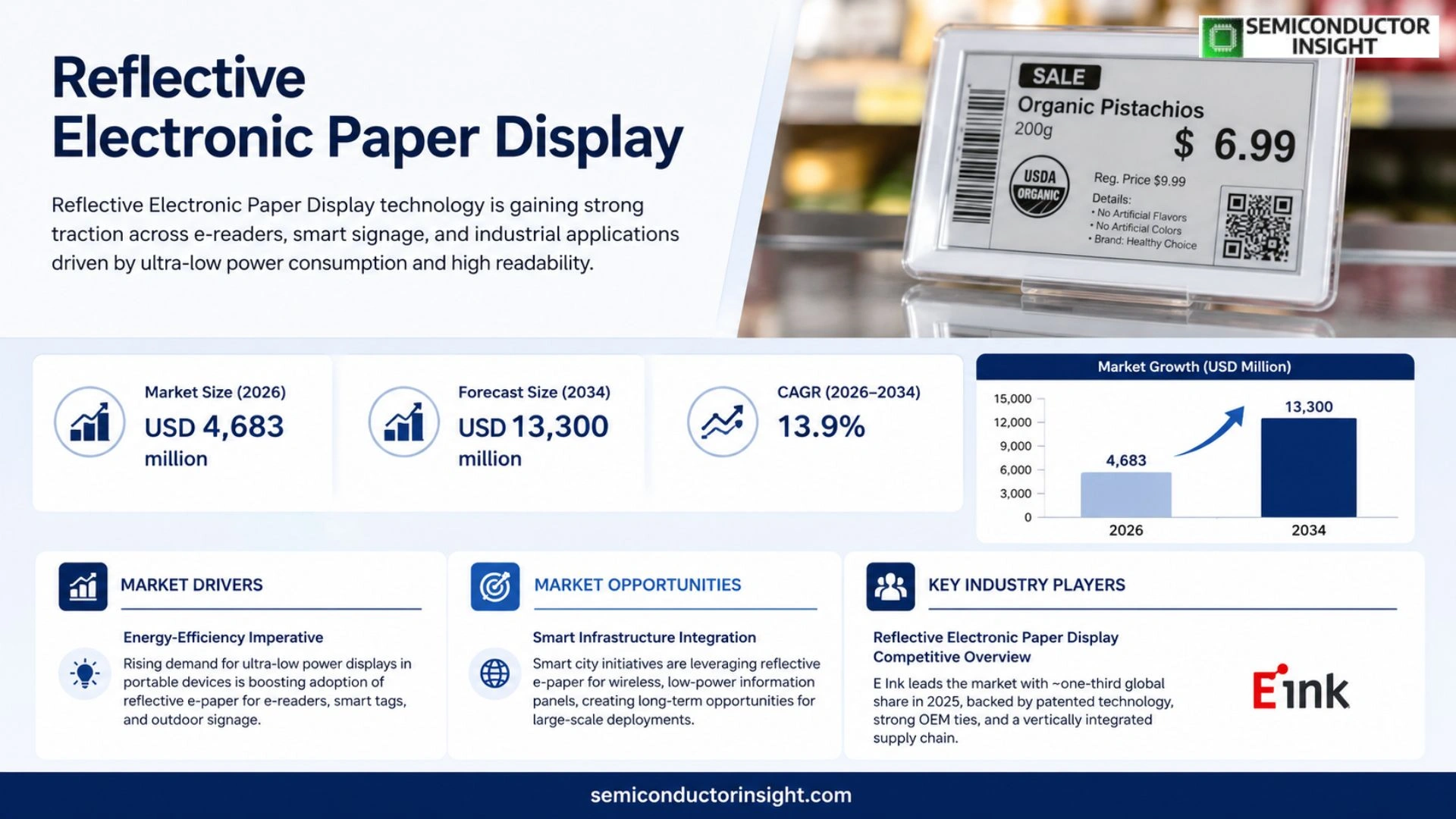
Global Reflective Electronic Paper Display market size was valued at USD 4,109 million in 2025. The market will rise from USD 4,683 million in 2026 to USD 13,300 million by 2034, showing a compounded annual growth rate of about 13.9 % over the period.
Reflective Electronic Paper Display is a reflective display technology that forms images through electrophoretic microcapsules, relying on ambient light instead of backlighting to achieve ultra‑low power consumption and paper‑like readability. Its core advantages include near‑zero static power draw, excellent sunlight visibility, wide viewing angles, and suitability for long‑duration information display where frequent refresh is not required.
MARKET DRIVERS
Energy‑Efficiency Imperative
Reflective Electronic Paper Display Market benefits from the escalating push for low‑power visual solutions in portable devices. Manufacturers increasingly favour displays that consume micro‑watts in standby, allowing battery‑operated products to prolong usage cycles without frequent recharging. This efficiency imperative translates into higher adoption rates for e‑readers, smart tags and outdoor signage that rely on ambient light.
Regulatory Momentum for Sustainable Packaging
Legislation across Europe and North America that limits disposable plastics has nudged brands toward reusable, digitally printed packaging. Reflective electronic paper offers a recyclable substrate that can be updated remotely, satisfying both compliance and brand‑experience goals. Companies that integrate this technology gain a competitive edge in markets where sustainability is a purchasing driver.
➤ “Adoption of reflective e‑paper in logistics labels is projected to cut label‑replacement costs by up to 30 % while delivering real‑time inventory visibility.”
Beyond sustainability, the technology’s high contrast under direct sunlight makes it attractive for outdoor wayfinding and public‑transport displays. Operators report lower maintenance expenses because the displays retain readability without backlighting, especially in regions with extreme temperature fluctuations.
MARKET CHALLENGES
Manufacturing Yield Constraints
Current production lines for reflective electrophoretic layers encounter yield inefficiencies tied to substrate handling and encapsulation processes. Small defect rates can inflate unit costs, limiting price competitiveness against conventional LCDs in high‑volume segments such as automotive dashboards.
Other Challenges
Supply‑Chain Volatility
Fluctuations in rare‑earth material availability, combined with geopolitical tensions, create unpredictable lead times for key components. End‑users must factor these uncertainties into product‑launch timelines, often opting for safer, established technologies.
MARKET RESTRAINTS
Limited Refresh Rates
Reflective electronic paper inherently refreshes slower than emissive displays, restricting its suitability for dynamic content such as video or rapid‑change dashboards. This technical ceiling deters sectors that demand real‑time visual updates, narrowing the addressable market.
MARKET OPPORTUNITIES
Smart Infrastructure Integration
Urban planners are piloting reflective e‑paper panels for low‑maintenance information boards within smart‑city ecosystems. The ability to wirelessly update content while consuming negligible power aligns with municipal budgets focused on long‑term operational savings. Early adopters stand to capture significant share as citywide rollouts gain momentum.
Reflective Electronic Paper Display Market Trends
Scaling Networked Deployments and Capacity Discipline
In 2025 the sector shipped roughly 750 million units at an average price of US$ 6, generating a gross margin near 30 %. The most visible shift is the migration of downstream buyers,from isolated e‑reader contracts to large‑scale electronic shelf‑label rollouts. As retailers and logistics firms integrate thousands of labels across hundreds of stores, procurement teams are bargaining on batch consistency, yield predictability, and delivery reliability rather than on incremental feature upgrades. This change forces manufacturers to tighten plant utilization, which lingered at about 59 % last year, and to hedge material cost swings for electrophoretic microcapsules and TFT substrates. Companies that can promise stable throughput while keeping unit economics in check are positioning themselves as preferred long‑term suppliers.
Other Trends
Supply‑Chain Consolidation Around Core Materials
The upstream ecosystem is narrowing around a handful of microcapsule producers,E Ink, LG Chem, and Samsung Display dominate the mix,while substrate suppliers such as BOE and Visionox battle for volume discounts. This concentration reduces price volatility for the most critical inputs, yet it also raises the strategic importance of securing multi‑source agreements. Midstream firms are responding by standardizing stack‑assembly processes and investing in automated bonding equipment, which lifts yield rates and shortens time‑to‑market for new form‑factors. The net effect is a modest uplift in effective capacity utilization, nudging the sector toward the mid‑60 % range without risking the ultra‑low power advantage that defines the Reflective Electronic Paper Display niche.
Application Diversification Beyond E‑Readers
The traditional e‑reader base still accounts for the bulk of shipments, but a growing share of orders now stems from electronic shelf labels and niche digital signage projects that value sunlight readability and near‑zero standby draw. Because these applications demand long service lives,often exceeding five years,customers stress reliability metrics and total cost of ownership over headline performance specs. As replacement cycles lengthen, revenue streams become more predictable, encouraging investors to view the market as infrastructure rather than a fad. Suppliers that align product roadmaps with these long‑duration programs, while maintaining disciplined cost structures, are likely to preserve profitability even as competitive pressure on unit pricing intensifies.
COMPETITIVE LANDSCAPE
Key Industry Players
Reflective Electronic Paper Display Competitive Overview
E Ink remains the de‑facto leader, commanding roughly one‑third of global shipments in 2025 and anchoring a vertically integrated supply chain that spans electrophoretic microcapsule chemistry, substrate fabrication, and module assembly. Its dominance stems from early patents on electrophoretic technology, a deep‑seated relationship with major e‑reader OEMs, and a production footprint that can flex between high‑volume e‑book readers and lower‑volume electronic shelf labels. The company’s ability to secure long‑term supply contracts and sustain average gross margins near 30 % reinforces its pricing power, while its strategic investments in next‑generation color E‑paper keep it ahead of incremental specification changes demanded by downstream customers.
Beyond E Ink, a constellation of manufacturers competes across distinct value‑chain niches. BOE and Tianma leverage massive TFT/ITO substrate capacity in China, offering cost‑competitive panels that appeal to large‑scale digital signage projects. LG Chem and Samsung Display supply the electrophoretic microcapsule materials, with the latter increasingly targeting premium automotive interiors. European‑origin firms such as DKE, Holitech and Varitronix specialize in niche color‑E‑paper and high‑contrast solutions for specialty wearables. Meanwhile, emerging Asian players,including Wuxi Weifeng Technology, Suzhou Qingyue Optoelectronic, Guangzhou OED Technologies, Yes Optoelectronics, SoluM, Nemoptic, ZBD Display, SiPix Imaging, AUO and HKC Display,focus on rapid prototyping, localized supply and customized integration services that attract regional e‑label integrators and niche device makers.
List of Key Reflective Electronic Paper Display Companies Profiled
- E Ink
- BOE Technology Group
- LG Chem
- Samsung Display
- DKE
- Holitech
- Wuxi Weifeng Technology
- Suzhou Qingyue Optoelectronic
- Guangzhou OED Technologies
- Yes Optoelectronics (Group)
- SoluM
- Varitronix
- Nemoptic
- ZBD Display
- SiPix Imaging
- AU Optronics (AUO)
- HKC Display
Segment Analysis:
| Segment Category | Sub-Segments | Key Insights |
| By Type |
|
Electrophoretic Display (EPD)
|
| By Application |
|
eReaders
|
| By End User |
|
Retailers
|
| By Screen Size |
|
4‑7 Inch
|
| By Color |
|
Black & White Display
|
Regional Analysis: Reflective Electronic Paper Display Market
Europe
The EU’s Ecodesign Directive incentivizes devices that minimize power draw, prompting OEMs to prioritize reflective paper displays over back‑lit alternatives. Compliance pathways are now embedded in product roadmaps, accelerating adoption across smart watches and portable GPS units.
Proximity to glass‑coating specialists and polymer manufacturers enables tighter inventory control. Collaborative R&D labs in the Benelux region shorten prototype cycles, allowing start‑ups to bring niche products to market within months rather than years.
In markets such as Germany and the UK, users value readability in direct sunlight without glare. This preference drives demand for e‑ink‑type displays in outdoor navigation tools, reinforcing the commercial case for reflective technologies.
Universities in Sweden and Finland contribute research on bistable pigments, feeding patents into the regional ecosystem. The resulting intellectual property pool equips manufacturers with a competitive edge in texture rendering and low‑latency refresh rates.
North America
The United States market demonstrates a strong appetite for reflective electronic paper displays in the logistics sector, where carriers use ultra‑thin tags to convey shipment status without compromising battery longevity. Canadian smart‑home firms are experimenting with wall‑mounted panels that combine ambient lighting with high‑contrast text, appealing to consumers seeking minimalist aesthetics. While regulatory pressure is less pronounced than in Europe, corporate sustainability goals are pushing brands toward low‑energy display solutions. The result is a diversified adoption pattern that spans consumer electronics, industrial instrumentation, and emerging retail applications.
Asia‑Pacific
In Asia‑Pacific, rapid urbanization and dense outdoor environments drive interest in displays that remain legible under intense sunlight. Mobile device manufacturers in South Korea and Japan are integrating reflective panels into rugged tablets used by field technicians, leveraging the technology’s durability. Meanwhile, Indian startups are targeting the affordable e‑learning segment, offering low‑cost readers that benefit from the battery‑saving attributes of reflective paper. The region’s expansive manufacturing base ensures component cost advantages, yet the market remains fragmented, with adoption hinging on localized partnerships and education campaigns that highlight the operational benefits of these displays.
South America
Brazilian retailers are piloting reflective electronic paper displays for dynamic shelf‑edge labeling, capitalizing on the technology’s capacity to retain clarity in bright store illumination. In Argentina, agricultural equipment firms see potential for field‑ready dashboards that function reliably in the intense sun of the Pampas. Although overall market size lags behind more mature economies, growing consumer awareness of sustainable electronics and the presence of regional distribution hubs present a fertile ground for incremental market penetration.
Middle East & Africa
The Middle East’s desert climate creates a compelling use case for displays that can operate without back‑lighting, making reflective electronic paper panels attractive for outdoor signage and handheld navigation devices used by oil‑field workers. In Africa, NGOs are exploring low‑maintenance information kiosks powered by solar energy, where the display’s minimal power draw aligns with off‑grid deployment constraints. While infrastructure challenges temper rapid scaling, targeted projects that showcase durability and energy efficiency are laying the groundwork for broader commercial acceptance in the coming years.
Report Scope
This market research report provides a comprehensive analysis of the Reflective Electronic Paper Display Market , covering the forecast period 2026–2034. It offers detailed insights into market dynamics, technological advancements, competitive landscape, and key trends shaping the industry.
Key focus areas of the report include:
- Market Overview: The report begins with an overview outlining its current market scenario, key growth indicators, and industry transformation drivers. It discusses macroeconomic factors, demand–supply balance, regulatory landscape, and the strategic role of semiconductors in powering advancements across industries such as automotive, telecommunications, consumer electronics, and industrial automation.
- Market Size & Forecast: Historical data and future projections for revenue, unit shipments, and market value across major regions and segments.
- Segmentation Analysis: Detailed breakdown by product type, technology, application, and end-user industry to identify high-growth segments and investment opportunities.
- Regional Insights: Insights into market performance across North America, Europe, Asia-Pacific, Latin America, and the Middle East & Africa, including country-level analysis where relevant.
- Competitive Landscape: Profiles of leading market participants, including their product offerings, R&D focus, manufacturing capacity, pricing strategies, and recent developments such as mergers, acquisitions, and partnerships.
- Technology Trends & Innovation: Assessment of emerging technologies, integration of AI/IoT, semiconductor design trends, fabrication techniques, and evolving industry standards.
- Market Drivers & Restraints: Evaluation of factors driving market growth along with challenges, supply chain constraints, regulatory issues, and market-entry barriers.
- Stakeholder Insights: Insights for component suppliers, OEMs, system integrators, investors, and policymakers regarding the evolving ecosystem and strategic opportunities.
Primary and secondary research methods are employed, including interviews with industry experts, data from verified sources, and real-time market intelligence to ensure the accuracy and reliability of the insights presented.
FREQUENTLY ASKED QUESTIONS:
What is the current market size of Reflective Electronic Paper Display Market?
-> Global Reflective Electronic Paper Display market will rise from USD 4,683 million in 2026 to USD 13,300 million by 2034
Which key companies operate in Reflective Electronic Paper Display Market?
-> Key players include E Ink, LG Chem, Samsung Display, BOE, Tianma Microelectronics, Visionox, among others.
What are the key growth drivers?
-> Key growth drivers include ultra‑low power consumption, excellent sunlight visibility, long service life, and expanding deployments in e‑readers and electronic shelf labels.
Which region dominates the market?
-> Asia holds the largest market share, while Europe remains a significant region.
What are the emerging trends?
-> Emerging trends include networked large‑scale deployments, emphasis on yield stability across batches, and cost‑discipline in manufacturing to sustain margins.

Get Sample Report PDF for Exclusive Insights
Report Sample Includes
- Table of Contents
- List of Tables & Figures
- Charts, Research Methodology, and more...
 Download Sample Report PDF