Reed Switch Sensor Market Insights
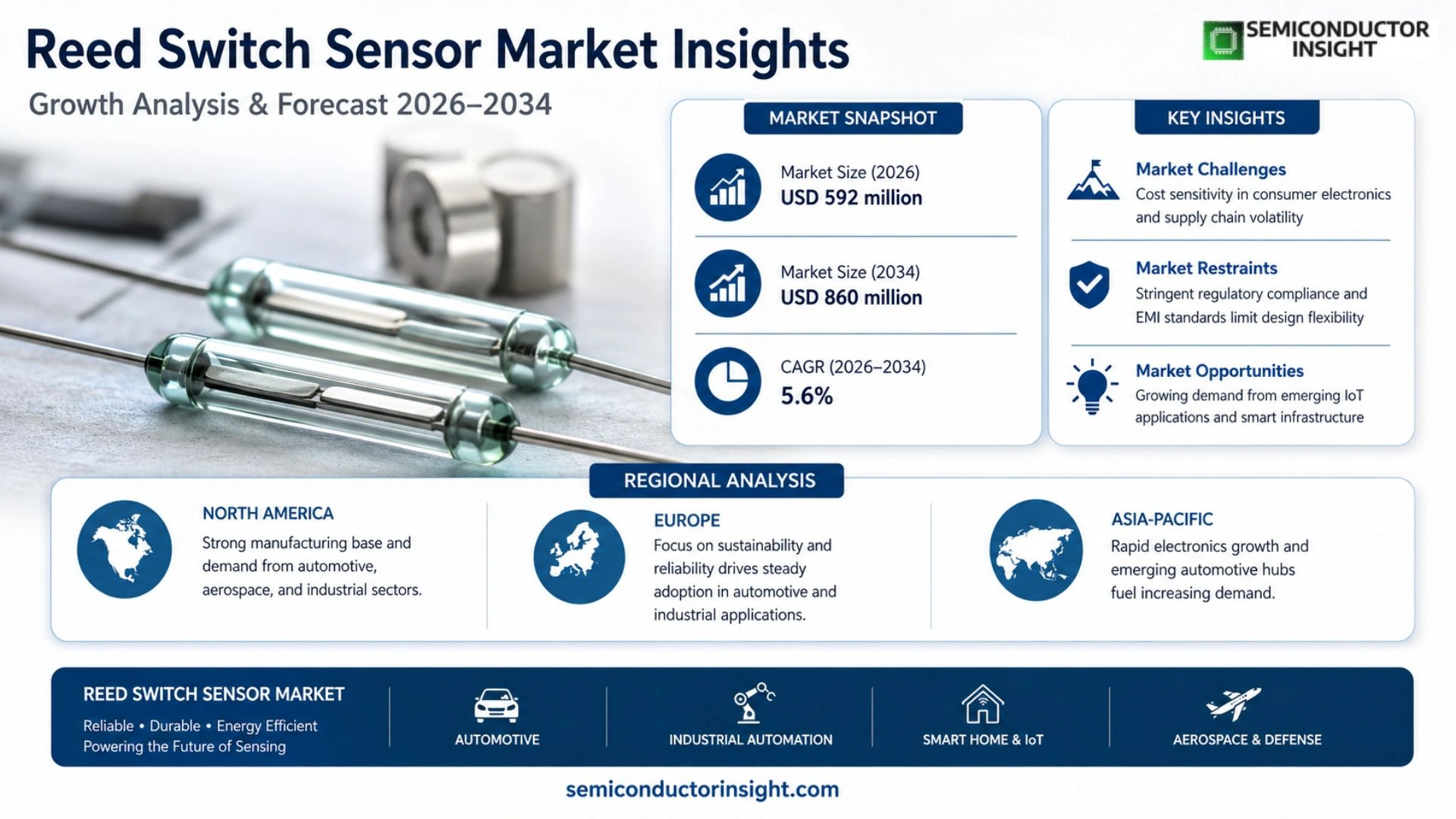
Reed Switch Sensor market size was valued at USD 592 million in 2026. The market is projected to reach USD 860 million by 2034, exhibiting a CAGR of 5.6% during the forecast period.
A reed switch is an electromagnetic switch that controls electrical flow within a circuit. It consists of two or more ferrous reeds sealed inside a glass tube; when an external magnetic field approaches, the reeds magnetise and either make contact or separate.
Adoption accelerates in IoT devices where sensors detect motion or position, while miniaturisation enables integration into wearables and medical equipment. Manufacturers are also offering customised sensitivity and form‑factor options, and many units now embed wireless modules or micro‑controllers for remote monitoring. Automotive applications such as seat‑belt detection and EV‑charging safety continue to drive demand.
MARKET DRIVERS
Industrial Automation Adoption
The surge in factory‑floor digitisation is prompting equipment designers to favour components that combine durability with low power draw. Reed Switch Sensor Market participants are benefiting from the shift toward modular control panels, where the hermetic sealing of reed switches mitigates downtime caused by dust ingress.
Automotive Safety Systems
Modern vehicle architectures rely heavily on position‑sensing functions for seat‑belt pretensioners and air‑bag deployment. The intrinsic fail‑safe nature of magnetic actuation makes reed switches a preferred choice, compelling manufacturers to allocate larger bill‑of‑materials shares to these devices.
➤ “When a sensor can operate for decades without recalibration, OEMs view it as a strategic cost‑avoidance tool.”
Beyond hardware, the ongoing push for energy‑efficient designs amplifies demand for passive sensing solutions. Companies that can bundle reed‑based modules with smart‑gateway firmware are positioning themselves to capture premium pricing within Reed Switch Sensor market.
MARKET CHALLENGES
Cost Sensitivity in Consumer Electronics
Low‑margin product lines such as wearables and portable audio devices pressure suppliers to trim unit costs. While reed switches are inexpensive per piece, the ancillary expenses of magnetic shielding and PCB redesign can erode price advantages, forcing vendors to justify value through reliability metrics.
Other Challenges
Supply Chain Volatility
Fluctuations in glass‑tube and rare‑earth magnet availability have introduced lead‑time extensions. Manufacturers that lack diversified sourcing face the risk of delayed product launches, a factor that weighs heavily on strategic planning for Reed Switch Sensor market.
MARKET RESTRAINTS
Regulatory Compliance Limits
Stringent safety certifications for aerospace and medical devices demand exhaustive testing cycles. The added engineering effort and documentation required to certify reed‑based assemblies prolongs time‑to‑market, discouraging smaller firms from entering niche segments of Reed Switch Sensor market.
Furthermore, emerging electromagnetic‑interference (EMI) standards in high‑frequency environments constrain the permissible magnetic field strengths, limiting design flexibility and prompting some designers to substitute alternative sensing technologies.
These regulatory hurdles collectively restrain market breadth, especially for applications where certification costs outweigh the long‑term reliability benefits offered by reed switches.
MARKET OPPORTUNITIES
Emerging IoT Applications
Smart‑city infrastructure,including waste‑collection bins and street‑light controllers,requires sensors that can survive outdoor exposure while consuming negligible power. Reed switches, with their inherent isolation from harsh weather, align perfectly with these low‑energy IoT nodes, opening a growth corridor for Reed Switch Sensor market.
Parallel developments in wireless mesh networking enable distributed reed‑based sensors to report status without frequent battery replacements, a proposition that appeals to municipalities seeking to reduce operational expenditures.
Companies that bundle edge‑computing capabilities with reed‑switch modules stand to capture a differentiated share of this emerging segment, positioning themselves ahead of competitors still focused on traditional, siloed designs.
Reed Switch Sensor Market Trends
IoT Integration Accelerates Adoption
The surge in connected devices has turned reed switch sensors into a discreet yet indispensable component of many IoT solutions. Their inherent ability to detect magnetic proximity with virtually no power draw makes them ideal for battery‑operated smart‑home locks, occupancy sensors, and industrial safety interlocks. As manufacturers embed these sensors directly into circuit boards, system designers gain a reliable, low‑cost method to capture state changes without adding complex electronics. This shift not only shortens development cycles but also opens revenue streams for suppliers that can certify their parts for widely adopted IoT communication standards.
Other Trends
Miniaturization Fuels New Applications
Demand for slimmer wearables, compact medical monitors, and ultra‑thin smartphones has forced sensor makers to shrink the glass envelope and refine reed geometry. Today’s designs fit within a few millimetres, yet they retain the same switching reliability as their larger ancestors. The practical outcome is a broader placement window: devices that previously could not accommodate a mechanical switch now benefit from its immunity to electromagnetic interference and its seamless integration with magnetic actuators. Companies that master precision glass sealing and high‑density coil winding are positioning themselves as preferred partners for OEMs racing to differentiate on form factor.
Customization and Smart Integration
Beyond size, the market is moving toward application‑specific configurations. Buyers are asking for tailored contact materials to survive harsh chemicals, adjusted magnetic sensitivities for niche detection thresholds, and built‑in logic such as debounce circuits or wireless telemetry modules. When a reed switch is combined with a microcontroller or PLC, the resulting smart sensor can report status over Bluetooth or LoRa, enabling real‑time analytics without additional wiring. This convergence reduces the total bill of materials and shortens the time to market for automated factories, electric‑vehicle charging stations, and safety‑critical automotive subsystems. Vendors that offer modular platforms,allowing customers to select the exact feature set,gain a competitive edge by avoiding one‑size‑fits‑all solutions.
COMPETITIVE LANDSCAPE
Key Industry Players
Reed Switch Sensor Market Competitive Overview
OKI remains the market anchor, leveraging a vertically integrated supply chain that spans glass tube fabrication to final sensor assembly. Its extensive OEM network across automotive, consumer‑electronics, and industrial IoT segments secures a steady flow of high‑volume contracts. By aligning product development with the precise needs of electric‑vehicle charging stations and smart‑home actuators, OKI has cultivated a revenue share that eclipses that of many peers. The broader market exhibits a modest concentration, with the top three manufacturers accounting for roughly 40 % of global sales, while the remaining space is populated by highly specialized firms that compete on customization, niche compliance, or cost advantage. Recent strategic moves,such as OKI’s acquisition of a micro‑contact specialist in Europe,have reinforced its ability to deliver application‑specific solutions and to respond swiftly to evolving electrical safety standards.
Beyond the leader, a cluster of mid‑size players shapes the competitive fabric. Littelfuse focuses on safety‑critical applications, embedding reed switches within circuit‑protection modules that cater to automotive seat‑belt and door‑position systems. Standex‑Meder distinguishes itself through bespoke magnetic‑material engineering, enabling customers to specify sensitivity curves for wearables and medical devices. HSI Sensing’s R&D pipeline targets ultra‑miniature form factors, a response to the ongoing push for compact IoT nodes. Coto Technology anchors its market share in East Asia, where it supplies high‑volume glass‑encapsulated reeds to local smartphone manufacturers. PIT‑RADWAR leverages defense contracts to diversify its revenue base, while PIC introduces programmable logic layers that add diagnostic capability to traditional reed switches. European‑focused STG provides certified components for rail‑transport signalling, and Harbin Electric Group supplies bulk‑grade sensors for large‑scale automotive assembly lines. Zhejiang Xurui Company competes on cost, capturing price‑sensitive segments in South‑East Asia. Aleph America Corporation and Nippon Aleph occupy niche positions in high‑frequency magnetic environments, and RMCIP distinguishes itself through proprietary magnetic alloy formulations that enhance durability under extreme temperature swings.
List of Key Reed Switch Sensor Companies Profiled
- OKI
- Littelfuse
- Standex-Meder
- HSI Sensing
- Coto Technology
- PIT‑RADWAR
- PIC
- STG
- Harbin Electric Group
- Zhejiang Xurui Company
- Aleph America Corporation
- Nippon Aleph
- RMCIP
Segment Analysis:
| Segment Category | Sub-Segments | Key Insights |
| By Type |
|
Glass‑enclosed reed switches
|
| By Application |
|
IoT devices
|
| By End User |
|
Vehicle manufacturers
|
| By Integration Capability |
|
Wireless‑enabled reed modules
|
| By Emerging Use Cases |
|
Medical device actuation
|
Regional Analysis: Reed Switch Sensor Market
North America
Vehicle manufacturers rely on reed switches for oil‑level monitoring, door‑latch feedback, and climate‑control actuators. The mechanical simplicity of the devices provides a deterministic response that electronic alternatives struggle to match, especially in extreme temperature environments. Consequently, OEMs continue to specify these components in safety‑critical circuits, reinforcing the region’s demand base.
Factories integrating predictive‑maintenance platforms favour reed switches for position sensing on pneumatic valves and limit switches. The low power draw and long‑term stability of the sensors align with the high‑uptime mandates of North American plants, prompting steady procurement cycles.
In aircraft, reed switches secure cabin‑pressure monitoring and landing‑gear status. The aerospace sector values components that can endure vibration and radiation while delivering a binary output, a niche that reinforces regional supplier relevance.
Portable devices and smart home products incorporate reed switches for lid‑open detection and magnetic safety interlocks. The trend toward thinner enclosures drives manufacturers to adopt compact, hermetically sealed variants that preserve performance.
Europe
European adopters emphasize sustainability standards, prompting manufacturers to highlight the low‑energy profile of reed switches. The automotive sector, especially in Germany and France, integrates these sensors in emission‑control systems where reliability directly influences compliance. Meanwhile, industrial players in the United Kingdom and Scandinavia favour the device’s long service life to lower total‑cost‑of‑ownership calculations, reinforcing a modest yet steady growth trajectory.
Asia‑Pacific
Rapid product cycles in China, South Korea, and Taiwan generate a sizeable need for compact, cost‑effective sensors. Electronics assemblers exploit the ease of integration offered by reed switches to meet aggressive time‑to‑market targets. Concurrently, emerging automotive hubs in India and Vietnam are beginning to standardise on these components for safety‑critical functions, suggesting a nascent but expanding market footprint.
South America
In Brazil and Argentina, manufacturers focus on rugged designs that can tolerate high humidity and temperature swings. The agricultural equipment sector, a major driver in the region, uses reed switches for soil‑moisture and hydraulic‑system monitoring. Local firms are increasingly sourcing domestically to reduce lead times, although imported components still dominate high‑spec applications.
Middle East & Africa
The Middle East’s oil‑and‑gas infrastructure leans on reed switches for pressure‑sensing and emergency‑shutdown mechanisms, where failure tolerance is paramount. In North Africa, expanding renewable‑energy projects introduce demand for reliable position sensors in wind‑turbine pitch control systems. The overall market remains niche, yet strategic projects continue to validate the technology’s relevance.
Report Scope
This market research report provides a comprehensive analysis of the Reed Switch Sensor Market , covering the forecast period 2026–2034. It offers detailed insights into market dynamics, technological advancements, competitive landscape, and key trends shaping the industry.
Key focus areas of the report include:
- Market Overview: The report begins with an overview outlining its current market scenario, key growth indicators, and industry transformation drivers. It discusses macroeconomic factors, demand–supply balance, regulatory landscape, and the strategic role of semiconductors in powering advancements across industries such as automotive, telecommunications, consumer electronics, and industrial automation.
- Market Size & Forecast: Historical data and future projections for revenue, unit shipments, and market value across major regions and segments.
- Segmentation Analysis: Detailed breakdown by product type, technology, application, and end-user industry to identify high-growth segments and investment opportunities.
- Regional Insights: Insights into market performance across North America, Europe, Asia-Pacific, Latin America, and the Middle East & Africa, including country-level analysis where relevant.
- Competitive Landscape: Profiles of leading market participants, including their product offerings, R&D focus, manufacturing capacity, pricing strategies, and recent developments such as mergers, acquisitions, and partnerships.
- Technology Trends & Innovation: Assessment of emerging technologies, integration of AI/IoT, semiconductor design trends, fabrication techniques, and evolving industry standards.
- Market Drivers & Restraints: Evaluation of factors driving market growth along with challenges, supply chain constraints, regulatory issues, and market-entry barriers.
- Stakeholder Insights: Insights for component suppliers, OEMs, system integrators, investors, and policymakers regarding the evolving ecosystem and strategic opportunities.
Primary and secondary research methods are employed, including interviews with industry experts, data from verified sources, and real-time market intelligence to ensure the accuracy and reliability of the insights presented.
FREQUENTLY ASKED QUESTIONS:
What is the current market size of Reed Switch Sensor Market?
-> Reed Switch Sensor market is projected to reach USD 860 million by 2034, exhibiting a CAGR of 5.6% during the forecast period.
Which key companies operate in Reed Switch Sensor Market?
-> Key players include OKI, Littelfuse (Hamlin), RMCIP, Standex-Meder, Nippon Aleph, HSI Sensing, Coto, PIT‑RADWAR, PIC, STG, Harbin Electric Group, Zhejiang Xurui Company, Aleph America Corporation, Coto Technology.
What are the key growth drivers?
-> Key growth drivers include increasing adoption in IoT applications, miniaturization of sensors, development of customized and application‑specific sensors, integration with advanced technologies such as PLCs and wireless modules, and rising demand in automotive and electric‑vehicle charging systems.
Which region dominates the market?
-> Asia holds the largest share of Reed Switch Sensor market, driven by strong manufacturing bases and rapid growth in automotive and consumer electronics sectors, while North America and Europe also demonstrate significant adoption.
What are the emerging trends?
-> Emerging trends include greater IoT connectivity, further sensor miniaturization for wearables and medical devices, advanced customization for specific industry needs, and integration with AI‑enabled analytics for smarter control systems.
Get Sample Report PDF for Exclusive Insights
Report Sample Includes
- Table of Contents
- List of Tables & Figures
- Charts, Research Methodology, and more...
 Download Sample Report PDF