Radiation Hardened (Rad-Hard) Memory for Space Market Insights
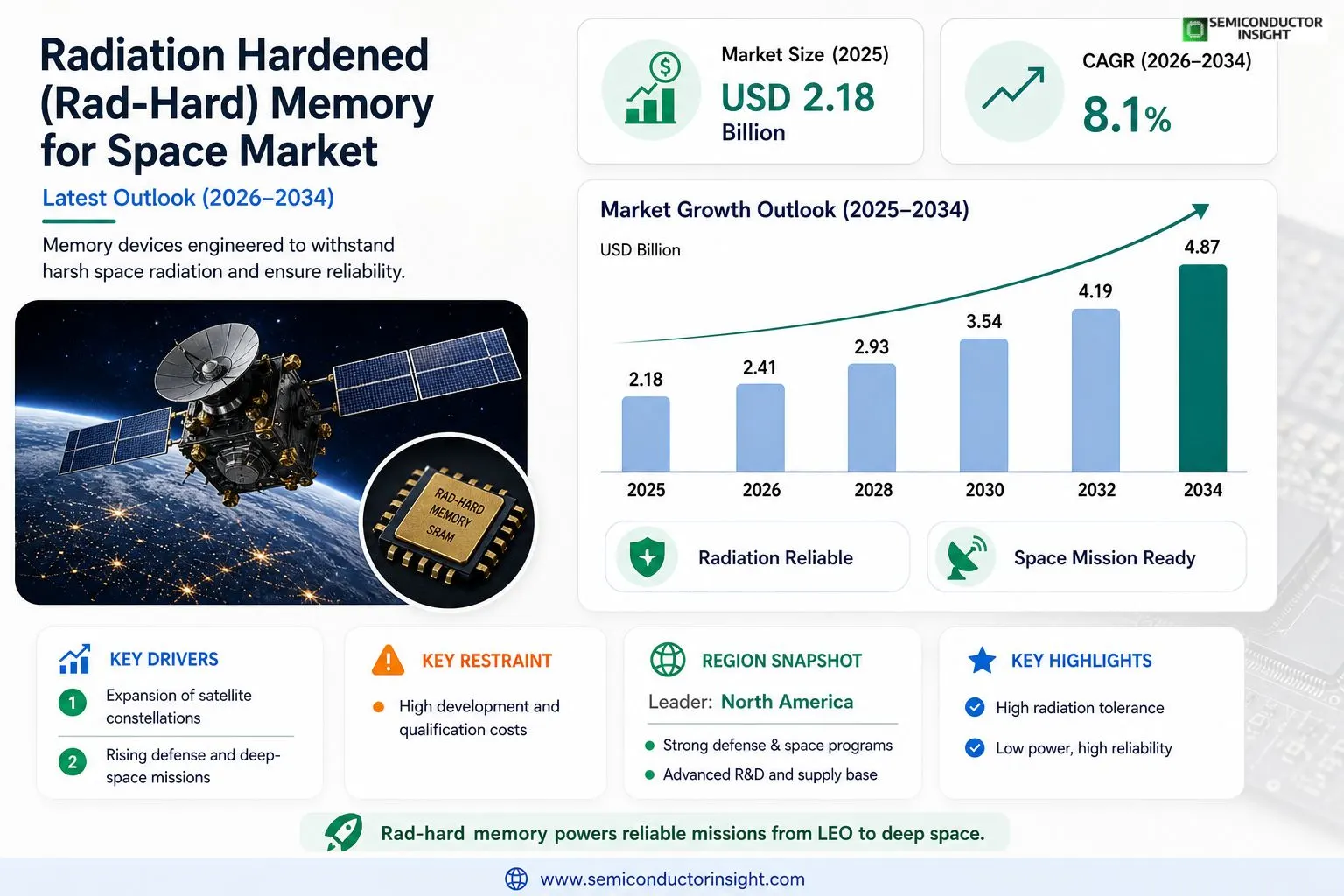
Global Radiation Hardened (Rad-Hard) Memory for Space Market size was valued at USD 2.18 billion in 2025. The market is projected to grow from USD 2.41 billion in 2026 to USD 4.87 billion by 2034, exhibiting a CAGR of 8.1% during the forecast period.
Radiation hardened memory refers to semiconductor memory devices specifically engineered to withstand the harsh radiation environments encountered in space, including exposure to cosmic rays, solar particle events, and trapped radiation belts. These memory solutions encompass a broad range of technologies, including SRAM (Static Random-Access Memory), DRAM (Dynamic Random-Access Memory), Flash memory, and EEPROM, all designed with specialized manufacturing processes and hardening techniques , such as Silicon-on-Insulator (SOI) technology and redundant circuit architectures , to prevent single-event upsets (SEUs), total ionizing dose (TID) effects, and other radiation-induced failures.
The market is experiencing robust growth driven by the rapid expansion of satellite constellations, increasing defense space programs, and the growing commercialization of low Earth orbit (LEO) missions. Furthermore, rising government investments in deep-space exploration initiatives , including NASA’s Artemis program and various international lunar and Mars missions , are significantly amplifying demand for reliable rad-hard memory solutions. Key players operating in this market with comprehensive product portfolios include Honeywell International Inc., BAE Systems plc, Microchip Technology Inc., Renesas Electronics Corporation, and STMicroelectronics N.V.
MARKET DRIVERS
Surging Demand from Commercial and Government Space Programs
Global space industry has entered an era of unprecedented expansion, with both government agencies and commercial entities significantly increasing their launch cadences and satellite deployments. This acceleration has directly propelled demand for radiation hardened memory solutions capable of surviving the harsh conditions of low Earth orbit (LEO), medium Earth orbit (MEO), and deep space environments. Programs including next-generation military communications satellites, earth observation constellations, and interplanetary exploration missions require reliable, rad-hard memory components that can withstand total ionizing dose (TID) and single-event effects (SEE) without data corruption or system failure.
Growing LEO Mega-Constellation Deployments Driving Volume Demand
The proliferation of large-scale LEO satellite constellations for broadband connectivity and IoT applications has created substantial volume demand for radiation tolerant and radiation hardened memory devices. Operators deploying hundreds to thousands of satellites require cost-effective yet reliable memory solutions that can sustain performance over multi-year mission lifespans in radiation-rich environments. This trend has incentivized semiconductor manufacturers to develop scalable, higher-density rad-hard SRAM, Flash, and DRAM products tailored specifically for space-grade applications, further stimulating Radiation Hardened Memory For Space Market.
➤ The convergence of national space agency modernization programs, commercial satellite broadband initiatives, and defense-oriented space situational awareness missions is collectively reinforcing sustained investment in radiation hardened memory technologies, establishing a robust and multi-layered demand foundation for the foreseeable future.
Defense and intelligence agencies worldwide are upgrading satellite-based communication, navigation, and reconnaissance infrastructure, mandating the use of MIL-SPEC and space-qualified memory components with verified radiation hardness assurance (RHA). This regulatory and procurement-driven demand, combined with expanding civil space exploration budgets, constitutes a strong and durable driver for the broader radiation hardened memory for space market.
MARKET CHALLENGES
High Development and Qualification Costs Limiting Market Accessibility
One of the most significant challenges facing Radiation Hardened Memory For Space Market is the exceptionally high cost associated with designing, fabricating, and qualifying rad-hard memory components to the standards required by space missions. Achieving radiation hardness by design (RHBD) or radiation hardness by process (RHBP) requires specialized semiconductor fabrication processes, extensive radiation testing in particle accelerator or nuclear reactor environments, and rigorous qualification campaigns aligned with standards such as MIL-STD-883 and JEDEC JESD57. These requirements substantially increase unit costs compared to commercial off-the-shelf (COTS) alternatives, creating financial barriers particularly for emerging small satellite operators and academic research missions with constrained budgets.
Other Challenges
Technology Obsolescence and Long Qualification Lifecycles
The semiconductor industry evolves rapidly, but space-qualified memory components operate on extended qualification and supply lifecycles that can span a decade or more. By the time a rad-hard memory device completes full space qualification, the underlying semiconductor node may already be considered legacy technology. This misalignment between commercial semiconductor advancement and the rigid requirements of space qualification creates persistent challenges in keeping radiation hardened memory solutions technologically competitive with COTS counterparts in terms of density, speed, and power efficiency.
Limited Supplier Base and Supply Chain Concentration Risk
Global supply chain for radiation hardened memory for space applications remains highly concentrated among a small number of qualified manufacturers. This limited supplier ecosystem introduces risks related to production capacity constraints, single-source dependencies, and potential disruptions from geopolitical factors or export control regulations such as ITAR. Satellite integrators and defense prime contractors must navigate these supply chain complexities carefully to ensure component availability aligned with program schedules.
MARKET RESTRAINTS
Stringent Export Control Regulations Constraining Global Market Expansion
Radiation Hardened Memory For Space Market operates under a complex and restrictive international trade regulatory environment. In the United States, rad-hard memory components are frequently classified under the International Traffic in Arms Regulations (ITAR) or the Export Administration Regulations (EAR), which impose significant licensing requirements on the export of these technologies to foreign entities. These regulatory constraints limit the ability of leading U.S.-based manufacturers to freely serve international customers, thereby restricting global market reach and creating competitive advantages for manufacturers in jurisdictions with comparatively lighter export control frameworks, such as certain European and Asian suppliers.
Performance Gap Between Rad-Hard and Commercial Memory Technologies
A persistent restraint within Radiation Hardened Memory For Space Market is the performance disparity between space-qualified rad-hard memory devices and state-of-the-art commercial memory technologies. Commercial DRAM and NAND Flash memory continue to advance rapidly in terms of storage density, access speeds, and power consumption through sub-10nm process nodes and advanced 3D stacking architectures. In contrast, radiation hardened memory products are typically manufactured on more mature, larger process nodes to achieve the necessary radiation tolerance characteristics, resulting in lower densities and higher power consumption relative to COTS equivalents. This performance gap can constrain the capabilities of space-based computing systems and acts as a restraint on the broader adoption of high-performance space electronics architectures.
MARKET OPPORTUNITIES
Advancement of New Space and SmallSat Missions Creating Cost-Optimized Product Opportunities
The rapid growth of the New Space economy, characterized by the proliferation of small satellites, CubeSats, and nanosatellites for commercial, scientific, and governmental applications, presents a significant opportunity for manufacturers within Radiation Hardened Memory For Space Market. This segment demands rad-tolerant and rad-hard memory solutions that balance radiation performance with reduced cost and smaller form factors compared to traditional large spacecraft components. Semiconductor companies that can successfully develop and commercialize cost-optimized, compact radiation hardened memory products specifically targeting the small satellite segment stand to capture meaningful market share as constellation deployment volumes continue to scale.
Deep Space Exploration and Lunar Economy Programs Unlocking High-Value Application Segments
Renewed global interest in lunar exploration, Mars missions, and deep space science programs represents a high-value opportunity for suppliers in Radiation Hardened Memory For Space Market. Deep space environments expose onboard electronics to significantly higher radiation fluxes, galactic cosmic rays, and solar particle events compared to LEO operations, necessitating the most robust levels of radiation hardness assurance in memory components. Programs such as NASA’s Artemis lunar initiative, ESA’s lunar gateway contributions, and commercial lunar payload service (CLPS) missions are generating demand for next-generation rad-hard SRAM, NOR Flash, and emerging non-volatile memory technologies qualified for extreme radiation and thermal environments, offering premium pricing and long-term procurement opportunities for qualified suppliers.
Emerging Non-Volatile Memory Technologies Offering Next-Generation Product Development Pathways
The development and space qualification of emerging non-volatile memory technologies , including magnetoresistive RAM (MRAM), ferroelectric RAM (FeRAM), and phase-change memory (PCM) , represents a compelling opportunity within Radiation Hardened Memory For Space Market. These technologies offer inherent radiation tolerance characteristics, non-volatility, high endurance, and competitive access speeds, positioning them as strong candidates to supplement or replace legacy rad-hard Flash and SRAM solutions in future spacecraft designs. Companies investing in the space qualification of these advanced memory technologies are well-positioned to address the evolving requirements of next-generation satellite buses, deep space probes, and advanced defense space platforms, potentially reshaping the competitive landscape of the market over the coming decade.
Trends
Surge in Satellite Constellation Deployments Driving Rad-Hard Memory Demand
The Radiation Hardened (Rad-Hard) Memory for Space Market is witnessing a significant upswing, primarily fueled by the rapid expansion of satellite constellation programs across both commercial and government sectors. As operators deploy large clusters of low Earth orbit (LEO) satellites for communications, Earth observation, and navigation, the demand for reliable radiation hardened memory solutions has intensified considerably. These satellites operate in environments exposed to cosmic rays, solar particle events, and trapped radiation belts, necessitating memory devices engineered specifically to withstand such conditions. Technologies including SRAM, Flash memory, DRAM, and EEPROM , hardened through advanced processes such as Silicon-on-Insulator (SOI) architecture and redundant circuit design , are increasingly becoming mission-critical components in modern spacecraft systems. The growing volume of LEO satellite launches is, therefore, a primary trend reshaping the competitive and technological landscape of the rad-hard memory industry.
Other Trends
Deep-Space Exploration Programs Amplifying Technology Requirements
Rising government investments in deep-space exploration are emerging as a defining trend in the Radiation Hardened (Rad-Hard) Memory for Space Market. Initiatives such as NASA’s Artemis lunar program and various international missions targeting the Moon and Mars are creating sustained demand for advanced rad-hard memory components capable of operating reliably in extreme radiation environments far beyond Earth’s magnetosphere. These missions require memory solutions that can withstand significantly higher total ionizing dose (TID) levels and single-event upsets (SEUs) compared to standard Earth-orbit applications, pushing manufacturers to develop next-generation hardening techniques and higher-density memory architectures tailored for deep-space use cases.
Defense Sector Investments Reinforcing Market Expansion
Increasing defense space programs globally are contributing substantially to the growth trajectory of the radiation hardened memory market. Military satellites used for reconnaissance, secure communications, and early-warning systems demand memory devices with stringent reliability standards. Defense agencies across North America, Europe, and Asia-Pacific are allocating higher budgets toward space-based assets, directly benefiting suppliers of rad-hard memory. Leading market participants including Honeywell International Inc., BAE Systems plc, Microchip Technology Inc., Renesas Electronics Corporation, and STMicroelectronics N.V. maintain comprehensive product portfolios addressing both civil and defense space program requirements.
Commercialization of Space Accelerating Adoption of Advanced Memory Technologies
The broader commercialization of space activities represents another influential trend shaping the Radiation Hardened (Rad-Hard) Memory for Space Market. Private sector participation in satellite broadband, space tourism infrastructure, and on-orbit servicing missions is expanding the addressable customer base for rad-hard memory suppliers. As commercial operators increasingly prioritize performance, miniaturization, and cost-efficiency alongside radiation tolerance, manufacturers are innovating to deliver higher-density, lower-power memory solutions without compromising hardening effectiveness. This convergence of commercial demand with technical advancement is expected to continue driving the evolution of radiation hardened memory technologies across the forecast period.
COMPETITIVE LANDSCAPE
Key Industry Players
Radiation Hardened (Rad-Hard) Memory for Space Market: Competitive Dynamics and Leading Manufacturers
Global Radiation Hardened (Rad-Hard) Memory for Space Market is characterized by the presence of a select group of technologically advanced and highly specialized manufacturers that collectively define the competitive landscape. Honeywell International Inc. stands out as a prominent force in this space, leveraging decades of aerospace expertise and a robust portfolio of radiation-hardened memory components engineered for military satellites, deep-space probes, and commercial LEO constellations. BAE Systems plc and Microchip Technology Inc. also command significant market positions, offering a broad range of rad-hard SRAM, Flash, and EEPROM solutions that comply with stringent MIL-SPEC and ESA standards. Renesas Electronics Corporation and STMicroelectronics N.V. further reinforce their standing through continuous R&D investments in Silicon-on-Insulator (SOI) technology and advanced hardening-by-design (HBD) methodologies, enabling their products to withstand total ionizing dose (TID) effects and single-event upsets (SEUs) across geostationary, medium Earth orbit, and interplanetary mission profiles.
Beyond the tier-one leaders, several niche yet strategically significant players contribute to the competitiveness of the rad-hard memory market. Cobham Advanced Electronic Solutions (CAES) and Vorago Technologies are recognized for their deep specialization in radiation-tolerant and radiation-hardened embedded memory architectures tailored to CubeSats and small satellite platforms. Maxwell Technologies, a subsidiary of TD SYNNEX, maintains a strong presence through its heritage radiation-hardened product lines. Meanwhile, Cypress Semiconductor (now part of Infineon Technologies) and Integrated Device Technology (IDT, acquired by Renesas) have expanded the accessible memory bandwidth for space-grade applications. Emerging players such as Everspin Technologies, with its MRAM-based solutions, are gaining traction as next-generation alternatives offering inherent radiation resilience and non-volatility, further intensifying competition and innovation across the sector.
List of Key Radiation Hardened (Rad-Hard) Memory for Space Companies Profiled
- Honeywell International Inc.
- BAE Systems plc
- Microchip Technology Inc.
- Renesas Electronics Corporation
- STMicroelectronics N.V.
- Cobham Advanced Electronic Solutions (CAES)
- Vorago Technologies
- Maxwell Technologies (TD SYNNEX)
- Infineon Technologies AG (Cypress Semiconductor)
- Integrated Device Technology, Inc. (IDT)
- Everspin Technologies, Inc.
- Solid State Devices, Inc. (SSDI)
- Microsemi Corporation (Microchip Technology)
- Data Device Corporation (DDC)
- Texas Instruments Incorporated
Segment Analysis:
| Segment Category | Sub-Segments | Key Insights |
| By Type |
|
SRAM (Static Random-Access Memory) holds the leading position within the rad-hard memory type segment, driven by its inherently stable architecture and superior resistance to radiation-induced single-event upsets (SEUs).
|
| By Application |
|
Satellite Systems represent the dominant application segment for radiation hardened memory, fueled by the unprecedented expansion of both government and commercial satellite constellations operating across low Earth orbit, medium Earth orbit, and geostationary orbit.
|
| By End User |
|
Government & Defense Agencies constitute the leading end-user segment, reflecting the longstanding reliance of national space programs and military satellite operations on thoroughly qualified and mission-proven radiation hardened memory technologies.
|
| By Hardening Technology |
|
Silicon-on-Insulator (SOI) Based technology leads the hardening technology segment, as it offers an inherent structural advantage by electrically isolating transistors from the substrate, significantly reducing susceptibility to both single-event effects and total ionizing dose accumulation.
|
| By Orbit Type |
|
Geostationary Orbit (GEO) missions remain the leading segment by radiation severity requirements, as satellites operating at this altitude are continuously exposed to intense trapped radiation from the Van Allen belts, necessitating the highest grades of radiation hardened memory to ensure uninterrupted operational lifetimes spanning well over a decade.
|
Regional Analysis: Radiation Hardened (Rad-Hard) Memory for Space Market
North America
North America’s radiation hardened memory for space market is substantially shaped by federal defense procurement cycles. Long-term contracts awarded by agencies such as the U.S. Space Force and DARPA to domestic suppliers ensure consistent demand visibility. Classified satellite programs and resilient military communication networks represent key end-use domains where rad-hard memory qualification and reliability standards are most stringent, reinforcing the region’s technological leadership.
The proliferation of low Earth orbit satellite constellations by commercial operators has significantly expanded the addressable market for radiation hardened memory in North America. As constellation operators scale deployment, demand for cost-optimized yet radiation-tolerant memory solutions has intensified. This trend is prompting manufacturers to develop scalable rad-hard memory product families that cater to both high-reliability government missions and commercially oriented satellite programs simultaneously.
North America’s extensive semiconductor research infrastructure sustains continuous innovation in radiation hardened memory design. Investment in silicon-on-insulator processes, advanced shielding techniques, and fault-tolerant memory architectures is particularly pronounced among established domestic manufacturers. University research partnerships and government-funded R&D initiatives further accelerate the development of next-generation rad-hard memory technologies tailored for deep-space and high-radiation orbital environments.
Stringent export control regulations governing radiation hardened components reinforce a preference for domestically sourced memory solutions across North American space programs. This regulatory environment creates a protective competitive advantage for regional suppliers while simultaneously limiting market access for foreign competitors. As geopolitical considerations increasingly influence procurement decisions, North American manufacturers of rad-hard memory are well positioned to capture sustained long-term demand from allied nations seeking compliant sourcing alternatives.
Europe
Europe represents a strategically significant region within Global radiation hardened memory for space market, characterized by coordinated investment through the European Space Agency and strong contributions from national space agencies across France, Germany, Italy, and the United Kingdom. European space programs spanning Earth observation, scientific exploration, and navigation satellite systems generate consistent demand for qualified rad-hard memory components. The region has progressively emphasized technological sovereignty, driving investment in domestic radiation hardened semiconductor capabilities to reduce dependency on non-European supply sources. Defense satellite modernization programs across NATO member states are further augmenting procurement of radiation hardened memory solutions. European manufacturers are increasingly focused on developing rad-hard memory products compliant with ESA qualification standards, enabling them to compete effectively on both regional institutional programs and select export opportunities. The transition toward next-generation geostationary and medium Earth orbit platforms is expected to sustain demand momentum across the European radiation hardened memory for space market throughout the forecast horizon.
Asia-Pacific
The Asia-Pacific region is emerging as one of the fastest-growing markets for radiation hardened memory for space applications, propelled by accelerating national space ambitions across China, Japan, India, South Korea, and Australia. China’s expansive civil and military space program represents the most significant demand driver within the region, encompassing lunar exploration initiatives, crewed space station operations, and a rapidly expanding satellite constellation network. Japan and India are independently advancing their space launch and satellite development capabilities, creating additional procurement opportunities for rad-hard memory components. South Korea’s growing defense satellite investment further contributes to regional demand. While dependence on domestic rad-hard memory supply chains varies significantly by country, the overarching regional trend reflects a strong push toward indigenous space technology development, which is gradually reshaping sourcing strategies and competitive dynamics within the Asia-Pacific radiation hardened memory for space market.
South America
South America occupies a developing position within Global radiation hardened memory for space market, with Brazil serving as the region’s primary driver of space sector activity. Brazil’s national space agency and defense satellite programs represent the most meaningful sources of demand for radiation hardened memory components within the continent. The region’s space infrastructure remains comparatively nascent relative to North America, Europe, and Asia-Pacific; however, growing government commitment to satellite-based communications, remote sensing, and disaster monitoring services is gradually expanding the application base for rad-hard memory solutions. Collaborative programs with established space-faring nations are providing South American agencies with access to qualified radiation hardened memory technologies. As regional space budgets increase and launch infrastructure develops, South America is expected to progressively strengthen its engagement with Global radiation hardened memory for space market over the forecast period through 2034.
Middle East & Africa
The Middle East and Africa region represents an emerging frontier in Global radiation hardened memory for space market, characterized by increasing governmental investment in satellite infrastructure across Gulf Cooperation Council nations and select African countries. The United Arab Emirates and Saudi Arabia have emerged as the most active space program investors within the region, with lunar exploration missions, Earth observation satellites, and communications satellite programs generating initial demand for radiation hardened memory components. Israel’s advanced defense satellite capabilities additionally contribute to regional market development. Across Africa, the prioritization of satellite connectivity for underserved populations is motivating sovereign satellite development efforts in countries such as South Africa, Nigeria, and Egypt. While the Middle East and Africa region currently accounts for a modest share of global rad-hard memory demand, expanding space program investment and growing reliance on domestic satellite assets position the region for measured market growth over the coming years.
Report Scope
This market research report provides a comprehensive analysis of the Radiation Hardened (Rad-Hard) Memory for Space Market , covering the forecast period 2026–2034. It offers detailed insights into market dynamics, technological advancements, competitive landscape, and key trends shaping the industry.
Key focus areas of the report include:
- Market Overview: The report begins with an overview outlining its current market scenario, key growth indicators, and industry transformation drivers. It discusses macroeconomic factors, demand–supply balance, regulatory landscape, and the strategic role of semiconductors in powering advancements across industries such as automotive, telecommunications, consumer electronics, and industrial automation.
- Market Size & Forecast: Historical data and future projections for revenue, unit shipments, and market value across major regions and segments.
- Segmentation Analysis: Detailed breakdown by product type, technology, application, and end-user industry to identify high-growth segments and investment opportunities.
- Regional Insights: Insights into market performance across North America, Europe, Asia-Pacific, Latin America, and the Middle East & Africa, including country-level analysis where relevant.
- Competitive Landscape: Profiles of leading market participants, including their product offerings, R&D focus, manufacturing capacity, pricing strategies, and recent developments such as mergers, acquisitions, and partnerships.
- Technology Trends & Innovation: Assessment of emerging technologies, integration of AI/IoT, semiconductor design trends, fabrication techniques, and evolving industry standards.
- Market Drivers & Restraints: Evaluation of factors driving market growth along with challenges, supply chain constraints, regulatory issues, and market-entry barriers.
- Stakeholder Insights: Insights for component suppliers, OEMs, system integrators, investors, and policymakers regarding the evolving ecosystem and strategic opportunities.
Primary and secondary research methods are employed, including interviews with industry experts, data from verified sources, and real-time market intelligence to ensure the accuracy and reliability of the insights presented.
FREQUENTLY ASKED QUESTIONS:
What is the current market size of Radiation Hardened (Rad-Hard) Memory for Space Market?
-> The Radiation Hardened (Rad-Hard) Memory for Space Market was valued at USD 2.18 billion in 2025 and is projected to grow from USD 2.41 billion in 2026 to USD 4.87 billion by 2034, exhibiting a CAGR of 8.1% during the forecast period.
Which key companies operate in Radiation Hardened (Rad-Hard) Memory for Space Market?
-> Key players include Honeywell International Inc., BAE Systems plc, Microchip Technology Inc., Renesas Electronics Corporation, and STMicroelectronics N.V., among others.
What are the key growth drivers?
-> Key growth drivers include the rapid expansion of satellite constellations, increasing defense space programs, growing commercialization of low Earth orbit (LEO) missions, and rising government investments in deep-space exploration initiatives such as NASA’s Artemis program and various international lunar and Mars missions.
Which region dominates the market?
-> North America remains a dominant market driven by strong defense space programs and government-funded deep-space exploration, while Asia-Pacific is among the fastest-growing regions owing to expanding satellite and space program investments.
What are the emerging trends?
-> Emerging trends include the adoption of Silicon-on-Insulator (SOI) technology, redundant circuit architectures, and advanced hardening techniques to address single-event upsets (SEUs) and total ionizing dose (TID) effects, alongside growing demand for SRAM, DRAM, Flash memory, and EEPROM solutions engineered for harsh space radiation environments.

Get Sample Report PDF for Exclusive Insights
Report Sample Includes
- Table of Contents
- List of Tables & Figures
- Charts, Research Methodology, and more...
 Download Sample Report PDF