Quantum Random Source Chip Market Insights
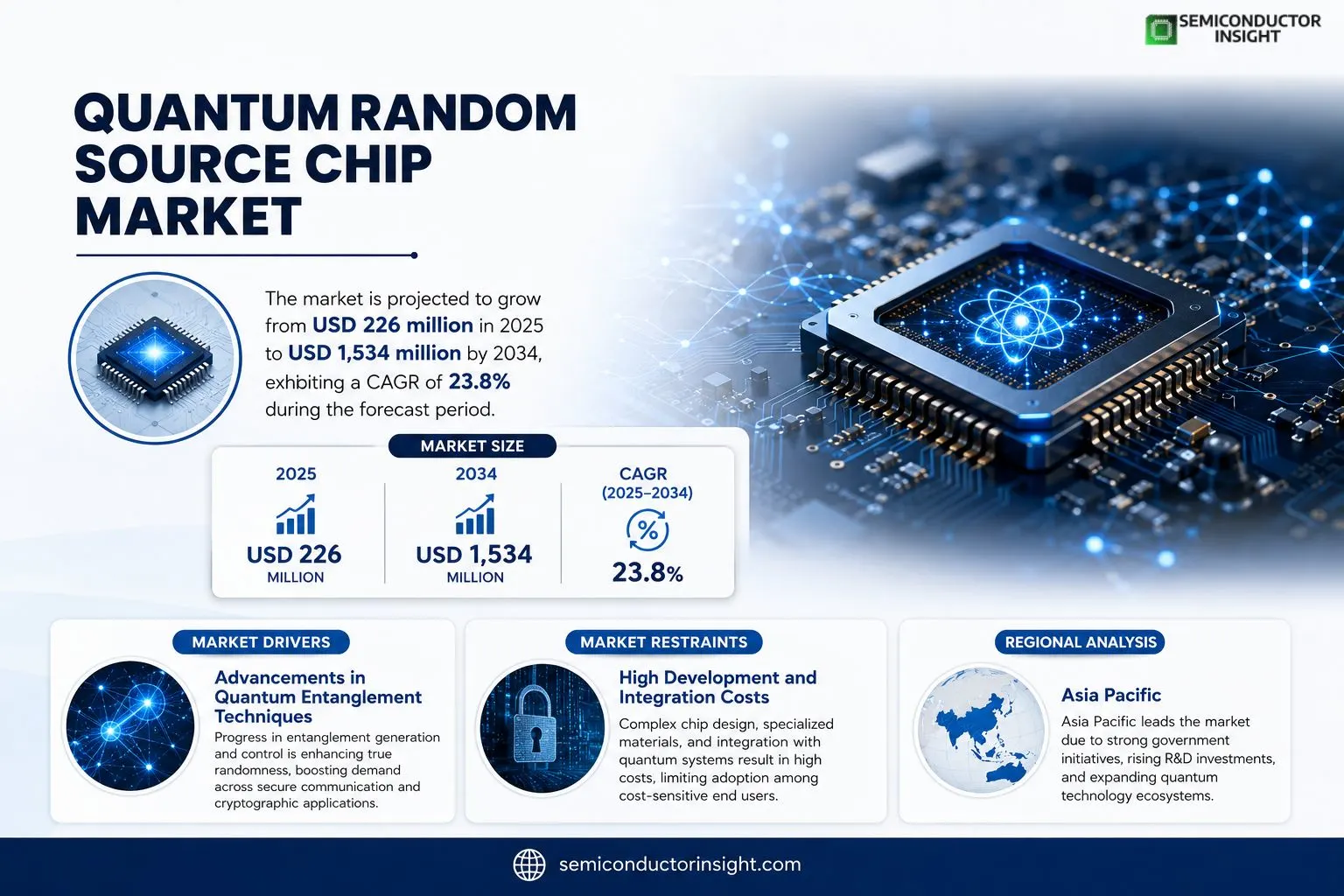
Quantum Random Source Chip market size was valued at USD 226 million in 2026. The market is projected to grow from USD 226 million in 2026 to USD 1,534 million by 2034, exhibiting a CAGR of approximately 23.8% during the forecast period.
A quantum random source chip is a security‑grade silicon device that exploits the inherent uncertainty of quantum phenomenasuch as photon detection, vacuum fluctuations, phase‑noise or tunnellingto generate true random entropy directly on‑chip. High‑speed detectors convert quantum events into electrical signals which are then processed by entropy‑extraction circuits, delivering a continuous stream of non‑repeatable random bits.The expansion is fueled by escalating investments in quantum‑safe encryption, growing adoption of quantum key distribution across financial institutions, and heightened regulatory focus on data‑center security. Demand is further reinforced by the rollout of next‑generation photonic processors that require embedded entropy sources for reliable operation. Leading manufacturersincluding Xanadu, PsiQuantum, TuringQ Co., Ltd, Hefei Guizhen Chip Technology, Beijing QBoson Quantum Technology, QuiX Quantum, Quandela, Photonic, C*Core Technology, and Anhui Qasky Quantum Technologyare scaling production capacity while pursuing strategic alliances to embed chips into commercial cryptographic platforms.
MARKET DRIVERS
Advancements in Quantum Entanglement Techniques
The emergence of more reliable entanglement generation methods has lowered error rates in quantum random source chips, making them attractive for cryptographic applications. Manufacturers are now able to certify randomness with statistical confidence that rivals classical generators, prompting early adopters in finance and defense to pilot deployments.
Regulatory Momentum for Hardware‑Based Security
Legislative bodies across Europe and North America are tightening standards around true‑random number generation for critical infrastructure. This regulatory climate forces vendors to demonstrate hardware‑rooted entropy, a niche where Quantum Random Source Chip Market enjoys a clear advantage over software‑only solutions.
➤ “Hardware‑centric randomness is becoming a compliance prerequisite, not an optional enhancement.”
Concurrently, the rise of edge‑computing devices that demand on‑board security functions is expanding the addressable pool of end‑users. By integrating quantum chips directly into IoT gateways, system architects can offload entropy generation, reducing latency and bandwidth consumption in secure communications.
MARKET CHALLENGES
High Production Costs and Yield Variability
Quantum fabrication still requires ultra‑clean environments and cryogenic testing, which inflate unit costs. Small‑volume runs struggle to achieve the economies of scale that conventional CMOS chips enjoy, leading to price premiums that deter cost‑sensitive segments such as consumer electronics.
Other Challenges
Talent Gap in Quantum Engineering
The pool of engineers capable of designing, testing, and integrating quantum random source chips remains limited. Companies must invest heavily in training or partner with academic labs, stretching project timelines and budgets.
Standardization Uncertainty
Without universally accepted benchmarks for quantum entropy, buyers face difficulty comparing products. This ambiguity slows procurement decisions and hampers broader market acceptance.
MARKET RESTRAINTS
Stringent Certification Pathways
Security‑critical industries such as aerospace and banking require certifications that involve extensive testing cycles. The time‑intensive nature of these approvals can postpone product launches, limiting momentum for newcomers.The necessity to operate at cryogenic temperatures for optimal performance introduces integration hurdles with existing electronics, often requiring specialized packaging and thermal management solutions that add design complexity.Furthermore, the market’s reliance on a narrow set of foundries creates supply‑chain concentration risk; any disruption at these facilities can cascade into delayed deliveries and increased costs for end users.
MARKET OPPORTUNITIES
Emerging Demand from Post‑Quantum Cryptography
As governments and corporations begin transitioning to algorithms resistant to quantum attacks, the need for true‑random seeds becomes critical. Quantum Random Source Chip Market players that can certify quantum‑grade entropy stand to capture a growing share of this security upgrade cycle.Another avenue lies in secure hardware wallets for digital assets. The convergence of high‑value cryptocurrency storage and regulatory scrutiny creates a niche where on‑chip quantum randomness can differentiate products and justify premium pricing.Finally, collaborations between semiconductor giants and quantum research institutes are spawning heterogeneous integration platforms that embed quantum chips alongside classical processors. These hybrid solutions open pathways to new applications in AI model initialization and scientific simulations, broadening the market’s addressable horizon.
Quantum Random Source Chip Market Trends
Escalating Adoption of Quantum‑Secure Encryption
The surge in data‑center workloads and the intensifying threat landscape have propelled organizations to replace conventional pseudo‑random generators with hardware‑based quantum entropy sources. By embedding true quantum randomness directly on silicon, chip manufacturers are delivering a security‑grade foundation that satisfies emerging regulatory requirements for cryptographic primitives. This shift is especially evident among cloud service providers that must guarantee non‑replicable keys for multi‑tenant environments; the intrinsic uncertainty of photon‑detection or vacuum‑fluctuation mechanisms eliminates the predictability risk inherent in algorithmic randomness. Consequently, procurement cycles are shortening, and design‑to‑volume timelines have compressed, forcing OEMs to prioritize integration density and power‑efficiency alongside raw entropy rates.
Other Trends
Hybrid Integration with Photonic Platforms
Manufacturers are increasingly marrying quantum entropy circuits with silicon‑photonic interconnects to address bandwidth constraints in high‑frequency trading and financial‑services applications. The hybrid approach leverages existing photonic foundries, reducing the capital outlay required for pure quantum fabs. As a result, suppliers can offer modules that plug into standard telecom‑grade transceivers, extending the reach of quantum‑grade randomness beyond niche research labs into mainstream network equipment. This convergence also opens avenues for bundled services, where chip vendors partner with software firms to provide turnkey quantum‑random‑number‑as‑a‑service (QRaaS) platforms.
Strategic Positioning of Tier‑One Players
Leading firms such as Xanadu, PsiQuantum, and TuringQ have pivoted from purely research‑oriented roadmaps to commercial production lines that emphasize manufacturability and supply‑chain resilience. Their recent investments in modular wafer‑scale integration signal an intent to lock in volume discounts for downstream chip designers, especially those targeting quantum communication protocols. By securing long‑term silicon‑photonic wafer capacity, these companies are mitigating the risk of component shortages that have historically hampered rollout schedules. The strategic emphasis on price‑performance balance is reshaping competitive dynamics, compelling smaller entrants to specialize in niche entropy‑source variants like quantum tunneling or phase‑noise technologies.
COMPETITIVE LANDSCAPE
Key Industry Players
Quantum Random Source Chip Market – Competitive Overview
In 2026 the segment was dominated by a small cadre of firms that have leveraged deep quantum‑photonic expertise to embed true random entropy sources directly onto silicon. Xanadu, with its integrated photonic platform, commands a sizable portion of high‑volume contracts in data‑center encryption and quantum‑key‑distribution deployments. PsiQuantum, traditionally focused on scalable quantum‑computer hardware, has translated its wafer‑scale manufacturing capabilities into a premium line of quantum entropy chips, attracting strategic partnerships with leading telecommunications providers. Both companies differentiate through proprietary photon‑detection architectures that push bit‑rate limits while maintaining low power footprints, enabling them to capture the bulk of the $226 million market in 2026. Their vertical integrationfrom wafer fab to entropy‑extraction firmwarecreates high barriers for new entrants and pressures pricing dynamics across the ecosystem.Beyond the two market leaders, a constellation of niche players contributes specialized value propositions that keep the competitive field vibrant. Chinese manufacturers such as Hefei Guizhen Chip Technology, Beijing QBoson Quantum Technology, and Anhui Qasky Quantum Technology focus on vacuum‑fluctuation and tunneling‑based entropy sources, often securing government‑backed projects in secure communications. European outfits like QuiX Quantum and Quandela differentiate through modular photonic‑integrated circuits aimed at research institutions, while North‑American startups such as C*Core Technology target ultra‑low‑latency chips for high‑frequency‑trading platforms. These firms frequently pursue joint‑development agreements with academic labs, allowing rapid iteration on niche architectures that larger players may overlook. Their agility, combined with region‑specific funding incentives, creates pockets of growth that could reshape the market share landscape over the next several years.
List of Key Quantum Random Source Chip Companies Profiled
- Xanadu
- PsiQuantum
- TuringQ Co., Ltd.
- Hefei Guizhen Chip Technology Co., Ltd.
- Beijing QBoson Quantum Technology Co., Ltd.
- QuiX Quantum
- Quandela
- Photonic
- C*Core Technology Co., Ltd.
- Anhui Qasky Quantum Technology Co., Ltd.
- QuantumCTek Co., Ltd.
- QuantumSecure Labs
Segment Analysis:
| Segment Category | Sub-Segments | Key Insights |
| By Type |
|
Vacuum‑fluctuation is emerging as the preferred foundational technology because it delivers inherently high entropy without requiring complex external stabilization.
|
| By Application |
|
Quantum Key Distribution drives demand for true‑random entropy at the chip level, as it underpins the security guarantees of QKD protocols.
|
| By End User |
|
Cryptography Systems represent the core end‑user segment where QRSCs are valued for their ability to generate non‑deterministic keys.
|
| By Technology Approach |
|
Photonic Integration is currently seen as the most scalable avenue for QRSC deployment.
|
| By Integration Level |
|
Embedded IP Cores are gaining favor because they balance performance with design simplicity.
|
Regional Analysis: Quantum Random Source Chip Market
The European Union has published a harmonized security standard that explicitly references quantum‑generated entropy, reducing compliance uncertainty for manufacturers and end‑users alike.
Established wafer fabs and a dense network of component distributors shorten lead times, allowing OEMs to scale production without significant bottlenecks.
Financial services, cloud providers, and defense contractors dominate demand, each seeking provable randomness for encryption, signing, and Monte‑Carlo simulations.
Venture capital and EU Horizon programmes converge on quantum hardware, creating a pipeline of startups focused on integrating random source chips into edge devices.
North America
North America’s market dynamics are shaped by a strong emphasis on commercial scalability. Leading cloud service providers have begun integrating quantum random source chips into server racks to reinforce key‑generation processes. Simultaneously, defense contracts prioritize tamper‑proof randomness for cryptographic modules, prompting a surge in custom ASIC designs. The region’s venture ecosystem funds early‑stage innovators, but market adoption hinges on the ability to certify chips against evolving federal security standards, which remain more fragmented than Europe’s approach.
Asia‑Pacific
The Asia‑Pacific region exhibits a rapid transition from research‑centric activities to volume manufacturing. Government initiatives in China, Japan, and South Korea aim to position the region as a hub for quantum hardware. Domestic chipmakers are leveraging existing semiconductor capacity to add quantum random source modules to mixed‑signal portfolios. However, divergent regulatory stances across countries create a patchwork that can slow cross‑border product rollout, compelling companies to adopt a localized compliance strategy.
South America
South America’s engagement with Quantum Random Source Chip Market remains nascent but is gaining traction through academic‑industry consortia in Brazil and Argentina. These collaborations focus on low‑cost, low‑power implementations suitable for telecom and renewable‑energy monitoring. While funding levels are modest compared with other regions, the emergence of regional standards bodies signals a growing intention to formalize security requirements for critical infrastructure.
Middle East & Africa
In the Middle East & Africa, strategic interest centers on secure communications for sovereign data‑centers and financial hubs such as Dubai and Johannesburg. Limited local fabrication capacity drives reliance on imported chips, yet partnerships with European suppliers are fostering technology transfer. The primary constraint is the scarcity of skilled engineers, prompting firms to invest in training programs that couple classical semiconductor expertise with quantum‑level randomness engineering.
Report Scope
This market research report provides a comprehensive analysis of the Quantum Random Source Chip Market , covering the forecast period 2026–2034. It offers detailed insights into market dynamics, technological advancements, competitive landscape, and key trends shaping the industry.
Key focus areas of the report include:
- Market Overview: The report begins with an overview outlining its current market scenario, key growth indicators, and industry transformation drivers. It discusses macroeconomic factors, demand–supply balance, regulatory landscape, and the strategic role of semiconductors in powering advancements across industries such as automotive, telecommunications, consumer electronics, and industrial automation.
- Market Size & Forecast: Historical data and future projections for revenue, unit shipments, and market value across major regions and segments.
- Segmentation Analysis: Detailed breakdown by product type, technology, application, and end-user industry to identify high-growth segments and investment opportunities.
- Regional Insights: Insights into market performance across North America, Europe, Asia-Pacific, Latin America, and the Middle East & Africa, including country-level analysis where relevant.
- Competitive Landscape: Profiles of leading market participants, including their product offerings, R&D focus, manufacturing capacity, pricing strategies, and recent developments such as mergers, acquisitions, and partnerships.
- Technology Trends & Innovation: Assessment of emerging technologies, integration of AI/IoT, semiconductor design trends, fabrication techniques, and evolving industry standards.
- Market Drivers & Restraints: Evaluation of factors driving market growth along with challenges, supply chain constraints, regulatory issues, and market-entry barriers.
- Stakeholder Insights: Insights for component suppliers, OEMs, system integrators, investors, and policymakers regarding the evolving ecosystem and strategic opportunities.
Primary and secondary research methods are employed, including interviews with industry experts, data from verified sources, and real-time market intelligence to ensure the accuracy and reliability of the insights presented.
FREQUENTLY ASKED QUESTIONS:
What is the current market size of Quantum Random Source Chip Market?
-> Quantum Random Source Chip Market was valued at USD 226 million in 2026 and is expected to reach USD 1001 million by 2032, growing at a CAGR of 23.8% during the forecast period.
Which key companies operate in Quantum Random Source Chip Market?
-> Key players include Xanadu, PsiQuantum, TuringQ Co.,Ltd., Hefei Guizhen Chip Technology Co., Ltd., Beijing QBoson Quantum Technology Co.,Ltd., QuiX Quantum, Quandela, Photonic, C*Core Technology Co., Ltd., Anhui Qasky Quantum Technology Co., Ltd.
What are the key growth drivers?
-> Key growth drivers include rising adoption of quantum cryptography, increasing demand for secure data center encryption, and expanding financial security applications.
Which region dominates the market?
-> North America and Asia show the strongest market activity, with the United States and China being major contributors.
What are the emerging trends?
-> Emerging trends include integration of quantum random source chips into quantum key distribution systems and growth of quantum communication networks.
Get Sample Report PDF for Exclusive Insights
Report Sample Includes
- Table of Contents
- List of Tables & Figures
- Charts, Research Methodology, and more...
 Download Sample Report PDF