Quantum Cryptographic Card Market Insights
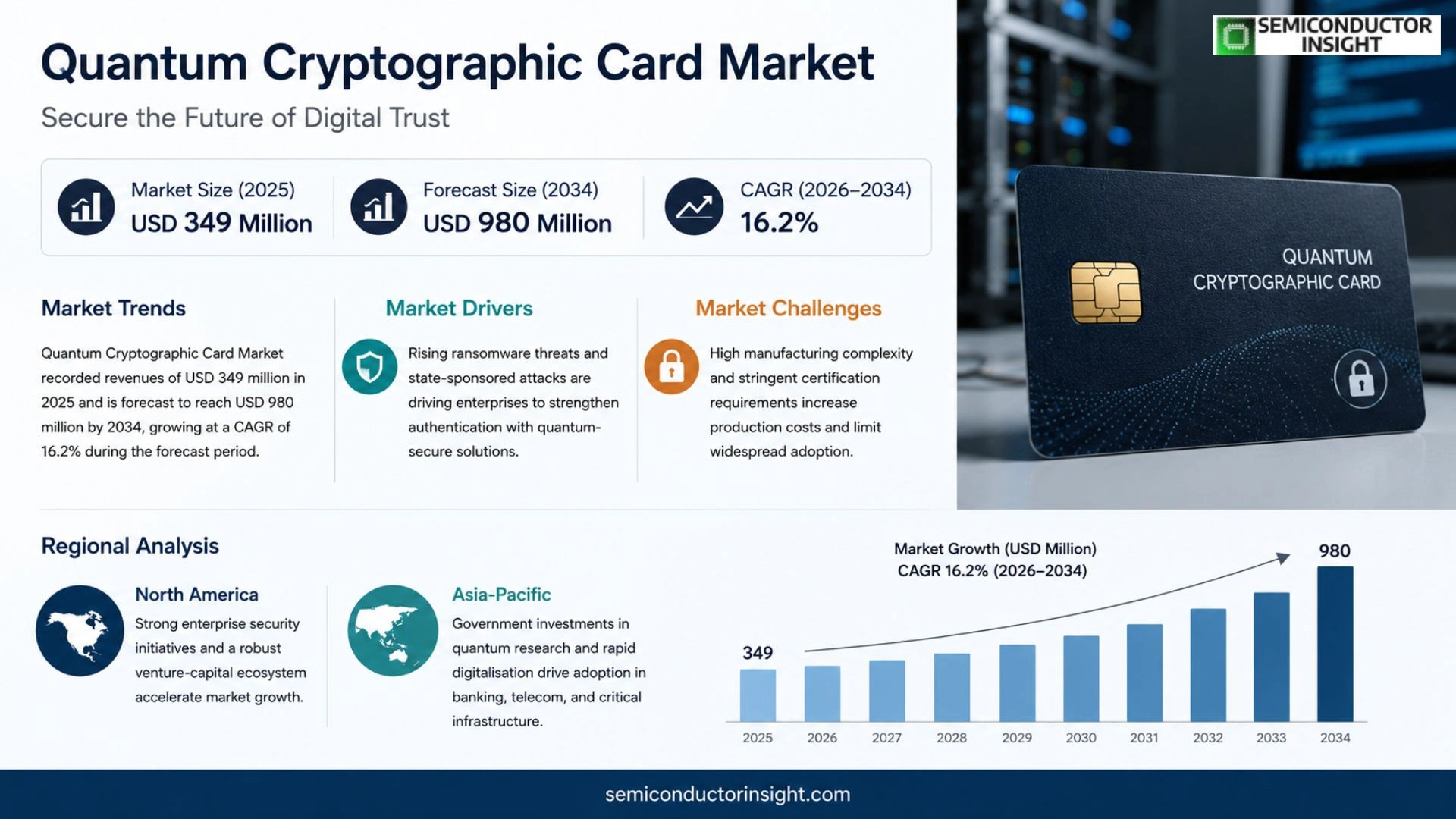
Global Quantum Cryptographic Card market is projected to grow from USD 349 million in 2025 to USD 980 million by 2034, exhibiting a CAGR of 16.2% during the forecast period.
Quantum cryptographic cards are hardware security modules that employ quantum‑key‑distribution (QKD) principles. Typically delivered as smart cards, encryption boards or embedded modules, they generate, store and protect cryptographic keys using the uncloneable nature of quantum states; any eavesdropping attempt inevitably perturbs the signal, providing information‑theoretic security. In 2025 sales reached 128 000 units at an average price of USD 2,985, with a capacity utilization of 92 % and a gross profit margin of 64 %.
The sector’s expansion is fueled by rising governmental and financial‑sector demand for quantum‑resistant protection, escalating concerns over future quantum‑computer attacks on classical algorithms, and increasing investment in national security programs. Leading suppliers such as ID Quantique, Toshiba, Quantum Xchange, Hefei Guizhen Chip Technology, and QuintessenceLabs are accelerating product rollouts and forging partnerships with defense agencies to embed quantum security layers into critical infrastructure.
MARKET DRIVERS
Escalating Cyber‑Threat Landscape
The surge in sophisticated ransomware attacks and state‑sponsored intrusions has forced enterprises to reassess the security of their authentication infrastructure. Organizations are turning to hardware‑based solutions that can generate and store keys immune to quantum‑computing attacks, thereby lowering the risk of credential compromise. Quantum Cryptographic Card Market sales are buoyed by this heightened risk awareness, especially among financial services and defense contractors.
Regulatory Momentum for Post‑Quantum Readiness
Recent revisions to data‑protection regulations in Europe and North America now reference “quantum‑resistant” encryption as a compliance checkpoint. Companies seeking to avoid punitive fines are accelerating procurement cycles for quantum‑enabled smart cards, which offer a tangible pathway to meet the new standards. This regulatory push not only creates demand but also legitimizes spending on emerging security hardware.
➤ Early adopters report a 30 % reduction in key‑management overhead after integrating quantum cryptographic cards, highlighting operational efficiency as a compelling value proposition.
Beyond compliance, the tangible cost‑benefit narrative,lowered breach penalties, reduced incident response expenses, and streamlined key lifecycle management,strengthens the business case. Vendors that bundle firmware updates with secure element upgrades are capturing a larger share of the evolving market.
MARKET CHALLENGES
High Initial Capital Outlay
Quantum‑grade secure cards require specialized manufacturing processes and rigorous certification, driving up unit costs. Small‑ to mid‑size enterprises often find the upfront investment prohibitive, leading to slower adoption rates in segments that could otherwise benefit from enhanced protection.
Other Challenges
Integration Complexity
Legacy authentication ecosystems frequently rely on legacy protocols that are incompatible with quantum‑ready hardware. Organizations must allocate skilled engineering resources to bridge the gap, elongating deployment timelines and adding hidden costs.
MARKET RESTRAINTS
Supply‑Chain Bottlenecks
Component shortages for semiconductor‑based secure elements have created a lag between demand spikes and actual product availability. Manufacturers, constrained by limited fab capacity, are forced to prioritize large contracts, leaving niche markets underserved.
MARKET OPPORTUNITIES
Cloud Service Provider Partnerships
Leading cloud platforms are beginning to offer quantum‑resistant key management as a managed service. Aligning quantum cryptographic cards with these offerings opens a channel to reach enterprises that prefer outsourced security, effectively expanding the addressable market.
The convergence of edge computing and secure hardware presents another growth vector. As devices at the network perimeter demand tamper‑proof credentials, vendors that can deliver lightweight, quantum‑ready cards for IoT gateways will capture a distinct competitive advantage.
Quantum Cryptographic Card Market Trends
Escalating Demand from Government and Critical Infrastructure
Quantum Cryptographic Card Market recorded revenues of $349 million in 2025 and a forecast pushes the figure to $980 million for 2032, reflecting a compound‑annual increase of roughly 16 percent. Unit shipments topped 128 000 in 2025, with an average selling price near $2,985 and utilization running at 92 percent, which generated a gross margin of 64 percent. This performance stems from heightened awareness of quantum‑computing threats among sovereign and financial entities, prompting procurement programs that embed quantum‑key‑distribution (QKD) cards into existing PKI frameworks. Policymakers in the United States, Europe, and China have introduced mandatory post‑quantum compliance roadmaps, compelling legacy systems to adopt a quantum‑security overlay. Consequently, vendors are scaling production lines, driving the observed utilization uptick and reinforcing the profit profile of the sector.
Other Trends
Shift Toward Integrated Quantum Modules
A second‑stage trend reshapes the product mix. Rather than standalone smart cards, manufacturers are embedding QKD and quantum‑random‑number‑generator (QRNG) engines directly onto server‑grade boards and embedded modules. This integration reduces insertion loss, shortens key‑exchange latency, and aligns with data‑center refresh cycles that prioritize compact, high‑density security solutions. Early adopters report a 15 percent reduction in overall power consumption compared with separate card deployments, a compelling metric for hyperscale operators. The move also eases supply‑chain pressures, as a single wafer‑fabrication run can satisfy both server and edge‑device requirements, enabling economies of scale that support the rising volume targets outlined in the forecast.
Emergence of Domestic Supply Chains in Asia
Asian manufacturers are consolidating regional ecosystems to lessen reliance on Western component imports. Companies such as ID Quantique’s Asian subsidiaries and domestic chipmakers have announced joint‑fabrication facilities that benchmark against the 92 percent capacity utilization seen in 2025. By localizing wafer production and assembly, these players can respond to government tenders faster and offer price points that remain competitive despite the premium associated with quantum‑grade hardware. The regional focus also spurs collaborative research programs aimed at enhancing error‑correction algorithms for QKD, which could improve the reliability of long‑haul fiber links. For market participants, the growing Asian supply base represents both a source of cost discipline and a strategic hedge against export‑control uncertainties, ultimately influencing investment decisions across the broader Quantum Cryptographic Card Market.
COMPETITIVE LANDSCAPE
Key Industry Players
Quantum Cryptographic Card Market Competitive Overview
The market is anchored by a handful of firms that have translated early quantum‑key‑distribution research into production‑ready hardware. ID Quantique commands a premium position thanks to a deep patent suite, long‑standing collaborations with European defence agencies, and a manufacturing line that consistently runs above 90 % capacity. Toshiba leverages its semiconductor scale, integrating quantum‑secure modules onto server‑grade cards that appeal to large‑enterprise IT departments. Together these two vendors capture the bulk of revenue while setting pricing benchmarks that shape downstream negotiations. Their dominance forces smaller entrants to specialize,either by targeting niche verticals such as government‑grade encryption or by offering differentiated form factors like embedded quantum modules for IoT gateways. This bifurcated structure creates a competitive environment where size and breadth of product portfolios coexist with highly focused innovation.
Beyond the leaders, a diverse set of specialists is expanding the ecosystem. Quantum Xchange has built a cloud‑centric service layer that pairs its cards with managed QKD networks, attracting fintech firms seeking regulatory‑grade security. Chinese manufacturers,including Hefei Guizhen Chip Technology, Shudun Information Technology, C*Core Technology, Hangzhou Post Quantum Cryptography, Shenzhen Kedun Quantum Information, and Nanjing Shouchuan Xin’an Technology,are rapidly scaling capacity to meet domestic demand from the finance and power sectors. QuintessenceLabs differentiates through a software‑first approach that bundles quantum‑random‑number‑generation with its hardware, while MagiQ Technologies and QNu Labs focus on portable quantum cards for field deployment. LuxQuanta and KETS Quantum Security round out the field with custom solutions for defence and aerospace, illustrating how niche expertise sustains a vibrant competitive tableau.
List of Key Quantum Cryptographic Card Companies Profiled
- ID Quantique
- Toshiba
- Quantum Xchange
- Hefei Guizhen Chip Technology Co., Ltd.
- Shudun Information Technology Co., Ltd.
- C*Core Technology Co., Ltd.
- Hangzhou Post Quantum Cryptography Technology Co., Ltd.
- Shenzhen Kedun Quantum Information Technology Co., Ltd.
- Nanjing Shouchuan Xin’an Technology Co., Ltd.
- QuintessenceLabs
- MagiQ Technologies
- QNu Labs
- LuxQuanta
- KETS Quantum Security
Segment Analysis:
| Segment Category | Sub-Segments | Key Insights |
| By Type |
|
Quantum Key Distribution Card is emerging as the flagship sub‑segment because it directly leverages the unforgeable nature of quantum states to protect key exchange.
|
| By Application |
|
Financial & Critical Infrastructure drives adoption due to the high value of transaction security and regulatory pressure.
|
| By End User |
|
Government Agencies are the leading end‑user because of national security imperatives and the need to protect classified communications.
|
| By Form Factor |
|
Embedded Quantum Crypto Module is gaining traction as system designers seek seamless integration within existing hardware platforms.
|
| By Integration Level |
|
Hybrid Quantum–Classical Security Suite is viewed as the strategic pathway for enterprises balancing legacy investments with future‑proof security.
|
Regional Analysis: Quantum Cryptographic Card Market
Europe
The EU’s quantum‑readiness roadmap mandates that critical infrastructure adopt quantum‑safe encryption within the next decade. This creates a clear procurement signal for vendors, encouraging them to certify cards against emerging standards and to engage early with policy makers.
Financial institutions and cloud providers dominate early demand, motivated by the need to protect high‑value transactions and cross‑border data flows from future quantum attacks. Their appetite for resilient hardware fuels pilot projects across multiple jurisdictions.
A handful of established security firms dominate the market, yet a surge of niche start‑ups offering specialised quantum cards introduces fresh pressure, prompting incumbents to accelerate innovation cycles.
Partnerships between academic consortia and hardware manufacturers are expected to yield reference designs that lower entry barriers for mid‑size enterprises, expanding the addressable market beyond the current early adopters.
North America
North America’s Quantum Cryptographic Card Market is driven by a blend of corporate risk‑management initiatives and a vibrant venture‑capital ecosystem. Major cloud providers have begun integrating quantum‑resistant modules into their data‑center offerings, prompting a cascade of demand among technology‑intensive firms. Federal agencies, while not imposing uniform mandates, encourage agencies to experiment with quantum‑grade tokens, creating a test‑bed that informs commercial roll‑outs. The region’s competitive landscape is marked by aggressive M&A activity as larger security firms absorb niche innovators to broaden their product portfolios. This consolidation accelerates time‑to‑market for advanced cards, yet it also raises integration challenges for customers seeking seamless compatibility across heterogeneous environments.
Asia-Pacific
In the Asia‑Pacific, governmental ambition and rapid digitalisation converge to shape Quantum Cryptographic Card Market. Nations such as Japan and South Korea are investing heavily in quantum research hubs, translating breakthroughs into prototype cards that attract early adopters in banking and telecommunications. Meanwhile, emerging economies view quantum‑safe solutions as a differentiator for export‑oriented technology firms, prompting a modest yet growing procurement trend. Market participants must navigate a fragmented standards environment, where regional bodies propose divergent technical criteria, complicating cross‑border product deployment. Successful players will therefore prioritize flexible architectures that can be re‑configured to satisfy multiple regulatory expectations.
South America
South America’s engagement with quantum‑grade security remains nascent, but a rising awareness of cyber‑risk is prompting cautious exploration. Financial regulators in Brazil have issued advisory notes encouraging banks to assess quantum‑resistant options, opening doors for pilot initiatives. The region’s limited domestic manufacturing capacity drives reliance on imported solutions, creating an opportunity for global vendors to establish localized partnerships. However, price sensitivity and budgetary constraints mean that adoption will likely be confined to large multinational corporations and state‑owned enterprises until economies of scale reduce costs.
Middle East & Africa
The Middle East & Africa exhibit a heterogeneous landscape where sovereign wealth funds and oil‑related enterprises lead early interest in quantum‑resistant hardware. Strategic security concerns motivate these entities to experiment with quantum cards as part of broader digital‑infrastructure upgrades. In contrast, many African markets face infrastructural hurdles that limit immediate uptake, directing focus toward capacity‑building programs and knowledge transfer initiatives. Providers that can bundle quantum solutions with consulting services stand to capture the limited but high‑value demand emerging from state‑driven digital transformation agendas.
Report Scope
This market research report provides a comprehensive analysis of the Quantum Cryptographic Card Market , covering the forecast period 2026–2034. It offers detailed insights into market dynamics, technological advancements, competitive landscape, and key trends shaping the industry.
Key focus areas of the report include:
- Market Overview: The report begins with an overview outlining its current market scenario, key growth indicators, and industry transformation drivers. It discusses macroeconomic factors, demand–supply balance, regulatory landscape, and the strategic role of semiconductors in powering advancements across industries such as automotive, telecommunications, consumer electronics, and industrial automation.
- Market Size & Forecast: Historical data and future projections for revenue, unit shipments, and market value across major regions and segments.
- Segmentation Analysis: Detailed breakdown by product type, technology, application, and end-user industry to identify high-growth segments and investment opportunities.
- Regional Insights: Insights into market performance across North America, Europe, Asia-Pacific, Latin America, and the Middle East & Africa, including country-level analysis where relevant.
- Competitive Landscape: Profiles of leading market participants, including their product offerings, R&D focus, manufacturing capacity, pricing strategies, and recent developments such as mergers, acquisitions, and partnerships.
- Technology Trends & Innovation: Assessment of emerging technologies, integration of AI/IoT, semiconductor design trends, fabrication techniques, and evolving industry standards.
- Market Drivers & Restraints: Evaluation of factors driving market growth along with challenges, supply chain constraints, regulatory issues, and market-entry barriers.
- Stakeholder Insights: Insights for component suppliers, OEMs, system integrators, investors, and policymakers regarding the evolving ecosystem and strategic opportunities.
Primary and secondary research methods are employed, including interviews with industry experts, data from verified sources, and real-time market intelligence to ensure the accuracy and reliability of the insights presented.
FREQUENTLY ASKED QUESTIONS:
What is the current market size of Quantum Cryptographic Card Market?
-> Quantum Cryptographic Card market is projected to USD 980 million by 2034, exhibiting a CAGR of 16.2% during the forecast period.
Which key companies operate in Quantum Cryptographic Card Market?
-> Key players include ID Quantique, Toshiba, Quantum Xchange, Hefei Guizhen Chip Technology Co., Ltd., Shudun Information Technology Co., Ltd., C*Core Technology Co., Ltd., Hangzhou Post Quantum Cryptography Technology Co., Ltd., Shenzhen Kedun Quantum Information Technology Co., Ltd., Nanjing Shouchuan Xin’an Technology Co., Ltd., QuintessenceLabs, MagiQ Technologies, QNu Labs, LuxQuanta, KETS Quantum Security.
What are the key growth drivers?
-> Key growth drivers include the imminent threat of quantum computers to classical encryption, increasing demand for information‑theoretic security in government and financial sectors, and the rollout of quantum key distribution infrastructure.
Which region dominates the market?
-> North America leads the market owing to early adoption in the United States for defense and financial applications, supported by strong R&D investment.
What are the emerging trends?
-> Emerging trends include the development of integrated quantum‑enhanced cryptographic cards, hybrid solutions combining QKD with existing PKI, and expansion of server‑grade quantum security modules.
Get Sample Report PDF for Exclusive Insights
Report Sample Includes
- Table of Contents
- List of Tables & Figures
- Charts, Research Methodology, and more...
 Download Sample Report PDF