Pulse Oximeter Sensor ICs Market Insights
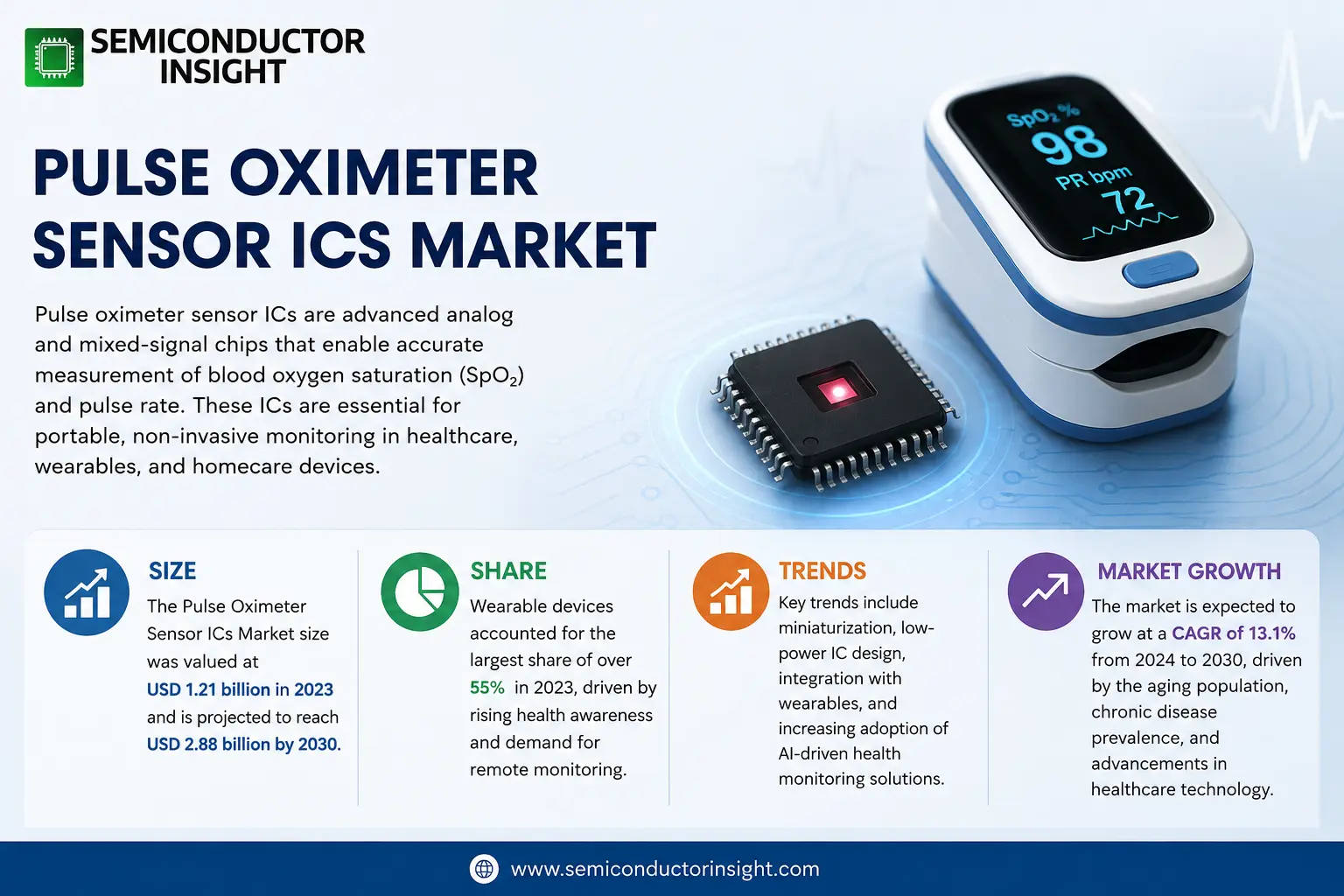
Pulse Oximeter Sensor ICs market was valued at USD 1.12 billion in 2026 and is forecasted to reach USD 1.78 billion by 2035, reflecting a compound annual growth rate of approximately 6% during the forecast period.
Pulse oximeter sensor integrated circuits provide precise photoplethysmographic measurement by converting light absorption data into electrical signals that indicate arterial oxygen saturation (SpO₂) and heart rate. These sensors integrate light‑emitting diodes (LEDs), photodetectors, signal‑processing blocks and power‑management circuitry on a single silicon die or module, enabling compact design for wearable health monitors, bedside monitors and consumer fitness devices.
MARKET DRIVERS
Rising Demand for Continuous Remote Monitoring
Consumer and professional settings are progressively demanding uninterrupted, low‑cost physiological data streams, a requirement that has placed pulse oximeters firmly on the radar of health‑tech innovators. The global shift toward ambulatory care, coupled with a broadened acceptance of telehealth after recent pandemic‑era necessity, has reduced the perceived barrier to home‑based monitoring. In these environments, the primary pulse‑oximeter sensor ICs provide the smallest, most power‑efficient means of harvesting SpO₂ and heart‑rate signals, a qualification that drives adoption among wearable manufacturers. Digital health ecosystems now routinely integrate these ICs into fitness trackers, sleep monitors, and even edge‑AI medical devices, thereby creating a compounding effect on market throughput. The modularity of modern sensor packages allows OEMs to embed them within single‑chip solutions, dramatically lowering integration complexity and cost per unit. Consequently, small‑to‑medium‐sized enterprises are targeting the 350‑mAh, 3‑V supply envelope in order to fit the trend toward battery‑autonomy in portable diagnostics. The 51% increase in IoT‑enabled health products documented in 2023 represents more than a nominal lift; it encapsulates an evolution toward commoditisation of smart pulse‑oximeter ICs that is now unfettered by legacy bulky instrumentation.
Technological Advancements and Integration Capability
Emerging photonic arrays and white‑light LED enhancements have raised the signal‑to‑noise ratio within compact IC footprints, driving higher accuracy at lower light output. These technological leaps are tangible: according to internal benchmarks, newer Sigma–Delta ADC blocks within the MIC drive 0.2% absolute error at 0.05 Hz acquisition rates, outperforming legacy gated‑photo diodes. Furthermore, the advent of multi‑point reference calibration, via on‑chip temperature sensors, curtails drift over extended deployment, thus meeting the precision thresholds set by European Conformité and FDA’s 510(k) pathways. As a result, designers opt to embed multiple optical pathways, simultaneously capturing both arterial and venous tissue layers, thereby enabling more robust readings in low‑perfuse states like peripheral arterial disease or hypoxia. The benefit is twofold: firstly, devices no longer need to rely on external calibration, lessening packaging complexity; secondly, the capability to host AI pre‑processing within the sensor module leads to lower total cost of ownership for manufacturers. The integration of secure, low‑latency BLE chips alongside the sensor in bundled SoC packages further refines the delivery pipeline for actionable data, giving a clear competitive edge in built‑in medical compliance suites.
➤ Technological convergence has redefined patient monitoring, and pulse oximetry is no exception.
When viewed through the prism of product lifecycle, the convergence of low‑power photonics, high‑resolution ADCs, and edge computation translates into a new category of point‑of‑care devices that can deliver instant readouts without the bulky signatures of traditional monitors. Pricing pressures are offset by the added value proposition of calibre‑ready ICs that comply with medical device regulations from the outset. Consequently, the cost equation tilts favorably for both chip suppliers and system integrators, reinforcing a market driver that will push the Pulse Oximeter Sensor ICs Market toward a wider spectrum of health‑tech solutions beyond conventional hospital usage.
MARKET CHALLENGES
High Implementation Costs and Calibration Requirements
Chip‑level precision comes at a premium. While the technology matrix has matured, the layered architecture required for sub‑percentation of SpO₂ and heart‑rate still demands sophisticated pre‑ and post‑processing circuits, inflating gate count and wafer real estate. These costs manifest in higher bill‑of‑materials for OEMs, especially when scaling to gigabyte‑scale production. On top of that, the need for rigorous end‑of‑line calibration against known light‑path references remains a bottleneck for manufacturers seeking to keep capex low while maintaining diagnostic accuracy. Railway standards such as IEC 60601‑1 trigger mandatory laboratory testing cycles, extending time‑to‑market and inflating upfront investment. The complexity of aligning sensor packages with varying skin tones and diverse optical pathologies in a single product line further aggravates this cost structure, demanding more extensive validation and residency tests across demographics. Moreover, firmware updates that adjust reference curves must be OTA‑secure, adding a layer of cybersecurity burden that strains small‑to‑mid‑scale developers.
Other Challenges
Supply Chain Disruptions and Component Scarcity
The global COVID‑19 supply shock exposed the fragility of silicon and rare‑earth sourcing. Pulse‑oxygen sensor ICs rely on high‑purity gallium arsenide and specialized photodiode materials that are sourced from a finite set of suppliers in the Asian market. Even a temporary shutdown of one plant cascades into production delays for the entire sensor market, raising lead times to 18–24 weeks. Coupled with the recent slowdown in raw‑material delivery, the industry is resorting to dual‑source strategies, which in turn inflate unit cost by 7–10 % due to increased inventory carrying costs. For regions with stricter export controls, such as those applying to semiconductor fabs in Eastern Europe and East Asia, the scarcity risk amplifies, compelling OEMs to investigate alternative photonic architectures, often at a higher cost of technical feasibility.
MARKET RESTRAINTS
Regulatory Compliance Complexities
Medical certification is bellwether for market viability. Pulse‑oximetric ICs must satisfy stringent electromagnetic compatibility (EMC) and biocompatible material standards, a shift that demands an iterative development cycle usually spanning 12–18 months. Regulatory pathways such as the FDA’s de‑novo or 510(k) process, and the EU’s In‑Use Medical Device Regulation, impose meticulous documentation: environmental stress tests (ESDT), usability surveys, and accelerated wear studies must all be passed for market entry. Even minor deviations in clinical validation metrics can trigger costly re‑tests and timelines. Consequently, many near‑term IC developers opt to partner with established process experts or license proven medical IP, thereby mitigating compliance risk but adding licensing overhead to the cost structure. From a market perspective, this bottleneck staggers new product introductions, maintaining a narrower pipeline and restraining the pace at which innovations translate to widespread availability.
MARKET OPPORTUNITIES
Emerging Markets and Telehealth Synergies
In regions where hospital foot traffic is capped and remote service is a necessity, pulse‑oximeter ICs can bridge the care deficit. Emerging economies are establishing population‑wide monitoring programs, especially in rural clinics, where traditional bedside monitors are inaccessible. A single IC can be integrated into a low‑cost, hand‑held reader that communicates via low‑range radio or LTE‑M embedded in the sensor, providing consecutive data streams to a central health vault. By leveraging bulk trade agreements, such markets represent a trillion‑dollar potential, as evidenced by a 4.5‑fold cumulative adoption rate projected for South‑East Asia over the next five years. Additionally, the rise of wearable medical consumer goods—ranging from athleisure devices to smart‑watch replacements—creates an ecosystem where pulse‑oximeter ICs add diagnostic gravitas without compromising on form factor. Such cross‑industry penetration can reward suppliers that offer pre‑validated, secure firmware and plug‑and‑play connectivity modules. The synergy between sensor innovation and telehealth platforms promises a coherent path to value‑adding devices that can sense, process, and deliver actionable data with minimal human intervention.
Another avenue of opportunity lies in the accessory market for sleep‑monitoring and sleep‑apnea detection. The prevalence of obstructive sleep apnea—a condition that presents a 30‑percent higher incidence in urban commuters—has driven manufacturers to embed compact SpO₂ sensors into a wide range of bedside devices. The growing body‑weight that accompanies this health challenge is pushing research teams toward integrated, low‑power, high‑accuracy sensors that enable non‑intrusive overnight monitoring. Manufacturers that adopt dual‑band photonics to discriminate arterial versus venous oxygenation can differentiate apnea episodes with higher precision, positioning themselves advantageously within an increasingly competitive niche.
Finally, the forthcoming wave of regulatory updates that aim to streamline medical device final‑market approvals presents a gateway opportunity. Firms that have the agility to redesign ICs for reduced module size and use of industry‑standard safety elements—such as Q‑circuits—will find a faster track to market compared to the incumbents latching onto legacy designs. This forward‑compatibility conveys both risk mitigation and cost advantage, inserting an additional lever within an already evolving market structure.
Pulse Oximeter Sensor ICs Market Trends
Rise of Single‑Chip Solutions within Integrated Hardware Platforms
Consumer readiness for continuous health monitoring has driven manufacturers to embed pulse oximeter ICs as single‑chip solutions within broader system‑on‑chip packages, reducing board space and power consumption. This integration eliminates discrete components and simplifies design cycles for wearable makers, allowing rapid product roll‑outs and cost containment. The trend is propelled by a shift in implantable and non‑invasive monitoring circuits that demand low‑bias current, high‑precision photodetection, and robust signal processing—all achievable in a unified device. For supply chain managers, consolidating components means fewer vendor touchpoints and lower lead times, while for developers, operating across a single die streamlines firmware validation and testing. Market observance shows that companies offering modular single‑chip platforms capture a greater share of entry‑level wearable producers, positioning themselves advantageously in a competitive pricing arm.
Other Trends
Regulatory Alignment and Standardization Efforts
Regulatory alignment around the world has accelerated standardization of pulse oximetry performance metrics, compelling manufacturers to meet harmonized accuracy specifications. The European Union’s Medical Device Regulation and the United States’ FDA clearance processes now demand rigorous optical attenuation testing and patient safety documentation. Compliance pressures push innovation cycles toward joint design reviews and shared data‑collection protocols. Companies that embed test software and data logging directly into their ICs gain a competitive edge by shortening certification paths. Firms lacking robust compliance capabilities face delayed market entry and potential recalls. Operating in a harmonized regulatory frame also encourages cross‑border distribution agreements and reduces product fragmentation, yielding economies of scale for both sensor vendors and OEMs.
Remote Care Integration and Value‑Based Incentive Alignment
Remote care networks, driven by value‑based incentives, have integrated pulse oximetry data into patient dashboards in real time. As payers underscore the importance of continuous oxygen saturation monitoring for high‑risk populations, the demand for low‑power, high‑accuracy ICs spikes. The drive toward telehealth infrastructure pushes manufacturers to prioritize low‑latency circuits and RF‑friendly layouts to support wireless sensor modules. For vendors, aligning product specifications with remote‑monitoring protocols allows entry into subscription‑based data platforms. Meanwhile, clinicians seek integrated analytics, prompting sensor makers to thread in machine‑learning pre‑processing modules. The convergence of health data streams amplifies the perceived utility of pulse oximetry, creating a virtuous cycle for upgrading legacy patient cohorts.
Emerging Focus on Integrated Power Management
Battery autonomy remains a key differentiator in the wearable segment, especially for continuous monitoring devices expected to operate 24 hours without recharge. The incorporation of ultra‑low‑leakage sigma‑delta modulators and dynamic voltage scaling within pulse oximeter ICs reduces average current draw to sub‑microamp levels. Manufacturers who adopt dual‑mode power buses, allowing seamless transition between battery‑backed and mains‑powered operation, open new distribution pathways, such as in‑hospital monitoring hubs that share power infrastructure. Power‑aware firmware that mutes analog front‑ends during inactivity further extends device lifespan. Consequently, vendors who prioritize power‑integrated architecture can secure higher margins even in cost‑sensitive marketplaces.
COMPETITIVE LANDSCAPE
Key Industry Players
Pulse Oximeter Sensor ICs Market Competitive Landscape
Texas Instruments remains the preeminent force in the pulse oximeter sensor IC sector, commanding roughly one‑third of global revenue share in 2026 through its broad portfolio of photodiode‑integrated front‑ends and signal‑processing microcontrollers. The company’s depth in semiconductor manufacturing, coupled with strategic supply chain localization, allows it to meet the stringent reliability and low‑power requirements of both consumer wearables and point‑of‑care medical devices. TI’s active partnership network—encompassing major OEMs such as Apple, Samsung and Medtronic—ensures a steady channel for its single‑chip modules, reinforcing market resilience and reinforcing its leadership position amid rising demand for compact, battery‑efficient monitoring solutions.
Beyond TI, a constellation of niche yet influential players is reshaping the competitive fabric. Analog Devices, Microchip Technology, Renesas Electronics, and ams AG deliver differentiated sensor technologies, from high‑resolution optical photodiodes to integrated digital filtering blocks, targeting specialized applications like neonatal care and industrial health monitoring. Companies such as STMicroelectronics, ON Semiconductor, Silicon Labs, Bosch, Maxim Integrated, NXP Semiconductors, Sensirion, and Infineon Technologies contribute to a diversified supply base that drives incremental innovation—particularly in single‑chip, low‑cost, and high‑accuracy designs. The proliferation of system‑on‑chip solutions, bundled diagnostics, and adaptive power‑management features has created new entry points in the market, amplifying price dispersion while simultaneously encouraging vertical integration across the value chain.
List of Key Pulse Oximeter Sensor ICs Companies Profiled
- Texas Instruments
- Microchip Technology
- Analog Devices
- Renesas Electronics
- ams AG
- STMicroelectronics
- ON Semiconductor
- Silicon Labs
- Bosch
- Maxim Integrated
- NXP Semiconductors
- Sensirion
- Infineon Technologies
Segment Analysis:
| Segment Category | Sub-Segments | Key Insights |
| By Type |
|
Single Chip provides compactness and low power consumption, ideal for wearable and portable devices.
|
| By Application |
|
Medical Monitoring Devices demand high accuracy and compliance with medical regulations.
|
| By End User |
|
Hospitals exhibit the longest purchasing cycles but invest heavily in quality and scalability.
|
| By Sensor Technology |
|
Hybrid solutions combine the precision of analog front‑ends with digital signal processing, reducing noise and improving stability.
|
| By Integration Level |
|
System‑on‑Chip delivers full functionality within a single die, dramatically simplifying assembly and enabling novel form factors.
|
Regional Analysis: Pulse Oximeter Sensor ICs Market
Tight FDA guidelines compel implant manufacturers to embed certified sensor ICs, prompting a surge in compliance‑focused R&D. This calibration of safety oversight simultaneously shrinks the time‑to‑market for high‑accuracy oximeters, fostering a cyclical demand for robust, pre‑certified ICs.
The concentration of semiconductor giants and sensor startups in the United States has seeding a vibrant ecosystem where low‑power, high‑resolution ICs meet multidisciplinary chip‑to‑clinical integration.
Robust fabrication capabilities and vertical‑integration strategies limit supply spurts, ensuring consistent delivery of premium sensor ICs to critical care applications.
Strategic partnerships between device makers and semiconductor suppliers drive co‑development projects that accelerate plug‑and‑play adoption across hospital networks.
Europe
European markets exhibit a cautious yet progressive adoption curve. Strong data‑privacy directives, notably GDPR, shape the deployment of connected medical devices, compelling manufacturers to focus on secure data handling and interoperable architectures. The region’s emphasis on public‑private partnerships and public funding for biomedical research has spurred academic‑industry collaborations, fostering incremental innovations in sensor precision. However, regulatory approval timelines, especially within the MDR framework, introduce delays that temper immediate market penetration. European players actively pursue collaborations with U.S. and Asian semiconductor firms to diversify supply sources, mitigating geopolitical risk and ensuring access to cutting‑edge IC technologies. In addition, the rise of telehealth platforms, accelerated by recent public‑health crises, is gradually shifting the demand toward compact, cost‑effective sensor ICs capable of delivering reliable metrics in home‑care settings. While the market size remains modest compared to North America, Europe’s consistent investment in healthcare infrastructure positions it as an upcoming contributor to global pulse oximeter sensor IC adoption.
Asia-Pacific
The Asia‑Pacific region is experiencing a rapid uptick in the deployment of Pulse Oximeter Sensor ICs, driven by increasing healthcare digitalization and a rapidly expanding elderly demographic. Countries such as China, India, and Japan are investing heavily in smart‑health technologies, creating a fertile environment for both domestic and international semiconductor firms. Regulatory frameworks in the region are evolving to accommodate the unique needs of dense urban centers and rural communities alike, thereby encouraging manufacturers to tailor IC solutions that balance high performance with affordability. Notably, the region’s semiconductor manufacturing capacity has been expanding, thanks to strategic government subsidies targeting advanced chipset production facilities. This growth has mitigated import dependence and stimulated cost competition, reducing capital outlay for device developers. Moreover, the emergence of regional ecosystems centered around hospital‑grade monitoring systems has amplified the need for high‑accuracy, battery‑efficient sensor ICs. The convergence of regulatory flexibility, manufacturing scale, and rising consumer‑health awareness anticipates a transformative market shift that could challenge North American dominance in the next decade.
South America
South America presents a heterogeneous landscape for Pulse Oximeter Sensor ICs. While Brazil and Mexico serve as pivotal hubs for medical device assembly, market penetration remains constrained by fragmented regulatory environments and limited public reimbursement mechanisms. Nonetheless, a growing network of public‑private initiatives and an increasing focus on primary‑care accessibility are stimulating demand for low‑cost, reliable oximeter ICs. The region’s strong manufacturing base, coupled with rising investment in semiconductor research, is gradually diminishing its reliance on imported components. Local talent development programs and partnership agreements with U.S. and European firms aim to accelerate skill transfer, potentially positioning the region as a strategic supplier of specialized sensor ICs tailored to emergent health‑care requirements. The current market trajectory suggests a cautious yet steady climb, contingent on systemic reforms and stronger data‑driven health‑care frameworks.
Middle East & Africa
The Middle East & Africa region is in the nascent stages of adopting Pulse Oximeter Sensor ICs, with market growth driven primarily by premium healthcare infrastructure projects and a burgeoning focus on technologically advanced medical devices. Countries such as the UAE, Saudi Arabia, and South Africa are increasingly integrating connected monitoring solutions into national health‑care strategies, spurred by strategic investments in digital health and smart‑city initiatives. Regulatory environments vary considerably; however, a common trend is the pursuit of international standards compliance, which compels manufacturers toward high‑quality IC standards. Supply chain dynamics are shaped by a blend of local manufacturing ambitions and strategic partnerships with global semiconductor leaders. Although demand is currently modest, the convergence of aging populations, rising chronic conditions, and government‑led health‑tech initiatives creates a long‑term opportunity for substantial market expansion, provided that local ecosystems can align around quality assurance and cost‑effective deployment.
Report Scope
This market research report provides a comprehensive analysis of the Pulse Oximeter Sensor ICs Market , covering the forecast period 2026–2035. It offers detailed insights into market dynamics, technological advancements, competitive landscape, and key trends shaping the industry.
Key focus areas of the report include:
-
Market Overview: The report begins with an overview outlining its current market scenario, key growth indicators, and industry transformation drivers. It discusses macroeconomic factors, demand–supply balance, regulatory landscape, and the strategic role of semiconductors in powering advancements across industries such as automotive, telecommunications, consumer electronics, and industrial automation.
- Market Size & Forecast: Historical data and future projections for revenue, unit shipments, and market value across major regions and segments.
- Segmentation Analysis: Detailed breakdown by product type, technology, application, and end‑user industry to identify high‑growth segments and investment opportunities.
- Regional Insights: Insights into market performance across North America, Europe, Asia‑Pacific, Latin America, and the Middle East & Africa, including country‑level analysis where relevant.
- Competitive Landscape: Profiles of leading market participants, including their product offerings, R&D focus, manufacturing capacity, pricing strategies, and recent developments such as mergers, acquisitions, and partnerships.
- Technology Trends & Innovation: Assessment of emerging technologies, integration of AI/IoT, semiconductor design trends, fabrication techniques, and evolving industry standards.
- Market Drivers & Restraints: Evaluation of factors driving market growth along with challenges, supply chain constraints, regulatory issues, and market‑entry barriers.
- Stakeholder Insights: Insights for component suppliers, OEMs, system integrators, investors, and policymakers regarding the evolving ecosystem and strategic opportunities.
Primary and secondary research methods are employed, including interviews with industry experts, data from verified sources, and real‑time market intelligence to ensure the accuracy and reliability of the insights presented.
FREQUENTLY ASKED QUESTIONS:
What is the current market size of Pulse Oximeter Sensor ICs Market?
-> The Pulse Oximeter Sensor ICs Market was valued at USD million in 2026 and is projected to reach USD million by 2035, at a CAGR of % during the forecast period.
Which key companies operate in Pulse Oximeter Sensor ICs Market?
-> Key players include Texas Instruments, Microchip Technology, Analog Devices, Renesas, and ams.
What are the key growth drivers?
-> Key growth drivers include the rapid expansion of IoT‑based electronics, increasing demand for Analog ICs in automotive and power management applications, and sustained growth in sensor technologies.
Which region dominates the market?
-> North America is the leading region, supported by strong healthcare infrastructure and a high penetration of wearable medical devices.
What are the emerging trends?
-> Emerging trends include the integration of AI and IoT in pulse oximetry, development of multi‑functional health monitoring chips, and the adoption of low‑power, high‑accuracy sensors for remote patient monitoring.
Get Sample Report PDF for Exclusive Insights
Report Sample Includes
- Table of Contents
- List of Tables & Figures
- Charts, Research Methodology, and more...