Key Statistics
Key Takeaways
- 15–30W is the leading power segment in the report scope because it balances compact magnetics, low BOM cost and sufficient output for mass-market chargers and adapters.
- Charger is the dominant application as primary-side sensing removes optocouplers and secondary feedback parts from high-volume compact AC/DC designs.
- Asia Pacific leads the market with more than half of reported demand and a large electronics-manufacturing base in China, Taiwan, South Korea, Japan and Southeast Asia.
- Synchronous rectification is gaining traction because lower secondary conduction loss improves efficiency as output current and fast-charging power increase.
- Ultra-low standby power remains a core design target. TI’s active UCC2871x PSR family supports no-load power below 10 mW on selected devices, while ST’s HVLED001B targets very low standby consumption.
- Flyback integration is broadening. Infineon’s 2026 CoolSET SiP combines primary and secondary controllers, synchronous rectification and an 800 V switch to reduce component count in appliance auxiliary supplies.
Primary-Side-Regulation (PSR) Controllers Market Overview
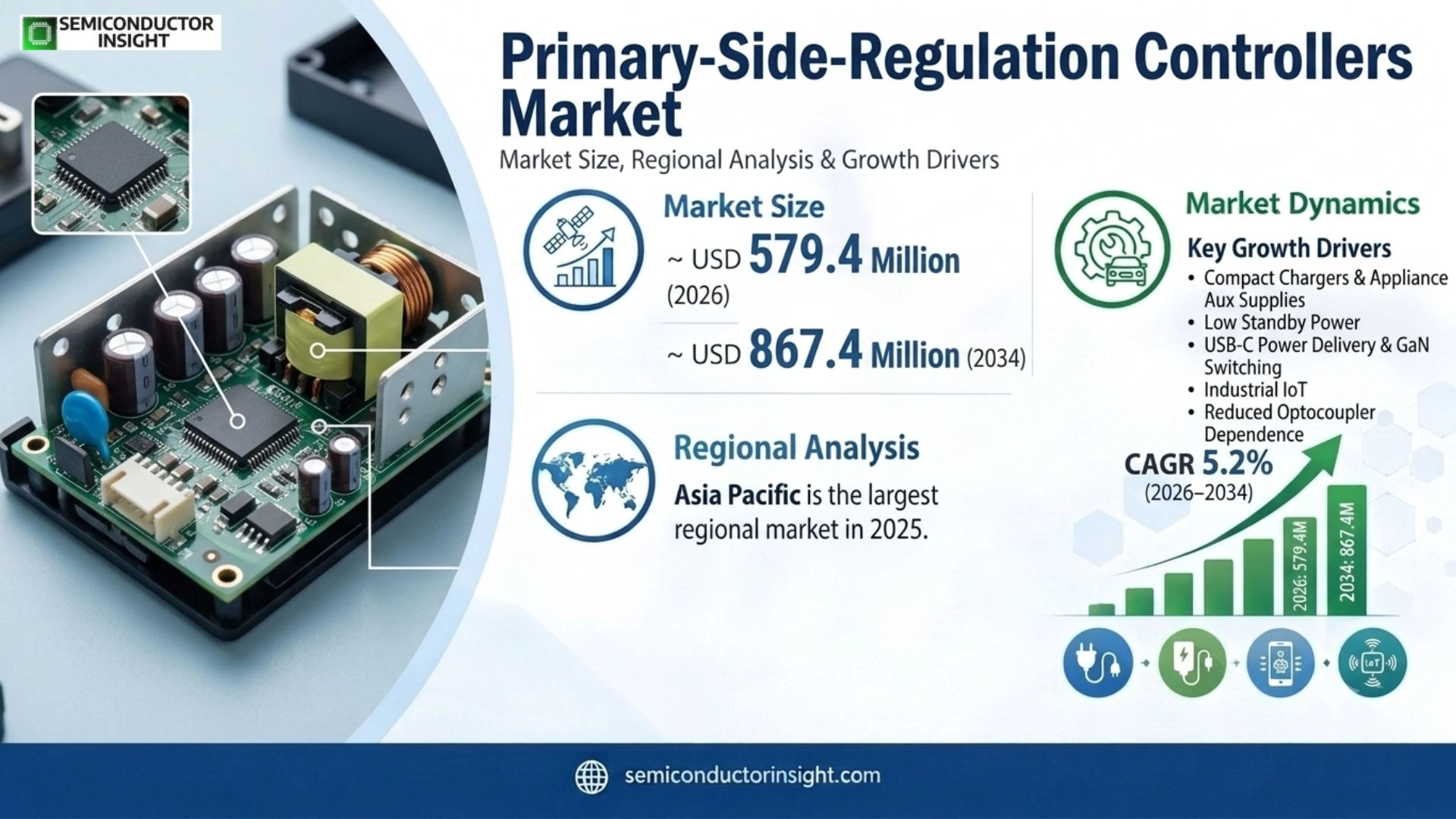
Primary-Side-Regulation Controllers Market was valued at USD 550.9 million in 2025, is estimated at USD 579.4 million in 2026, and is projected to reach USD 867.4 million by 2034, representing a CAGR of 5.2% during 2026–2034. Asia Pacific is the largest market in 2025, while the commercial growth mechanism is increasingly shaped by compact chargers, appliance auxiliary supplies, low standby power, synchronous rectification, USB-C power delivery, GaN switching, industrial IoT, and reduced optocoupler dependence.
Primary-side-regulation controllers manage isolated flyback power converters by estimating output voltage and current from signals measured on the transformer primary or auxiliary winding. This can eliminate the optocoupler and secondary-side reference used in conventional isolated feedback, reducing component count, PCB area and cost while improving long-term reliability in chargers, adapters, LED drivers and auxiliary power supplies.
The architecture is most attractive in low- and medium-power products where compact size and BOM efficiency are critical. Modern controllers use quasi-resonant or valley switching, cable compensation, high-voltage startup and low-power burst modes to maintain regulation across line and load. Synchronous rectification and GaN are extending practical power levels upward while preserving efficiency.
Competition increasingly spans a continuum between pure PSR controllers and highly integrated flyback switcher ICs. Texas Instruments maintains dedicated primary-side regulated controllers, ST offers high-power-factor devices with primary sensing, and Infineon and Power Integrations combine primary control with power switches, secondary functions and isolated communication. This expands the market from simple low-cost chargers into appliances, industrial systems and programmable USB-C power.
Segment Analysis: By Type
By power rating, the market is segmented into 15W Below, 15–30W, and 30W Above. The 15–30W segment leads because it is widely used in smartphone, appliance, IoT and general adapter designs where PSR can remove feedback components without creating excessive regulation or thermal complexity.
| Type | Technical role | Market position |
|---|---|---|
| 15W Below | Low-power flyback controllers target small chargers, standby supplies, LED drivers and IoT products where cost and no-load power are critical. | A large unit-volume category with strong competition and emphasis on few external components, small magnetics and very low standby consumption. |
| 15–30W | Mid-power PSR designs support faster chargers, appliance auxiliary rails and broader consumer/industrial adapters while retaining compact flyback economics. | The leading segment in the report scope. It balances attainable regulation, manageable thermal design and high-volume cost. |
| 30W Above | Higher-power products use more sophisticated primary-side estimation, synchronous rectification, GaN or integrated isolated-control approaches. | A faster-innovation segment. New SiP and programmable flyback solutions extend compact high-efficiency architectures into 45 W, 60 W, 100 W and higher designs. |
Why does PSR become harder as output power rises?
At higher power, load transients are larger and conduction losses, transformer parasitics and thermal behavior have greater impact on regulation. A controller that estimates output conditions from the primary side must compensate accurately for these effects without direct secondary measurement. Synchronous rectification, digital control and isolated communication can improve performance, but they also move the architecture toward more integrated solutions rather than the simplest low-cost PSR topology.
Segment Analysis: By Application
By application, the market is segmented into Charger, Adapter, and Others. Charger is the largest application, supported by the huge installed base of smartphones, tablets, wearables and other portable electronics.
| Application | Demand characteristics | Market position |
|---|---|---|
| Charger | Wall chargers and compact USB power products use PSR to reduce optocouplers, references and PCB area while maintaining constant-voltage and constant-current output. | The dominant application. Product differentiation centers on power density, USB-C profiles, standby power and total BOM. |
| Adapter | Adapters for routers, set-top boxes, appliances, peripherals and industrial equipment use PSR flyback for efficient isolated AC/DC conversion. | A broad and stable segment that values low no-load consumption, cable compensation and long-term reliability. |
| Others | Includes LED drivers, smart meters, appliance auxiliary supplies, industrial IoT, automotive auxiliary supplies and specialized isolated power. | A diversified growth segment as integration, synchronous rectification and higher voltage switches expand usable power and application range. |
Why do chargers continue to favor primary-side regulation?
Chargers are cost and space sensitive, and the feedback loop can account for several components plus isolation spacing. Primary-side regulation removes the optocoupler and secondary reference, simplifies the transformer interface and can achieve very low standby power. TI’s UCC28712, for example, provides PSR constant-voltage and constant-current operation with valley switching and less than 10 mW no-load power in a compact controller architecture.
Regional Analysis
Asia Pacific leads the Primary-Side-Regulation Controllers market, with the report assigning the region more than half of global demand and China representing a major share. North America and Europe remain important design centers and high-value markets for efficient adapters, industrial supplies and appliances.
Why does Asia Pacific dominate PSR controller volume?
The region manufactures a large share of global chargers, adapters, appliances, networking equipment and consumer electronics. Chinese and Taiwanese controller suppliers compete closely with global vendors on cost and local support. North America and Europe contribute major semiconductor design, energy-efficiency requirements and premium industrial applications, creating a market where volume production and control-IP leadership are geographically distributed.
| Region | Position | Growth outlook | Demand profile | What decides supplier selection |
|---|---|---|---|---|
| Asia Pacific | Largest >50% | Strong | Chargers, adapters, appliances and electronics manufacturing | BOM cost, compactness and local support |
| North America | Technology & premium market | Moderate to strong | Industrial, consumer, networking and design IP | Efficiency, regulation accuracy and design tools |
| Europe | Energy-efficiency & appliance market | Moderate | White goods, industrial and LED power | Standby power, regulation and compliance |
| South America | Developing import market | Selective | Consumer electronics, appliances and solar | Cost, availability and certification |
| Middle East & Africa | Emerging infrastructure market | Selective | Telecom, appliances and industrial supplies | Ruggedness, cost and distributor support |
Competitive Landscape
The market includes Texas Instruments, NXP Semiconductors, onsemi, Infineon Technologies, Richtek Technology, Joulwatt Technology, Silan Microelectronics, Chipown Micro-electronics, Dongke Semiconductor and other regional controller suppliers.
Texas Instruments maintains a deep dedicated PSR portfolio covering low-cost BJT-drive, MOSFET flyback and zero-standby concepts. Its advantage is extensive application documentation, reference designs and global distribution.
Infineon and ST increasingly blur the boundary between a controller and a complete flyback power stage. CoolSET SiP integrates primary and secondary control, isolated communication and high-voltage switching, while ST combines primary sensing with high-power-factor functions for lighting and auxiliary power.
Richtek, Silan, Chipown, Joulwatt and other Asian suppliers compete strongly in charger and adapter markets through cost optimization and local support. As USB-C power rises, vendors must decide whether to extend pure PSR or adopt more integrated synchronous and digitally controlled architectures.
| Competitive tier | Representative companies | Commercial basis |
|---|---|---|
| Global controller leaders | Texas Instruments; Infineon Technologies; onsemi; NXP Semiconductors | Broad power-management portfolios, efficiency features, global support and industrial/consumer qualification. |
| Integrated flyback platform suppliers | Power Integrations; STMicroelectronics; Infineon CoolSET | Primary control plus switching, synchronous rectification, isolated feedback and higher-power integration. |
| Asian cost-focused specialists | Richtek; Joulwatt; Silan Microelectronics; Chipown; Dongke Semiconductor | High-volume charger/adapter design support, compact BOM and local customer access. |
Key Market Participants
Texas Instruments, NXP Semiconductors, onsemi, Infineon Technologies, Richtek Technology, Joulwatt Technology, Silan Microelectronics, Chipown Micro-electronics, Dongke Semiconductor.
Production Capacity Analysis
PSR controller production uses mixed-signal and high-voltage semiconductor processes that integrate analog sensing, timing, digital state machines, gate drivers and startup circuitry. More integrated products add high-voltage MOSFET or GaN devices and secondary-side communication within the same package.
Dedicated PSR controllers are typically compact mixed-signal ICs manufactured on mature high-voltage analog processes. Process longevity and cost are more important than leading-edge transistor density.
Controller accuracy depends on internal references, current sensing and timing because the output is inferred from primary-side waveforms. Production test must therefore verify regulation thresholds, protection and startup behavior tightly.
System-in-package and integrated switchers add power semiconductors and isolated communication, increasing package complexity but reducing the customer’s BOM. These architectures are especially attractive as output power rises.
| Capacity layer | Where it concentrates | Commercial constraint |
|---|---|---|
| High-voltage analog wafer fabrication | United States, Europe and Asia | Precision references, startup cells, analog sensing and process longevity. |
| Power switch integration | Europe, United States and Asia | 650–900 V silicon/GaN devices, thermal design and switching loss. |
| Packaging & test | Asia Pacific and global backend hubs | High-voltage spacing, mixed-signal test and power dissipation. |
| Reference design / OEM qualification | Global power-supply design centers | Transformer tuning, EMC, efficiency, safety certification and thermal validation. |
Market Dynamics
PSR controller growth is driven by compact efficient AC/DC power and continued removal of secondary feedback components. The main constraints are regulation accuracy at higher power, transformer variability, thermal density and competition from increasingly integrated flyback architectures.
Market Drivers
| Factor | Directional impact | Why it matters |
|---|---|---|
| Compact chargers & adapters | High | Eliminating optocouplers and references reduces BOM and board area. |
| Low standby power | High | Global efficiency rules reward controllers with advanced burst and startup modes. |
| Synchronous rectification | Medium-High | Lower secondary loss enables higher output current and power density. |
| GaN & higher switching frequency | Medium-High | Smaller magnetics and ZVS can extend compact flyback power upward. |
BOM reduction remains PSR’s core economic advantage
A controller that regulates from the primary side can remove optocoupler, TL431-like reference and associated passives. In high-volume chargers, saving even a few components materially improves cost and assembly yield.
Standby efficiency drives controller sophistication
Adapters and appliances spend long periods at light load. Valley switching, burst operation and high-voltage startup allow modern PSR controllers to meet low no-load power targets.
Synchronous rectification broadens the usable power range
Replacing the secondary diode with a controlled MOSFET reduces conduction loss, especially at low output voltage and high current. This makes compact flyback more competitive for fast charging and appliance auxiliaries.
GaN enables smaller high-power adapters
Higher switching frequency reduces transformer and filter size. Integrated GaN flyback platforms show how control technology can move beyond the traditional sub-30 W PSR niche.
Market Restraints
| Factor | Directional impact | Why it matters |
|---|---|---|
| Higher-power regulation accuracy | High | Primary-side estimation becomes harder under fast load changes and parasitic variation. |
| Transformer dependency | High | Leakage inductance and winding tolerances influence sensed waveforms. |
| Thermal density | Medium-High | Compact adapters must remove switching and conduction heat from small enclosures. |
| Integrated architecture substitution | Medium-High | Secondary-sensing or isolated-link ICs can provide tighter control while still eliminating optocouplers. |
Primary estimation has inherent limits
The controller does not measure output voltage continuously on the secondary side. Cable drop, diode or SR behavior and transformer parasitics can therefore reduce accuracy under dynamic loads.
Magnetics become part of the control loop
Transformer turns ratio, leakage and auxiliary-winding behavior affect feedback. Manufacturing tolerance must be considered during controller compensation and production test.
Power density creates thermal trade-offs
Faster switching shrinks magnetics but raises switching and package heat. Designers need careful layout, thermal spreading and efficiency optimization in sealed chargers and appliances.
Highly integrated alternatives can bypass pure PSR
FluxLink-like isolated communication or integrated secondary control can deliver tighter regulation without an optocoupler. These architectures compete directly for higher-value fast-charging designs.
Market Opportunities
15–30 W mass-market chargers
Low component count and PSR economics remain compelling in very high-volume compact adapters.
Appliance auxiliary power
Low standby and higher-voltage integrated flyback can serve inverter white goods and smart appliances.
Industrial IoT
Small isolated supplies can use PSR to reduce size and improve field reliability.
GaN / synchronous hybrid architectures
Combining primary control with GaN switching and SR can extend power density into premium fast chargers.
Supply Chain Analysis
Controller IC Design. PSR relies on accurate primary-side waveform sampling, internal references and mode control. Design IP and application algorithms are therefore more important than transistor scaling.
Wafer & Packaging. Most controllers use mature analog processes for cost and high-voltage integration. More advanced SiP products combine power switches and isolated links, increasing backend complexity.
Transformer / Power Stage Design. Transformer parameters strongly affect regulation, so semiconductor vendors provide reference designs and calculation tools. Synchronous rectification adds another control element but improves efficiency.
Adapter / Appliance Integration. Final products must meet safety isolation, EMC, active-mode efficiency and no-load limits. A controller with robust reference designs can reduce certification iterations and customer time to market.
Recent Developments in the Primary-Side-Regulation (PSR) Controllers Market
Developments tracked to September 2026. Entries are dated to the official publication date where available.
-
2 June 2026 IntegrationInfineon introduced three new CoolSET System-in-Package variants for white-goods auxiliary supplies. The devices integrate an 800 V power switch, primary/secondary control, synchronous rectification and isolated communication and extend supported output power up to 150 W.
-
2026 Active productTexas Instruments continues offering UCC28722 as a low-cost constant-voltage/current flyback controller with primary-side regulation. The device eliminates optocoupler feedback and fits in a six-pin SOT-23 package.
-
2026 Low standbyTI’s active UCC28712 combines PSR, valley switching, high-voltage startup and less than 10 mW no-load power. These features target compact energy-efficient adapters.
-
2026 Lighting & auxiliary powerSTMicroelectronics keeps HVLED001B in volume production. The controller supports primary-side regulation in high-power-factor flyback designs with very low standby consumption and broad fault protection.
-
2026 High-power flybackPower Integrations’ InnoSwitch5-Pro platform supports up to 140 kHz, ZVS, PowiGaN switching and synchronous rectification for programmable flyback power supplies. It demonstrates how integrated architectures are pushing compact flyback into higher power classes.
Report Scope & Segmentation
| Attribute | Coverage |
|---|---|
| Report title | Primary-Side-Regulation (PSR) Controllers Market, Trends, Business Strategies 2025-2032 |
| Base Year | 2025 |
| Estimated Year | 2026 |
| Forecast Period | 2026–2034 |
| By Type | 15W Below; 15-30W; 30W Above |
| By Application | Charger; Adapter; Others |
| By Technology | Non-synchronous Rectification; Synchronous Rectification |
| By End User | Consumer Electronics; Telecommunications; Automotive; Industrial; Others |
| Regions | North America; Europe; Asia Pacific; South America; Middle East & Africa |
| Companies | Texas Instruments; NXP Semiconductors; onsemi; Infineon Technologies; Richtek Technology; Joulwatt Technology; Silan Microelectronics; Chipown Micro-electronics; Dongke Semiconductor |
| Customization scope | Country, segment, company, application, technology, production and competitive-detail customization available within the study scope. |
Frequently Asked Questions
What is the size of the Primary-Side-Regulation Controllers market?
The global PSR Controllers market is valued at USD 550.9 million in 2025, is estimated at USD 579.4 million in 2026, and is projected to reach USD 867.4 million by 2034, representing a 5.2% CAGR during 2026–2034. The standardized 2025–2034 series is used consistently across the overview so market size, forecast outlook and growth rate remain on one time basis. Commercial demand is shaped by compact chargers, appliance auxiliary supplies, low standby power, synchronous rectification, USB-C power delivery, GaN switching, industrial IoT, and reduced optocoupler dependence.
Which region leads the PSR Controllers market?
Asia Pacific leads with more than half of reported demand because the region manufactures a large share of the world’s chargers, adapters, appliances and consumer electronics. Regional leadership reflects installed production or consumption, customer concentration, supplier ecosystems and end-market intensity. Country discussion focuses on markets with clear operating drivers rather than forcing unsupported country shares. Supplier selection in these markets therefore reflects local service, qualification history and supply assurance as well as headline component performance.
Which power segment leads?
15–30W leads in the report scope because it offers a strong balance of output power, compact size, regulation performance and BOM cost. Segment leadership matters because suppliers allocate R&D, capacity and channel resources toward the product classes with the strongest combination of volume, qualification value and system relevance. Over the forecast period, the mix can still shift toward higher-value variants as technical requirements rise. This remains commercially relevant because design-in decisions can persist for several product generations once performance and reliability are validated.
Which application is largest?
Charger is the largest application because primary-side regulation can eliminate optocouplers and secondary feedback components in compact high-volume AC/DC products. Application demand also depends on design cycles, qualification requirements, replacement timing and end-user investment, so suppliers that solve a measurable performance, efficiency or reliability problem are better positioned to defend design wins. Long design cycles can make successful application wins durable and commercially attractive for qualified suppliers.
What is the main benefit of primary-side regulation?
PSR reduces component count and isolation-side complexity by estimating output conditions from primary-side transformer signals instead of using a traditional optocoupler feedback loop. The commercial importance of this technology comes from improving system performance or simplifying implementation while balancing cost, efficiency, reliability, integration and qualification requirements. That system-level value is the main reason the technology can command a premium over simpler alternatives in demanding use cases.
Why is synchronous rectification important?
Synchronous rectification replaces the secondary diode with a controlled MOSFET, reducing conduction losses and helping compact flyback supplies handle higher current efficiently. This trend affects both component selection and the surrounding system architecture, so buyers increasingly evaluate the complete power, thermal, signal or manufacturing outcome rather than one headline specification. Vendors that support application design and validation can turn this technical shift into longer customer relationships.
What are the main restraints?
Higher-power regulation accuracy, transformer tolerance, thermal density and competition from more integrated isolated-control architectures are the main restraints. These constraints influence where adoption is fastest and which suppliers can earn premium margins. Proven reliability, application engineering, supply continuity and qualification support can reduce several of these barriers. These barriers can also protect established suppliers once their devices or systems are approved in production programs. For Primary-Side-Regulation (PSR) Controllers, this point also affects supplier qualification, product positioning and purchasing decisions across the 2026–2034 forecast period.
Who are the major PSR controller companies?
Major companies include Texas Instruments, NXP, onsemi, Infineon, Richtek, Joulwatt, Silan Microelectronics, Chipown and Dongke Semiconductor. Competitive position depends on breadth of qualified products, manufacturing scale, customer support, process technology and participation in higher-value applications rather than market presence alone. This is why product breadth and engineering support remain meaningful competitive differentiators throughout the forecast period. In the Primary-Side-Regulation (PSR) Controllers market, buyers therefore evaluate lifecycle support, technical fit and supply continuity alongside the headline specification.
How is GaN changing the market?
GaN reduces switching losses and supports higher frequency, which shrinks magnetic components and allows flyback power supplies to deliver more output from smaller enclosures. The shift is important because packaging, integration or control architecture can improve usable system performance without requiring a complete change in the end application, leaving room for differentiated products even in mature markets. Suppliers that combine device performance with manufacturability and qualification support are best placed to monetize the shift.
Where are the strongest opportunities?
The strongest opportunities are in 15–30 W chargers, appliance auxiliary supplies, industrial IoT and GaN/synchronous high-density flyback architectures. Opportunity is strongest where a clear system bottleneck is emerging and suppliers can solve it with better performance, integration, capacity or lifecycle support. The most attractive niches also tend to have higher qualification barriers. That combination of structural demand and qualification barriers supports the most defensible growth opportunities.
Research Sources & Evidence Base
Get Sample Report PDF for Exclusive Insights
Report Sample Includes
- Table of Contents
- List of Tables & Figures
- Charts, Research Methodology, and more...
 Download Sample Report PDF