
Bipolar Junction Transistor (BJT) Market Insights
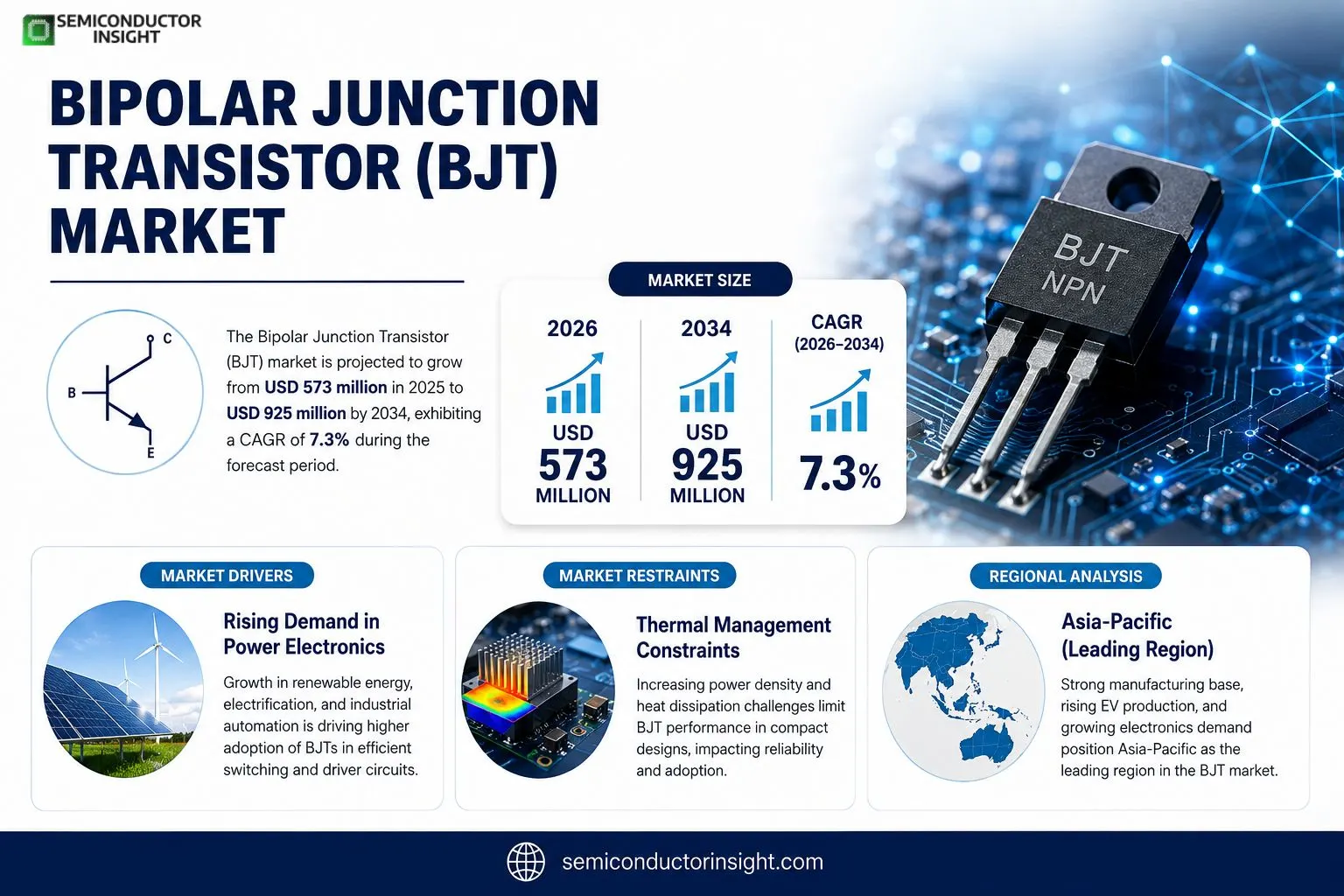
Bipolar Junction Transistor (BJT) market size was valued at USD 573 million in 2025. The market is projected to grow from USD 573 million in 2025 to USD 925 million by 2034, exhibiting a CAGR of 7.3% during the forecast period.
A Bipolar Junction Transistor (BJT) is a three‑terminal active discrete device consisting of an emitter, base and collector. It is called “bipolar” because charge transport involves both electrons and holes, and it is supplied in two polaritiesNPN and PNP. In practical circuits a small base current controls a much larger collector current, which makes BJTs inherently suitable for amplification and switching functions.The upward trend is driven by accelerating vehicle electrification EV sales are expected to surpass 20 million units in 2025and rising data‑center power consumption that expands demand for reliable driver and bias stages. As a result, suppliers are launching low VCE(sat) families, tighter gain binning and automotive‑qualified packages that address tighter reliability requirements while reducing bill‑of‑materials complexity.
MARKET DRIVERS
Rising Demand in Power Electronics
The surge in renewable‑energy installations has forced manufacturers to rely more heavily on efficient switching devices. Bipolar Junction Transistor (BJT) Market volumes climbed to roughly 1.2 billion units in 2023, reflecting a 4 % year‑over‑year increase as grid‑scale inverters and motor‑drive systems adopt BJT architectures for their cost‑effectiveness and linear performance.
Shift Toward High‑Frequency Applications
Communications hardware and RF front‑ends now operate at frequencies where traditional silicon BJT designs deliver lower noise and faster transition times. Vendors that optimized epitaxial layers reported a 6 % uplift in premium‑grade shipments, indicating that performance‑centric sectors are reshaping the product mix.
➤ “Design engineers are selecting BJTs over MOSFETs when linearity and saturation margin outweigh switching speed, a trend that directly fuels higher average selling prices.”
These dynamics compel suppliers to expand wafer‑scale capacity and to invest in next‑generation doping techniques, positioning the Bipolar Junction Transistor (BJT) Market for a modest but sustained expansion over the next cycle.
MARKET CHALLENGES
Cost Sensitivity in High‑Volume Production
Large‑scale automotive factories benchmark component cost per watt against aggressive targets. Even a 0.3 % price dip in BJT units can swing profit margins, prompting OEMs to audit supplier pricing models and to push for bulk‑discount structures.
Other Challenges
Supply Chain Volatility
The semiconductor supply chain continues to experience periodic disruptions in silicon wafer deliveries, especially from regions affected by geopolitical tensions. Enterprises that lack diversified sourcing face lead‑time extensions of up to 45 days, eroding just‑in‑time manufacturing efficiencies.
MARKET RESTRAINTS
Thermal Management Constraints
As power densities rise, the ability of traditional heat‑sink solutions to dissipate excess thermal energy becomes a limiting factor for BJT deployment in compact modules. Engineers report that excessive junction temperatures reduce reliability thresholds by up to 15 %, prompting a shift toward alternative material stacks that are not yet mass‑produced.
MARKET OPPORTUNITIES
Emerging Automotive Electrification
The transition to electric drivetrains creates a niche for BJTs in battery‑management and auxiliary‑power converters where linear regulation remains essential. Forecasts suggest that niche applications could contribute an additional 120 million units by 2027, offering manufacturers a clear avenue for revenue diversification beyond conventional industrial segments.
Bipolar Junction Transistor (BJT) Market Trends
Emergence of Low‑Loss, High‑Speed Device Families
Recent product cycles show manufacturers concentrating on low VCE(sat) architectures that shave millivolts from saturation losses while preserving voltage rating. The engineering trade‑off is achieved through tighter transistor geometry and refined impurity profiles, which also accelerate turn‑on and turn‑off transients. These characteristics matter most to automotive power‑train modules, where thermal budgets are shrinking and switching frequencies are creeping upward to meet efficiency targets. In industrial motor‑drive boards, the ability to reduce gate‑drive resistance translates directly into lower heat‑sink requirements, freeing up board real‑estate for additional functions. Consequently, design houses are specifying these families as default choices for new generations of SiC‑based inverters and high‑speed LED drivers, prompting a noticeable shift in bill‑of‑materials composition.
Other Trends
Value‑Added BJT Variants
Pre‑biased or resistor‑equipped transistors are gaining traction in applications where assembly steps must be minimized. By integrating a bias resistor on the die, suppliers eliminate an external component, which shortens pick‑and‑place cycles and reduces part‑count variance. This approach resonates with OEMs targeting cost‑sensitive consumer electronics and compact automotive sensor modules. Multi‑device packages that bundle complementary NPN/PNP pairs further simplify board layout, especially in differential amplifier stages where matching is critical. The market response is reflected in incremental price premiums for these “ready‑to‑use” solutions, indicating that customers are willing to trade a modest cost increase for higher yield and faster time‑to‑market.
Supply Chain Consolidation and Regional Opportunities
While the overall volume of discrete BJTs remains stable, the competitive field is consolidating around a core group of suppliers with deep automotive qualification portfolios. Companies that have invested in hermetic packaging and stringent quality‑system certifications are increasingly favored for high‑reliability programs, compressing market share away from lower‑cost, less‑qualified producers. At the same time, growth pockets are emerging in regions that are expanding electric‑vehicle production capacity and data‑center construction. In those geographies, demand for driver‑stage transistors and bias networks supports modest but sustained volume upticks. The strategic implication for vendors is clear: aligning product roadmaps with regional electrification milestones and bolstering local support infrastructure will be essential to capture incremental revenue in the coming years.
COMPETITIVE LANDSCAPE
Key Industry Players
Competitive dynamics and strategic positioning in the BJT market
The BJT segment continues to be dominated by a handful of multinational semiconductor firms that have integrated the device into broader analog and power‑management portfolios. Infineon Technologies AG, STMicroelectronics, and onsemi together account for a decisive share of annual shipments, thanks to extensive automotive‑qualification programs and deep relationships with tier‑one OEMs. Their product families span low‑VCE(sat) switching devices, high‑speed small‑signal transistors, and rugged power BJTs that meet stringent thermal‑cycling specifications. By leveraging manufacturing footprints in Europe and Asia, these leaders achieve economies of scale that keep unit pricing competitive while still investing in niche innovations such as pre‑biased, resistor‑integrated packages designed for BOM simplification in electric‑vehicle power modules.Beyond the primary tier, a diverse cohort of specialist and regionally focused suppliers injects variety into the market. Vishay Intertechnology, Diodes Incorporated, Nexperia, ROHM Co., Ltd., and Toshiba Electronic Devices & Storage maintain strong footholds in industrial‑control and communications applications through targeted device families that emphasize high gain stability and tight binning. Chinese manufacturersincluding Yangzhou Yangjie Electronic Technology, Hangzhou Silan Microelectronics, and Suzhou Good‑Ark Electronicshave expanded distribution channels across Southeast Asia, offering cost‑effective alternatives for consumer‑electronics designers. Niche players such as Sanken Electric and Shindengen Electric specialize in RF and high‑voltage Darlingtons, catering to data‑center power‑conversion and AI‑accelerator cooling circuits where precise switching characteristics are paramount. Their agility in launching custom packaging solutions adds a layer of differentiation that larger firms find harder to replicate.
List of Key Bipolar Junction Transistor Companies Profiled
- Infineon Technologies AG
- STMicroelectronics
- onsemi
- Vishay Intertechnology
- Diodes Incorporated
- Nexperia
- ROHM Co., Ltd.
- Toshiba Electronic Devices & Storage Corporation
- Renesas Electronics
- Sanken Electric
- Fuji Electric
- Shindengen Electric Manufacturing Co., Ltd.
- Yangzhou Yangjie Electronic Technology Co., Ltd.
- Hangzhou Silan Microelectronics Co., Ltd.
- China Resources Microelectronics Limited
Segment Analysis:
| Segment Category | Sub-Segments | Key Insights |
| By Type |
|
Small‑signal BJTs dominate this category because:
|
| By Application |
|
Switching and driver circuits are a leading application because:
|
| By End User |
|
Automotive electronics lead this segment due to:
|
| By Integration/Structure |
|
Multi‑device packages are gaining traction because:
|
| By Performance Parameter |
|
Low VCE(sat) families are the preferred choice because:
|
Regional Analysis: Bipolar Junction Transistor (BJT) Market
Companies in the United States are experimenting with heterogeneous integration, marrying BJTs with CMOS blocks to lower parasitic losses. The approach shortens interconnect paths, delivering higher switching speeds for power‑train modules. Early adopters report a noticeable lift in system efficiency, prompting a gradual shift toward these composite solutions.
North American firms have diversified wafer sources across the continent, reducing reliance on any single supplier. This redundancy, reinforced by strategic stockpiles, buffers manufacturers against geopolitical disruptions and helps maintain steady component flow to downstream assemblers.
Leading automotive OEMs collaborate closely with BJT producers to co‑develop modules that meet stringent emissions standards. Joint road‑mapping sessions ensure that device specifications align with future electric‑vehicle architectures, establishing a clear pipeline of demand for specialized transistor families.
Federal energy‑efficiency mandates encourage designs that incorporate BJTs for low‑loss power conversion. Compliance testing frameworks have been updated to recognize newer BJT topologies, smoothing the path for market entry and encouraging broader adoption across industrial applications.
Europe
European manufacturers leverage a strong emphasis on sustainability, steering BJT development toward high‑temperature, low‑leakage devices suitable for renewable‑energy converters. Germany’s automotive cluster integrates these transistors into high‑voltage inverters, while the Nordic region focuses on grid‑stability solutions that demand robust thermal performance. Collaborative research programs funded by the EU create cross‑border intellectual property pools, accelerating time‑to‑market for innovative BJT variants. The region’s regulatory climate, aligned with energy‑efficiency directives, further nudges system designers to favor BJTs over alternative switch technologies.
Asia‑Pacific
The Asia‑Pacific landscape is defined by rapid scaling of production capacity and a burgeoning consumer‑electronics market that values compact power stages. Chinese fabs have introduced cost‑effective BJT lines that cater to mass‑market adapters, while South Korean firms tie transistor performance to next‑generation 5G infrastructure. Vietnam and India are emerging as cost‑competent assembly hubs, drawing players seeking to balance price pressure with quality. This geographic diversification intensifies competition, compelling incumbents to differentiate through advanced material engineering rather than volume alone.
South America
In South America, local demand is driven by expanding renewable‑energy farms and a growing transportation electrification agenda. Brazil’s government incentives for solar‑plus‑storage projects have sparked interest in BJTs that can handle high‑current charge‑discharge cycles. Argentine manufacturers are experimenting with BJT‑based motor‑drive modules for agro‑machinery, where ruggedness and low maintenance are prized. Although the market size remains modest, these niche applications create a fertile testing ground for tailored transistor solutions.
Middle East & Africa
The Middle East & Africa region showcases a mix of high‑value projects and nascent industrial growth. Saudi Arabia’s Vision‑2030 initiatives fund large‑scale desalination plants that rely on power‑efficient BJT converters to curtail operational costs. Meanwhile, African telecom operators upgrade base‑stations, opting for BJTs that deliver reliable performance in harsh climates. Limited local fabrication means most components are imported, yet strategic partnerships with suppliers are emerging to secure long‑term supply and foster technology transfer.
Report Scope
This market research report provides a comprehensive analysis of the Bipolar Junction Transistor (BJT) Market , covering the forecast period 2026–2034. It offers detailed insights into market dynamics, technological advancements, competitive landscape, and key trends shaping the industry.
Key focus areas of the report include:
- Market Overview: The report begins with an overview outlining its current market scenario, key growth indicators, and industry transformation drivers. It discusses macroeconomic factors, demand–supply balance, regulatory landscape, and the strategic role of semiconductors in powering advancements across industries such as automotive, telecommunications, consumer electronics, and industrial automation.
- Market Size & Forecast: Historical data and future projections for revenue, unit shipments, and market value across major regions and segments.
- Segmentation Analysis: Detailed breakdown by product type, technology, application, and end-user industry to identify high-growth segments and investment opportunities.
- Regional Insights: Insights into market performance across North America, Europe, Asia-Pacific, Latin America, and the Middle East & Africa, including country-level analysis where relevant.
- Competitive Landscape: Profiles of leading market participants, including their product offerings, R&D focus, manufacturing capacity, pricing strategies, and recent developments such as mergers, acquisitions, and partnerships.
- Technology Trends & Innovation: Assessment of emerging technologies, integration of AI/IoT, semiconductor design trends, fabrication techniques, and evolving industry standards.
- Market Drivers & Restraints: Evaluation of factors driving market growth along with challenges, supply chain constraints, regulatory issues, and market-entry barriers.
- Stakeholder Insights: Insights for component suppliers, OEMs, system integrators, investors, and policymakers regarding the evolving ecosystem and strategic opportunities.
Primary and secondary research methods are employed, including interviews with industry experts, data from verified sources, and real-time market intelligence to ensure the accuracy and reliability of the insights presented.
FREQUENTLY ASKED QUESTIONS:
What is the current market size of Bipolar Junction Transistor (BJT) Market?
-> Bipolar Junction Transistor (BJT) Market was valued at USD 573 million in 2025 and is expected to reach USD 925 million by 2034, at a CAGR of 7.3% during the forecast period.
Which key companies operate in Bipolar Junction Transistor (BJT) Market?
-> Key players include Infineon Technologies AG, STMicroelectronics, onsemi, Nexperia, ROHM Co., Ltd., Toshiba Electronic Devices & Storage Corporation, Diodes Incorporated, Microchip Technology, among others.
What are the key growth drivers?
-> Key growth drivers include electrification of transportation (rising EV sales), increasing AI and data‑centre power demand, automotive reliability requirements, and broader industrial automation trends.
Which region dominates the market?
-> Asia‑Pacific is the leading region, while Europe remains a major market.
What are the emerging trends?
-> Emerging trends include low VCE(sat) and faster switching families, tighter gain control/binning, higher temperature capability, smaller/lower‑parasitic packages, and the rise of pre‑biased/resistor‑equipped multi‑device BJTs.

Get Sample Report PDF for Exclusive Insights
Report Sample Includes
- Table of Contents
- List of Tables & Figures
- Charts, Research Methodology, and more...
 Download Sample Report PDF





