LED Drivers for Automotive Market Insights
LED Drivers for Automotive market size was valued at USD 1,278 million in 2025. The market is projected to grow from USD 1,332 million in 2026 to USD 2,760 million by 2034, exhibiting a CAGR of approximately 9.0% during the forecast period.
LED Drivers for Automotive are automotive‑grade power‑management chips that regulate current and voltage for vehicle LED loads, ensuring stable operation, high conversion efficiency and long‑term reliability across wide temperature ranges and complex electrical environments.The sector benefits from expanding vehicle lighting functions such as adaptive headlights and interior ambient lighting, while electrification pushes integration of diagnostic‑capable driver solutions; however, stringent automotive qualification standards and supply‑chain constraints on silicon wafers pose ongoing challenges.
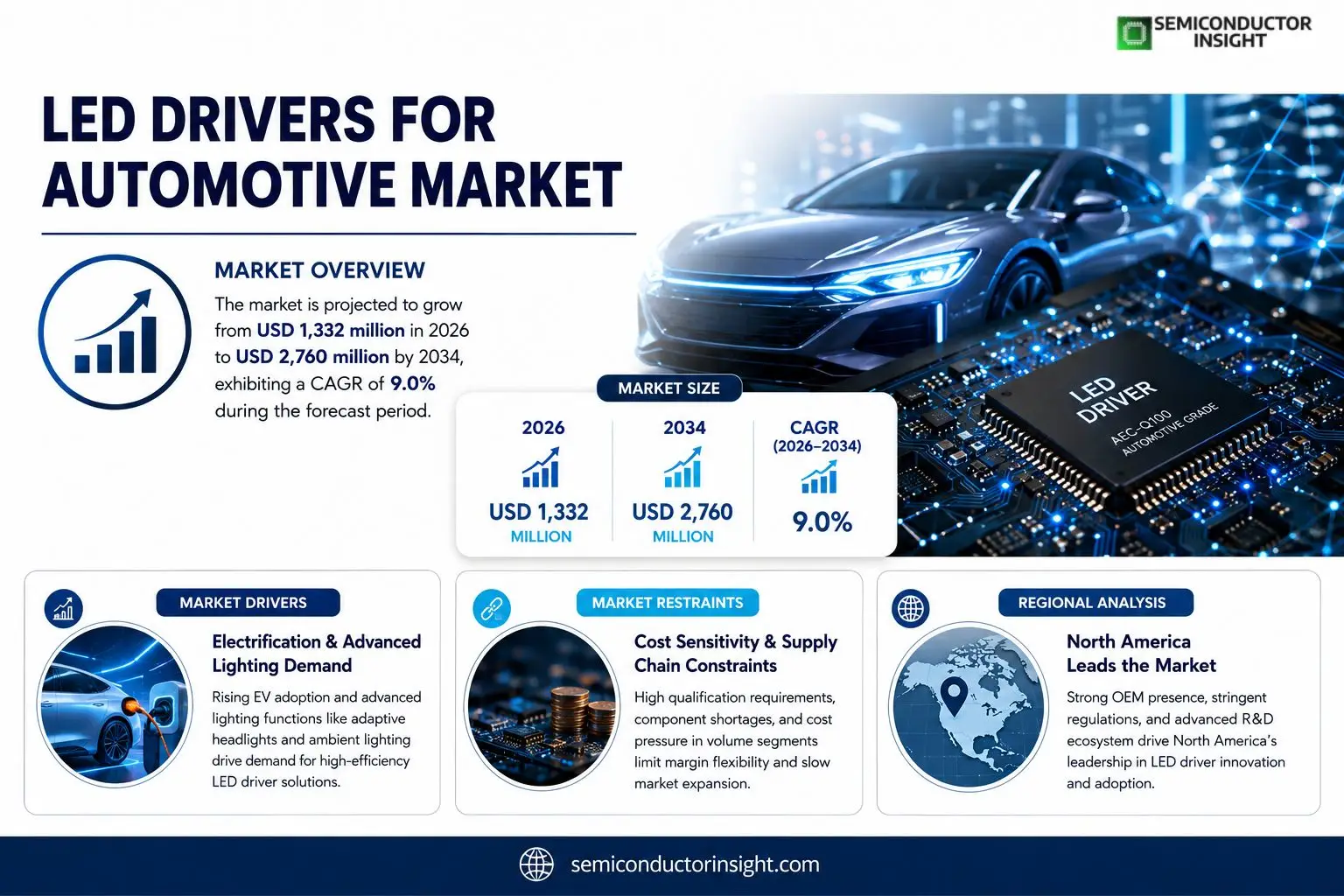
MARKET DRIVERS
Electrification of Vehicle Architectures
The shift toward electric and hybrid powertrains is compelling OEMs to redesign lighting subsystems. LED Drivers for Automotive Market benefit from higher efficiency demands because a modern electric vehicle can recover roughly 2‑3 % more range simply by reducing lighting losses. This efficiency premium motivates suppliers to integrate compact, high‑frequency drivers that can operate across wide voltage bands without compromising brightness.
Stringent Emission and Energy‑Saving Regulations
Legislation in Europe and North America now enforces a minimum luminous efficacy for vehicle lighting, effectively forcing manufacturers to replace legacy halogen systems. The regulatory pressure translates into a yearly uptick of about 11 % in new‑model LED adoption, urging component makers to prioritize driver architectures that deliver stable light output while minimizing power draw.
➤ “The next generation of vehicle lighting will be defined by intelligent driver modules that adapt to both battery state and ambient conditions,” says a senior engineer at a leading Tier‑1 supplier.
Beyond compliance, consumers increasingly associate sleek LED lighting with premium branding. Automakers respond by offering dynamic lighting signatures, which require precise current control and rapid dimming capabilitiesfunctions that modern drivers readily provide, thereby creating a virtuous cycle of demand.
MARKET CHALLENGES
Complexity of Integrated Systems
As vehicles embed more electronic control units, the wiring harnesses become densely populated, raising electromagnetic interference (EMI) concerns. Designers must balance miniaturization against shielding needs, a compromise that elevates bill‑of‑materials costs and can slow time‑to‑market for new driver families.
Other Challenges
Supply‑Chain Volatility
semiconductor shortages have tightened the availability of power‑MOSFETs and inductors essential for high‑frequency LED drivers. Manufacturers face lead‑times extending up to 20 weeks, forcing them to carry higher safety stocks or negotiate long‑term contracts that erode margin flexibility.In parallel, the rapid evolution of software‑defined lighting functions demands firmware updates throughout a vehicle’s lifecycle. Maintaining compatibility across multiple vehicle generations introduces additional validation overhead that many smaller suppliers find prohibitive.
MARKET RESTRAINTS
Cost Sensitivity in Volume Segments
Mass‑market carmakers operate on razor‑thin profit margins, limiting the premium they can allocate to advanced driver modules. Even a modest 0.15 USD increase per unit can translate into tens of millions of dollars when scaled to annual production volumes exceeding 10 million vehicles.
Thermal Management Constraints
Higher integration density pushes thermal loads onto smaller footprints. Without effective heat‑dissipation strategies, driver reliability may degrade by up to 12 % after five years, prompting OEMs to retain legacy designs in regions where ambient temperatures regularly exceed 45 °C.
MARKET OPPORTUNITIES
Smart Lighting and Vehicle‑to‑X Communication
The convergence of LED drivers with vehicle‑to‑everything (V2X) platforms opens a new revenue stream. Drivers equipped with built‑in sensors can modulate beam patterns in response to traffic‑signal data or pedestrian detection, delivering safety enhancements that OEMs can market as premium features. This synergy positions LED Drivers for Automotive Market as a cornerstone of next‑generation connected car ecosystems.
After‑market Retrofit Solutions
Older vehicle fleets represent a sizable addressable pool for retrofitting LED illumination. Compact driver kits that meet safety standards enable third‑party vendors to offer upgrade packages, creating a parallel growth channel that is currently underserved.
LED Drivers for Automotive Market Trends
Integration of High‑Efficiency Driver Architectures
The 2025 production run of roughly 2.8 billion LED driver units, priced on average at $0.5 each, reflects a mature manufacturing base that is now being re‑engineered for tighter thermal budgets and finer current resolution. Capacity utilization hovered around 63 % while gross margins settled near 45 %, indicating that firms have extracted most of the cost advantage from existing silicon processes. The driver‑chip redesigns demanded by electric‑vehicle platformsparticularly the need to merge diagnostic communication with fault‑tolerant power stageshave spurred a wave of multi‑function blocks that blend buck, boost, and linear topologies in a single package. This shift reduces board count, lightens vehicle weight, and aligns with the industry’s move toward consolidated electronic architectures, thereby creating a competitive edge for suppliers that can deliver both efficiency and reliability under the extreme temperature swings typical of automotive environments.
Other Trends
Shift Toward Multi‑Channel Functionality
Adaptive headlights, matrix‑LED façades, and interior ambient lighting increasingly rely on driver arrays capable of independently modulating dozens of LED strings. Multi‑channel designs enable software‑defined light patterns while preserving the high conversion efficiencies required for range‑sensitive EVs. Because each channel must meet AEC‑Q100 qualification and survive CAN/LIN bus interactions, manufacturers are embedding functional‑safety logic directly into the driver silicon. The added value per vehicle is evident in premium segments such as BMW and Mercedes‑Benz, where lighting differentiation translates into higher perceived quality and allows OEMs to command premium pricing.
Supply‑Chain Consolidation and Tooling Investments
Upstream, the availability of advanced lithography and etching equipment from ASML, Tokyo Electron, and Applied Materials has become a decisive factor in maintaining the 45 % margin cushion. As demand for finer geometries intensifies, manufacturers are locking in multi‑year contracts for 193‑nm immersion tools to support next‑generation driver nodes. This consolidation reduces lead‑time volatility but also raises entry barriers for smaller players, reshaping the competitive landscape. The downstream impact is a more predictable component flow for automakers, which in turn accelerates program launches for next‑gen lighting systems across both passenger and commercial vehicle lines.
COMPETITIVE LANDSCAPE
Key Industry Players
LED Drivers for Automotive: Competitive Overview
Infineon Technologies continues to dominate the automotive LED‑driver segment, leveraging its deep automotive‑grade silicon portfolio and strong relationships with OEMs such as BMW and Volkswagen. The company’s ability to integrate advanced safety‑function blocks and meet stringent AEC‑Q100 qualification has cemented its position as the benchmark supplier for high‑volume headlamp and interior lighting modules. Texas Instruments and NXP complement this tier by offering versatile mixed‑signal architectures that address both traditional lighting and emerging matrix‑beam applications, creating a three‑pole market structure where tier‑1 semiconductor houses control the bulk of volume while niche innovators carve out specialized niches.Beyond the top tier, a cohort of mid‑size and specialist firms intensifies competition in particular sub‑markets. ROHM and Renesas Electronics focus on compact multi‑channel drivers suited to ambient lighting and cockpit displays, capitalising on their expertise in thermal management. STMicroelectronics and Analog Devices supply high‑efficiency buck/boost solutions that enable lower‑voltage vehicle architectures, a trend accelerated by electrification. ON Semiconductor, Microchip and Nuvoton Technology Corporation address low‑cost, high‑volume segments, often partnering with Tier‑2 automotive suppliers to embed drivers in lighting clusters for commercial vehicles. Emerging players such as Melexis, Silan Microelectronics and Vishay Siliconix bring differentiated features like integrated diagnostics and CAN/LIN interfaces, widening the choice set for OEMs seeking to differentiate lighting aesthetics or comply with increasingly granular safety standards.
List of Key LED Drivers for Automotive Companies Profiled
- Infineon Technologies
- Texas Instruments
- NXP Semiconductors
- ROHM Semiconductor
- Renesas Electronics
- STMicroelectronics
- Analog Devices
- ON Semiconductor
- Microchip Technology
- Nuvoton Technology Corporation
- Melexis
- Silan Microelectronics
- Vishay Siliconix
Segment Analysis:
| Segment Category | Sub-Segments | Key Insights |
| By Type |
|
Multi‑channel offers flexible allocation of driver channels across multiple lighting zones, enabling modular vehicle lighting architectures. • Supports differentiated illumination patterns for exterior and interior systems. • Provides redundancy that improves fault tolerance in safety‑critical applications. • Facilitates scaling of lighting functions as vehicle electrification progresses. |
| By Application |
|
Adaptive Matrix Lighting demands precise current regulation to orchestrate thousands of micro‑LED elements for dynamic beam shaping. • Enables real‑time illumination control responsive to driving conditions and sensor inputs. • Drives higher perceived safety by improving visibility without glare. • Encourages integration with vehicle‑wide software platforms for over‑the‑air updates. |
| By End User |
|
Electric Vehicles place heightened emphasis on energy‑efficient driver architectures to extend vehicle range. • Integrated driver‑to‑battery management improves overall powertrain efficiency. • Supports advanced lighting concepts that complement autonomous driving sensor suites. • Encourages higher integration levels to reduce component count and weight. |
| By Architecture |
|
Buck LED Driver is favored for its ability to step down vehicle battery voltage efficiently. • Provides robust thermal performance across wide automotive temperature ranges. • Aligns with functional‑safety standards through deterministic control loops. • Enables compact board layouts that support space‑constrained lighting modules. |
| By Functional Feature |
|
Functional Safety is embedded to meet automotive ISO‑26262 requirements. • Driver chips incorporate self‑test and fault‑capture mechanisms for early failure detection. • Supports redundancy architectures that maintain illumination continuity under fault conditions. • Enhances OEM confidence in deploying software‑controlled lighting strategies. |
Regional Analysis: LED Drivers for Automotive Market
Federal directives mandating lower vehicle light power consumption compel manufacturers to adopt LED drivers that can modulate intensity without sacrificing reliability, prompting a shift toward smarter driver circuitry across the continent.
An established semiconductor supply network cushions North American producers against shortages, ensuring a steady flow of driver components and enabling rapid scaling of production lines.
Vehicle architecture trends, such as digital instrument clusters and adaptive lighting, demand drivers with programmable dimming and fault‑tolerant designs, accelerating the rollout of next‑gen driver modules.
Tier‑1 suppliers are forging joint development agreements with leading automakers to co‑design driver solutions that integrate seamlessly with vehicle networks, reducing time‑to‑market for innovative lighting systems.
Europe
European automakers are channeling considerable engineering resources toward lightweight LED driver concepts to satisfy EU emissions caps. The region’s emphasis on circular economy principles encourages designs that facilitate component reuse and recycling, nudging suppliers toward modular driver architectures. Concurrently, fragmented regulatory regimes across member states create pockets of accelerated adoption, especially in premium segments where consumers expect sophisticated interior lighting options.
Asia‑Pacific
In Asia‑Pacific, fast‑growing economies are scaling vehicle production volumes, which translates into heightened demand for cost‑effective LED driver solutions. Local manufacturers leverage extensive manufacturing capacity to produce driver units at competitive price points, often integrating basic dimming functions to meet regional safety standards. The emergence of smart‑city initiatives is also prompting fleet operators to consider advanced lighting control, opening avenues for driver upgrades in public transport fleets.
South America
South American markets are witnessing a gradual transition from conventional halogen drivers to LED‑based counterparts, spurred by rising fuel‑efficiency awareness. While overall vehicle penetration remains moderate, niche adoption in premium and electric vehicle segments showcases the market’s potential. Import dependency on North American and Asian suppliers underscores the importance of establishing local assembly to reduce lead times and tariffs.
Middle East & Africa
The Middle East & Africa region exhibits a mixed landscape, with affluent Gulf states investing heavily in luxury vehicle fleets that prioritize high‑end lighting experiences. This creates a demand for sophisticated driver modules capable of handling extreme temperature variations. In contrast, many African markets remain price‑sensitive, favoring robust yet affordable driver solutions that can endure rugged road conditions without compromising basic functionality.
Report Scope
This market research report provides a comprehensive analysis of the LED Drivers for Automotive Market , covering the forecast period 2026–2034. It offers detailed insights into market dynamics, technological advancements, competitive landscape, and key trends shaping the industry.
Key focus areas of the report include:
- Market Overview: The report begins with an overview outlining its current market scenario, key growth indicators, and industry transformation drivers. It discusses macroeconomic factors, demand–supply balance, regulatory landscape, and the strategic role of semiconductors in powering advancements across industries such as automotive, telecommunications, consumer electronics, and industrial automation.
- Market Size & Forecast: Historical data and future projections for revenue, unit shipments, and market value across major regions and segments.
- Segmentation Analysis: Detailed breakdown by product type, technology, application, and end-user industry to identify high-growth segments and investment opportunities.
- Regional Insights: Insights into market performance across North America, Europe, Asia-Pacific, Latin America, and the Middle East & Africa, including country-level analysis where relevant.
- Competitive Landscape: Profiles of leading market participants, including their product offerings, R&D focus, manufacturing capacity, pricing strategies, and recent developments such as mergers, acquisitions, and partnerships.
- Technology Trends & Innovation: Assessment of emerging technologies, integration of AI/IoT, semiconductor design trends, fabrication techniques, and evolving industry standards.
- Market Drivers & Restraints: Evaluation of factors driving market growth along with challenges, supply chain constraints, regulatory issues, and market-entry barriers.
- Stakeholder Insights: Insights for component suppliers, OEMs, system integrators, investors, and policymakers regarding the evolving ecosystem and strategic opportunities.
Primary and secondary research methods are employed, including interviews with industry experts, data from verified sources, and real-time market intelligence to ensure the accuracy and reliability of the insights presented.
FREQUENTLY ASKED QUESTIONS:
What is the current market size of LED Drivers for Automotive Market?
-> LED Drivers for Automotive Market was valued at USD 1278 million in 2025 and is expected to reach USD 2328 million by 2032.
Which key companies operate in LED Drivers for Automotive Market?
-> Key players include Infineon Technologies, Texas Instruments, NXP, Renesas Electronics, STMicroelectronics, ROHM, Analog Devices, ON Semiconductor, Microchip, and Nuvoton Technology Corporation, among others.
What are the key growth drivers?
-> Key growth drivers include expansion of vehicle lighting and display systems, adoption of adaptive and matrix headlights, ambient and backlit lighting, vehicle electrification, integration of diagnostics and functional safety, and increasingly stringent lighting performance regulations.
Which region dominates the market?
-> Asia holds the dominant share of LED Drivers for Automotive Market, driven by large automotive production volumes and rapid adoption of advanced lighting technologies.
What are the emerging trends?
-> Emerging trends include software‑controlled intelligent lighting, multi‑channel high‑efficiency driver architectures, matrix and adaptive headlight systems, ambient interior illumination, and integration of LED drivers with vehicle connectivity and diagnostic platforms.
Get Sample Report PDF for Exclusive Insights
Report Sample Includes
- Table of Contents
- List of Tables & Figures
- Charts, Research Methodology, and more...
 Download Sample Report PDF