Portable Explosion Proof Light Market Insights
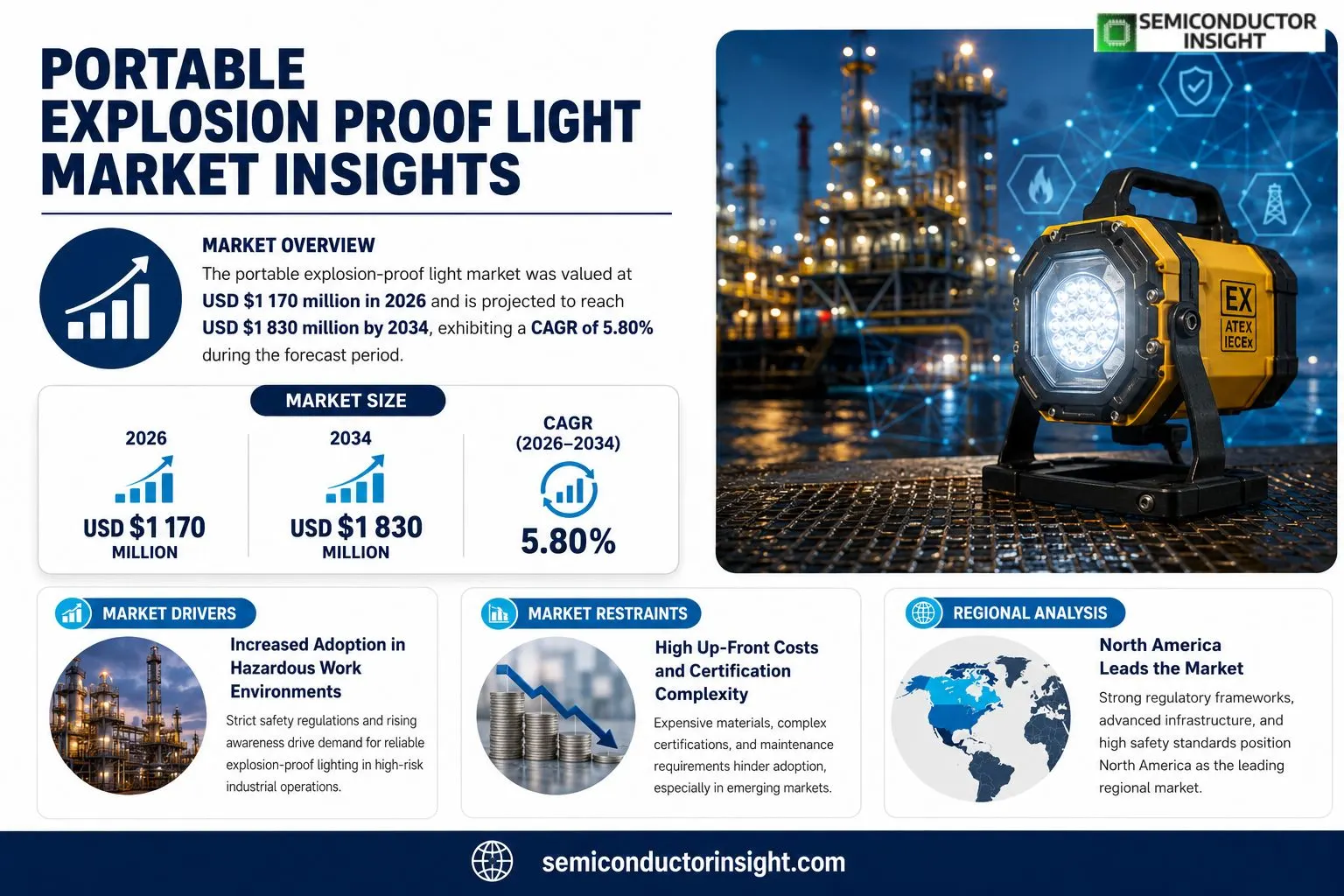
Portable explosion‑proof light market was valued at USD $1 170 million in 2026 and industry analysts project it will reach USD $1 830 million by 2034.
Portable explosion‑proof lights are rugged illumination systems specifically engineered for operation within explosive atmospheres such as those encountered on offshore platforms, petrochemical plants or underground mines.The expansion of this segment is driven largely by heightened safety regulations across high‑risk industries, coupled with the shift toward energy‑efficient LED technology that offers lower operating costs while maintaining compliance with stringent hazardous location standards.
MARKET DRIVERS
Increased Adoption in Hazardous Work Environments
The Portable Explosion Proof Light Market is gaining momentum as industries that operate in NFPA Class I zonessuch as oil & gas extraction, petrochemical refineries, and underground miningrecognize the safety advantage of portable illumination designed to prevent ignition. Recent incidents in deep‑sea drilling platforms have highlighted the necessity for lights that remain sealed against explosive dust and vapor. The compliance posture is further strengthened by regulatory frameworks that demand the use of explosion‑proof equipment, prompting firms to switch from conventional portable fixtures to specialized models. Accordingly, businesses invest in portable units that maintain integrity across cycles of exposure, reducing the risk of catastrophic failures in confined spaces.
Advances in Materials and Power Technologies
Material science breakthroughsespecially the adoption of high‑strength polycarbonate housings and advanced encapsulantsboost the durability of portable lights. Coupled with the progressive integration of lithium‑ion battery chemistry, these innovations deliver longer runtimes and lower maintenance requirements. The shift toward LEDs has also diminished heat output, a critical consideration in explosion‑prone atmospheres. Collectively, these technological strides reduce the total cost of ownership for enterprises that rely on portable illumination, thereby encouraging further penetration into safety‑critical settings. Manufacturers who possess strong intellectual property portfolios can capture premium pricing, reinforcing the cycle of investment in safety lighting.
➤ The combination of heightened safety standards and product durability is reshaping the procurement priorities of upstream operators, turning portable explosion‑proof lighting into a cornerstone of operational resilience.
As the industry evolves, real‑time monitoring systems are beginning to compete for attention. Sensors that detect temperature excursions or seal breach events can be integrated into the lighting module, offering the capability to shut down the unit automatically in the event of a fault. Enterprises that implement such proactive measures anticipate fewer operational interruptions and lower compliance breach penalties. In market terms, the integration of smart safety features is poised to drive long‑term revenue streams, providing a compelling prospect for both equipment manufacturers and system integrators involved in the Portable Explosion Proof Light Market.
MARKET CHALLENGES
Cost Sensitivity in Emerging Economies
While the safety imperative remains clear, the premium pricing of explosion‑proof lighting units poses a barrier in price‑competitive regions. Cost structures vary widely across markets, with raw‑material costs for marine‑grade stainless steel and high‑performance encapsulants sometimes elevating the final unit price above that of standard portable fixtures. In an environment where tight margins are the norm, firms often postpone the adoption of explosion‑proof lighting, opting instead for different safety protocols. This hesitation can temper overall market penetration, especially in emerging industrial hubs that lack the capital reserves for upfront safety investments.Maintenance Complexity Also hampers broader deployment. Explosion‑proof housings necessitate specialized servicing protocols; technicians must use compliant atmospheric tools and follow stringent disassembly guidelines. Consequently, downtime is extended, and service costs increase. When the risk of field failure is factored against the indirect costs of labor and downtime, some operators view the trade‑off as less favorable. This effect is particularly pronounced for small‑to‑medium enterprises, which lack the in‑house expertise required to manage routine maintenance cycles.
Other Challenges
Supplier Concentration and Material Volatility
The market remains heavily dependent on a limited number of suppliers for critical components such as explosion‑proof housings, specialized seals, and flame‑retardant LED drivers. Fluctuations in material availability or price spikespropelled by supply‑chain disruptions or geopolitical tensionscan exert pressure on the end‑user pricing floor. Consequently, firms that rely on a single source for key components face a heightened risk of supply delays and cost escalations, which can undermine their ability to deliver on warranty commitments and service level agreements.
MARKET RESTRAINTS
High Up‑Front Capital Expenditure
The capital intensity required to implement a robust fleet of portable explosion‑proof lights is the principal restraint for many organizations. Even with favorable long‑term benefits, the initial purchase priceoften ranging between several thousand and tens of thousands of dollars per unitcan be a disproportionate expense for companies whose budgets are allocated to more immediate revenue‑generating activities. The perception that safety equipment is a static asset, rather than an evolving technology with disposability, further discourages investment, especially in cyclical industries where revenue streams fluctuate.
Certification and Regulatory Lag
Meeting comprehensive explosion‑proof certificationssuch as ATEX 114, IEC Ex0008, or NFPA 79demands extensive testing regimes that extend products’ time to market. The procedural complexity of these certifications can introduce cycles of thirty to sixty days between product development and placement in the field. Moreover, in certain jurisdictions, local regulatory interpretation may differ, leading to duplicated testing or re‑certification processes that upsurge costs and introduce uncertainty. Companies that operate in multiple countries therefore confront differing certification pathways, thereby complicating standardization efforts across global operations and acting as a restraint on the effective scale of deployment.
Device compatibility with legacy infrastructure also restrains adoption. Industrial facilities often feature heft and size restrictions in confined spaces, requiring equipment that can be folded or easily integrated into existing rigging systems. Many current models, while meeting explosion‑proof criteria, remain too bulky for practical use in tight shafts or vessels. As a result, firms defer upgrades, which delays the transition to standardized, high‑efficiency portable lighting solutions.
MARKET OPPORTUNITIES
Emerging Digital Integration and Smart Safety Ecosystems
Portables that incorporate connectivity modulessupporting protocols such as Zigbee, LoRaWAN, or 5Geven within hazardous compartments are carving a niche within the Portable Explosion Proof Light Market. By interfacing with facility monitoring systems, these units can transmit data on power consumption, performance degradation, and environmental conditions, enabling predictive maintenance schemes. Firms that embed such capabilities can leverage new revenue streams from subscription‑based monitoring services, expanding their role from equipment suppliers to integrated safety partners.In parallel, the expanding adoption of “smart factory” practices within the oil & gas and chemical processing sectors reveals a fertile opportunity. Executives prioritize automation, yet they recognize that lighting remains a critical control loop for safety. By offering smart explosion‑proof lighting solutions coupled with cloud‑based analytics, manufacturers can demonstrate value through improved compliance reporting, reduced audit time, and faster just‑in‑time adjustments to safety protocols.Additionally, untapped markets in waste‑management plants, offshore wind farms, and deep‑sea renewable energy installations present unique frontiers. These environments demand robust lighting solutions that can tolerate salty marine atmospheres, low temperatures, or high levels of particulate dust. Light manufacturers that innovate to address these conditionsthrough corrosion‑resistant enclosures or temperature‑controlled LEDscan secure early ground‑share in expanding markets, positioning themselves as chosen suppliers for frontier energy projects.Finally, voluntary safety standards and industry initiatives, such as Heat Remediation Alliance, are encouraging the development of modular lighting kits that can be added retroactively onto existing rigs. By offering plug‑and‑play solutions that meet current explosion‑proof criteria, manufacturers can follow the trail of retrofitting demand that is both cost‑effective for service operators and aligns with overarching sustainability goals. This convergence of digital, retrofitting, and diversification trends creates a multi‑facet opportunity framework within the Portable Explosion Proof Light Market, offering a roadmap for firms willing to adapt their portfolios to evolving safety imperatives.
Portable Explosion Proof Light Market Trends
Rise of LED Technology in Hazardous Zones
In recent years, the shift from incandescent sources to LED drivers tailored for explosion‑prone areas reflects tightening safety mandates across the oil, gas, and petrochemical sectors. LED systems designed to meet stringent ATEX or IECEx certifications deliver lower ignition risk, reduced heat output, and extended operating life. The improved spill‑resistant housings and IP68 enclosures guarantee durability for harsh environments, while the lower power draw translates into cost savings on industrial electricity budgets. Suppliers who have incorporated these features into their portable product lines are already seeing accelerated installation rates in new facilities and retrofits of legacy assets.
Other Trends
Intensity‑Controlled LED Modules
Manufacturers are now offering dimmable LED modules that allow operators to fine‑tune illumination levels. This capability eliminates the need for multiple beam‑angle fixtures and provides precise control over spill risk mapping. The ability to vary luminance mirrors emerging safety frameworks that require adaptive lighting in dynamic process zones, and it gives plant operators a lever to balance visibility with energy consumption.
Wireless Remote Management
Remote‑controlled lighting is gaining traction through integration with SCADA and IIoT platforms. By enabling real‑time monitoring of status, brightness, and fault logs, operators can preempt failures and schedule maintenance without dispatching crews into hazardous areas. The covariance between data transparency and ownership responsibility is driving corporate investment in digital lighting ecosystems.
Modular Design for Quick Replacement
The trend toward modular housings with quick‑disconnect connectors reduces downtime when replacing a failing unit. In sectors such as mining and offshore platforms where power interruptions are costly, a plug‑and‑play design ensures compliance with uptime targets while maintaining explosion proof integrity. This approach is also being adopted by service vendors to streamline field service operations.
Shift to Automation and Remote Operations
The convergence of portable explosion proof lighting with automation platforms underpins a broader shift toward zero‑touch safety solutions. Companies that can embed sensor data, contextual beam adjustments, and predictive maintenance into their lighting portfolios are positioning themselves ahead of regulatory deadlines. Compliance, operational efficiency, and cost control become tightly linked, and those who fail to evolve risk marginalization in a market that increasingly rewards integrated, smart solutions.
COMPETITIVE LANDSCAPE
Key Industry Players
Portable Explosion Proof Light Market: Competitive Landscape
Among the market, Eaton and Emerson Electric anchor the competitive field with integrated lighting solutions that span from high‑intensity LEDs to compact incandescent fixtures, offering both IEC and ATEX certified models. Their dual focus on expanding industrial automation and tightening safety compliance affords them a breadth of distribution across oil & gas, chemical, and power generation sectors. Coupled with robust R&D pipelines, these firms maintain a tiered strategy that leverages OEM partnerships to embed lighting into larger machinery, thereby cementing their market dominance and driving the baseline expectations for safety standards worldwide.Parallel to this leadership, a constellation of niche suppliersWestern Technology, Inc., Glowforge Technologies, ECOM Instruments GmbH, and Glamoxfurnishes specialized offerings that meet differentiated operational needs. These players capitalize on design agility, targeting high‑pressure environments such as pipeline inspections, mining sites, and offshore platforms. Their focus on custom brightness, battery autonomy, and modular integration allows them to capture regions where legacy solutions lag, creating fragmented yet growth‑rich pockets amid the broader industry. In turn, these pockets exert upward pressure on pricing and technical standards, compelling the market leaders to innovate and diversify beyond traditional illumination.
List of Key Portable Explosion Proof Light Companies Profiled
- Eaton
- Eaton
- Emerson Electric
- Emerson Electric
- Western Technology, Inc.
- Western Technology, Inc.
- Glowforge Technologies
- Glowforge Technologies
- ECOM Instruments GmbH
- ECOM Instruments GmbH
- Glamox
- Glamox
- Atexindustries
- James Industry
- TORMIN
- LDPI Inc
- Ocean’s King Lighting
- Larson Electronics
- WorkSite Lighting
- STAR Technology
- J&J Energy
Segment Analysis:
| Segment Category | Sub-Segments | Key Insights |
| By Type |
|
LED Light description:
|
| By Application |
|
Oilfield description:
|
| By End User |
|
Industrial Facilities description:
|
| By Installation Type |
|
Portable Fixed Mount description:
|
| By Material |
|
High‑temperature alloy description:
|
Regional Analysis: Portable Explosion Proof Light Market
North America
North American regulators mandate that explosion‑proof lights meet Class I, Division 1 criteria, with annual audits reinforcing compliance. These standards, combined with ISO 13849 guidance, create a high barrier for new entrants and a decisive edge for firms with proven certifications. Regulatory updates drive product tweaksparticularly in LED back‑lightingwhich feed into a continuous improvement cycle for manufacturers.
The supply chain relies on a network of tier‑one components sourced from both domestic and overseas suppliers. Currency fluctuations and logistic bottlenecks prompt regional stocking strategies, while nanoceramic coatings boost component durability. Integration of automation in warehousing reduces order fulfillment times, creating a leaner, more responsive distribution model that matches demand spikes during peak construction cycles.
The North American market rewards innovation, as seen in the shift from incandescent to ultra‑efficient LED housings that cut energy load by up to 40%. Embedded communication modules allow real‑time diagnostics, a feature that is starting to become an industry standard. Early adopters report significant reductions in maintenance labor and a decrease in fire‑incident risk across critical infrastructure.
Capital allocation focuses on research and development of smart‑sensor arrays and on‑grid power management to extend operational longevity. Private‑equity funding is disproportionately directed toward startups developing low‑cost, dual‑mode lights capable of operating in both hazardous and non‑hazardous zones, signalling a strategic pivot toward flexibility and cost efficiency.
Europe
Europe’s market exhibits a steady, risk‑averse growth pattern, rooted in comprehensive compliance frameworks such as the EU ATEX directive. Production centers in Germany and the Netherlands emphasize high‑reliability LED modules, while a growing emphasis on sustainability forces manufacturers to focus on materials with reduced environmental footprints. The region’s fragmented regulatory landscape creates varied certification overheads, which discourages smaller players but encourages consolidation through M&A. Consequently, the market sees an influx of joint ventures aimed at spreading certification costs, thereby accelerating cross‑border supply chain integration. The overall effect is a more homogeneous product portfolio that still respects local compliance nuances, delivering predictable value to operators invested in long‑term safety and compliance.
Asia‑Pacific
Asia‑Pacific stands as the fastest‑growing segment, propelled by expansive oil & gas exploration, mining projects, and rapid industrialization. Chinese, Japanese, and South Korean firms lead the charge, utilizing hybrid trench‑light designs that couple explosion protection with low‑power consumption. Joint‑venture models are prevalent, allowing foreign firms to sidestep local certification hurdles; meanwhile, domestic companies extrapolate learned patterns from Western standards to localize offerings. Supply chain resilience is improved through diversified supplier networks that mitigate freight disruptions. The partnership between local expertise and global standards forms a catalyst for innovation, particularly in the realm of wireless monitoring as enterprises adopt Industry 4.0 principles.
South America
South America presents a fragmented yet opportunistic landscape. Brazilian and Chilean territories host robust mining operations that depend heavily on portable illumination, yet local certification pathways lag behind those of Europe. This absence of standardization creates entry barriers for newcomers, while incumbent manufacturers gain a competitive moat through well‑established compliance knowledge. Emerging trends show a pivot toward modular lighting solutions that can adapt to fluctuating regulatory demands, thereby easing installation cycles across borders. Regional economic volatility pushes stakeholders to prioritize cost‑efficient solutions, spurring research into lightweight composite housings and energy‑smoothing electronics that extend service life and cut operating costs.
Middle East & Africa
The Middle East & Africa region reflects a dual dynamic: high safety expectations in oil & gas hubs coupled with limited infrastructure in emerging economies. Established national safety regimes in Saudi Arabia, Qatar, and the UAE demand top‑grade explosion‑proof equipment, driving premium pricing and loyalty to certified suppliers. Conversely, sub‑regional markets such as Morocco and Egypt see heightened price sensitivity, encouraging a shift towards semi‑explosion‑proof lighting that balances regulatory compliance with cost constraints. The churn in local OEM capabilities creates a market door for global players to introduce turnkey solutions featuring modularity, facilitating quick deployment while ensuring compliance with evolving safety statutes.
Report Scope
This market research report provides a comprehensive analysis of the Portable Explosion Proof Light Market , covering the forecast period 2026–2034. It offers detailed insights into market dynamics, technological advancements, competitive landscape, and key trends shaping the industry.
Key focus areas of the report include:
- Market Overview: The report begins with an overview outlining its current market scenario, key growth indicators, and industry transformation drivers. It discusses macroeconomic factors, demand–supply balance, regulatory landscape, and the strategic role of semiconductors in powering advancements across industries such as automotive, telecommunications, consumer electronics, and industrial automation.
- Market Size & Forecast: Historical data and future projections for revenue, unit shipments, and market value across major regions and segments.
- Segmentation Analysis: Detailed breakdown by product type, technology, application, and end-user industry to identify high-growth segments and investment opportunities.
- Regional Insights: Insights into market performance across North America, Europe, Asia-Pacific, Latin America, and the Middle East & Africa, including country-level analysis where relevant.
- Competitive Landscape: Profiles of leading market participants, including their product offerings, R&D focus, manufacturing capacity, pricing strategies, and recent developments such as mergers, acquisitions, and partnerships.
- Technology Trends & Innovation: Assessment of emerging technologies, integration of AI/IoT, semiconductor design trends, fabrication techniques, and evolving industry standards.
- Market Drivers & Restraints: Evaluation of factors driving market growth along with challenges, supply chain constraints, regulatory issues, and market-entry barriers.
- Stakeholder Insights: Insights for component suppliers, OEMs, system integrators, investors, and policymakers regarding the evolving ecosystem and strategic opportunities.
Primary and secondary research methods are employed, including interviews with industry experts, data from verified sources, and real-time market intelligence to ensure the accuracy and reliability of the insights presented.
FREQUENTLY ASKED QUESTIONS:
What is the current market size of Portable Explosion Proof Light Market?
-> Portable explosion‑proof light market was valued at USD $1 170 million in 2026 and industry analysts project it will reach USD $1 830 million by 2034
What is the projected CAGR for the period 2024‑2031?
-> The report forecasts a compound annual growth rate of X % CAGR for Global Portable Explosion Proof Light Market between 2024 and 2031.
How is the market segmented by type?
-> Segmentation by type includes Incandescent Lamp and LED Light, each evaluated for size, revenue, and market share.
What are the primary application segments?
-> The market is divided into applications such as Oilfield, Chemical Industry, Steel Industry, Power, Port, and Firefighting.
Which companies are identified as top players?
-> Key players include Larsen Electronics, Western Technology, Inc., WorkSite Lighting, ECOM Instruments GmbH, Atexindustries, James Industry, TORMIN, Ysmarines, LDPI Inc, Ocean’s King Lighting, Eaton, Emerson Electric, and Glamox.
What research methodology is applied?
-> The study uses a blend of primary interviews, secondary data collection, statistical modeling, and triangulation to ensure robustness.
What is the base year for the market analysis?
-> The base year defined for historical reference is 2020.
What are the main growth drivers?
-> Key growth drivers include increasing safety regulations, expansion of oil & gas infrastructure, and rising demand for explosion‑proof lighting in hazardous environments.
What factors restrain market growth?
-> Restraints consist of high product cost, stringent certification processes, and limited awareness in emerging regions.
Which region is expected to grow the fastest?
-> Asia is projected to be the fastest‑growing region, driven by rapid industrialization in China, India, and Southeast Asian markets.
Get Sample Report PDF for Exclusive Insights
Report Sample Includes
- Table of Contents
- List of Tables & Figures
- Charts, Research Methodology, and more...
 Download Sample Report PDF