MARKET INSIGHTS
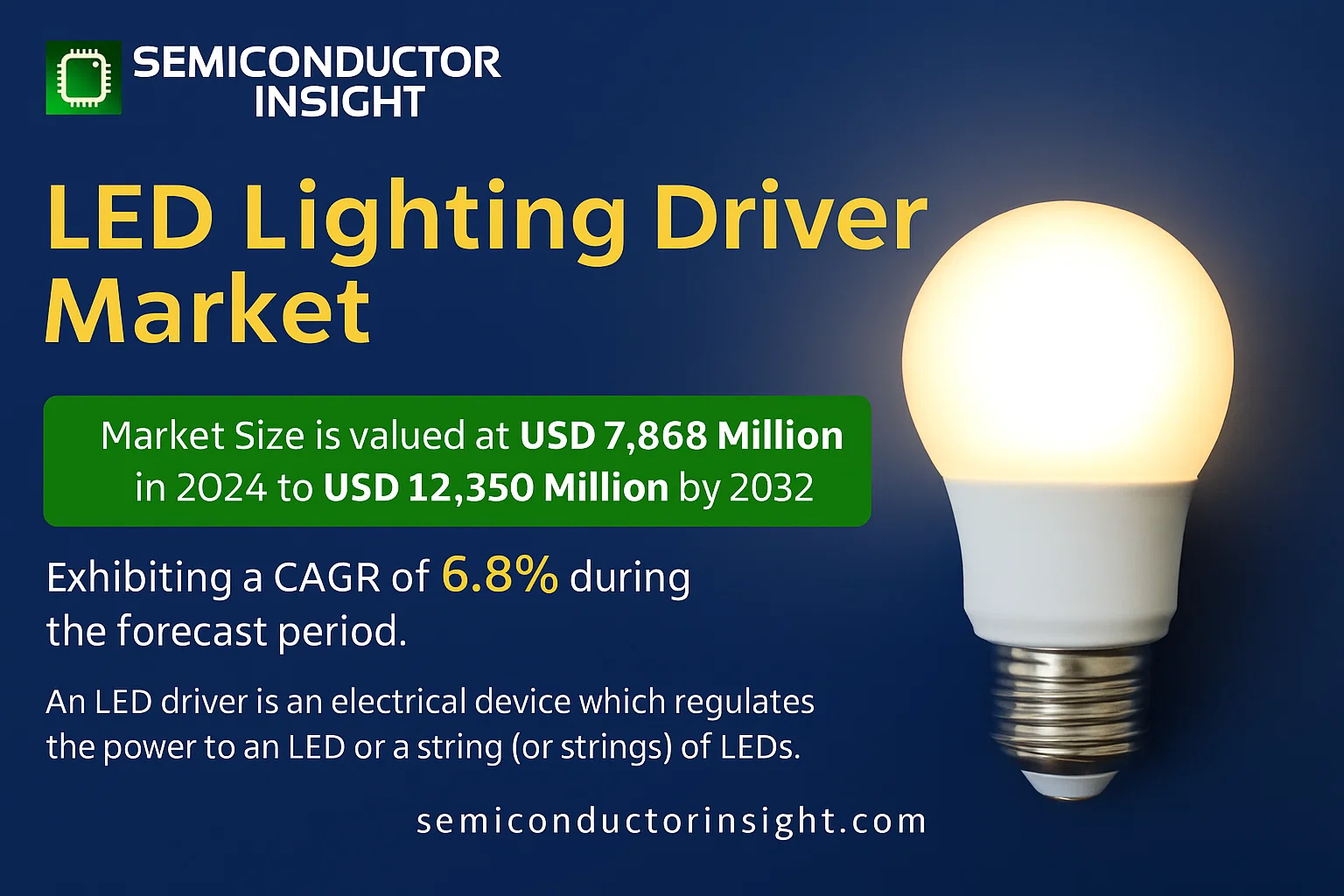
Global LED Lighting Driver Market size was valued at USD 7,868 million in 2024 to USD 12,350 million by 2032, exhibiting a CAGR of 6.8% during the forecast period.
An LED driver is an electrical device which regulates the power to an LED or a string (or strings) of LEDs. These components are crucial for converting higher voltage alternating current to low voltage direct current while maintaining consistent power supply and protecting LEDs from voltage fluctuations. The drivers include various types such as DALI, 0-10V dimming, standard (non-dim), triac dimming, and smart drivers.
The market is experiencing steady growth due to several factors, including increased adoption of energy-efficient lighting solutions, government regulations phasing out traditional incandescent bulbs, and growing demand for smart lighting systems. Additionally, the expanding construction industry and infrastructure development projects worldwide are contributing to market expansion. Asia-Pacific dominates the global market with approximately 47% share due to rapid urbanization and manufacturing activities in countries like China and India. Europe follows as the second-largest market with about 22% share. Key players such as MEAN WELL, Philips, Inventronics, Tridonic, and Delta Electronics operate in this competitive landscape with diverse product portfolios.
MARKET DRIVERS
Global Push Towards Energy Efficiency and Sustainability
Stringent government regulations worldwide, such as the European Union’s Ecodesign Directive and energy efficiency standards in North America, are phasing out inefficient lighting technologies. This regulatory landscape is a primary driver, compelling businesses and municipalities to adopt LED lighting systems, which in turn fuels demand for reliable LED drivers. Global focus on reducing carbon emissions has led to increased investments in green buildings and smart city projects, where intelligent LED lighting solutions are foundational.
Proliferation of Smart and Connected Lighting Systems
The rapid growth of the Internet of Things (IoT) and the demand for smart homes and commercial buildings are significantly boosting the market. Advanced LED drivers are essential components for enabling features like dimming, color tuning, and connectivity protocols such as DALI, Zigbee, and Bluetooth Mesh. This trend is creating a robust market for intelligent drivers that offer greater control, energy savings, and data collection capabilities.
Furthermore, the declining cost of LED components, coupled with their long operational lifespan, continues to make LED lighting a cost-effective solution for both new installations and retrofits, sustaining market growth across residential, commercial, and industrial segments.
MARKET CHALLENGES
Intense Price Pressure and Cost-Sensitivity
The LED Lighting Driver Market is highly competitive, leading to significant price pressure from low-cost manufacturers, particularly in the Asia-Pacific region. This makes it challenging for companies to maintain profitability while investing in research and development for next-generation products. End-users are often highly cost-sensitive, especially in price-driven markets, prioritizing initial product cost over long-term quality or advanced features.
Other Challenges
Technical Complexity and Standardization Issues
The lack of universal standards for connectivity and dimming protocols creates interoperability challenges. Manufacturers must develop multiple driver variants to be compatible with different control systems, increasing complexity and production costs.
Supply Chain Volatility
The market remains susceptible to disruptions in the supply of critical raw materials like semiconductors and rare-earth elements. Recent global chip shortages have highlighted the vulnerability of the supply chain, leading to production delays and increased component costs.
MARKET RESTRAINTS
Market Maturity in Key Regions
The LED Lighting Driver Market in developed regions like North America and Europe is reaching a stage of maturity. The initial wave of large-scale retrofits from traditional lighting to LED is largely complete, leading to a slowdown in growth rates. The market is now increasingly dependent on replacement demand and new construction activity, which can be cyclical and sensitive to economic conditions.
Performance and Reliability Concerns
While LED technology is known for longevity, the driver is often the component that fails first. Concerns about the reliability and lifespan of drivers, especially from lesser-known brands, can restrain market growth. End-users may delay adoption or opt for cheaper, less reliable options if they perceive a risk of premature failure, which can tarnish the reputation of LED technology as a whole.
MARKET OPPORTUNITIES
Expansion in Horticulture and Human-Centric Lighting
The application of LED lighting is expanding beyond general illumination into high-growth niche markets. Horticulture lighting requires specialized drivers for precise spectrum and intensity control to optimize plant growth. Similarly, Human-Centric Lighting (HCL), which aims to support human well-being and circadian rhythms, demands tunable white LED drivers, representing a significant value-added opportunity.
Growth in Emerging Economies
Rapid urbanization, infrastructure development, and rising disposable incomes in emerging economies across Asia-Pacific, Latin America, and Africa present substantial growth opportunities. Government initiatives aimed at improving energy infrastructure and phasing out incandescent bulbs are driving the adoption of LED lighting in these regions, creating a new wave of demand for drivers.
Integration with Li-Fi and Energy Harvesting
Emerging technologies like Li-Fi (Light Fidelity), which uses light to transmit data, require highly specialized LED drivers capable of rapid modulation. Additionally, the development of drivers that can work with energy harvesting systems, such as those using solar power, opens up new applications in outdoor and off-grid lighting, further expanding the market frontier.
LED Lighting Driver Market Trends
Steady Market Expansion and Growth Trajectory
Global LED Lighting Driver market, valued at USUSD 7,868 million in 2024, is on a robust growth path, projected to reach USUSD 12,350 million by 2032. This expansion represents a Compound Annual Growth Rate (CAGR) of 6.8% during the forecast period. The growth is primarily fueled by the global transition towards energy-efficient lighting solutions and the increasing adoption of LED technology across residential, commercial, and industrial sectors. As an essential component regulating power to LED fixtures, the driver market’s health is directly tied to the broader LED lighting industry’s momentum.
Other Trends
Asia-Pacific Dominance and Regional Dynamics
The Asia-Pacific region stands as the undisputed leader in the LED Lighting Driver market, commanding approximately 47% of the global market share. This dominance is attributed to massive manufacturing capabilities, government initiatives promoting energy efficiency, and rapid infrastructure development in countries like China and India. Europe follows as the second-largest market, holding about 22% share, driven by stringent regulations and high adoption rates of advanced lighting systems. The regional analysis highlights a clear geographical concentration of market activity and production.
Fragmented Competitive Landscape
The market is characterized by a high degree of fragmentation with a large number of players. Key manufacturers include MEAN WELL, Philips, Inventronics, Tridonic, and Delta Electronics, among others. Notably, the top three companies collectively occupy a relatively small portion of the market, approximately 9%, indicating intense competition and the presence of numerous small and medium-sized enterprises. This competitive environment drives continuous innovation and price competitiveness, benefiting end-users.
Segmentation by Technology and Application
Market segmentation reveals key technological trends, with drivers categorized into types such as DALI, 0-10V Dimming, Standard (non-dim), Triac Dimming, and the emerging category of Smart Drivers. The application of these drivers is segmented into Indoor Lighting, Outdoor Lighting, and Special Lighting. This diversification reflects the market’s response to the need for specialized control, energy management, and integration with smart building systems, pointing towards a future where intelligent, controllable lighting is the standard.
COMPETITIVE LANDSCAPE
Key Industry Players
A Dynamic Market Characterized by a High Degree of Fragmentation and Regional Specialization
Global LED Lighting Driver market is highly fragmented, with the top three companies collectively holding only about 9% of the total market share, reflecting intense competition and a diverse supplier base. MEAN WELL stands as a recognized global leader, known for its broad product portfolio and strong distribution network, particularly dominating in the Asia-Pacific region, which is the largest market accounting for approximately 47% of global demand. Other established multinational players like Signify (Philips), Inventronics, and Tridonic leverage their historical expertise in lighting and electronics to maintain significant positions, driving innovation in areas such as smart and dimmable drivers for both indoor and outdoor applications. The competitive dynamics are heavily influenced by technological advancements, cost efficiency, and the ability to meet regional energy standards.
Beyond the top tier, numerous specialized and regional players compete effectively by focusing on specific market niches. Companies such as Delta Electronics and MOSO Power are key forces, particularly strong in the industrial and outdoor lighting segments. Other significant contributors include Hubbell Lighting in North America, and prominent Asia-based manufacturers like Eaglerise, TCI, and LIFUD, which are critical in serving the vast domestic and export markets with cost-competitive solutions. The market also features specialized suppliers like SELF, which carve out niches in particular driver types or applications. This diverse ecosystem ensures a constant flow of innovation and price competition, compelling all players to continuously enhance product features, efficiency, and reliability.
List of Key LED Lighting Driver Companies Profiled
- MEAN WELL
- Signify (Philips)
- Inventronics
- Tridonic
- Delta Electronics
- Hubbell Lighting
- MOSO Power
- Eaglerise
- TCI
- OSRAM SYLVANIA
- LIFUD
- SELF
- ERP Power
- MaxLite
Segment Analysis:
| Segment Category | Sub-Segments | Key Insights |
| By Type |
|
Smart Driver is emerging as the most dynamic and high-growth segment, fueled by the global push for energy efficiency and building automation. These intelligent drivers offer features like remote monitoring, predictive maintenance, and seamless integration with IoT ecosystems, which are highly valued in smart city projects and modern commercial infrastructures. The demand for basic Standard drivers remains robust due to their cost-effectiveness for general lighting, but the superior functionality and long-term energy savings of Smart Drivers are driving significant market interest and innovation from leading manufacturers. |
| By Application |
|
Indoor Lighting represents the largest and most established application segment, driven by continuous retrofitting of commercial buildings, offices, and residential spaces with energy-efficient LED solutions. The outdoor lighting segment is also experiencing strong growth, particularly for street lighting and architectural illumination, supported by government initiatives for public infrastructure modernization. Special lighting applications, including those for horticulture and automotive, represent niche but high-value markets that demand specialized driver capabilities for precise control and reliability in challenging environments. |
| By End User |
|
Commercial & Industrial end users are the dominant force in the market, as businesses prioritize LED upgrades to reduce operational costs and meet sustainability targets. This segment demands reliable, high-performance drivers for extensive lighting systems in offices, retail spaces, and warehouses. The residential sector continues to show steady adoption driven by consumer awareness and the availability of affordable LED products. The government and public infrastructure segment is a key growth area, with municipalities investing in large-scale projects like street lighting upgrades and public building retrofits, often driven by regulatory mandates and energy-saving goals. |
| By Power Rating |
|
Low Power drivers are the most widely used segment, catering to the vast majority of residential and small-scale commercial lighting applications like downlights and bulbs. Their high volume is driven by mass-market adoption. Medium power drivers are essential for larger commercial fixtures and outdoor luminaires, balancing performance with cost. The high-power segment, while smaller in volume, is critical for industrial lighting, stadiums, and high-bay applications, requiring robust thermal management and high reliability, which presents opportunities for specialized manufacturers with advanced engineering capabilities. |
| By Sales Channel |
|
Direct Sales to original equipment manufacturers (OEMs) is the leading channel, as lighting fixture producers integrate drivers directly into their products. This channel demands high-volume supply agreements and close technical collaboration. Distributors and wholesalers play a vital role in serving the electrical contractor and system integrator market, providing inventory and logistical support. The retail and e-commerce channel is growing steadily, particularly for the residential and small business segments, offering convenience and accessibility for replacement and small-scale project needs, though it typically deals with standardized, lower-power products. |
Regional Analysis: LED Lighting Driver Market
The region’s dominance is anchored in its role as the world’s primary manufacturing hub for LED components and finished products. This concentration allows for economies of scale, rapid prototyping, and a highly responsive supply chain that can quickly adapt to global demand fluctuations and technological changes in driver specifications.
Strong governmental support through stringent energy efficiency standards, subsidies for LED adoption, and national programs like India’s UJALA scheme directly stimulate the market. These policies not only boost domestic consumption but also encourage local manufacturers to invest in advanced, compliant driver technologies.
Unprecedented rates of urbanization and massive investments in infrastructure projects, including commercial complexes, highways, and public lighting systems, create a continuous and high-volume demand for reliable LED lighting drivers. The scale of these projects necessitates durable and efficient driver solutions.
A highly competitive landscape with numerous local and international players drives rapid innovation in driver technology. There is a strong focus on developing smarter, more efficient, and dimmable drivers that integrate with IoT systems for smart lighting applications, keeping the region at the forefront of product development.
North America
The North American market for LED lighting drivers is characterized by mature adoption, high consumer awareness, and stringent regulatory standards. Demand is primarily driven by large-scale retrofitting projects in the commercial and industrial sectors, alongside steady growth in residential applications. The emphasis is on high-quality, reliable drivers that offer features like dimmability, connectivity for smart home and building systems, and long lifespans to reduce maintenance costs. Regulations such as Title 20 in California push manufacturers toward more efficient products. The market is also seeing growth in outdoor lighting applications, including streetlights and architectural lighting, which require robust and weather-resistant driver solutions.
Europe
Europe represents a sophisticated market for LED lighting drivers, heavily influenced by the European Union’s ambitious energy efficiency and circular economy directives. There is a strong push for drivers that support smart lighting ecosystems, contributing to the region’s smart city initiatives. The market demand is for high-performance, durable, and recyclable drivers with a low total cost of ownership. Standards like the ErP Lot requirements ensure that drivers meet strict efficiency benchmarks. Growth is sustained through renovations in the building sector and the modernization of public lighting infrastructure, with a notable focus on tunable white and human-centric lighting solutions that require advanced driver capabilities.
South America
The South American market for LED lighting drivers is in a growth phase, driven by increasing urbanization and government efforts to improve energy infrastructure. Countries like Brazil and Chile are leading the adoption, with a focus on replacing inefficient public lighting and promoting energy savings in commercial buildings. The market is price-sensitive, creating demand for cost-effective yet reliable driver solutions. Challenges include economic volatility and varying regulatory environments across countries. However, the long-term potential is significant as awareness of energy efficiency grows and infrastructure development continues, particularly for drivers used in outdoor and industrial lighting applications.
Middle East & Africa
The Middle East and Africa region shows diverse and emerging potential for the LED Lighting Driver Market. The Gulf Cooperation Council (GCC) countries are driving demand through massive smart city projects, tourism infrastructure development, and a focus on sustainability, requiring high-quality, robust drivers. In contrast, parts of Africa are witnessing growth primarily through off-grid solar LED lighting solutions, which necessitate specialized drivers compatible with DC power and battery systems. The overall market is nascent but expanding, with opportunities in both high-end commercial projects and basic lighting solutions aimed at energy access, though it is challenged by infrastructural limitations in some areas.
Report Scope
This market research report provides a comprehensive analysis of the LED Lighting Driver Market, covering the forecast period 2025–2032. It offers detailed insights into market dynamics, technological advancements, competitive landscape, and key trends shaping the industry.
Key focus areas of the report include:
- Market Overview: The report begins with an overview outlining its current market scenario, key growth indicators, and industry transformation drivers. It discusses macroeconomic factors, demand–supply balance, regulatory landscape, and the strategic role of semiconductors in powering advancements across industries such as automotive, telecommunications, consumer electronics, and industrial automation.
- Market Size & Forecast: Historical data and future projections for revenue, unit shipments, and market value across major regions and segments.
- Segmentation Analysis: Detailed breakdown by product type, technology, application, and end-user industry to identify high-growth segments and investment opportunities.
- Regional Insights: Insights into market performance across North America, Europe, Asia-Pacific, Latin America, and the Middle East & Africa, including country-level analysis where relevant.
- Competitive Landscape: Profiles of leading market participants, including their product offerings, R&D focus, manufacturing capacity, pricing strategies, and recent developments such as mergers, acquisitions, and partnerships.
- Technology Trends & Innovation: Assessment of emerging technologies, integration of AI/IoT, semiconductor design trends, fabrication techniques, and evolving industry standards.
- Market Drivers & Restraints: Evaluation of factors driving market growth along with challenges, supply chain constraints, regulatory issues, and market-entry barriers.
- Stakeholder Insights: Insights for component suppliers, OEMs, system integrators, investors, and policymakers regarding the evolving ecosystem and strategic opportunities.
Primary and secondary research methods are employed, including interviews with industry experts, data from verified sources, and real-time market intelligence to ensure the accuracy and reliability of the insights presented.
FREQUENTLY ASKED QUESTIONS:
What is the current market size of LED Lighting Driver Market?
-> LED Lighting Driver Market size was valued at USD 7,868 million in 2024 to USD 12,350 million by 2032, exhibiting a CAGR of 6.8% during the forecast period.
Which key companies operate in LED Lighting Driver Market?
-> Key players include MEAN WELL, Philips, Inventronics, Tridonic, Delta Electronics, Hubbell Lighting, MOSO Power, Eaglerise, TCI, OSRAM SYLVANIA, LIFUD, and SELF, among others.
What are the key growth drivers?
-> Key growth drivers include the increasing adoption of LED lighting, energy efficiency regulations, and advancements in smart lighting technologies.
Which region dominates the market?
-> Asia-Pacific is the largest market with about 47% market share, while Europe is the follower, accounting for about 22% market share.
What is the expected growth rate (CAGR) of the market?
-> The market is expected to grow at a CAGR of 6.8% during the forecast period from 2024 to 2032.

Get Sample Report PDF for Exclusive Insights
Report Sample Includes
- Table of Contents
- List of Tables & Figures
- Charts, Research Methodology, and more...
 Download Sample Report PDF