Plasma Doping (PLAD) Equipment Market Insights
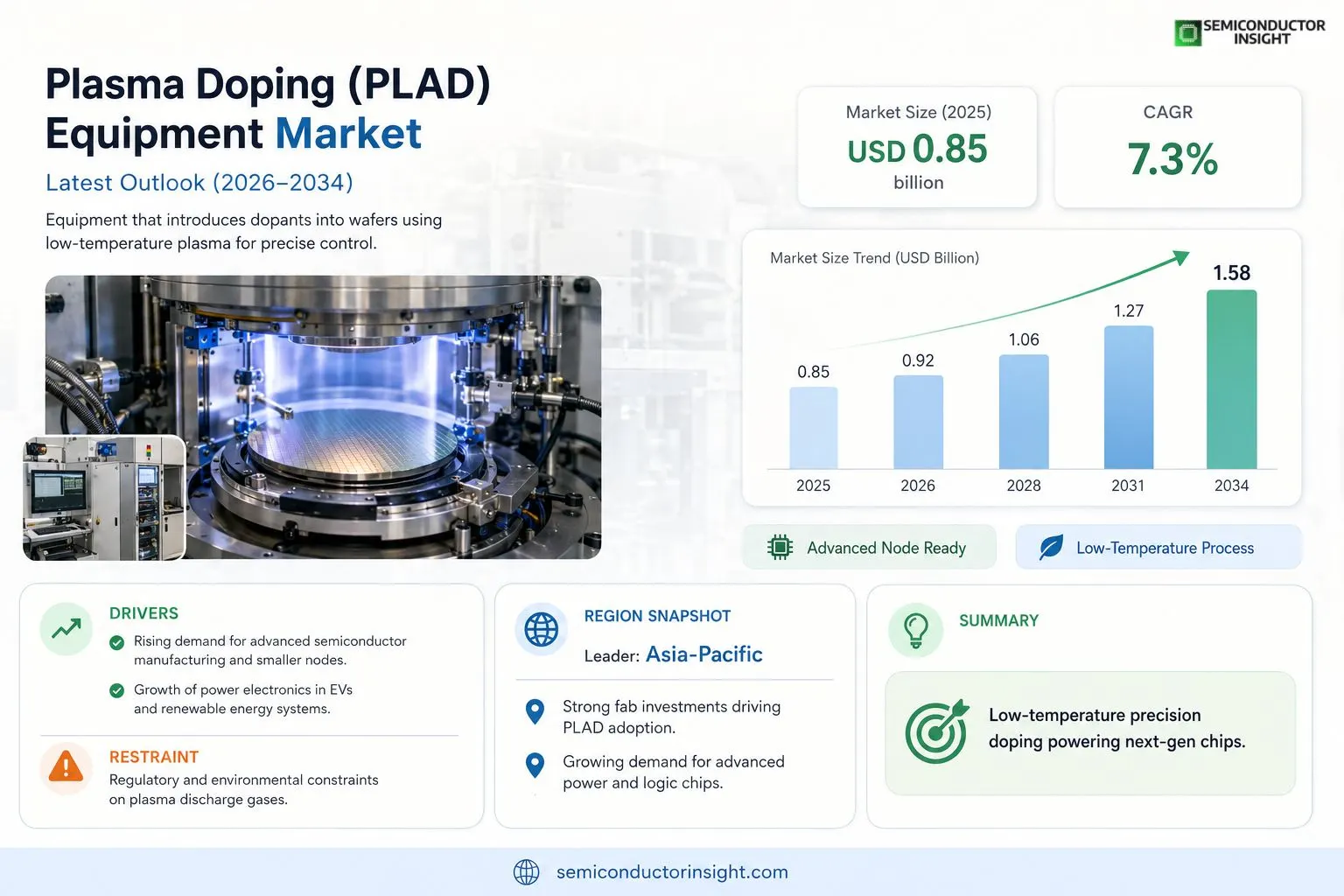
Global Plasma Doping (PLAD) Equipment Market size was valued at USD 0.85 billion in 2025. The market is projected to grow from USD 0.92 billion in 2026 to USD 1.58 billion by 2034, exhibiting a CAGR of 7.3% during the forecast period.
Plasma doping equipment enables precise introduction of dopants into semiconductor substrates using low‑temperature plasma processes, improving carrier concentration control while minimizing thermal budget. The technology is essential for advanced nodes, power devices, and emerging applications such as quantum computing because it offers uniformity and reduced defectivity compared with traditional ion implantation.
The market is experiencing rapid growth due to rising demand for high‑performance chips, increased investment in fab capacity, and the push toward heterogeneous integration. Furthermore, regulatory incentives for energy‑efficient manufacturing and collaborations between equipment manufacturers like Applied Materials, Tokyo Electron, and Lam Research are accelerating adoption. However, challenges related to process scalability and high capital expenditure temper expansion, prompting vendors to offer modular solutions and service models.
MARKET DRIVERS
Increasing Demand for Advanced Semiconductor Manufacturing
Plasma Doping (PLAD) Equipment Market is being propelled by the semiconductor industry’s push toward smaller node technologies, which require precise dopant control. Foundries are adopting PLAD systems to achieve tighter tolerance levels and improve device performance, thereby creating a steady demand for next‑generation equipment.
Growth of High‑Volume Power Electronics
Power devices for electric vehicles and renewable energy systems rely on PLAD processes to form shallow junctions with high uniformity. This trend is expanding the addressable market for PLAD tools, as manufacturers aim to meet rising efficiency standards while maintaining cost competitiveness.
➤ Adoption of AI‑driven process optimization is accelerating PLAD equipment upgrades across major semiconductor hubs.
Furthermore, strategic collaborations between equipment suppliers and chipmakers are shortening development cycles, enabling faster rollout of PLAD solutions that address emerging material challenges such as wide‑bandgap semiconductors.
MARKET CHALLENGES
High Capital Expenditure and Skill Requirements
Investments in PLAD platforms remain substantial, and the need for specialized engineering talent can deter smaller fabs from upgrading. The cost barrier is compounded by the rapid pace of technology change, which pressures owners to retire equipment earlier than anticipated.
Other Challenges
Integration with Existing Production Lines
Legacy process tools often lack compatibility with modern PLAD systems, requiring extensive retrofitting and validation efforts that can extend time‑to‑market for new products.
MARKET RESTRAINTS
Regulatory and Environmental Constraints
Stringent emissions regulations in key manufacturing regions impose limits on plasma discharge gases, forcing equipment vendors to invest in greener technologies that can increase product pricing and development timelines.
Limited availability of high‑purity dopant gases in certain geographies also restrains the full potential of Plasma Doping (PLAD) Equipment Market, as manufacturers may need to source materials from distant suppliers, adding logistical complexity.
MARKET OPPORTUNITIES
Emerging Applications in Quantum and Photonic Devices
Quantum computing and photonic integrated circuits require ultra‑precise dopant placement, presenting a niche yet high‑value segment for PLAD equipment providers. Early movers can capture a disproportionate share of this growing demand.Additionally, the shift toward modular, multi‑process platforms enables equipment manufacturers to offer scalable solutions that can be tailored to both large fabs and specialty foundries, expanding the addressable market base for Plasma Doping (PLAD) Equipment Market.
Plasma Doping (PLAD) Equipment Market Trends
Growth Driven by Advanced Node Adoption
Plasma Doping (PLAD) Equipment Market is responding to the accelerating rollout of advanced semiconductor nodes. Device manufacturers require precise dopant control at lower thermal budgets, a need that PLAD tools fulfill through low‑temperature plasma processes. This capability improves carrier concentration uniformity while limiting defect formation, making the technology essential for high‑performance logic, power devices, and emerging quantum‑computing applications. As fab capacity expands worldwide, demand for equipment that can integrate seamlessly into heterogeneous integration platforms is rising, reinforcing the market’s upward trajectory.
Other Trends
Scalability and Modular Solutions
Scalability remains a focal point for Plasma Doping (PLAD) Equipment Market. Vendors are shifting toward modular architectures that allow customers to upgrade specific subsystems without a full plant replacement. This approach mitigates the high capital outlay traditionally associated with PLAD installations and accelerates adoption in mid‑size foundries. Service‑oriented models, including equipment leasing and pay‑per‑use, are also gaining traction, providing flexibility for manufacturers navigating variable production volumes.
Regulatory Influence and Sustainability
Regulatory incentives aimed at reducing energy consumption in semiconductor manufacturing are influencing equipment selection. PLAD processes consume less power than conventional ion‑implantation techniques, aligning with sustainability goals set by major industrial policies. Collaborative programs among leading equipment suppliers such as Applied Materials, Tokyo Electron, and Lam Research are accelerating technology refinements that further lower the environmental footprint while maintaining throughput. These regulatory and sustainability drivers are reinforcing the market’s resilience and positioning plasma doping as a preferred solution for next‑generation chip fabrication.
COMPETITIVE LANDSCAPEKey Industry Players
Global Plasma Doping (PLAD) Equipment Market Competitive Overview
Plasma Doping (PLAD) Equipment Market is currently anchored by a triad of large‑scale manufacturers that together command the majority of revenue and drive the technology roadmap. Applied Materials, Tokyo Electron Ltd., and Lam Research dominate the high‑volume segment through integrated process suites that couple PLAD with other front‑end‑of‑line steps, enabling fab customers to meet the stringent thermal budgets of advanced nodes. Their collaborative R&D programs and joint service models have accelerated adoption in power‑device and emerging quantum‑computing fabs, contributing to the market’s projected CAGR of 7.3 % through 2034. These incumbents also benefit from deep capital‑intensive service networks, which reinforce their position as the primary source of turnkey PLAD solutions for major semiconductor manufacturers worldwide.
Beyond the leading trio, a constellation of specialized vendors provides differentiated capabilities that address niche process windows and emerging applications. Companies such as ASM International, Veeco Instruments, Oxford Instruments Plasma Technology, and Nissin Electric focus on ultra‑low‑damage plasma chemistries, modular reactor designs, and custom‑dose control for heterogeneous integration and advanced power devices. Smaller players like Canon Tokki, SENTECH Instruments, ULVAC Technologies, and Kokusai Electric contribute niche expertise in plasma source engineering, chamber materials, and process automation, often partnering with fabs on pilot lines or offering retrofit kits for legacy equipment. This diversification enriches the competitive landscape and creates pathways for incremental innovation across the PLAD value chain.
List of Key Plasma Doping (PLAD) Equipment Companies Profiled
- Applied Materials
- Tokyo Electron Ltd.
- Lam Research
- ASM International
- Veeco Instruments Inc.
- Oxford Instruments Plasma Technology
- Nissin Electric Co., Ltd.
- Canon Tokki Corporation
- SENTECH Instruments
- ULVAC Technologies
- Kokusai Electric
- Advanced Semiconductor Engineering (ASE) – PLAD division
- QPC Systems Ltd.
Segment Analysis:
| Segment Category | Sub-Segments | Key Insights |
| By Type |
|
Thermal PLAD
|
| By Application |
|
Advanced Logic Devices
|
| By End User |
|
Large Integrated Device Manufacturers
|
| By Integration Approach |
|
Heterogeneous 3D Integration
|
| By Device Category |
|
FinFETs
|
Regional Analysis: North America
United States
The primary drivers in the US market include the relentless pursuit of miniaturization in semiconductor devices, the increasing adoption of advanced packaging technologies, and the growing demand for high-performance computing and artificial intelligence applications.
The US PLAD equipment market is characterized by the presence of several established global players, alongside emerging domestic companies focusing on niche applications. Competition centers around technological innovation, system performance, and customer service.
Ongoing advancements in PLAD technology are geared towards achieving higher dopant precision, improved uniformity, and enhanced process control, all crucial for enabling the next generation of semiconductor devices.
The future of the US PLAD equipment market will be shaped by the continued evolution of semiconductor technology and the increasing adoption of advanced manufacturing techniques. There will be a strong emphasis on equipment that supports the production of leading-edge chips and caters to the growing demand for specialized semiconductor solutions.
Europe
The European PLAD Equipment Market is witnessing steady growth, anchored by strong semiconductor industries in countries like Germany, France, and the Netherlands. Europe’s focus is on specialized applications within the semiconductor value chain, including automotive electronics and industrial IoT. While not as dominant as the US, Europe is actively investing in R&D to maintain its technological edge in PLAD processes critical for advanced chip manufacturing. The market is driven by a need for energy-efficient and environmentally sustainable manufacturing processes.
Asia-Pacific
Asia-Pacific, particularly China, is emerging as a significant growth engine for the PLAD Equipment Market. The rapid expansion of its semiconductor industry, coupled with substantial government investments aimed at achieving self-sufficiency in chip manufacturing, is fueling high demand. While a large portion of the demand is for mature node technologies, there is a growing appetite for advanced PLAD equipment as China strives to compete in higher-end chip production. The region presents a complex market with diverse needs and varying levels of technological sophistication.
South America
The South American PLAD Equipment Market is currently a relatively nascent market, with limited adoption primarily driven by smaller electronics manufacturers and research institutions. The growth potential is present, particularly with the expansion of electronics manufacturing in countries like Brazil and Argentina. However, the market is constrained by factors such as limited investment capital and a less developed semiconductor ecosystem compared to other regions.
Middle East & Africa
The Middle East & Africa region represents a small but growing market for PLAD Equipment. The expansion of electronics industries in countries like the United Arab Emirates and South Africa is contributing to increased demand. The focus is on applications within consumer electronics and emerging sectors like renewable energy and electric vehicles, where advanced semiconductor components are increasingly being utilized.
Report Scope
This market research report provides a comprehensive analysis of the Plasma Doping (PLAD) Equipment Market , covering the forecast period 2026–2034. It offers detailed insights into market dynamics, technological advancements, competitive landscape, and key trends shaping the industry.
Key focus areas of the report include:
- Market Overview: The report begins with an overview outlining its current market scenario, key growth indicators, and industry transformation drivers. It discusses macroeconomic factors, demand–supply balance, regulatory landscape, and the strategic role of semiconductors in powering advancements across industries such as automotive, telecommunications, consumer electronics, and industrial automation.
- Market Size & Forecast: Historical data and future projections for revenue, unit shipments, and market value across major regions and segments.
- Segmentation Analysis: Detailed breakdown by product type, technology, application, and end-user industry to identify high-growth segments and investment opportunities.
- Regional Insights: Insights into market performance across North America, Europe, Asia-Pacific, Latin America, and the Middle East & Africa, including country-level analysis where relevant.
- Competitive Landscape: Profiles of leading market participants, including their product offerings, R&D focus, manufacturing capacity, pricing strategies, and recent developments such as mergers, acquisitions, and partnerships.
- Technology Trends & Innovation: Assessment of emerging technologies, integration of AI/IoT, semiconductor design trends, fabrication techniques, and evolving industry standards.
- Market Drivers & Restraints: Evaluation of factors driving market growth along with challenges, supply chain constraints, regulatory issues, and market-entry barriers.
- Stakeholder Insights: Insights for component suppliers, OEMs, system integrators, investors, and policymakers regarding the evolving ecosystem and strategic opportunities.
Primary and secondary research methods are employed, including interviews with industry experts, data from verified sources, and real-time market intelligence to ensure the accuracy and reliability of the insights presented.
FREQUENTLY ASKED QUESTIONS:
What is the current market size of Plasma Doping (PLAD) Equipment Market?
-> Plasma Doping (PLAD) Equipment Market was valued at USD 0.85 billion in 2025 and is expected to reach USD 1.58 billion by 2034.
Which key companies operate in Plasma Doping (PLAD) Equipment Market?
-> Key players include Applied Materials, Tokyo Electron, Lam Research, ASML, and KLA Corporation, among others.
What are the key growth drivers?
-> Key growth drivers include rising demand for high‑performance chips, increased fab capacity investments, heterogeneous integration trends, and regulatory incentives for energy‑efficient manufacturing.
Which region dominates the market?
-> Asia‑Pacific is the fastest‑growing region, while North America remains a dominant market.
What are the emerging trends?
-> Emerging trends include integration of plasma doping in quantum‑computing device fabrication, modular equipment solutions, and advanced low‑temperature plasma processes.

Get Sample Report PDF for Exclusive Insights
Report Sample Includes
- Table of Contents
- List of Tables & Figures
- Charts, Research Methodology, and more...
 Download Sample Report PDF