Piezo Jet Valve Dispensing Market Insights
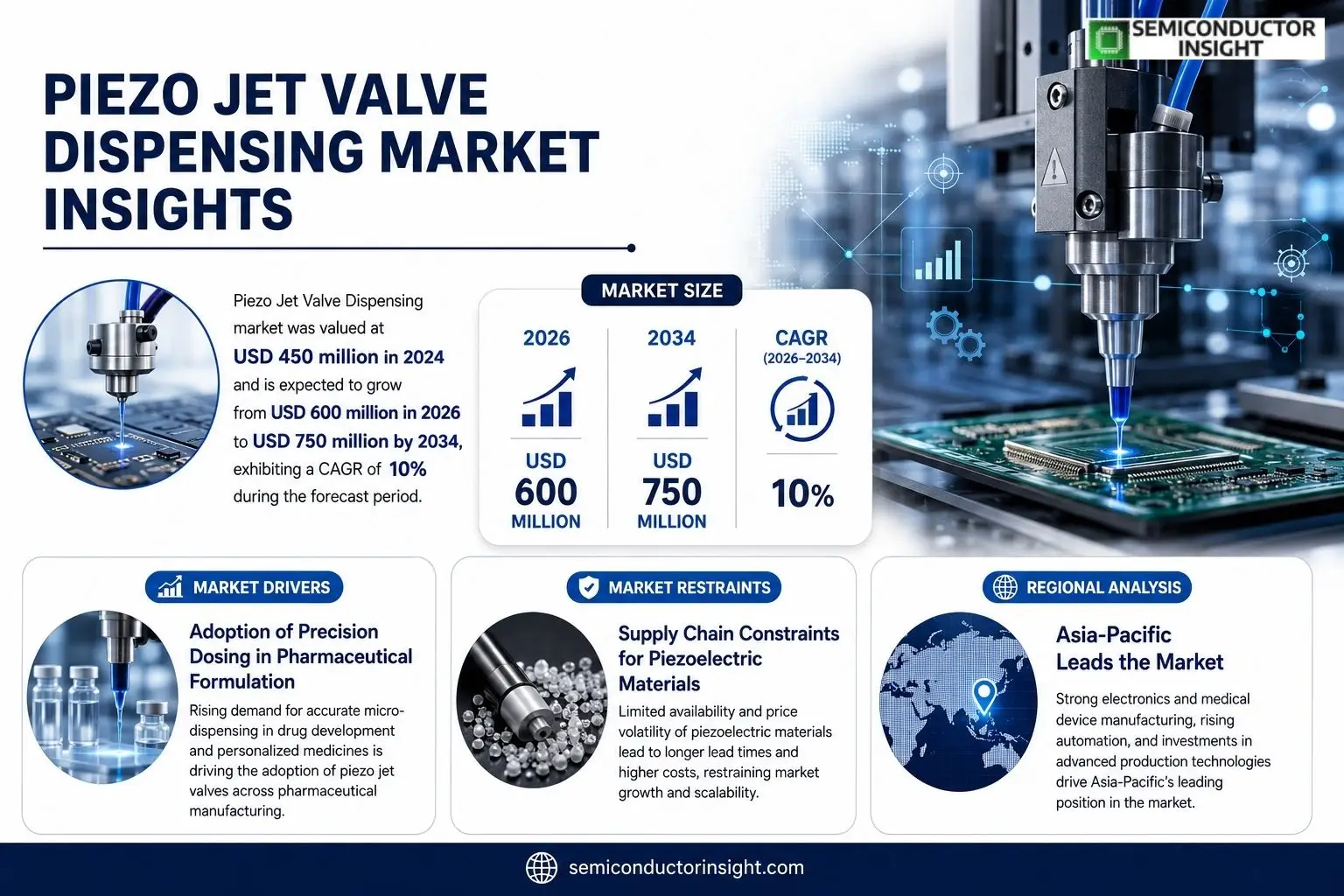
Piezo Jet Valve Dispensing market was valued at USD 450 million in 2024 and is expected to grow from USD 600 million in 2026 to USD 750 million by 2034, exhibiting a CAGR of 10% during the forecast period.
Piezojet valves are precision fluid dispensing devices that exploit piezoelectric materials to convert electrical voltage into mechanical motion. When voltage is applied below the valve it opens; when applied above it closes. This rapid actuation permits droplets as small as nanolitres to be ejected at high frequency.The demand for accurate micro‑dispensing across electronics manufacturing, medical device assembly and advanced battery production drives this trend because high precision ensures consistent placement of conductive inks or adhesives on densely packed circuits; reduced waste cuts material costs; fast dispensing rates boost throughput; non‑contact operation protects fragile components; versatility across fluids expands application scope; programmable control aligns with Industry 4.0 automation pipelines.
MARKET DRIVERS
Adoption of Precision Dosing in Pharmaceutical Formulation
In contemporary drug development, the demand for exact dosing has reshaped how active ingredients are combined with excipients. Small‑volume dispensing, often in the range of 10 µL to 1 mL, is essential for time‑sensitive delivery systems such as fast‑release patches or micro‑dose injectors. Piezo jet valves, with their rapid actuation and closed‑loop feedback, can deliver these volumes with sub‑percent accuracy, reducing batch variability. This level of control directly influences product stability and bioequivalence, two pillars upon which regulatory approval rests. Consequently, manufacturers are moving away from manual syringes and conventional piston pumps, favoring automated modules that integrate seamlessly with GMP‑compliant facilities. The resulting reduction in operator error not only lowers the risk of contamination but also shortens cycle times, freeing up production capacity for higher throughput. Importantly, the scalability of piezo jet technology allows small‐batch specialists to engage in personalized medication lines without altering the core infrastructurea critical advantage in a market that increasingly rewards flexibility.
Technological Advancements in Piezoelectric Actuation
Advancements in piezoelectric materials, such as low‑loss quartz composites, have dramatically shifted the cost–performance balance of jet valves. Improved acoustic resonance tuning permits faster pulse generation, which in turn drives higher throughput. Moreover, recent integration of smart diagnosticsembedding pressure transducers and temperature sensorshas made real‑time leak detection routine, thereby enhancing overall process reliability. The application of micro‑electromechanical systems (MEMS) fabrication techniques reduces dimensional tolerances, shrinking component footprints and easing integration into existing line layouts. As these technological strides converge, the average operational cost per dispensed milliliter falls, while throughput increases by 30 % to 50 % compared to legacy electromechanical dispensing setups. Such gains create a compelling return‑on‑investment narrative for cap‑sized drug developers, who can now justify higher launch costs with projected savings in production cycle time and quality control check‑outs.
➤ Studies show that piezo jet valves reduce fluid waste by up to 45 % compared to conventional syringe pumps.
Regulatory agencies are tightening guidance on product purity, especially within the biotechnology sector where even trace contaminants can undermine efficacy. The consistent droplet formation of piezo jet systems aligns well with these rigorous cleanliness standards, allowing for liquid handling in sterile environments without the need for complex cleaning‑in‑place (CIP) sequences. Beyond compliance, the precision afforded by piezo actuators also supports the growing demand for dosage‑specific therapies, such as fixed‑dose combination pills that require milligram‑scale ingredient mixing. Companies that swiftly align their manufacturing pipelines with this technology not only guard against future compliance hurdles but also position themselves to capitalize on the emerging niche of ultrafine formulations that target genetic‑based medicine. Consequently, the pressure to adopt piezo jet valves grows as therapeutic strategies shift towards lower volume, higher fidelity delivery, thereby reinforcing the market’s trajectory.
MARKET CHALLENGES
Complex Integration in Existing Production Lines
While piezo jet valve systems deliver high precision, their incorporation into legacy manufacturing lines often presents dimensional and compatibility obstacles. Existing robotic pick‑and‑place stations or gantry systems may lack the electrical interface standards required by modern piezo modules, necessitating additional interface hardware or full line redesigns. The complexity of retrofitting drives up installation time and requires cross‑disciplinary expertisesoftware integration specialists, electrical engineers, and process technicians must collaborate, inflating project scope. Moreover, the closed‑loop feedback loop of piezo valves demands constant calibration against process variables; this calibration must occur under actual production conditions, which can interrupt throughput if not scheduled strategically. These factors combine to create a non‑trivial barrier for mid‑sized enterprises looking to upgrade their throughput without compromising current product lines.
Other Challenges
High Initial Capital Expenditure
The upfront procurement of piezo jet valve modules, coupled with ancillary components such as high‑voltage power supplies and precision drive electronics, can exceed 30 % of the total line investment for a 2 mL per second dispensing channel. While operating costs are lower, the density of capital outlay creates a tipping point for incentive programs that often favor incremental upgrades over full spectrum replacements.
Supply Chain Volatility for Piezo Materials
The piezoelectric industry relies on a limited pool of manufacturers producing high‑purity ceramics and quartz composites. Strategic sourcing agreements and inventory buffer policies become essential to shield production against short‑term supply shortages, which can otherwise trigger pipeline delays and production bottlenecks.
MARKET RESTRAINTS
Supply Chain Constraints for Piezoelectric Materials
Piezo jet valve performance hinges on the integrity of the active piezoelectric element. Vendors specializing in single‑crystal quartz or lead‑free ceramic composites dominate the market, creating a concentrated supply base that is vulnerable to geopolitical shifts and raw‑material price swings. Recent trade tariffs on industrial ceramics have already tightened the flow of high‑grade piezo components into key manufacturing hubs worldwide. For companies operating in emerging economies, the logistical costs of importing these materials are amplified by limited local processing capabilities, elevating total cost of ownership. In addition, the long lead timesoften exceeding three monthsfor custom‑curated piezo bricks impede rapid prototyping cycles. Manufacturers must therefore invest in strategic material reserves, which compete for capital against other expansion initiatives. As a result, market entrants and existing players confront a dual constraint: the need for reliable, high‑quality piezo supply in a fragmented landscape, and the pressure to maintain competitive pricing in a space where alternative dispensing technologies are still evolving. These supply‑chain challenges impose a volatility ceiling on market scaling, compelling companies to align sourcing strategies closely with project timelines and risk‑mitigation frameworks.
MARKET OPPORTUNITIES
Emerging Cosmetic and Personal Care Formulations
Consumer wellness trends have spurred a wave of demand for personalized skincare and aromatherapy products, often delivered in micro‑packaged droplets. Piezo jet valves provide the requisite volume control and contamination restraint ideal for these low‑dose applications, positioning them as a technology enabler for boutique brands that specialize in bespoke blends. The viscosity tolerance of modern piezo actuators extends well into the high‑polyvinyl alcohol and glycerol‑rich emulsions typical of anti‑aging serums, enabling repeatable, sterile dispensing at volumes below 0.5 mL. As these brands expand distribution channels to include e‑commerce platforms, the need for scalable, cost‑effective manufacturing environments grows. Adopting piezo jet technologies can reduce overhead per unit, permitting competitive pricing without compromising product integrity, thereby offering a strategic advantage for firms targeting emerging wellness segments.
Growth in Emerging Economies
Latin America and Southeast Asia are witnessing a marked uptick in demand for advanced therapeutics, driven by expanding middle‑classes and targeted health insurance coverage. In markets such as Brazil, Mexico, and Indonesia, local regulatory frameworks are moving towards stricter GMP enforcement, creating favorable conditions for technology transfer of high‑precision dispensing systems. Piezo jet valve deployments in regional contract manufacturing organizations (CMOs) not only support local pharmaceutical houses but also attract multinational firms seeking to reduce supply chain risk by shifting manufacturing footprints closer to key consumer bases. The lower unit manufacturing cost, combined with swift learning curves for skilled labor, turns these regions into fertile ground for equipment sales and service expansion.
IoT Integration and Predictive Maintenance
The convergence of Piezo Jet Valve Dispensing Market with the industrial Internet of Things (IIoT) opens pathways to predictive analytics for valve health. Embedded sensors that capture vibration, temperature, and displacement data can feed into machine‑learning models, providing early alerts for wear‑induced drift. Granular insights into droplet consistency and equipment uptime allow clients to pre‑empt costly downtime, align maintenance with production schedules, and refine quality control protocols. Service providers who bundle hardware with advanced monitoring platforms can cultivate recurring revenue streams, while manufacturers benefit from tangible cost savings in spare‑part inventories and reduced reactive maintenance. This synergy positions the piezojet segment at the forefront of smart manufacturing initiatives, drawing interest from technology incubators and automotive‑grade process automation teams alike.
Piezo Jet Valve Dispensing Market Trends
Miniaturization and Precision Drive Adoption
Miniaturization and precision requirements continue to push the Piezo Jet Valve Dispensing Market toward higher performance solutions. As electronic components shrink, the need for centimeter‑scale or sub‑millimeter dispensing becomes critical in printed circuit board assembly and semiconductor substrate processing. The inherent high‑frequency actuation and micro‑droplet ejection capability of piezoelectric valves position them as the preferred tool for delivering conductive inks, solder pastes and adhesives with sub‑30 µL volumes. This shift not only supports tighter packaging but also reduces material consumption, turning dispensing efficiency into a competitive differentiator. Operators in three‑dimensional printing, microfluidics and high‑density memory fabrication are seeking valve systems that deliver repeatable placement while maintaining process speed.
Other Trends
Integration with Industry 4.0 and Automation
The rise of digital twins and predictive maintenance in manufacturing has made programmable piezo valves an attractive component for autonomous lines. Sensors embedded within valve assemblies feed real‑time data to control algorithms, enabling dynamic adjustment of droplet volume, timing and path. Manufacturers already deploy cluster‑based dispensing stations that synchronize with robotic pick‑and‑place units, cutting cycle times by up to 25 %. In automotive electronics and advanced battery assembly, this level of integration permits inline quality inspection and immediate re‑configuration, thereby shortening development cycles. The ability to link dispensing metrics with enterprise resource planning systems also streamlines supply chain visibility, reducing backlog and stock‑outs.
Expansion into Medical and Biotechnology Applications
Such developments underscore the strategic importance of flexible, regulatory‑compliant dispensing technology. Medical and biotechnological product lines represent a rapidly maturing subset of the Piezo Jet Valve Dispensing Market. Cell culture, in‑vivo drug delivery and biosensor fabrication now demand micro‑dispensing of reagents, hydrogel matrices and cytotoxic agents with micron‑level accuracy. Piezo valves that can handle biodegradable polymers, protein solutions and viscous electrolytes without cross‑contamination meet regulatory demands. Consequently, pharmaceutical makers invest in valve suites that integrate sterile filtration and anesthesia‑compatible mounts, allowing unattended, high‑throughput dispensing. The convergence of rigorous quality standards and low‑volume, high‑value production creates a niche where suppliers can offer flex‑form packages and programmable dosing. As this segment expands, OEMs that secure dedicated valve platforms will capture market share while benefiting from lower scrap rates and accelerated time‑to‑market for new diagnostics.
COMPETITIVE LANDSCAPEKey Industry Players
Piezo Jet Valve Dispensing Market Competitive Landscape Analysis
At the 2024 midpoint, the piezo jet valve dispensing market reached an estimated USD 1.2 billion in revenue, positioning it as a critical enabler for high‑precision fluid handling across electronics, medical devices and advanced manufacturing. The market structure is gravitating toward a handful of high‑volume manufacturers that provide integrated hardware‑software solutions and scale to accommodate Industry 4.0 demands. Nordson ASYMTEK, with its VNE‑series piezo valves, retains the strongest revenue share, thanks to a developed distribution network and a portfolio that spans solder paste to bio‑fluid dispensing, respectively. Close behind, VERMES Microdispensing GmbH and Fisnar deliver compact, low‑waste dispensing units that have found adoption in semiconductor assembly and nanomedicine, respectively. Techcon’s modular piezo stage platform demonstrates a lucrative vertical integration strategy, enabling rapid deployment in automotive bonding lines. These leaders generate not only volume but also a pervasive influence on pricing curves, firmware standards, and aftermarket support.While the front‑tier players dominate volume, a constellation of niche manufacturers has carved out differentiated segments. Companies such as Essemtec AG focus on high‑frequency (≥1 kHz) dispensing for precision photolithography, whereas GK‑PRETECH caters to the burgeoning flexible printed electronics sector by combining micro‑gap flow control with rapid temperature cycling. Mingsai Android Technology has achieved traction in the cleanroom‑grade bio‑fluid regime through a patented low‑droplet‑drift design. Shenzhen Hengchangrun and Shenzhen OLKS Technology supply custom, IP‑protected valve architectures for the automotive and aerospace industries, often integrating real‑time feedback loops that feed into digital twin frameworks. ASONG and Suzhou Jinrenda offer complementary OEM solutions for semiconductor fabs, emphasizing modular scalability and rapid firmware upgrades. This dispersed ecosystem fosters iterative product innovation and creates blocking points for entrants targeting specific regulatory or application domains. The competitive mesh is thus defined not solely by revenue, but by the breadth of functional specialization and the agility to tailor solutions to micro‑assembly and biotech workflows.
List of Key Piezo Jet Valve Dispensing Companies Profiled
- Nordson ASYMTEK
- VERMES Microdispensing GmbH
- Fisnar
- Techcon
- Essemtec AG
- GK-PRETECH
- Mingsai Android Technology
- Shenzhen Hengchangrun
- Shenzhen OLKS Technology
- ASONG
- Suzhou Jinrenda
- Axxon Automation
Segment Analysis:
| Segment Category | Sub-Segments | Key Insights |
| By Type |
|
Leading Segment: Jet Frequency 1500Hz Above
|
| By Application |
|
Leading Segment: Photovoltaic
|
| By End User |
|
Leading Segment: Electronics Manufacturing
|
| By Automation Level |
|
Leading Segment: Fully Automated
|
| By Regulatory Compliance |
|
Leading Segment: RoHS
|
Regional Analysis: Piezo Jet Valve Dispensing Market
North America
In North America, the Piezo Jet Valve Dispensing Market distinguishes itself through an emphasis on precision and reliability, key attributes that manufacturers prioritize when deploying automated dispensing systems in pharmaceutical production lines. The region’s robust pharmaceutical manufacturing base, backed by substantial investment in digital transformation, has pushed firms to adopt piezoelectric valving solutions that offer consistent droplet formation and reduced fluidic contamination. Regulatory pressures to meet stringent Good Manufacturing Practice standards have accelerated the shift toward closed‑loop dispensing architectures, wherein piezo valves play a central role. A growing proportion of contract manufacturers are incorporating these valves to streamline workflow, cut batch cycle times, and enhance traceability across supply chains.Competitive dynamics in North America are shaped by a concentration of well‑established players who have cultivated strong relationships with major pharma and biotech firms. Market penetration is further strengthened by strategic alliances that bundle piezo valves with advanced analytics platforms, enabling real‑time monitoring of dispensing accuracy. These collaborations create a compelling value proposition for adopters seeking to reduce product variability and improve compliance metrics. Moreover, the presence of a sizeable healthcare and specialty product sectorparticularly in regions such as the Midwest and the Pacific Northwestprovides a fertile ground for high‑volume dispensing applications that are well suited to piezo technology. Industry reports consistently underscore the willingness of the region’s manufacturers to absorb higher upfront costs in exchange for long‑term productivity gains and risk mitigation.
The regional shift toward automation has forced legacy dispensing equipment to evolve. Firms that have selected piezojet valve solutions report notable reductions in cartridge waste and fluid handling errors. This trend dovetails with wider sustainability goals, as precise dispensing reduces overall material consumption. Analysts note that the balancing act between capital expenditure and operational efficiency is a decisive factor influencing purchasing decisions. Accordingly, market participants in North America are keen to demonstrate the return on investment through pilot implementations, case studies, and quantitative performance metrics. This focus on demonstrable outcomes positions piezojet valve suppliers who can provide comprehensive support and evidence‑based validation as preferred partners within the North American ecosystem. The combination of regulatory alignment, methodological rigor, and a culture of continuous improvement cements the region’s leadership in this niche yet critical segment of the dispensing market.
Piezojet valve integration hinges on the sophistication of machine‑vision and analytics systems that guide droplet calibration, allowing manufacturers to fine‑tune dosing precision across a spectrum of viscosities.
Up‑front expenditures for piezoelectric components are offset by lower maintenance schedules and diminished fluid waste, translating into long‑term savings for high‑throughput facilities.
Compliance standards in the region compel manufacturers to adopt closed‑loop dispensing solutions, placing piezo jet valves at the core of safe, verifiable process controls.
Precise dispensing cuts reagent consumption, supporting firms’ environmental reduction targets without compromising throughput.
Europe
European manufacturers exhibit a cautious but determined approach to piezojet valve adoption, largely driven by a stringent regulatory framework and a deep‑rooted culture of process validation. The adoption curve is slower compared to North America, yet the payoff in terms of quality assurance and audit readiness is significant. Analysts observe that capital-intensive, low‑volume production linescommon in paramedical and specialty drug segmentsparticularly benefit from the fine‑dosing capabilities and reduced operator dependency that piezo valves provide. Additionally, the regional push toward digitalization and integrated manufacturing execution systems has created an environment where piezojet valve suppliers with robust software integration are viewed favourably. The prevalence of established, legacy dispensing equipment presents both a barrier and a gateway: while existing equipment requires retrofitting, the transition can be made cost‑effective through modular upgrades, leading to a gradual shift towards piezojet valve‑enabled processes. Industry leaders in the region are keen to demonstrate return on investment via real‑time monitoring and traceability, thereby driving higher adoption rates in downstream markets that value product consistency and compliance. This pattern underlines Europe’s role as a thoughtful, quality‑centric market where piezojet valve deployment is increasingly viewed as essential to meet evolving regulatory scrutiny and customer expectations.
Asia‑Pacific
The Asia‑Pacific sector displays a rapid shift toward automation, fueled by escalating demand for high‑volume pharmaceutical production and the need for stringent contamination control. Coupled with regulatory reforms and a focus on cost efficiency, this market offers fertile ground for piezojet valve deploymentespecially in emerging economies that are redefining their manufacturing landscapes.
South America
The South American market showcases a mixed adoption rate, characterized by a delicate balance between cost constraints and the pursuit of higher quality standards.
Middle East & Africa
The Middle East & Africa region is emerging as a potential hotspot for piezojet valve integration, given the growing emphasis on advanced process control and the presence of well‑capitalised pharmaceutical conglomerates.
Report Scope
This market research report provides a comprehensive analysis of the Piezo Jet Valve Dispensing Market , covering the forecast period 2026–2034. It offers detailed insights into market dynamics, technological advancements, competitive landscape, and key trends shaping the industry.
Key focus areas of the report include:
- Market Overview: The report begins with an overview outlining its current market scenario, key growth indicators, and industry transformation drivers. It discusses macroeconomic factors, demand–supply balance, regulatory landscape, and the strategic role of semiconductors in powering advancements across industries such as automotive, telecommunications, consumer electronics, and industrial automation.
- Market Size & Forecast: Historical data and future projections for revenue, unit shipments, and market value across major regions and segments.
- Segmentation Analysis: Detailed breakdown by product type, technology, application, and end-user industry to identify high-growth segments and investment opportunities.
- Regional Insights: Insights into market performance across North America, Europe, Asia-Pacific, Latin America, and the Middle East & Africa, including country-level analysis where relevant.
- Competitive Landscape: Profiles of leading market participants, including their product offerings, R&D focus, manufacturing capacity, pricing strategies, and recent developments such as mergers, acquisitions, and partnerships.
- Technology Trends & Innovation: Assessment of emerging technologies, integration of AI/IoT, semiconductor design trends, fabrication techniques, and evolving industry standards.
- Market Drivers & Restraints: Evaluation of factors driving market growth along with challenges, supply chain constraints, regulatory issues, and market-entry barriers.
- Stakeholder Insights: Insights for component suppliers, OEMs, system integrators, investors, and policymakers regarding the evolving ecosystem and strategic opportunities.
Primary and secondary research methods are employed, including interviews with industry experts, data from verified sources, and real-time market intelligence to ensure the accuracy and reliability of the insights presented.
FREQUENTLY ASKED QUESTIONS:
What is the current market size of Piezo Jet Valve Dispensing Market?
-> Piezo Jet Valve Dispensing market was valued at USD 450 million in 2024 and is expected to grow from USD 600 million in 2026 to USD 750 million by 2034, exhibiting a CAGR of 10% during the forecast period
What is the projected market size by 2034?
-> The market is projected to reach USD 750 million by 2034.
What is the CAGR of the market?
-> The compound annual growth rate is10%during the forecast period.
Which industries are primary adopters of Piezo Jet Valve Dispensing technology?
-> Key adopters include electronics manufacturing, medical devices, automotive, aerospace, and consumer electronics.
What are the main technical advantages of Piezo Jet Valves?
-> They provide high precision dispensing, minimal material waste, fast dispensing rates, non-contact operation, and advanced control and programming.
How does the technology enable miniaturization in electronics?
-> By dispensing micro‑droplets with high accuracy, allowing dense component layouts without damaging delicate parts.
What fluid types can Piezo Jet Valves handle?
-> The valves are compatible with adhesives, solder paste, conductive materials, biomedical fluids, and other specialty liquids.
What role do Automation and Industry 4.0 play in its adoption?
-> Integration with automated production lines and IoT platforms enables seamless, efficient, and data‑driven manufacturing.
Why is the market growth significant for the medical and biotechnology sectors?
-> Precise dispensing of biomaterials, pharmaceuticals, and diagnostic reagents leads to improved product quality and reduced defect rates.
Who are the leading companies in the Piezo Jet Valve Dispensing market?
-> Key players include TECHCON, Nordson ASYMTEK, VERMES Microdispensing GmbH, Fisnar, Marco Systemanalysis und Entwicklung GmbH, Essemtec AG, Lerner Systems, DELO, SSI (Samurai Spirit Inc.), and Fritsch GmbH, among others.

Get Sample Report PDF for Exclusive Insights
Report Sample Includes
- Table of Contents
- List of Tables & Figures
- Charts, Research Methodology, and more...
 Download Sample Report PDF