PCIe Interface Ethernet Controller Market Insights
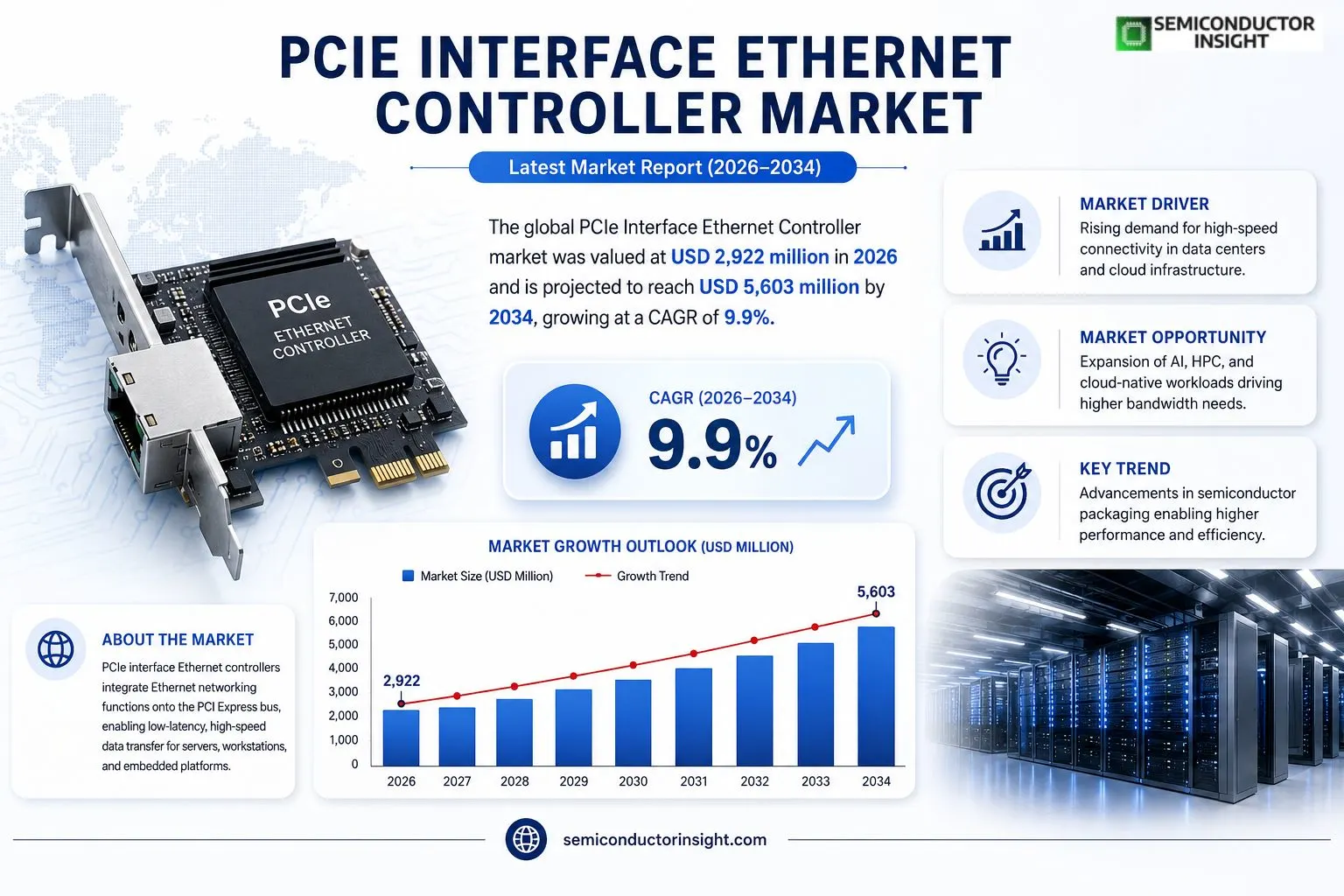
PCIe Interface Ethernet Controller market was valued at USD 2,922 million in 2026 and will reach USD 5,603 million by 2034, reflecting a compound annual growth rate of approximately 9.9% over the forecast horizon.
PCIe interface Ethernet controllers are semiconductor chips that integrate Ethernet networking functions directly onto the PCI Express bus of host computers. By combining high‑speed serial communication with standard Ethernet protocols, these devices enable low‑latency data transfer for servers, workstations and embedded platforms.The upward trajectory stems from expanding data‑center capacity, increasing adoption of high‑performance computing workloads and the shift toward cloud‑native architectures that demand greater bandwidth per socket. Moreover, advances in semiconductor packaging and the proliferation of AI‑accelerated workloads reinforce demand for controllers that can sustain multi‑gigabit throughput while maintaining power efficiency.
MARKET DRIVERS
Data‑Center Bandwidth Demands
Enterprise data‑centers are shifting to higher‑speed fabrics to accommodate spikes in cloud workloads, AI inference, and real‑time analytics. The move from 10 GbE to 25 GbE and 50 GbE is prompting server designers to adopt PCIe‑based Ethernet controllers that can leverage the latest lane configurations without redesigning the entire board architecture. This migration reduces latency and improves throughput, directly influencing total cost of ownership.
Convergence of Compute and Networking
Modern silicon platforms increasingly integrate compute, storage, and networking on a single substrate. PCIe interfaces provide a common, high‑density conduit that aligns with the industry’s push toward composable infrastructure. By standardizing on a PCIe Ethernet controller, OEMs can streamline supply chains, lower BOM costs, and accelerate time‑to‑market for new server models.
➤ “Designers who embrace PCIe Ethernet controllers now report up to a 30 % reduction in board real‑estate while maintaining performance headroom for future protocols.”
The emerging edge‑computing segment also feeds into this trend. Edge nodes require rugged, low‑power networking ASICs, and the compact footprint of a PCIe controller makes it a natural fit for space‑constrained deployments such as autonomous vehicles and industrial IoT gateways.
MARKET CHALLENGES
Thermal Management Constraints
As lane counts increase, power density on the controller climbs, compelling system architects to address heat dissipation more aggressively. Without effective cooling strategies, thermal throttling can erode the performance gains that PCIe Ethernet solutions promise, especially in blade‑server environments.
Other Challenges
Software Compatibility
Legacy operating systems and firmware stacks often lack native drivers for the newest PCIe Ethernet IP. Engineering teams must allocate additional resources to validate and certify software, inflating development budgets and prolonging product roll‑out cycles.
MARKET RESTRAINTS
Supply‑Chain Volatility
semiconductor shortages have intermittently throttled the availability of high‑performance PCIe PHYs and associated passives. Even modest lead‑time extensions can disrupt OEM production schedules, prompting some manufacturers to opt for legacy Ethernet solutions that are more readily stocked.
MARKET OPPORTUNITIES
AI‑Accelerated Infrastructures
AI accelerators such as GPUs and dedicated inference chips demand deterministic, high‑throughput networking to move tensors without bottlenecks. The PCIe Interface Ethernet Controller Market can capture a sizable share by offering controllers engineered for low‑latency, lossless Ethernet that aligns with RDMA and NVMe‑over‑Fabric protocols.
5G‑Enabled Edge Deployments
Telecom operators are rolling out distributed edge platforms to host virtualized network functions. These platforms require compact, power‑efficient Ethernet interfaces that can interoperate with both traditional data‑center and radio‑access network equipment. Tailoring PCIe Ethernet controllers for 5G edge workloads opens a revenue stream that complements the core data‑center business.
PCIe Interface Ethernet Controller Market Trends
Escalating Data‑Center Demand for High‑Bandwidth Controllers
The surge in hyperscale data‑center deployments has lifted the PCIe Interface Ethernet Controller market beyond its 2026 valuation of $2.9 billion. Operators seeking to consolidate workloads are retrofitting servers with 10 GbE and 25 GbE interfaces, which in turn elevates the unit price corridor toward the $13‑$15 range. Because the controller sits directly on the PCIe bus, the performance delta over legacy PHYs narrows, prompting OEMs to prioritize integrated solutions that reduce board real‑estate and power budgets. Consequently, manufacturers are reshaping product roadmaps to embed multiple high‑speed ports on a single die, a move that satisfies the bandwidth envelope while preserving the gross‑margin envelope that historically ranged from 38 % to 58 %.
Other Trends
Emergence of Multi‑Port Designs for Edge Computing
Edge nodes, especially those supporting industrial automation and automotive telematics, now require simultaneous connectivity to diverse networks. Multi‑port PCIe Interface Ethernet Controllers, featuring dual‑ and quad‑port configurations, are gaining traction because they enable a single compute module to serve both deterministic safety‑critical links and high‑throughput data streams. The 2026 production capacity of roughly 320 million units provides sufficient slack to accommodate this shift without inducing supply constraints. Vendors are leveraging advanced packaging (e.g., flip‑chip and fan‑out wafer‑level) to keep thermal envelopes within acceptable limits, thereby preserving the profitability cushion while meeting the tighter latency budgets imposed by real‑time edge workloads.
Margin Evolution from Advanced Packaging Technologies
While the raw silicon cost per controller has softened thanks to mature 28 nm processes, the adoption of chip‑scale packages adds a measurable overhead. However, the higher integration density enables OEMs to eliminate ancillary components, effectively offsetting the packaging premium. This dynamic is reflected in the 2026 gross‑margin spread of 38 %‑58 %, a range that remains attractive for incumbents such as Intel, Broadcom, and Realtek. The strategic implication for downstream players is clear: securing supply agreements for advanced‑package units will be a differentiator in markets where total cost of ownership is scrutinized as closely as raw performance.
COMPETITIVE LANDSCAPE
Key Industry Players
PCIe Interface Ethernet Controller market exhibits a tiered competitive structure with a handful of integrators and a vibrant set of specialist vendors.
The market is anchored by a few silicon powerhouses whose extensive design‑win pipelines lock in large server and data‑center contracts. Intel leverages its dominant CPU ecosystem to bundle Ethernet controllers that meet the latency requirements of hyperscale operators, while Broadcom’s broad portfolio of network‑processor solutions enables tight coupling with high‑throughput fabrics. Realtek sustains a cost‑effective presence in entry‑level and consumer‑grade platforms, capturing volume through aggressive pricing and rapid iteration. Marvell and Microchip Technology complement the upper‑end segment with highly integrated multi‑port devices that simplify board layouts for enterprise appliances. Texas Instruments and NXP Semiconductors, traditionally analog and automotive players, have expanded into PCIe‑based Ethernet offerings to serve edge‑computing and industrial automation niches where mixed‑signal expertise adds differentiation.Beyond the dominant tier, a cohort of midsize innovators injects specialty functionality and regional focus. ASIX Electronics and Davicom Semiconductor concentrate on compact single‑port designs optimized for embedded gateways, often partnering with original equipment manufacturers in the IoT space. MediaTek and Qualcomm, while better known for wireless SoCs, are entering the PCIe Ethernet arena to provide unified connectivity stacks for compute‑dense devices. MaxLinear and Infineon Technologies exploit their RF and power‑management heritage to embed advanced signal‑conditioning features that address the stringent electromagnetic compliance of automotive Ethernet. The overall landscape reflects a strategic layering: large integrators secure high‑margin, high‑volume contracts, whereas niche firms carve out value by tailoring silicon to specific form‑factor, power, or compliance constraints.
List of Key PCIe Interface Ethernet Controller Companies Profiled
- Intel
- Broadcom
- Realtek
- Marvell
- Microchip Technology
- Texas Instruments
- NXP Semiconductors
- MediaTek
- Qualcomm
- ASIX Electronics
- Davicom Semiconductor
- MaxLinear
- Infineon Technologies
Segment Analysis:
| Segment Category | Sub-Segments | Key Insights |
| By Type |
|
Gigabit Ethernet Controller continues to dominate the market because it balances performance and power consumption for a broad set of server and workstation workloads.
|
| By Application |
|
Data Centers & Servers represent the most compelling application segment driven by the surge in cloud workloads and AI training clusters.
|
| By End User |
|
Enterprise IT & Cloud Providers drive the premium segment through requirements for reliability, scalability, and energy efficiency.
|
| By Port Configuration |
|
Multi‑Port Ethernet Controller is gaining traction as system architects consolidate connectivity to reduce board space and power budgets.
|
| By Application Orientation |
|
Server‑Grade Ethernet Controller continues to be the cornerstone for high‑performance infrastructure due to its robust feature set and scalability.
|
Regional Analysis: PCIe Interface Ethernet Controller Market
North America
The concentration of hyperscale datacenters along the U.S. West Coast creates a localized demand surge for PCIe Interface Ethernet Controllers capable of sustaining multi‑terabit throughput. Suppliers are tailoring custom silicon variants to match the power‑efficiency targets of these facilities, which in turn accelerates design cycles.
Recent disruptions have prompted North American manufacturers to diversify component sourcing, favoring domestic fabs for critical wafers. This strategic shift reduces lead times and strengthens bargaining power with large system integrators.
Collaborative programmes between chipset designers and major cloud providers foster rapid prototyping of next‑gen Ethernet controllers, embedding advanced error‑correction features that address emerging latency‑sensitive applications.
Alignment of federal standards with industry roadmaps ensures that new PCIe specifications are quickly certified, giving North American firms a competitive edge in export markets.
Europe
European manufacturers are leveraging the region’s robust intellectual property framework to protect advanced Ethernet controller designs. While the market size trails North America, the emphasis on energy‑efficient solutions aligns with EU sustainability directives, prompting OEMs to integrate low‑power PCIe interfaces into edge‑computing platforms. Cross‑border collaborations, especially between Germany and France, are yielding modular controller families that can be adapted across automotive and industrial automation sectors.
Asia‑Pacific
Asia‑Pacific exhibits a heterogeneous landscape where fast‑growing economies such as India and Vietnam compete with established hubs like Taiwan and South Korea. The region’s competitive advantage lies in cost‑effective fabrication capacity, enabling large‑scale production of PCIe Interface Ethernet Controllers for consumer electronics and emerging 5G infrastructure. However, fragmented standards adoption slows the diffusion of higher‑speed PCIe generations, creating opportunities for firms that can bridge the gap between legacy devices and next‑gen networks.
South America
In South America, market momentum is driven by the expansion of broadband backbones and the gradual modernization of legacy telecom assets. Local OEMs are increasingly sourcing PCIe Ethernet controllers to retrofit existing switching equipment, a strategy that extends asset life while meeting rising data‑traffic demands. Strategic partnerships with North American design houses are facilitating technology transfer, though logistical challenges continue to affect rollout speeds.
Middle East & Africa
The Middle East & Africa region is characterized by concentrated investments in sovereign cloud initiatives and smart‑city projects. Governments are earmarking funds for data‑center construction, prompting demand for high‑throughput Ethernet controllers that can interoperate with regional power‑grid monitoring systems. Africa’s nascent manufacturing sector is beginning to assemble lower‑cost controller modules, positioning the continent as a potential outbound supplier for regional telecom operators.
Report Scope
This market research report provides a comprehensive analysis of the PCIe Interface Ethernet Controller Market , covering the forecast period 2026–2034. It offers detailed insights into market dynamics, technological advancements, competitive landscape, and key trends shaping the industry.
Key focus areas of the report include:
- Market Overview: The report begins with an overview outlining its current market scenario, key growth indicators, and industry transformation drivers. It discusses macroeconomic factors, demand–supply balance, regulatory landscape, and the strategic role of semiconductors in powering advancements across industries such as automotive, telecommunications, consumer electronics, and industrial automation.
- Market Size & Forecast: Historical data and future projections for revenue, unit shipments, and market value across major regions and segments.
- Segmentation Analysis: Detailed breakdown by product type, technology, application, and end-user industry to identify high-growth segments and investment opportunities.
- Regional Insights: Insights into market performance across North America, Europe, Asia-Pacific, Latin America, and the Middle East & Africa, including country-level analysis where relevant.
- Competitive Landscape: Profiles of leading market participants, including their product offerings, R&D focus, manufacturing capacity, pricing strategies, and recent developments such as mergers, acquisitions, and partnerships.
- Technology Trends & Innovation: Assessment of emerging technologies, integration of AI/IoT, semiconductor design trends, fabrication techniques, and evolving industry standards.
- Market Drivers & Restraints: Evaluation of factors driving market growth along with challenges, supply chain constraints, regulatory issues, and market-entry barriers.
- Stakeholder Insights: Insights for component suppliers, OEMs, system integrators, investors, and policymakers regarding the evolving ecosystem and strategic opportunities.
Primary and secondary research methods are employed, including interviews with industry experts, data from verified sources, and real-time market intelligence to ensure the accuracy and reliability of the insights presented.
FREQUENTLY ASKED QUESTIONS:
What is the current market size of PCIe Interface Ethernet Controller Market?
-> PCIe Interface Ethernet Controller Market was valued at USD 2922 million in 2026 and is expected to reach USD 5603 million by 2034, growing at a CAGR of 9.9% during the forecast period.
Which key companies operate in PCIe Interface Ethernet Controller Market?
-> Key players include Intel, Broadcom, Realtek, Marvell, Microchip Technology, Texas Instruments, NXP Semiconductors, MediaTek, Qualcomm, ASIX Electronics, Davicom Semiconductor, MaxLinear, Infineon Technologies.
What are the key growth drivers?
-> Key growth drivers include rising demand for high‑bandwidth, low‑latency data transmission in data centers and servers, increasing adoption of PCIe protocol integration, expansion of industrial automation and embedded platforms, and advancements in semiconductor design that enhance processing capability.
Which region dominates the market?
-> North America currently holds the leading share driven by strong data‑center deployments, while Asia‑Pacific is the fastest‑growing region due to rapid expansion of manufacturing and enterprise networking across China, Japan, and South Korea.
What are the emerging trends?
-> Emerging trends include the shift toward multi‑port and 10 Gigabit Ethernet controllers, integration of AI/IoT capabilities within network chips, and the development of low‑power, high‑performance controllers for edge and automotive applications.
Get Sample Report PDF for Exclusive Insights
Report Sample Includes
- Table of Contents
- List of Tables & Figures
- Charts, Research Methodology, and more...
 Download Sample Report PDF