PCIe AI Accelerator Card Market Insights
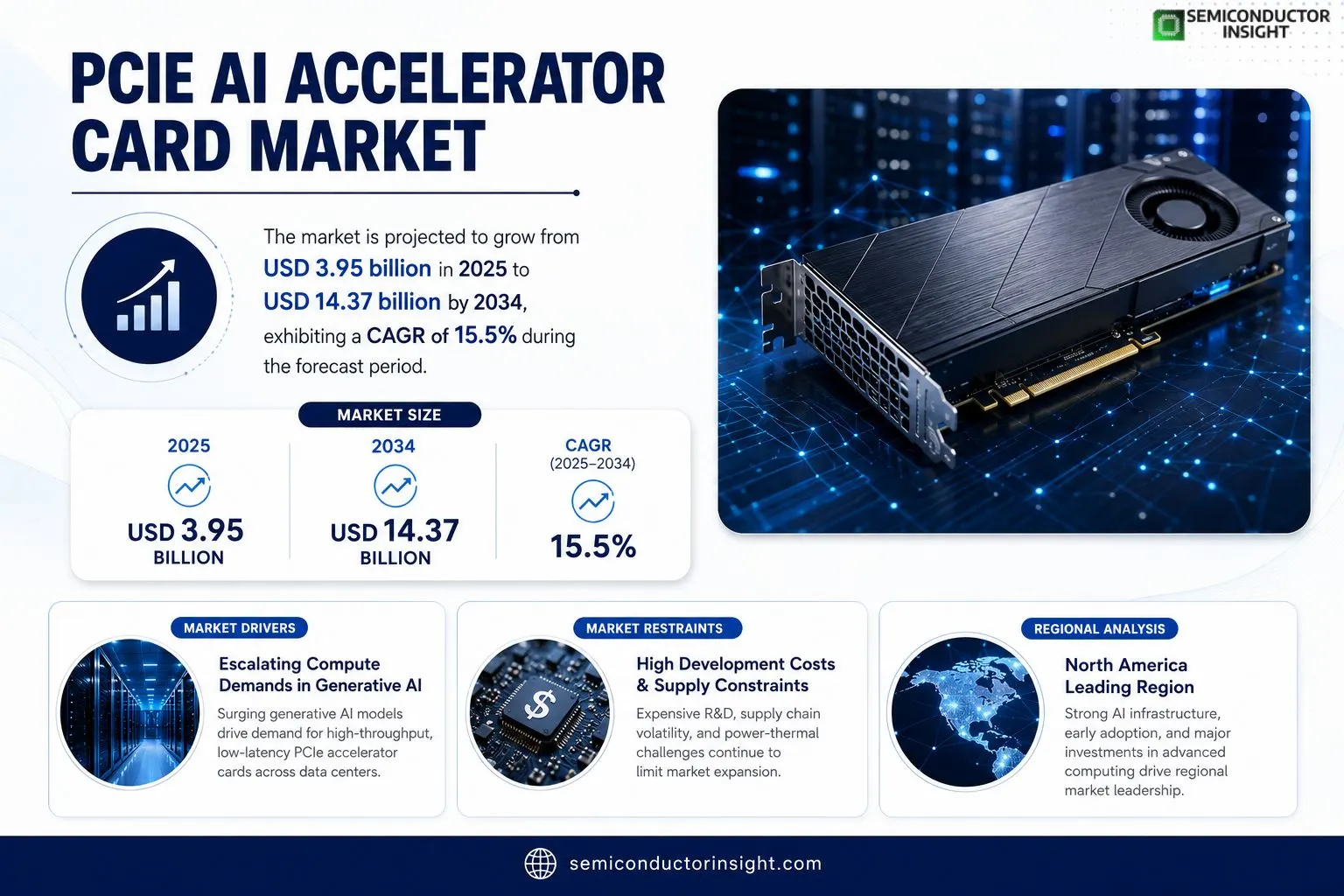
PCIe AI Accelerator Card market size was valued at USD 3.95 billion in 2025 and will reach USD 14.37 billion by 2034, reflecting an implied CAGR of roughly 15.5 % over the period.
PCIe AI accelerator cards are high‑performance computing modules that connect through a PCI Express slot; they combine GPUs, ASICs or FPGAs purpose‑built for accelerating artificial‑intelligence training and inference across data‑center, cloud and edge deployments.The rise of large‑scale generative‑AI models pushes demand for higher compute density, while enterprises embracing digital transformation adopt these cards for intelligent manufacturing, financial risk analytics and medical imaging analysis; nevertheless, steep development costs, supply‑chain constraints and power‑thermal challenges limit expansion.
MARKET DRIVERS
Escalating Compute Demands in Generative AI
The surge in large‑language models and diffusion‑based image generators has stretched the limits of traditional CPUs and GPUs. Enterprises are turning to purpose‑built PCIe AI accelerator cards to deliver the matrix‑multiplication throughput required for inference at scale. Latency‑critical workloads now prioritize these add‑in cards because they can be slotted into existing server chassis without costly architectural redesign.
Data‑Center Modernization and Modular Scalability
Operators upgrading legacy racks are favoring PCIe‑based solutions for their plug‑and‑play nature. The form factor aligns with standard server backplanes, allowing incremental capacity expansion as AI workloads fluctuate. Modular scaling reduces capital outlay and improves total cost of ownership, making the PCIe AI accelerator card an attractive upgrade path for hyperscalers.
➤ Strategic alliances between silicon vendors and OEMs are accelerating time‑to‑market for next‑generation cards, widening adoption across cloud and edge environments.
Beyond raw performance, the ecosystem of software toolchainsspanning compilers, libraries, and orchestration platformshas matured. This software readiness empowers developers to extract efficiency gains without deep hardware expertise, further strengthening the market’s momentum.
MARKET CHALLENGES
Thermal Management in High‑Density Deployments
As rack units become more densely populated with accelerator cards, heat dissipation emerges as a bottleneck. Conventional air‑cooling schemes struggle to maintain optimal junction temperatures, prompting data‑center operators to invest in liquid‑cooling loops or redesign airflow architecture. Thermal constraints can erode performance gains if not addressed early in the deployment lifecycle.
Other Challenges
Supply‑Chain Volatility
The semiconductor shortage that began in 2020 still reverberates, affecting the availability of high‑bandwidth memory and ASIC dies essential for AI cards. Lead times have stretched, compelling planners to secure long‑term contracts or diversify sources, which adds complexity to procurement strategies.Regulatory scrutiny over AI compute power, particularly in regions imposing export controls on advanced accelerators, introduces compliance overhead. Companies must navigate licensing frameworks to avoid penalties, influencing product roadmaps and market entry timing.
MARKET RESTRAINTS
Cost Sensitivity in Mid‑Market Segments
While flagship enterprises can justify the premium associated with PCIe AI accelerator cards, midsize firms often view the expense as prohibitive. The price‑to‑performance ratio must improve for broader diffusion, especially as alternative software‑only optimizations become more competitive.Legacy software stacks that lack native support for accelerator APIs require substantial refactoring. Organizations hesitant to allocate engineering resources for such migrations may delay adoption, tempering overall market velocity.Additionally, the rapid evolution of alternative interconnect standardssuch as Compute Express Link (CXL)creates uncertainty about long‑term compatibility. Prospective buyers worry that early‑stage PCIe investments could become obsolete as new protocols gain traction.
MARKET OPPORTUNITIES
Edge‑Centric AI Inference Solutions
Deploying AI inference at the network edge reduces latency and bandwidth costs for time‑critical applications such as autonomous vehicles and industrial IoT. Compact server form factors equipped with PCIe AI accelerator cards can bring high‑throughput inference close to the data source. Edge deployments therefore open a lucrative niche for vendors that tailor their cards for low‑power, rugged environments.Another promising avenue lies in the integration of accelerator cards with emerging software frameworks that abstract hardware specifics. Platforms that offer one‑click provisioning and auto‑scaling across cloud and on‑premise resources lower the barrier to entry for sectors traditionally slower to adopt AI, expanding the addressable market for PCIe AI Accelerator Card Market.
PCIe AI Accelerator Card Market Trends
Surging Demand from Generative AI Workloads
The emergence of large‑scale generative models has redefined compute requirements for data‑center operators. In 2025, manufacturers delivered roughly 1.2 million PCIe AI accelerator cards, each priced near $3,500, underscoring the willingness of cloud providers and enterprise AI teams to invest in higher‑density solutions. This purchasing behaviour stems from the need to compress training timelines and to sustain inference throughput for models that now exceed hundreds of billions of parameters. The market’s upward trajectory is reinforced by the convergence of faster PCIe 5.0 lanes, high‑bandwidth memory stacks, and tighter hardware‑software co‑design, which together trim latency and improve utilization rates. Companies that align product roadmaps with these architectural advances are seeing gross margins in the 45‑55 % band, reflecting the premium attached to performance‑leading silicon.
Other Trends
Supply‑Chain Constraints and Pricing Pressure
While demand is robust, the upstream segment faces a bottleneck in advanced process wafers and high‑speed interconnect components. Limited capacity at leading foundries translates into longer lead times for ASIC‑based cards, prompting some OEMs to diversify into FPGA hybrids that can be stocked in greater volumes. The resulting scarcity has modestly nudged average selling prices upward, yet price elasticity remains low because customers prioritize throughput over cost when scaling AI services. Vendors that secure multi‑year wafer allocations are gaining a strategic edge, allowing them to honour contracts without sacrificing margin.
Shift Toward Edge and Modular Designs
Beyond the data‑center, enterprises are extending inference workloads to edge locales such as factories, autonomous vehicles, and remote diagnostic stations. The latest generation of PCIe AI accelerator cards incorporates modular power connectors and scalable memory configurations, enabling integration into compact chassis that still meet the 225‑350 W envelope required for real‑time vision analytics. This migration to the edge is driven by stricter latency requirements and by regulatory incentives that favour on‑premise processing of sensitive data. Suppliers that bundle firmware‑level optimizations for popular large‑model frameworks are positioning themselves to capture a growing slice of the edge market, where differentiated performance can command a price premium.
COMPETITIVE LANDSCAPE
Key Industry Players
PCIe AI Accelerator Card Market – Competitive Overview
The market is dominated by a handful of firms that leverage deep‑chip design expertise and extensive software ecosystems. Nvidia retains the largest share, capitalising on its CUDA‑optimised GPU families that have been repurposed for PCIe form‑factor AI cards. Its aggressive roadmap, which pushes memory bandwidth and power‑efficiency limits, forces rivals to accelerate product cycles. Intel follows with a hybrid strategy that blends Xe‑based GPUs and custom ASIC blocks, targeting hyperscale data‑centre operators that value integration with existing Xeon platforms. AMD’s Radeon Instinct line offers a cost‑effective alternative, exploiting its RDNA architecture to balance throughput and thermal envelope, thereby appealing to mid‑tier cloud providers seeking to diversify away from a single supplier.Beyond the three-tier core, a vibrant cohort of niche innovators shapes specialization. Huawei’s Ascend cards focus on heterogeneous compute pipelines, making them attractive for domestic Chinese cloud services that require tight AI‑software coupling. Cambricon and Kunlunxin offer ASIC‑centric solutions tuned for inference workloads, carving out market segments in telecom and edge‑vision deployments. European and Israeli startups such as Graphcore, Cerebras, and Tenstorrent differentiate through novel dataflow architectures that reduce latency for large‑model training. Xilinx and Qualcomm pursue FPGA‑based accelerators that provide reconfigurability for AI‑driven inference on the edge, while companies like Biren Technology, Muxi Integrated Circuits, and Iluvatar CoreX concentrate on ultra‑low‑power designs for autonomous‑driving and industrial IoT. This mosaic of capabilities ensures that customers can select a product that matches their performance, power, and ecosystem requirements.
List of Key PCIe AI Accelerator Card Companies Profiled
- Nvidia
- AMD
- Intel
- Huawei Ascend
- Cambricon
- Kunlunxin
- Hygon
- Xilinx
- Qualcomm
- Graphcore
- Cerebras
- Tenstorrent
- ASUS
- EdgeCortix
- Biren Technology
- Muxi Integrated Circuits
- Iluvatar CoreX
- Moore Threads
- Enflame
- T‑Head
- SOPHGO
Segment Analysis:
| Segment Category | Sub-Segments | Key Insights |
| By Type |
|
GPU Accelerator Card
|
| By Application |
|
Data Center AI Training
|
| By End User |
|
Enterprise Digital Transformation Units
|
| By Power |
|
75 – 225 W Segment
|
| By Memory Capacity |
|
32 – 80 GB Segment
|
Regional Analysis: PCIe AI Accelerator Card Market
North America
The convergence of edge‑focused AI inference and the need for rapid data exchange has elevated PCIe accelerators as a cost‑effective bridge between CPUs and GPUs. Enterprises cite reduced latency and simplified provisioning as primary incentives for integration.
Federal initiatives encouraging domestic AI chip production have spurred a modest reshoring of component manufacturing, aligning with broader supply‑chain resilience goals and creating a favorable investment climate.
Tier‑1 PCB assemblers in the Midwest have expanded capacity for high‑density PCIe modules, allowing faster time‑to‑market for emerging designs and mitigating lead‑time volatility caused by overseas bottlenecks.
Established silicon giants leverage deep IP libraries, while agile startups differentiate through niche optimizations for specific AI workloads, fostering a vibrant two‑tier competitive environment.
Europe
European adopters place a premium on energy efficiency, prompting a shift toward PCIe AI accelerator cards that deliver high performance per watt. National AI strategies across Germany, France, and the Nordics encourage collaborative research clusters, which in turn stimulate demand for interoperable hardware platforms. Data‑sovereignty concerns have led several enterprises to prefer on‑premise acceleration over public‑cloud alternatives, reinforcing the appeal of modular PCIe solutions that can be seamlessly integrated into existing server farms. Vendors targeting Europe must therefore align product roadmaps with stringent ecological standards and provide comprehensive compliance documentation to satisfy regulators and procurement officers alike.
Asia‑Pacific
The Asia‑Pacific region exhibits a heterogeneous mix of early adopters and emerging players. In Japan and South Korea, long‑standing semiconductor expertise fuels sophisticated design houses that experiment with custom PCIe lane configurations to accelerate AI inference at the edge. Meanwhile, fast‑growing cloud providers in India and Southeast Asia prioritize scalability, driving demand for plug‑and‑play accelerator cards that can be rapidly deployed across distributed data centers. Cultural emphasis on rapid iteration means that companies often favor open‑source toolchains, encouraging a collaborative ecosystem where hardware and software co‑evolve. Market entrants that can navigate varied compliance regimes and offer localized support are poised to capture significant share.
South America
South American markets are gradually transitioning from proof‑of‑concept deployments to production‑grade AI workloads. Brazil’s burgeoning fintech sector, for instance, leverages PCIe accelerator cards to crunch transaction data in near real time, while Argentina’s agricultural tech firms apply accelerated models to optimize crop yields. Limited broadband infrastructure in certain locales makes on‑site acceleration more attractive than continuous cloud streaming, reinforcing the value proposition of compact, high‑density PCIe solutions. Companies that invest in regional training programs and robust after‑sales service networks will find a receptive audience eager to upgrade legacy compute assets.
Middle East & Africa
In the Middle East, sovereign wealth funds are channeling capital into AI research hubs, with a particular interest in security and oil‑field analytics. The region’s preference for vertically integrated solutions drives demand for PCIe AI accelerator cards that can be embedded within ruggedized edge devices. African markets, though still nascent, show promise as mobile‑first operators explore on‑device AI for telecommunications and health diagnostics. The key challenge lies in balancing cost constraints with performance requirements; therefore, vendors offering modular pricing models and localized firmware optimizations are likely to gain early footholds.
Report Scope
This market research report provides a comprehensive analysis of the PCIe AI Accelerator Card Market , covering the forecast period 2026–2034. It offers detailed insights into market dynamics, technological advancements, competitive landscape, and key trends shaping the industry.
Key focus areas of the report include:
- Market Overview: The report begins with an overview outlining its current market scenario, key growth indicators, and industry transformation drivers. It discusses macroeconomic factors, demand–supply balance, regulatory landscape, and the strategic role of semiconductors in powering advancements across industries such as automotive, telecommunications, consumer electronics, and industrial automation.
- Market Size & Forecast: Historical data and future projections for revenue, unit shipments, and market value across major regions and segments.
- Segmentation Analysis: Detailed breakdown by product type, technology, application, and end-user industry to identify high-growth segments and investment opportunities.
- Regional Insights: Insights into market performance across North America, Europe, Asia-Pacific, Latin America, and the Middle East & Africa, including country-level analysis where relevant.
- Competitive Landscape: Profiles of leading market participants, including their product offerings, R&D focus, manufacturing capacity, pricing strategies, and recent developments such as mergers, acquisitions, and partnerships.
- Technology Trends & Innovation: Assessment of emerging technologies, integration of AI/IoT, semiconductor design trends, fabrication techniques, and evolving industry standards.
- Market Drivers & Restraints: Evaluation of factors driving market growth along with challenges, supply chain constraints, regulatory issues, and market-entry barriers.
- Stakeholder Insights: Insights for component suppliers, OEMs, system integrators, investors, and policymakers regarding the evolving ecosystem and strategic opportunities.
Primary and secondary research methods are employed, including interviews with industry experts, data from verified sources, and real-time market intelligence to ensure the accuracy and reliability of the insights presented.
FREQUENTLY ASKED QUESTIONS:
What is the current market size of PCIe AI Accelerator Card Market?
-> PCIe AI Accelerator Card Market was valued at USD 3,947 million in 2025 and is expected to reach USD 10,777 million by 2032 with a CAGR of 15.8%.
Which key companies operate in PCIe AI Accelerator Card Market?
-> Key players include NVIDIA, AMD, Intel, Huawei Ascend, Cambricon, Kunlunxin, Hygon, Xilinx, Qualcomm, Google, Graphcore, Cerebras, Tenstorrent, ASUS, EdgeCortix, Biren Technology, Muxi Integrated Circuits, Iluvatar CoreX, Moore Threads, Enflame, T-Head, SOPHGO.
What are the key growth drivers?
-> Key growth drivers include increasing AI model complexity, growing data center demand, enterprise digital transformation, and upgrades in computing infrastructure.
Which region dominates the market?
-> North America and Asia‑Pacific are the largest contributors, driven by massive data‑center deployments and cloud service expansion.
What are the emerging trends?
-> Emerging trends include higher computing density, improved power efficiency, optimized heterogeneous architectures, stronger hardware‑software integration, higher‑bandwidth memory, advanced process nodes, modular scalability, and expansion into edge computing scenarios.
Get Sample Report PDF for Exclusive Insights
Report Sample Includes
- Table of Contents
- List of Tables & Figures
- Charts, Research Methodology, and more...
 Download Sample Report PDF