Palm Vein Recognition Sensor Market Insights
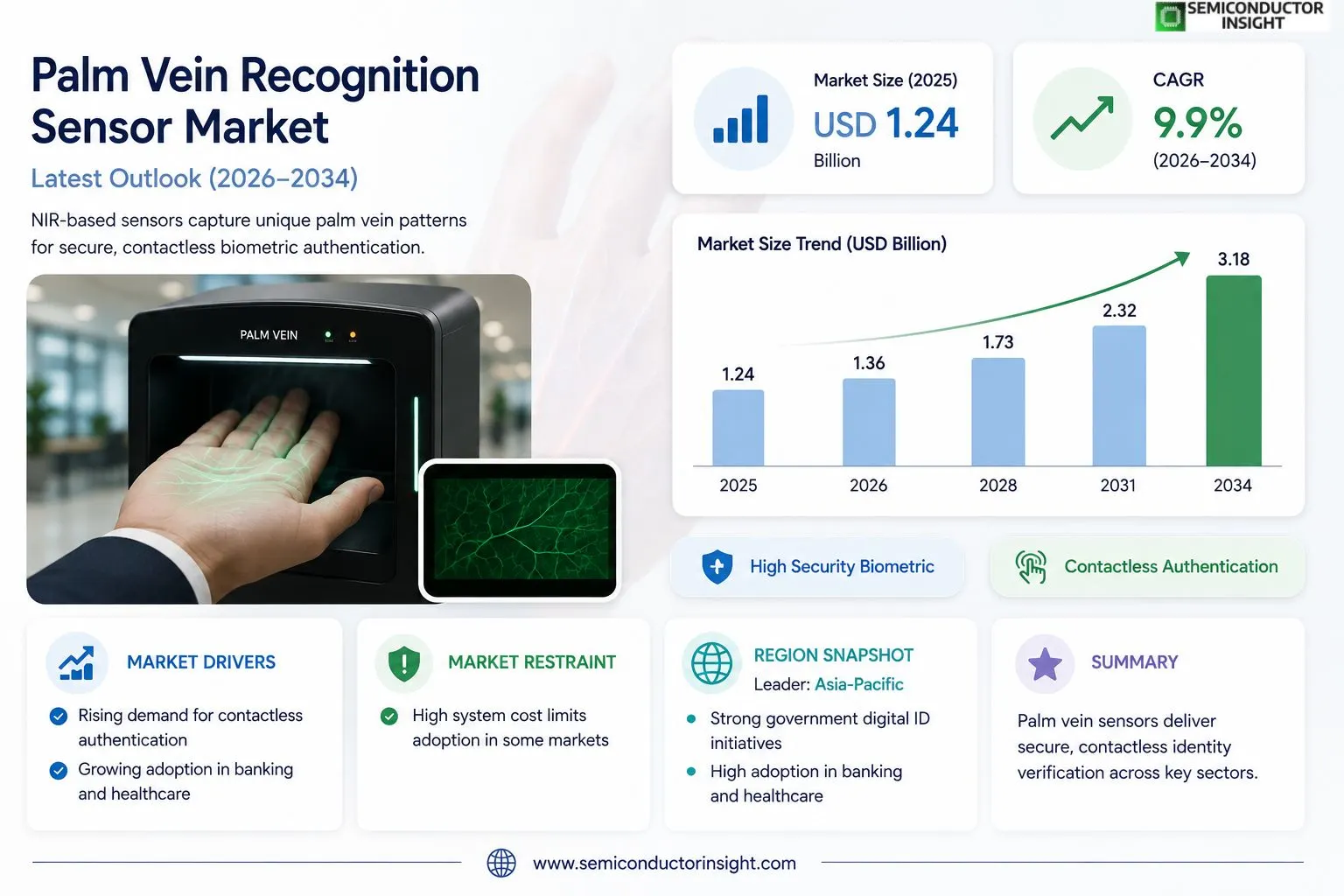
Global Palm Vein Recognition Sensor market size was valued at USD 1.24 billion in 2025. The market is projected to grow from USD 1.36 billion in 2026 to USD 3.18 billion by 2034, exhibiting a CAGR of 9.9% during the forecast period.
Palm vein recognition sensors are advanced biometric devices that use near-infrared light to capture the unique vein patterns beneath the surface of the human palm. Because vein patterns are internal and highly complex, this technology offers a significantly higher level of security compared to conventional biometric modalities such as fingerprint or facial recognition. The sensors encompass contact-based and contactless variants, and are integrated across a wide range of applications including access control systems, financial authentication, healthcare identity verification, and time-attendance management.
The market is witnessing robust growth driven by escalating demand for high-security, contactless biometric authentication solutions across banking, healthcare, and government sectors. Furthermore, increasing concerns over data breaches and identity fraud are prompting organizations to adopt more reliable identification technologies. Key players such as Fujitsu Limited, NEC Corporation, and BioSec Group Ltd. are actively expanding their palm vein recognition portfolios, reinforcing market momentum through strategic partnerships and continuous technological innovation.
MARKET DRIVERS
Rising Demand for Contactless and Hygienic Biometric Authentication
Global palm vein recognition sensor market is experiencing significant momentum, driven by the growing need for secure, contactless biometric authentication across banking, healthcare, and government sectors. Unlike fingerprint or facial recognition, palm vein recognition captures the unique subcutaneous vascular pattern of an individual’s hand using near-infrared light, making it exceptionally difficult to spoof or replicate. This inherent security advantage has accelerated institutional adoption, particularly in high-security environments where data integrity is non-negotiable. The post-pandemic shift toward hygiene-conscious, touchless identification systems has further reinforced demand for palm vein sensors in public access points, hospitals, and financial institutions.
Expansion of Financial Inclusion and Secure Banking Infrastructure
Financial institutions globally are investing in palm vein recognition technology as part of broader digital transformation initiatives aimed at reducing fraud and strengthening Know Your Customer (KYC) compliance. Banks and ATM networks, particularly across Asia-Pacific and the Middle East, have deployed palm vein authentication to replace or supplement traditional PIN-based systems. This transition is supported by regulatory frameworks mandating multi-factor authentication in financial transactions. The technology’s ability to deliver authentication accuracy rates exceeding 99.9% under controlled conditions makes it a preferred choice for high-value transaction verification and secure vault access management.
➤ Palm vein recognition sensors offer a false acceptance rate (FAR) among the lowest in biometric modalities, reinforcing their suitability for critical infrastructure protection and identity assurance in regulated industries.
The integration of palm vein sensors into smart access control systems for corporate campuses, data centers, and border management has created a robust secondary demand channel. Governments in developed and emerging economies alike are piloting palm vein-based national identity programs, further catalyzing hardware procurement and software development investment. This dual push from the private and public sectors continues to sustain healthy growth trajectories for palm vein recognition sensor market participants across the value chain.
MARKET CHALLENGES
High Implementation Costs Limiting Adoption Among Small and Mid-Sized Enterprises
Despite its technical superiority, Palm Vein Recognition Sensor Market faces notable resistance from cost-sensitive segments. The specialized near-infrared imaging components, ruggedized sensor housings, and proprietary algorithm licensing fees collectively contribute to a higher total cost of ownership compared to fingerprint or facial recognition alternatives. Small and medium-sized enterprises, particularly in retail and light commercial applications, often find it difficult to justify the capital expenditure associated with palm vein deployment. This cost barrier restricts the market’s addressable base and elongates sales cycles, especially in price-competitive emerging markets where budget constraints govern technology procurement decisions.
Other Challenges
Environmental and Physiological Sensitivity
Palm vein sensors can exhibit reduced performance under certain environmental conditions, including extreme temperatures, high ambient infrared light, or poor blood circulation in elderly users. These physiological variables introduce inconsistencies in recognition accuracy that require additional algorithmic compensation, increasing system complexity. Manufacturers must continuously invest in sensor calibration improvements and adaptive software to maintain reliability across diverse user demographics and deployment environments, adding to ongoing development costs.
Interoperability and Standardization Gaps
The absence of universally accepted interoperability standards for palm vein recognition systems poses integration challenges for enterprises operating multi-vendor biometric ecosystems. Proprietary data formats and communication protocols limit the seamless exchange of biometric templates across platforms, creating vendor lock-in scenarios that reduce customer flexibility. Industry bodies and standards organizations are working toward unified frameworks, but progress remains gradual, creating friction for large-scale cross-institutional deployments.
MARKET RESTRAINTS
Data Privacy Regulations and Biometric Data Governance Concerns
Stringent data protection regulations, including the General Data Protection Regulation (GDPR) in Europe and various state-level biometric privacy laws in the United States, impose significant compliance obligations on organizations deploying palm vein recognition systems. The collection, storage, and processing of biometric vein patterns are classified as sensitive personal data under most regulatory regimes, requiring explicit user consent, robust encryption protocols, and defined data retention limits. Compliance complexity increases operational overhead and legal exposure for enterprises, particularly those operating across multiple jurisdictions with divergent regulatory requirements, effectively restraining rapid market expansion.
Competition from Mature and Lower-Cost Biometric Modalities
Palm Vein Recognition Sensor Market operates in a highly competitive biometric landscape where fingerprint recognition, iris scanning, and facial recognition technologies have achieved significantly greater scale, cost efficiency, and developer ecosystem maturity. These established modalities benefit from extensive installed base networks, standardized APIs, and declining hardware costs driven by high-volume consumer device integration. For many general-purpose applications, the marginal security benefit offered by palm vein recognition does not readily justify the premium pricing differential, causing procurement decision-makers to default toward more familiar and budget-friendly alternatives. This competitive pressure continues to moderate the market’s growth velocity, especially in non-critical commercial applications.
MARKET OPPORTUNITIES
Integration with AI-Powered Identity Platforms and Smart Infrastructure
The convergence of palm vein recognition sensors with artificial intelligence and machine learning frameworks represents one of the most transformative opportunities in the market. AI-enhanced algorithms dramatically improve real-time vein pattern matching under suboptimal conditions, reduce processing latency, and enable continuous learning from expanded biometric datasets. This capability elevates palm vein systems from standalone authentication tools into intelligent identity assurance components within broader smart city and enterprise security platforms. Vendors investing in AI-native sensor architectures are well-positioned to capture high-value contracts from government smart infrastructure programs and large financial institutions undergoing digital identity modernization initiatives.
Emerging Healthcare and Patient Identity Management Applications
Healthcare represents a high-potential vertical for Palm Vein Recognition Sensor Market, driven by the urgent need to eliminate patient misidentification errors and strengthen medical record security. Hospitals and healthcare networks are exploring palm vein authentication to ensure accurate patient-record linkage at point-of-care, medication dispensing, and controlled substance management stations. The touchless nature of the technology aligns well with strict infection control protocols in clinical environments. As healthcare digitization accelerates globally and regulatory pressure around patient data accuracy intensifies, procurement of palm vein sensors for medical identity management applications is expected to grow, creating a durable and recurring revenue opportunity for market participants with healthcare-sector expertise and compliant solution architectures.
Palm Vein Recognition Sensor Market Trends
Rising Demand for Contactless Biometric Authentication Driving Market Expansion
Palm Vein Recognition Sensor Market is experiencing significant momentum as organizations across banking, healthcare, and government sectors increasingly prioritize high-security, contactless biometric authentication solutions. The growing frequency of data breaches and identity fraud incidents has accelerated adoption of palm vein recognition technology, which leverages near-infrared light to capture unique subsurface vein patterns , an internal biometric trait that is exceptionally difficult to replicate or spoof. Unlike conventional modalities such as fingerprint or facial recognition, palm vein recognition sensors offer a substantially elevated security profile, making them the preferred choice for high-stakes identity verification environments.
Other Trends
Expansion Across Banking and Financial Services
Financial institutions are increasingly integrating palm vein recognition sensors into customer authentication workflows to combat fraud and streamline secure transactions. Banks are deploying these sensors at ATMs, teller stations, and digital onboarding touchpoints to replace or supplement traditional PIN-based and card-based systems. The technology’s contactless nature has further accelerated its adoption in the post-pandemic era, where hygiene-conscious authentication has become a key operational requirement across retail banking environments globally.
Healthcare Sector Adoption for Patient Identity Verification
Healthcare providers are turning to palm vein recognition sensors to ensure accurate patient identification and prevent medical identity theft. Hospitals and clinics are deploying these systems at registration desks and medication dispensing stations to eliminate misidentification risks. The non-invasive and contactless characteristics of palm vein sensors align well with the hygiene standards required in clinical settings, reinforcing their rapid uptake within the healthcare identity verification segment of Palm Vein Recognition Sensor Market.
Strategic Investments and Technological Innovation by Key Players
Leading companies in Palm Vein Recognition Sensor Market, including Fujitsu Limited, NEC Corporation, and BioSec Group Ltd., are actively expanding their product portfolios through continuous research and development and strategic industry partnerships. These organizations are focusing on improving sensor miniaturization, enhancing accuracy under varying environmental conditions, and integrating palm vein recognition capabilities into broader multi-modal biometric platforms. Such innovation-driven strategies are reinforcing competitive positioning and sustaining long-term market momentum as demand for robust biometric identification solutions continues to grow across both public and private sector applications worldwide.
COMPETITIVE LANDSCAPE
Key Industry Players
Palm Vein Recognition Sensor Market: Competitive Dynamics, Strategic Positioning, and Leading Innovators Shaping Global Biometric Security Landscape
Global palm vein recognition sensor market is characterized by a moderately consolidated competitive structure, with a handful of technologically advanced incumbents commanding significant market share. Fujitsu Limited stands as the dominant force in this space, having pioneered PalmSecure technology , a contactless palm vein authentication solution widely deployed across banking, healthcare, and government verticals. The company’s deep R&D investment, extensive patent portfolio, and established global distribution networks have enabled it to maintain a formidable lead. NEC Corporation represents another tier-one competitor, leveraging its broader biometric identification expertise to integrate palm vein recognition into comprehensive identity management platforms. These leading players are actively pursuing strategic partnerships, mergers, and technology licensing agreements to consolidate their positions as the market is projected to grow from USD 1.36 billion in 2026 to USD 3.18 billion by 2034 at a CAGR of 9.9%.
Beyond the market leaders, a number of specialized and regional players are carving out meaningful niches within the palm vein recognition sensor ecosystem. BioSec Group Ltd. has gained recognition for its innovative contactless palm vein scanners tailored for access control and workforce management applications. Companies such as Hitachi, Ltd. are leveraging finger vein and palm vein hybrid technologies to address enterprise-grade security requirements, while M2SYS Technology and Imprivata Inc. focus on delivering palm vein biometric solutions specifically optimized for healthcare identity verification and patient safety workflows. Emerging competitors from Asia-Pacific, including Shenzhen Zhuo Ao Biometrics Technology Co., Ltd. and Dakar Technology, are expanding their global footprint by offering cost-competitive alternatives suited for large-scale deployments. The competitive intensity is further amplified by technology convergence, as players increasingly combine palm vein recognition with AI-driven liveness detection and multi-modal biometric frameworks to differentiate their offerings in a security-conscious marketplace.
List of Key Palm Vein Recognition Sensor Companies Profiled
- Fujitsu Limited
- NEC Corporation
- BioSec Group Ltd.
- Hitachi, Ltd.
- M2SYS Technology
- Imprivata Inc.
- Shenzhen Zhuo Ao Biometrics Technology Co., Ltd.
- Dakar Technology
- Recogtech B.V.
- Mantra Softech India Pvt. Ltd.
- Idex Biometrics ASA
- Mofiria Corporation
- Suprema Inc.
Segment Analysis:
| Segment Category | Sub-Segments | Key Insights |
| By Type |
|
Contactless Palm Vein Recognition Sensors have emerged as the dominant segment within Palm Vein Recognition Sensor Market, driven by a paradigm shift in how organizations approach hygiene-conscious and user-friendly biometric authentication.
|
| By Application |
|
Access Control Systems represent the leading application segment for palm vein recognition sensors, underpinned by a widespread organizational need to fortify physical and digital security perimeters.
|
| By End User |
|
Banking, Financial Services, and Insurance (BFSI) stands as the dominant end-user segment, propelled by an acute and growing need for robust identity verification and fraud prevention mechanisms.
|
| By Technology |
|
Near-Infrared (NIR) Imaging technology remains the foundational and most widely adopted approach within Palm Vein Recognition Sensor Market, owing to its proven efficacy and well-established deployment history.
|
| By Deployment Mode |
|
Integrated/Embedded Systems represent the fastest-growing and increasingly dominant deployment mode, as organizations seek cohesive and interoperable security ecosystems rather than isolated biometric solutions.
|
Regional Analysis: Palm Vein Recognition Sensor Market
Asia-Pacific
Asia-Pacific’s banking sector has been a primary driver of palm vein recognition sensor deployment. Financial institutions across Japan, China, and South Korea have integrated palm vein authentication into ATMs and branch access systems to elevate transaction security. The growing emphasis on fraud prevention and seamless customer experience continues to reinforce the market’s expansion in this segment.
Government investments in smart city infrastructure across China, India, and Southeast Asia are generating significant demand for palm vein recognition sensors in public access and identity verification applications. National digital identity programs and e-governance mandates are prompting large-scale biometric deployments, with palm vein technology gaining preference due to its contactless, hygienic, and highly accurate authentication capabilities.
Hospitals and healthcare systems across Asia-Pacific are deploying palm vein recognition sensors to streamline patient identification and prevent medical identity fraud. Japan and South Korea have led this adoption curve, where palm vein authentication ensures accurate patient record linkage and reduces administrative errors. Growing healthcare digitalization across emerging markets within the region is expected to further broaden this application landscape.
A well-established network of biometric technology manufacturers and R&D institutions in Asia-Pacific provides Palm Vein Recognition Sensor Market with a competitive edge. Local players are continuously innovating to improve sensor miniaturization, accuracy, and integration flexibility. This ecosystem enables faster technology iteration and cost-effective solutions tailored to the diverse needs of regional end-users across both developed and emerging economies.
North America
North America represents a highly mature and technologically advanced market for palm vein recognition sensors, characterized by strong enterprise demand and growing government interest in next-generation biometric authentication. The United States leads regional adoption, with palm vein recognition sensors being integrated into high-security access control environments, financial services infrastructure, and healthcare facilities seeking alternatives to traditional credential-based systems. The region’s stringent regulatory framework around data privacy and identity management, including compliance mandates such as HIPAA in healthcare, has accelerated the shift toward secure, contactless biometric solutions. Canada is also witnessing increasing interest from financial institutions and border security agencies exploring palm vein recognition for identity verification. North American enterprises are drawn to palm vein technology for its low false acceptance rates and resistance to spoofing, making it a preferred choice in environments where security precision is paramount. Continued investment in cybersecurity and identity assurance infrastructure positions North America as a key growth contributor to Global palm vein recognition sensor market.
Europe
Europe’s palm vein recognition sensor market is shaped by a careful balance between security innovation and stringent data protection regulation, most notably the General Data Protection Regulation. Despite regulatory complexity, European enterprises across banking, healthcare, and critical infrastructure sectors are progressively evaluating palm vein authentication as a privacy-respecting biometric modality, given that vein patterns are internal and cannot be easily captured without user cooperation. Germany, France, and the United Kingdom are among the most active markets, where financial institutions and government agencies are piloting palm vein recognition for secure access and identity verification. The region’s focus on contactless and hygienic authentication solutions, reinforced by public health considerations, has further elevated interest in palm vein sensor technology. European market growth is expected to be steady and deliberate, guided by regulatory clarity and enterprise risk management priorities rather than rapid mass deployment, positioning Europe as a quality-driven segment of Global palm vein recognition sensor market.
South America
South America presents an emerging landscape for Palm Vein Recognition Sensor Market, with growth anchored primarily in Brazil and Mexico, where financial inclusion initiatives and banking sector modernization are creating demand for advanced biometric authentication. The region’s expanding middle class and increasing smartphone and digital banking penetration are laying the groundwork for biometric identity solutions, including palm vein recognition, to enter mainstream financial and government services. Security concerns related to identity fraud and unauthorized access across public and private institutions are prompting decision-makers to explore palm vein technology as a more reliable alternative to traditional authentication methods. While infrastructure limitations and budget constraints may moderate the pace of adoption in smaller economies, strategic partnerships between global biometric solution providers and regional financial institutions are expected to gradually unlock market potential. South America’s palm vein recognition sensor market trajectory will be closely tied to the broader digital transformation agendas of its leading economies.
Middle East & Africa
The Middle East and Africa region offers a dynamic and opportunity-rich environment for Palm Vein Recognition Sensor Market, driven by ambitious smart city projects, large-scale government digitalization programs, and growing security infrastructure investments. The Gulf Cooperation Council countries, particularly the United Arab Emirates and Saudi Arabia, are aggressively adopting advanced biometric technologies across airports, government service centers, and financial institutions as part of their national transformation visions. Palm vein recognition sensors are gaining traction in these high-security environments due to their contactless nature and superior accuracy. In Africa, the market is at an earlier stage of development, yet increasing attention to digital identity frameworks and financial inclusion programs presents a long-term growth avenue. As regional governments and enterprises prioritize secure, scalable identity verification solutions, the Middle East and Africa segment is expected to register notable momentum in Global palm vein recognition sensor market over the forecast period.
Report Scope
This market research report provides a comprehensive analysis of the Palm Vein Recognition Sensor Market , covering the forecast period 2026–2034. It offers detailed insights into market dynamics, technological advancements, competitive landscape, and key trends shaping the industry.
Key focus areas of the report include:
- Market Overview: The report begins with an overview outlining its current market scenario, key growth indicators, and industry transformation drivers. It discusses macroeconomic factors, demand–supply balance, regulatory landscape, and the strategic role of semiconductors in powering advancements across industries such as automotive, telecommunications, consumer electronics, and industrial automation.
- Market Size & Forecast: Historical data and future projections for revenue, unit shipments, and market value across major regions and segments.
- Segmentation Analysis: Detailed breakdown by product type, technology, application, and end-user industry to identify high-growth segments and investment opportunities.
- Regional Insights: Insights into market performance across North America, Europe, Asia-Pacific, Latin America, and the Middle East & Africa, including country-level analysis where relevant.
- Competitive Landscape: Profiles of leading market participants, including their product offerings, R&D focus, manufacturing capacity, pricing strategies, and recent developments such as mergers, acquisitions, and partnerships.
- Technology Trends & Innovation: Assessment of emerging technologies, integration of AI/IoT, semiconductor design trends, fabrication techniques, and evolving industry standards.
- Market Drivers & Restraints: Evaluation of factors driving market growth along with challenges, supply chain constraints, regulatory issues, and market-entry barriers.
- Stakeholder Insights: Insights for component suppliers, OEMs, system integrators, investors, and policymakers regarding the evolving ecosystem and strategic opportunities.
Primary and secondary research methods are employed, including interviews with industry experts, data from verified sources, and real-time market intelligence to ensure the accuracy and reliability of the insights presented.
FREQUENTLY ASKED QUESTIONS:
What is the current market size of Palm Vein Recognition Sensor Market?
-> Global Palm Vein Recognition Sensor Market was valued at USD 1.24 billion in 2025 and is expected to reach USD 3.18 billion by 2034, growing at a CAGR of 9.9% during the forecast period from 2026 to 2034.
Which key companies operate in Palm Vein Recognition Sensor Market?
-> Key players include Fujitsu Limited, NEC Corporation, and BioSec Group Ltd., among others, who are actively expanding their palm vein recognition portfolios through strategic partnerships and continuous technological innovation.
What are the key growth drivers?
-> Key growth drivers include escalating demand for high-security contactless biometric authentication solutions across banking, healthcare, and government sectors, as well as increasing concerns over data breaches and identity fraud prompting organizations to adopt more reliable identification technologies.
Which region dominates the market?
-> Asia-Pacific is among the fastest-growing regions, while established markets across North America and Europe continue to demonstrate significant adoption of palm vein recognition technologies driven by stringent security requirements and advanced infrastructure.
What are the emerging trends?
-> Emerging trends include contactless biometric authentication, integration of palm vein sensors in access control systems, financial authentication, healthcare identity verification, and time-attendance management, as well as the use of near-infrared light technology to capture unique internal vein patterns for enhanced security.

Get Sample Report PDF for Exclusive Insights
Report Sample Includes
- Table of Contents
- List of Tables & Figures
- Charts, Research Methodology, and more...
 Download Sample Report PDF