ORing MOSFET Controller Market Insights
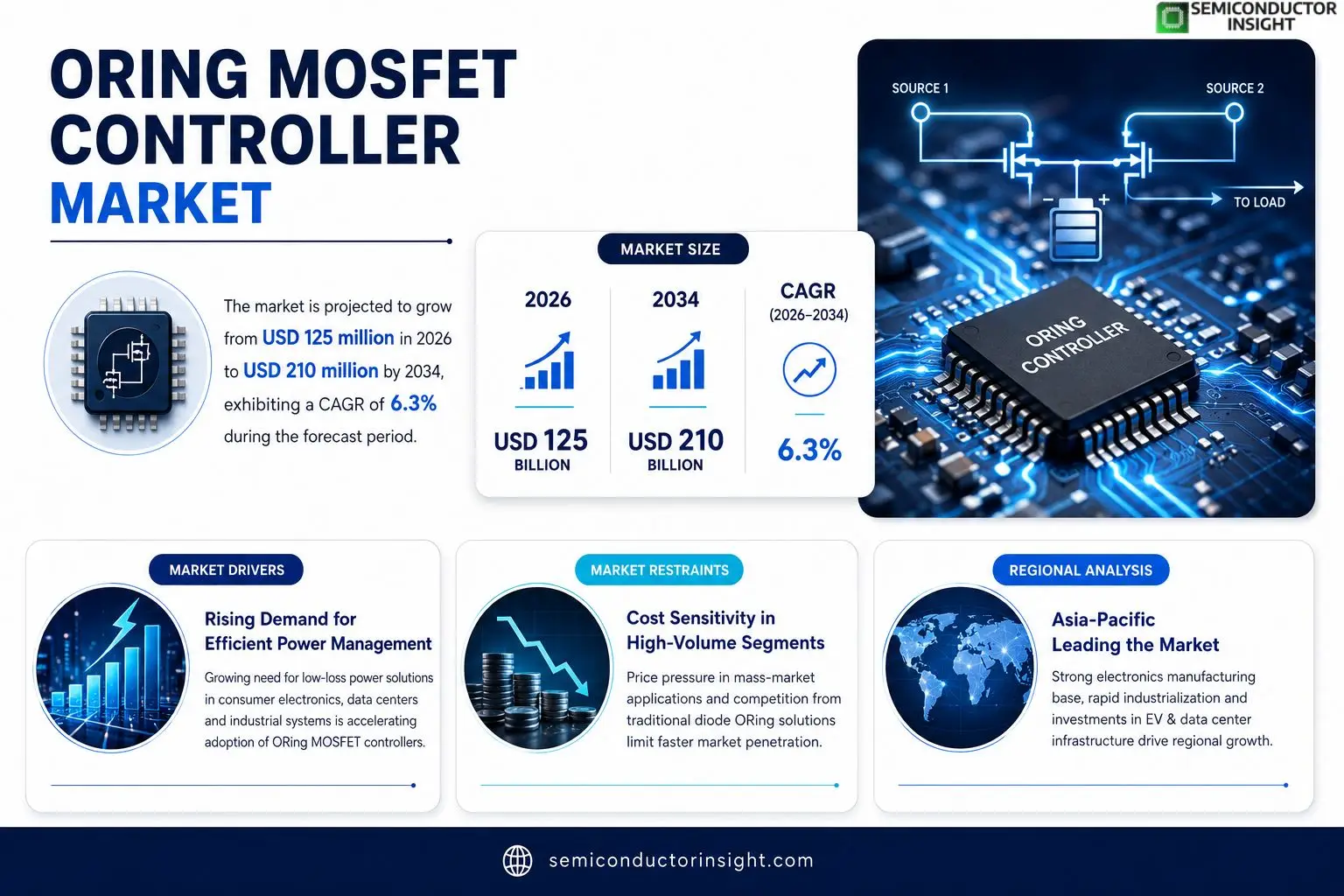
ORing MOSFET Controller market size was valued at USD 120 million in 2025. The market is projected to grow from USD 125 million in 2026 to USD 210 million by 2034, exhibiting a CAGR of approximately 6.3% during the forecast period.
An ORing controller, also known as an ideal diode controller, creates near‑perfect diodes using back‑to‑back N‑channel or P‑channel MOSFETs. By providing a low‑loss OR connection of multiple power supplies it improves system efficiency, reduces heat dissipation and minimizes voltage drop across the “OR” circuit.The ORing MOSFET Controller is essential for power management and battery protection across the electronics industry because electronic devices are becoming ever more ubiquitous. Key buyers include manufacturers of consumer electronics, communication equipment and industrial automation systems; typical uses cover power switching, battery charge‑discharge control and fault protection.
MARKET DRIVERS
Rising Power‑Management Efficiency Requirements
ORing MOSFET Controller Market benefits from manufacturers striving to minimise conduction loss in power‑distribution paths. Modern devicesparticularly in data‑center servers and portable electronicsdemand tighter voltage regulation, which pushes designers toward active ORing solutions that can quickly isolate faulted branches without sacrificing efficiency. By integrating MOSFETs with supervisory logic, system architects achieve a balance between protection and low standby power consumption.
System‑Level Integration and Footprint Reduction
Customers are consolidating multiple protection functions into a single silicon block, thereby shrinking board real estate. The trend toward highly integrated power‑management ICs encourages the adoption of ORing controllers that combine fault detection, switch control, and status signalling. This integration not only reduces component count but also simplifies layout, shortens time‑to‑market, and aligns with the miniaturisation goals of wearables and IoT gateways.
➤ “Active ORing architecture allows a seamless transition between power sources, preserving uptime while keeping thermal budgets in check.”
Strategically, OEMs view these controllers as enablers of reliability programmes that can differentiate products in competitive segments. The ability to guarantee uninterrupted power under transient conditions strengthens brand reputation and supports higher‑margin pricing strategies.
MARKET CHALLENGES
Design Complexity and Validation Overheads
Implementing an active ORing solution introduces additional firmware and analog calibration steps. Engineers must verify timing margins, ensure proper latch‑up protection, and conduct extensive EMI testing across multiple operating scenarios. These activities extend product development cycles, especially for firms transitioning from passive diode‑based protection to smarter MOSFET‑driven schemes.
Other Challenges
Thermal Management Constraints
The on‑resistance of MOSFETs, while low, still generates heat during high‑current events. Designers need to allocate sufficient thermal paths, which can become problematic in ultra‑compact modules where airflow is limited. Inadequate heat dissipation may erode the longevity benefits that the controller is meant to provide.
MARKET RESTRAINTS
Cost Sensitivity in High‑Volume Consumer Segments
Price‑point pressure remains a dominant restraint for large‑scale consumer electronics manufacturers. Even modest increases in bill‑of‑materials can affect profit margins, prompting some players to retain legacy diode ORing approaches despite their lower efficiency. The perceived value‑add of active control must offset the incremental expense to achieve broader acceptance.
MARKET OPPORTUNITIES
Emerging Automotive Electrification Platforms
Electrified vehicle architectures, including 48‑V mild‑hybrid systems, rely on robust power‑distribution networks that can tolerate rapid source changes. Active ORing controllers are uniquely positioned to safeguard battery packs, DC‑DC converters, and auxiliary loads while maintaining seamless operation during start‑stop events. This niche offers a clear growth path for ORing MOSFET Controller Market as OEMs tighten safety and efficiency standards.
Expansion into Edge‑Computing Infrastructures
Edge data centres and micro‑grid installations demand high availability with limited physical space. Deploying active ORing solutions enables these deployments to achieve redundancy without the bulk of traditional mechanical switches. Vendors that bundle controller IP with remote monitoring capabilities stand to capture a segment that values both reliability and manageability.
Overall, the convergence of tighter efficiency mandates, integration pressures, and sector‑specific safety requirements creates a fertile environment for innovative ORing MOSFET controller offerings. Companies that can navigate cost constraints while delivering validated, thermally‑robust designs are likely to secure a decisive advantage.
ORing MOSFET Controller Market Trends
Efficiency Gains Drive Adoption
ORing MOSFET Controller Market is being reshaped by the relentless pursuit of higher power‑conversion efficiency in modern electronic platforms. By replacing traditional diode OR’ing with MOSFET‑based ideal diodes, designers achieve markedly lower forward voltage drop and reduced heat dissipation. Those electrical savings translate directly into longer battery life for portable devices and lower operating costs for data‑center power supplies. As manufacturers embed power‑management functions deeper into ASICs, the demand for compact, low‑loss controllers rises, prompting original equipment makers to source components that can operate across a broader voltage window while maintaining tight thermal budgets.
Other Trends
Smart Battery Management Integration
In parallel, the market observes a convergence between ORing controllers and intelligent battery‑management systems (BMS). Engineers are increasingly expecting the controller to communicate status, fault conditions, and load‑share decisions over I²C or SMBus interfaces. This shift is fueled by the growth of electric‑vehicle platforms and IoT edge nodes where a single chip must monitor charge cycles, balance cells, and protect against over‑current events. The added functionality reduces board count, simplifies firmware development, and opens avenues for firmware‑updatable safety thresholds, thereby elevating the strategic value of the controller within the overall power‑train architecture.
Competitive Landscape and Regional Shifts
Competitive dynamics are intensifying as a core group of silicon specialistsAnalog Devices, Texas Instruments, Infineon, and Renesasexpand their product portfolios with higher‑integration variants and differentiated protection algorithms. At the same time, emerging regional players in Asia are leveraging advanced CMOS processes to offer cost‑effective alternatives for high‑volume consumer electronics. This geographic diversification is prompting original manufacturers to adopt a multi‑sourcing strategy, balancing cost, lead‑time, and reliability considerations. The trend underscores the importance of supply‑chain resilience, especially for sectors such as telecom infrastructure and industrial automation where uninterrupted power is non‑negotiable. Companies that can combine robust fault handling with adaptive control logic are poised to capture a larger share of ORing MOSFET Controller Market as system designers prioritize both performance and adaptability.
COMPETITIVE LANDSCAPE
Key Industry Players
ORing MOSFET Controller market – competitive pressures and strategic positioning
Analog Devices commands the premium segment of ORing MOSFET Controller Market, largely because its LDO‑PLUS and ADP series integrate precise current‑sense loops with voltage‑regulation features that address the stringent efficiency targets of telecom and data‑center OEMs. The company’s recent acquisition of Maxim Integrated bolstered its portfolio with high‑voltage silicon‑carbide (SiC) devices, enabling a tighter coupling of power‑path and battery‑management functions. Texas Instruments follows a parallel strategy, leveraging its extensive analog‑mixed‑signal design ecosystem to offer reference designs that shorten time‑to‑market for system integrators. Both firms invest heavily in automated design‑assist tools, which not only lock in design‑win relationships but also create a barrier for smaller entrants that lack comparable software support. Consequently, the upper tier of the market is defined by breadth of product families, application‑engineer networks, and the ability to bundle controller ICs with firmware updates that address emerging safety standards.Below the tier‑one tier, a constellation of niche players has cultivated defensible positions by targeting specific voltage ranges, form‑factor constraints, or emerging application domains such as edge‑computing and automotive‑level redundancy. Silergy’s focus on ultra‑low‑dropout circuitry for battery‑backed IoT devices has earned it a loyal base among board‑level designers seeking sub‑10 mV losses. Vicor and Joulwatt differentiate through advanced packaging that integrates thermal‑management elements directly on the die, a tactic that resonates with manufacturers of high‑density power modules. Companies like Bel Fuse and ON Semiconductor have broadened their addressable markets by bundling ORing controllers with protective fuses, creating a one‑stop‑shop proposition for industrial automation customers. Meanwhile, regional champions such as Rohm (Japan) and NXP (Netherlands) exploit localized supply‑chain advantages to meet the fast‑turn requirements of Asian data‑center builders, reinforcing a fragmented but vibrant competitive landscape.
List of Key ORing MOSFET Controller Companies Profiled
- Analog Devices
- Texas Instruments
- Diodes Incorporated
- Infineon Technologies
- Renesas Electronics
- Vicor
- Silergy
- Bel Fuse
- Joulwatt
- ON Semiconductor
- Microchip Technology
- NXP Semiconductors
- STMicroelectronics
- Maxim Integrated (now part of Analog Devices)
- Rohm Semiconductor
Segment Analysis:
| Segment Category | Sub-Segments | Key Insights |
| By Type |
|
Low Voltage Controllers are favored for consumer electronics and portable devices because they deliver minimal conduction loss and enable compact board layouts.
|
| By Application |
|
Redundant Power Supply Solutions underpin mission‑critical infrastructures where uninterrupted operation is paramount.
|
| By End User |
|
Electronic Product Manufacturers drive demand for compact, high‑efficiency power protection.
|
| By Architecture |
|
Integrated Controller with Embedded Diagnostics is increasingly preferred for its streamlined footprint and self‑monitoring capabilities.
|
| By Market Trend |
|
Smart Power Management trends shape the future of ORing MOSFET controllers.
|
Regional Analysis: ORing MOSFET Controller Market
North America
Stringent UL and IEC standards drive North American designers to embed robust over‑current protection, prompting ORing MOSFET controller suppliers to certify their devices for higher voltage classes and to offer built‑in diagnostic feedback that eases compliance testing.
The market sees a pivot toward integrated thermal‑monitoring loops within the controller, allowing real‑time adjustment of MOSFET gate drive to mitigate hot‑spot formation, a feature that resonates with customers seeking higher reliability in compact power modules.
Recent reshoring initiatives encourage manufacturers to source silicon wafers from domestic fabs, reducing lead times for ORing controllers and granting greater visibility into process variations that affect device performance.
End‑users prioritize fault‑tolerance that does not compromise efficiency; consequently, they demand solutions delivering sub‑microsecond response while maintaining low on‑resistance, a balance that defines purchasing decisions.
Europe
European manufacturers are channeling ORing MOSFET Controller Market toward automotive electrification mandates, where EU emissions directives press automakers to adopt power‑train architectures that rely on fail‑safe protection. German and French design houses emphasize modularity, preferring controller families that can be scaled across vehicle platforms without extensive redesign. Energy‑grid integrators in the region value the ability of ORing solutions to endure harsh climatic swings, prompting a focus on silicon carbide compatibility that extends operational bandwidth. The collective push for sustainability translates into procurement policies that reward long‑life components, nudging suppliers to highlight end‑of‑life recyclability alongside performance metrics.
Asia‑Pacific
In Asia‑Pacific, rapid growth of consumer electronics and aggressive cost engineering shape ORing MOSFET Controller Market. Chinese OEMs leverage high‑volume production to drive price pressure, yet they also invest in next‑generation controller IP that supports dual‑gate MOSFETs, enabling tighter integration in smartphones and wearables. Japanese firms, meanwhile, balance cost with a cultural emphasis on precision, favoring controllers that incorporate extensive self‑test circuitry to pre‑empt field failures. The region’s burgeoning renewable‑energy sector fuels demand for controllers that can handle bi‑directional power flow, an attribute that differentiates market entrants willing to customize firmware for solar‑inverter applications.
South America
South American adoption of ORing MOSFET Controller Market is anchored by expanding telecom infrastructure and modest growth in automotive assembly. Local integrators look for controllers that can tolerate voltage fluctuations inherent to less‑stable grid conditions, making robust clamp functionality a decisive factor. Brazilian manufacturers, in particular, value controllers that deliver a clear diagnostic interface, allowing service teams to pinpoint fault locations without extensive equipment. The regional focus on durability often outweighs the pursuit of ultra‑low on‑resistance, reflecting a market where operational resilience is paramount.
Middle East & Africa
The Middle East & Africa region experiences a distinct set of drivers for ORing MOSFET Controller Market, primarily centered on oil‑and‑gas and mining equipment that operate in extreme temperatures. Customers demand controllers with hardened packaging and thermal derating curves that guarantee performance at temperatures well beyond conventional limits. In the emerging renewable‑energy pockets of North Africa, developers seek controllers that seamlessly switch between solar and battery storage, emphasizing flexibility over raw speed. Procurement committees across the region are increasingly scrutinizing total‑ownership cost, encouraging suppliers to articulate how integrated protection reduces downtime and service expenses.
Report Scope
This market research report provides a comprehensive analysis of the ORing MOSFET Controller Market , covering the forecast period 2026–2034. It offers detailed insights into market dynamics, technological advancements, competitive landscape, and key trends shaping the industry.
Key focus areas of the report include:
- Market Overview: The report begins with an overview outlining its current market scenario, key growth indicators, and industry transformation drivers. It discusses macroeconomic factors, demand–supply balance, regulatory landscape, and the strategic role of semiconductors in powering advancements across industries such as automotive, telecommunications, consumer electronics, and industrial automation.
- Market Size & Forecast: Historical data and future projections for revenue, unit shipments, and market value across major regions and segments.
- Segmentation Analysis: Detailed breakdown by product type, technology, application, and end-user industry to identify high-growth segments and investment opportunities.
- Regional Insights: Insights into market performance across North America, Europe, Asia-Pacific, Latin America, and the Middle East & Africa, including country-level analysis where relevant.
- Competitive Landscape: Profiles of leading market participants, including their product offerings, R&D focus, manufacturing capacity, pricing strategies, and recent developments such as mergers, acquisitions, and partnerships.
- Technology Trends & Innovation: Assessment of emerging technologies, integration of AI/IoT, semiconductor design trends, fabrication techniques, and evolving industry standards.
- Market Drivers & Restraints: Evaluation of factors driving market growth along with challenges, supply chain constraints, regulatory issues, and market-entry barriers.
- Stakeholder Insights: Insights for component suppliers, OEMs, system integrators, investors, and policymakers regarding the evolving ecosystem and strategic opportunities.
Primary and secondary research methods are employed, including interviews with industry experts, data from verified sources, and real-time market intelligence to ensure the accuracy and reliability of the insights presented.
FREQUENTLY ASKED QUESTIONS:
What is the current market size of ORing MOSFET Controller Market?
-> ORing MOSFET Controller Market was valued at USD million in 2024 and is expected to reach USD million by 2031 at a CAGR of % during the forecast period.
Which key companies operate in ORing MOSFET Controller Market?
-> Key players include Analog Devices (ADI), Texas Instruments, Diodes Incorporated, Renesas Electronics, Infineon Technologies, Vicor, Silergy, Bel Fuse, Joulwatt, among others.
What are the key growth drivers?
-> Key growth drivers include increasing demand for efficient power management, growth of electronic devices, battery protection needs, and integration of smart technologies.
Which region dominates the market?
-> Asia-Pacific is the fastest‑growing region, while North America holds a dominant market share due to advanced electronics manufacturing.
What are the emerging trends?
-> Emerging trends include more intelligent and integrated ORing controllers, AI‑enabled power management, and higher‑voltage MOSFET solutions.
Get Sample Report PDF for Exclusive Insights
Report Sample Includes
- Table of Contents
- List of Tables & Figures
- Charts, Research Methodology, and more...
 Download Sample Report PDF