One Glass Solution (OGS) Capacitive Touch Screen Market Insights
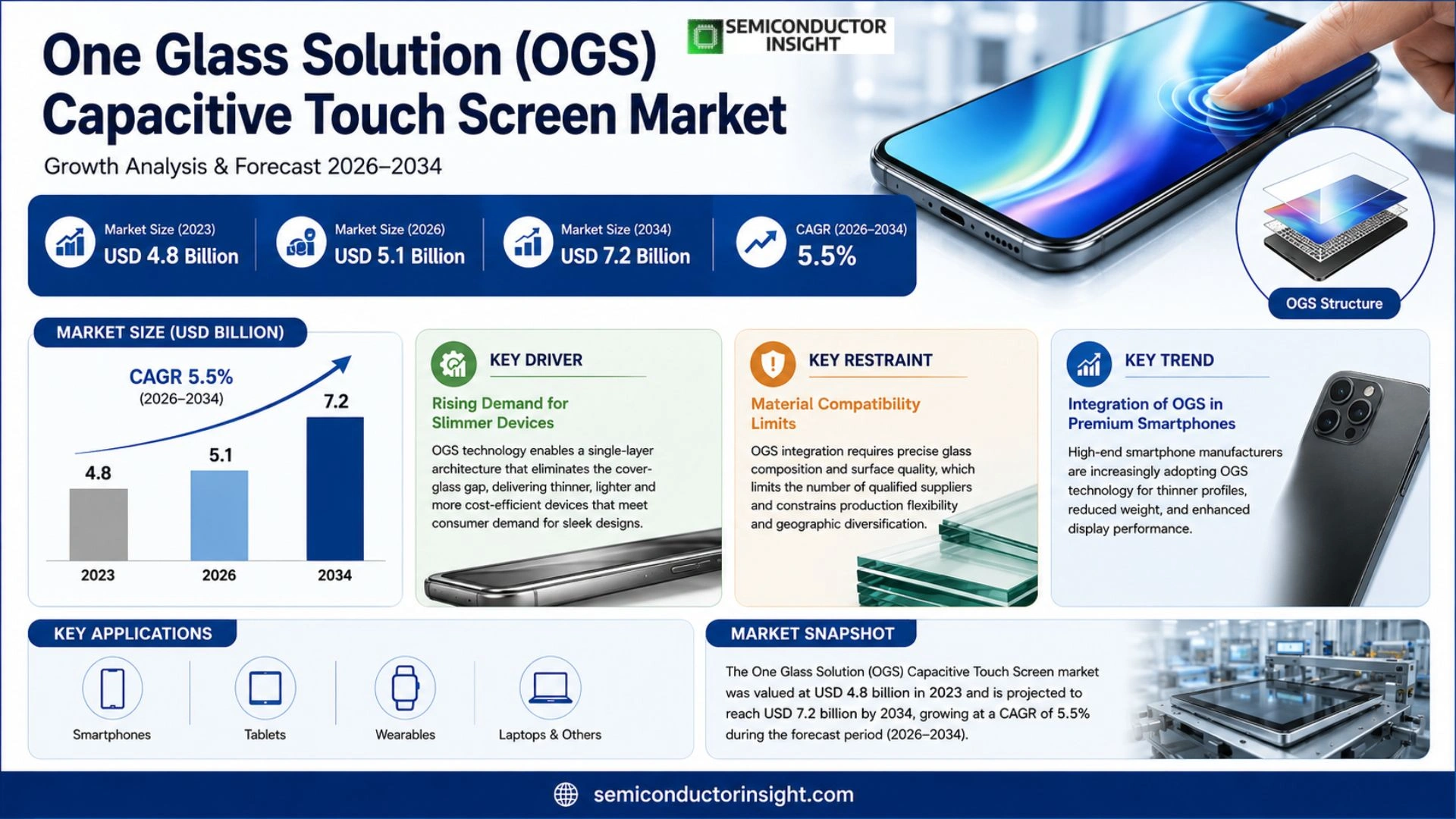
One Glass Solution (OGS) Capacitive Touch Screen market size was valued at USD 4.8 billion in 2023. The market will increase from USD 5.1 billion in 2026 to USD 7.2 billion by 2034, reflecting a CAGR of about 5.5 % during the forecast period.
One Glass Solution (OGS) Capacitive Touch Screens integrate the protective glass and capacitive sensor into a single laminated layer, eliminating the traditional air‑gap adhesive stack and enabling thinner displays with higher optical transmittance.
The expansion is driven by consumer demand for slimmer smartphones, tablets and wearables; manufacturers also benefit from lower bill‑of‑materials costs thanks to fewer components, although yield management remains challenging as bonding processes become more sophisticated.
MARKET DRIVERS
Rising Demand for Slimmer Devices
Manufacturers of smartphones, tablets and wearables are reshaping product roadmaps to achieve thinner form‑factors. One Glass Solution (OGS) Capacitive Touch Screen Market supplies a single‑layer architecture that eliminates the traditional cover‑glass gap, directly translating into lighter, more pocket‑friendly devices. This engineering advantage reduces bill of materials and aligns with consumer expectations for sleek aesthetics, prompting OEMs to accelerate adoption.
Advancements in Sensor Integration
Recent progress in in‑cell sensor technology allows touch sensitivity to coexist with high‑resolution display performance. By embedding touch electrodes within the display stack, OGS designs deliver faster response times and lower power consumption. These technical gains are especially valuable for devices that demand extended battery life, such as AR glasses and medical monitors, thereby expanding the addressable market.
➤ Manufacturers that engineer OGS early in the design cycle can secure a competitive edge through reduced assembly steps and higher yield rates.
Strategic partnerships between display panel producers and touch controller firms are strengthening the supply ecosystem. Collaborative R&D reduces time‑to‑market for new form‑factors, reinforcing the momentum behind OGS solutions and encouraging broader industry investment.
MARKET CHALLENGES
Cost Sensitivity in OEM Production
While OGS offers material savings, the initial tooling for in‑cell touch processes remains capital‑intensive. Mid‑tier manufacturers, operating on slim profit margins, often hesitate to allocate funds for re‑tooling, preferring legacy multi‑glass architectures that are more familiar to their production lines.
Other Challenges
Supply Chain Volatility
Fluctuations in indium‑tin‑oxide (ITO) and specialty glass prices can erode the projected cost benefits of OGS, forcing buyers to renegotiate contracts and potentially delay large‑scale rollouts.
MARKET RESTRAINTS
Material Compatibility Limits
Integrating touch functionality directly onto the display panel imposes stringent requirements on glass composition and surface roughness. Not all substrate suppliers can meet these tolerances, limiting the pool of qualified vendors and constraining geographic diversification of production.
The thermal expansion coefficients of touch and display layers must be closely matched; otherwise, yield losses manifest as dead pixels or touch dead zones. This technical barrier adds another layer of complexity to scaling OGS across multiple product categories.
MARKET OPPORTUNITIES
Emerging Applications in Automotive HUDs
Automotive heads‑up displays increasingly rely on transparent touch interfaces to blend navigation cues with driver‑focused graphics. OGS technology offers the optical clarity required for safety‑critical HUDs while maintaining a compact sensor stack, opening a niche yet high‑value revenue stream for suppliers.
Beyond automotive, industrial IoT panels and smart retail kiosks are seeking rugged, low‑profile touch solutions. The reduced layer count of OGS improves durability under harsh environmental conditions, positioning the market to capture demand from sectors that have traditionally avoided capacitive touch due to durability concerns.
One Glass Solution (OGS) Capacitive Touch Screen Market Trends
Integration of OGS in Premium Smartphones
Manufacturers of high‑end mobile devices are increasingly adopting One Glass Solution (OGS) Capacitive Touch Screen technology because it eliminates the intermediate cover glass layer, allowing thinner profiles and reduced weight. The engineering advantage translates into a more seamless optical stack, which improves touch latency and visual clarity,attributes that premium brands leverage to differentiate their flagship models. At the same time, the simplified stack lowers assembly steps, creating modest cost savings despite the higher per‑unit price of OGS panels. This combination of performance and economics explains why several leading OEMs have announced multi‑year supply contracts with OGS panel producers, signaling a shift away from traditional stacked designs.
Other Trends
Regional Supply‑Chain Consolidation
East Asian producers continue to dominate the OGS ecosystem, with China mainland, Taiwan, and South Korea accounting for more than 70 % of the global semiconductor equipment share. Their dominance is reinforced by vertically integrated fabs that control both the sensor substrate and the passivation processes required for OGS manufacture. North America, Europe, and Japan, collectively holding roughly a quarter of the market, are focusing on niche applications such as high‑resolution tablets and specialized industrial panels, where customized driver integration offsets the lack of scale. The geographic concentration creates a competitive moat for the leading Asian firms, while also prompting western players to explore joint‑venture arrangements to gain access to the necessary lithography and bonding capabilities.
Emergence of OGS in Automotive Displays
The automotive sector is beginning to recognize the value of OGS‑based touch interfaces for in‑vehicle infotainment and cockpit controls. Sensors that combine display and touch functionality on a single glass pane reduce the overall panel thickness, a critical factor for curved dashboards and driver‑focused ergonomics. Moreover, the reduced internal reflections improve readability under varying lighting conditions, an attribute that aligns with safety regulations. As electric‑vehicle manufacturers integrate larger, software‑defined dashboards, the demand for reliable, space‑efficient touch solutions is expected to fuel modest but steady adoption of OGS technology, prompting established panel makers to adapt their roadmaps toward automotive‑grade certifications.
COMPETITIVE LANDSCAPE
Key Industry Players
One Glass Solution (OGS) Capacitive Touch Screen: Competitive Overview
Corning Inc. remains the benchmark for premium OGS panels, leveraging its Gorilla Glass heritage to secure high‑margin contracts with flagship smartphone makers. AU Optronics, with a deep fab base in Taiwan, commands a sizable share of the tablet and notebook segment, where panel size and durability command premium pricing. The market architecture features a handful of vertically integrated giants that control both substrate processing and final‑panel assembly, while a broader layer of specialized fabs supplies mid‑tier volume to automotive and IoT vendors. Geographic concentration is pronounced: more than two‑thirds of capacity resides in China, Taiwan and South Korea, reflecting the region’s mature supply chain and R&D ecosystem. Recent M&A activity indicates a slow but steady consolidation, as larger players absorb niche suppliers to broaden their technology portfolios and achieve economies of scale.
Beyond the headline names, a cluster of agile firms fuels diversification. Shenzhen Laibao Hi‑Tech and Wintek specialize in cost‑effective OGS solutions for low‑end smartphones targeting emerging markets. Nissha Printing and Young Fast Optoelectronics have carved niches in automotive HUDs, where reliability under temperature stress is paramount. Iljin Display and MELFAS focus on industrial panels, emphasizing long‑life cycle support. BOE Technology and Tianma are expanding into large‑area displays for smart‑home and public‑information systems, capitalizing on their extensive LCD line‑up. CPT and Truly Semiconductors, though smaller, supply bespoke panels for wearable devices, where form‑factor constraints demand innovative glass‑on‑sensor integration. These players collectively buttress the ecosystem, offering differentiated process options and regional manufacturing footprints that mitigate supply‑chain risk for OEMs.
List of Key One Glass Solution (OGS) Capacitive Touch Screen Companies Profiled
- Corning Inc.
- AU Optronics
- BOE Technology Group
- Samsung Display
- Shenzhen Laibao Hi-Tech Co., Ltd.
- Nissha Printing
- TPK
- Wintek
- Young Fast Optoelectronics
- Innolux
- Iljin Display
- MELFAS
- Truly Semiconductors
- Tianma
- CPT
Segment Analysis:
| Segment Category | Sub-Segments | Key Insights |
| By Type |
|
ATT Type
|
| By Application |
|
Smartphone
|
| By End User |
|
Consumer Electronics
|
| By Integration Approach |
|
In‑Cell Integration
|
| By Industry Vertical |
|
Automotive
|
Regional Analysis: One Glass Solution (OGS) Capacitive Touch Screen Market
North America
The smartphone segment remains the primary driver, yet enterprise tablets and in‑vehicle infotainment systems are closing the gap. Retail kiosks adopt OGS to deliver uninterrupted visual continuity, while medical diagnostics benefit from the hygienic, single‑glass architecture that reduces cleaning complexity. Each vertical values the aesthetic and functional advantages uniquely, as they seek to differentiate user experience and comply with stringent durability standards.
The consolidation of glass polishing facilities with sensor assembly lines shortens hand‑off intervals, cutting inventory buffers. North American firms increasingly certify local suppliers for low‑temperature bonding processes, mitigating thermal stress on thin glass sheets. This shift nurtures a more resilient supply chain, reducing exposure to overseas logistics disruptions while enabling quicker custom‑order fulfillment.
Regulators focus on material safety and electromagnetic compliance, prompting manufacturers to adopt lead‑free adhesives and low‑emission coatings. Standards bodies such as IEC are updating touch‑screen directives to encompass single‑glass designs, which forces vendors to validate durability under harsher drop‑test regimes. Consequently, product development cycles now embed compliance testing earlier.
Emerging data‑fusion sensors that combine capacitive touch with proximity detection are reshaping OGS design philosophies. Companies experiment with nano‑textured glass to enhance fingertip sensitivity without compromising optical clarity. Parallelly, advances in ultra‑thin encapsulants allow OGS panels to be embedded beneath curved substrates, expanding possibilities for flexible and immersive interfaces.
Europe
Europe’s adoption of One Glass Solution (OGS) Capacitive Touch Screen Market is shaped by a blend of design‑centric consumer expectations and stringent environmental directives. Premium smartphone manufacturers across the continent prioritize the sleek aesthetic afforded by OGS, while automotive OEMs integrate the technology to meet interior design guidelines that favor seamless surfaces. The European Union’s RoHS and REACH regulations compel suppliers to source low‑impact chemicals for adhesives and coatings, prompting collaborative R&D initiatives between display fabs and material scientists. Moreover, the region’s strong design schools and industrial design firms act as influencers, translating tactile elegance into product roadmaps that emphasize both visual and haptic refinement. This ecosystem of regulatory rigor and design ambition sustains a measured but steady demand trajectory.
Asia‑Pacific
Asia‑Pacific represents a fertile ground for One Glass Solution (OGS) Capacitive Touch Screen Market, driven largely by the sheer scale of mobile device production and aggressive price competition. Manufacturers in China, South Korea, and Taiwan capitalize on economies of scale to perfect low‑cost OGS processes, while Japanese firms focus on reliability for automotive and industrial panels. The region’s rapid rollout of 5G infrastructure fuels demand for larger, high‑resolution touch displays, encouraging OEMs to replace multi‑glass stacks with single‑glass configurations to meet thinness targets. Local government incentives for advanced display research further accelerate technology transfer, ensuring that innovation cycles remain brisk despite margin pressures.
South America
South America’s engagement with One Glass Solution (OGS) Capacitive Touch Screen Market reflects a maturing consumer electronics landscape tempered by economic variability. Brazil’s growing smartphone penetration creates incremental demand, especially for mid‑range devices where cost‑effective OGS production offers a competitive edge. Automotive assemblers in the region begin to explore OGS for infotainment displays, attracted by reduced part counts that simplify assembly lines. However, limited local glass‑processing capacity forces many firms to rely on imports, making supply continuity sensitive to exchange‑rate fluctuations. Collaborative ventures with North American and European partners are emerging, aiming to transfer know‑how and establish regional assembly hubs that could alleviate import dependence.
Middle East & Africa
The Middle East & Africa region exhibits a niche yet opportunistic posture toward One Glass Solution (OGS) Capacitive Touch Screen Market. High‑end hospitality installations and luxury automotive interiors in the Gulf states favor OGS for its seamless visual appeal, aligning with the premium experience these markets demand. Meanwhile, rising adoption of smart home panels in affluent urban households introduces new end‑user categories for OGS‑enabled touch interfaces. Limited local manufacturing infrastructure means the majority of glass substrates are sourced from Asian exporters, underscoring the importance of robust logistics and trade agreements. Regional investment funds are beginning to back start‑ups that focus on thin‑glass sensor integration, signalling an embryonic ecosystem that could mature as demand for premium display solutions expands.
Report Scope
This market research report provides a comprehensive analysis of the One Glass Solution (OGS) Capacitive Touch Screen Market , covering the forecast period 2026–2034. It offers detailed insights into market dynamics, technological advancements, competitive landscape, and key trends shaping the industry.
Key focus areas of the report include:
- Market Overview: The report begins with an overview outlining its current market scenario, key growth indicators, and industry transformation drivers. It discusses macroeconomic factors, demand–supply balance, regulatory landscape, and the strategic role of semiconductors in powering advancements across industries such as automotive, telecommunications, consumer electronics, and industrial automation.
- Market Size & Forecast: Historical data and future projections for revenue, unit shipments, and market value across major regions and segments.
- Segmentation Analysis: Detailed breakdown by product type, technology, application, and end-user industry to identify high-growth segments and investment opportunities.
- Regional Insights: Insights into market performance across North America, Europe, Asia-Pacific, Latin America, and the Middle East & Africa, including country-level analysis where relevant.
- Competitive Landscape: Profiles of leading market participants, including their product offerings, R&D focus, manufacturing capacity, pricing strategies, and recent developments such as mergers, acquisitions, and partnerships.
- Technology Trends & Innovation: Assessment of emerging technologies, integration of AI/IoT, semiconductor design trends, fabrication techniques, and evolving industry standards.
- Market Drivers & Restraints: Evaluation of factors driving market growth along with challenges, supply chain constraints, regulatory issues, and market-entry barriers.
- Stakeholder Insights: Insights for component suppliers, OEMs, system integrators, investors, and policymakers regarding the evolving ecosystem and strategic opportunities.
Primary and secondary research methods are employed, including interviews with industry experts, data from verified sources, and real-time market intelligence to ensure the accuracy and reliability of the insights presented.
FREQUENTLY ASKED QUESTIONS:
What is the current market size of One Glass Solution (OGS) Capacitive Touch Screen Market?
-> One Glass Solution (OGS) Capacitive Touch Screen market will increase from USD 5.1 billion in 2026 to USD 7.2 billion by 2034, reflecting a CAGR of 5.5%
Which key companies operate in One Glass Solution (OGS) Capacitive Touch Screen Market?
-> Key players include Shenzhen Laibao Hi-Tech Co., Ltd., Nissha Printing, TPK, Wintek, Young Fast Optoelectronics, AU Optronics, HannsTouch Solution, Innolux, Iljin Display, MELFAS, Truly Semiconductors.
What are the key growth drivers?
-> Key growth drivers include high performance computing, artificial intelligence (AI), cloud computing, servers, 5G, and electric vehicles (EV).
Which region dominates the market?
-> Asia dominates, with China mainland, Taiwan and South Korea together accounting for over 70% of the market share.
What are the emerging trends?
-> Emerging trends include integration of AI/IoT in touch screen technologies, advancements in 5G‑enabled devices, and higher demand for EV infotainment displays.
Get Sample Report PDF for Exclusive Insights
Report Sample Includes
- Table of Contents
- List of Tables & Figures
- Charts, Research Methodology, and more...
 Download Sample Report PDF