On‑Chip Antennas Market Insights
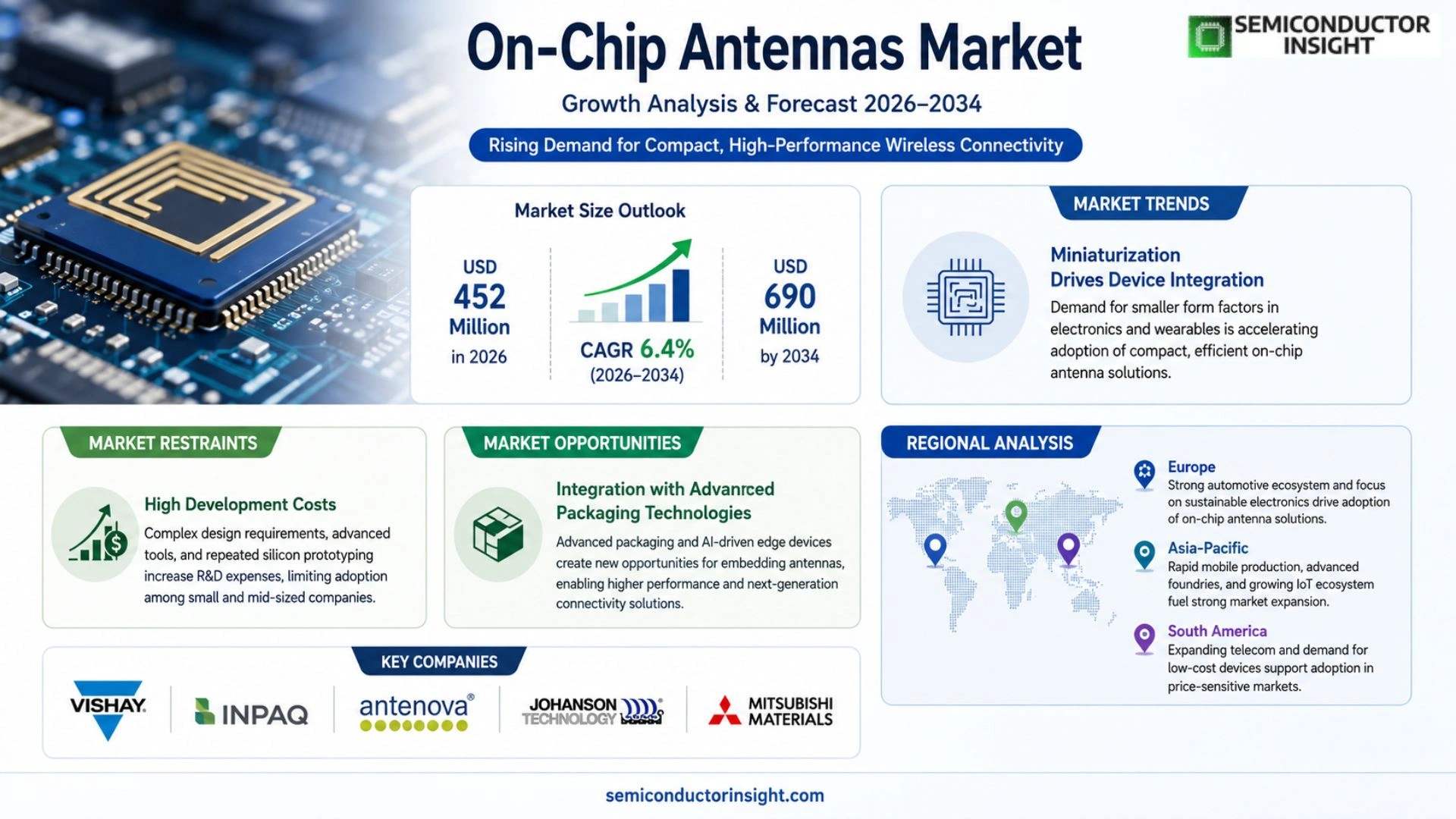
Global On‑Chip Antennas market is projected to grow from USD 452 million in 2026 to USD 690 million by 2034, exhibiting a CAGR of 6.4% during the forecast period.
Chip antennas are a particular type of antenna valued for their small footprint. They are most commonly integrated into circuit boards to radiate high‑frequency electromagnetic waves, and their limited range makes them optimal for compact devices such as wearables, IoT modules, and medical implants.
The market gains momentum because semiconductor integration costs are falling and demand for miniaturized wireless modules rises across automotive, healthcare and industrial sectors. Recent collaborations,such as Vishay’s partnership with a leading smartphone OEM in early 2024,highlight manufacturers’ focus on expanding product portfolios. Key players include Vishay, INPAQ, Antenova, Johanson Technology, Mitsubishi Materials, Abracon, TAIYO YUDEN, Linx Technologies, Wurth Elektronik and Taoglas.
MARKET DRIVERS
Miniaturization of Wireless Modules
Device manufacturers are compressing form‑factors to accommodate wearables, IoT sensors, and autonomous vehicles. Integrating the antenna directly onto the silicon die eliminates the need for external radiators, thereby freeing valuable board space. This shift directly fuels demand for On‑Chip Antennas Market, as designers prioritize solutions that marry size reduction with reliable RF performance.
Emergence of 5G and mmWave Applications
High‑frequency bands used in 5G infrastructure require antennas that can operate efficiently at millimeter‑wave wavelengths. On‑chip implementations offer tighter tolerances and reduced parasitic losses compared with traditional PCB antennas. Consequently, equipment vendors are allocating larger portions of their RF budgets to on‑chip designs, accelerating adoption across telecom and defense segments.
➤ Industry surveys indicate that more than 60 % of new semiconductor projects now earmark on‑chip antenna integration as a baseline requirement.
Beyond connectivity, on‑chip antennas simplify supply‑chain logistics by consolidating components into a single package. This convergence lowers assembly costs and improves yield rates, prompting semiconductor fabs to embed antenna IP as a standard offering.
MARKET CHALLENGES
Material Compatibility and Process Variability
Silicon substrates impose dielectric constraints that can degrade antenna efficiency, especially at frequencies above 30 GHz. Variations in CMOS process steps,such as metal thickness and spacing,introduce performance uncertainties that designers must mitigate through extensive electromagnetic simulation.
Other Challenges
Regulatory Compliance
Meeting SAR and emission standards across multiple regions adds a layer of testing complexity, often extending time‑to‑market for on‑chip antenna products.
MARKET RESTRAINTS
High Development Costs
Designing an antenna that satisfies stringent bandwidth and gain criteria while remaining compatible with a given semiconductor node demands sophisticated tools and specialized expertise. Small‑to‑mid‑size firms frequently lack the capital to sustain such R&D cycles, limiting market participation.
Furthermore, the need for repeated silicon prototyping escalates expense, prompting some customers to defer adoption until a mature, cost‑effective library becomes available.
MARKET OPPORTUNITIES
Integration with Advanced Packaging Technologies
Emerging packaging formats,such as fan‑out wafer‑level packaging (FOWLP) and heterogeneous integration,create new spaces for embedding antennas beneath the package lid. This architectural shift reduces path loss and opens avenues for higher data‑rate links, positioning on‑chip antennas as a cornerstone of next‑generation packaging solutions.
In parallel, the growing adoption of AI‑enabled edge devices presents a lucrative niche. These devices require low‑latency, high‑throughput wireless links, a demand profile that aligns neatly with the performance envelope of finely tuned on‑chip antennas.
On-Chip Antennas Market Trends
Miniaturization Drives Device Integration
On‑Chip Antennas Market is being reshaped by a relentless push toward smaller form factors across consumer electronics, wearables, and edge‑computing nodes. As system‑in‑package (SiP) architectures replace traditional board‑level solutions, designers demand antenna elements that occupy merely a few square millimetres while maintaining efficiency at GHz frequencies. This pressure has accelerated adoption of planar and three‑dimensional dielectric structures that can be laminated directly onto silicon substrates. Suppliers that can deliver consistent impedance matching within such constrained footprints are gaining preference, because any mismatch translates quickly into reduced link budget for low‑power IoT transmitters. Consequently, manufacturers are re‑engineering their photolithographic processes to embed antennas early in the wafer‑fabrication stage, shortening time‑to‑market for next‑generation smart sensors.
Other Trends
Dielectric Innovations Lower Insertion Loss
Recent breakthroughs in low‑loss ceramic composites have cut insertion loss by roughly 30 % compared with legacy materials. The shift stems from tighter control of grain orientation and the introduction of nano‑scale filler particles that suppress dielectric dispersion at millimetre‑wave bands. For system designers, this translates into higher quality factors without enlarging the antenna footprint. The commercial impact is evident in automotive radar modules, where tighter loss budgets enable longer detection ranges while preserving the compact packaging required for chassis‑integrated designs. Moreover, the improved thermal stability of these ceramics aligns with the increasing need for antennas that survive harsh automotive and industrial environments, reducing the frequency‑shift risk that previously forced over‑design of RF front ends.
Application Diversification Fuels Geographic Shifts
Beyond traditional telecommunications, On‑Chip Antennas Market is experiencing a surge in demand from healthcare implants and industrial IoT gateways. Implantable medical devices benefit from the tiny radiating area, which minimizes tissue disruption while supporting reliable telemetry for monitoring vitals. In parallel, factories adopting predictive‑maintenance platforms rely on dense sensor networks; embedded antennas cut installation costs and improve reliability in dusty or vibration‑prone settings. These application trends are nudging regional investment toward Asia‑Pacific, where large‑scale manufacturing ecosystems can iterate rapidly on test‑beds, and toward North America, where regulatory pathways for medical devices accelerate market entry. Companies that align their product roadmaps with these sectoral demands are likely to secure a stronger foothold as the ecosystem expands.
COMPETITIVE LANDSCAPE
Key Industry Players
On‑Chip Antennas Market – Competitive Overview
Vishay remains the anchor of the global on‑chip antenna arena, leveraging its extensive portfolio of passive components and deep foothold in automotive and consumer‑electronics segments. The company’s ability to integrate antenna designs directly into system‑in‑package (SiP) solutions has translated into a revenue share that eclipses the combined contribution of many midsize rivals. This concentration reflects a strategic preference among device makers for suppliers that can guarantee both performance and supply‑chain reliability, especially as manufacturers shift toward higher‑frequency bands for 5G and emerging IoT applications. Vishay’s recent acquisition of a specialized RF‑simulation boutique illustrates how incumbents are reinforcing design competence to lock in long‑term contracts with OEMs.
Beyond the clear market leader, the competitive field comprises a blend of niche specialists and diversified electronics firms. Players such as INPAQ, Antenova, and Johanson Technology differentiate themselves through ultra‑compact dielectric structures that cater to wearable and medical‑device niches, where board space is at a premium. Mitsubishi Materials and Abracon have built modest but growing footholds in the automotive infotainment segment by offering robust LTCC‑based designs that can survive harsh thermal cycles. TAIYO YUDEN and Linx Technologies focus on high‑frequency millimetre‑wave products for emerging 6G prototypes, while Wurth Elektronik and Taoglas supply tailored antenna modules for industrial IoT gateways. A secondary tier,including Partron, Yageo, Rainsun, Fractus, Cirocomm, Microgate, Sunlord and TDK,contributes depth to the supply chain, often serving as original equipment manufacturers’ secondary sources or as partners in joint‑development projects. This layered ecosystem creates both collaborative opportunities and competitive pressure, compelling larger firms to innovate while allowing smaller innovators to capture niche margins.
List of Key On‑Chip Antennas Companies Profiled
- Vishay
- INPAQ
- Antenova
- Johanson Technology
- Mitsubishi Materials
- Abracon
- TAIYO YUDEN
- Linx Technologies
- Wurth Elektronik
- Taoglas
- Partron
- Yageo
- Rainsun
- Fractus
- Cirocomm
- Microgate
- Sunlord
- TDK
Segment Analysis:
| Segment Category | Sub-Segments | Key Insights |
| By Type |
|
Dielectric Chip Antennas
|
| By Application |
|
Automotive
|
| By End User |
|
Consumer Electronics
|
| By Frequency Band |
|
GHz
|
| By Integration Level |
|
Integrated On‑Die Antennas
|
Regional Analysis: On-Chip Antennas Market
North America
Companies are embedding antenna patterns into advanced CMOS processes, leveraging the same lithography steps used for digital logic. This convergence cuts packaging costs and improves signal integrity, prompting design teams to treat antenna layout as a first‑order block rather than an after‑thought.
The push for miniaturized wearable devices and autonomous sensors fuels demand for on‑chip solutions that can operate across fragmented frequency bands without external modules, delivering density and power advantages.
Domestic wafer manufacturers are expanding capacity for high‑frequency silicon, meaning designers can secure volumes for antenna‑enabled wafers without confronting long lead‑times typical of specialty processes.
Federal agencies have streamlined specific spectrum allocations for millimeter‑wave applications, giving firms a clearer path to certify on‑chip radiators for consumer and industrial use.
Europe
European nations are leveraging strong automotive engineering capabilities to embed on‑chip antennas within vehicle telematics and driver‑assistance systems. German and French OEMs are collaborating with semiconductor firms to ensure antenna performance meets stringent safety standards while maintaining low‑cost integration. Simultaneously, the region’s focus on sustainable electronics encourages the adoption of antenna‑on‑silicon designs that minimize material usage and support circular‑economy objectives.
Asia‑Pacific
Asia‑Pacific exhibits rapid scaling of mobile handset production, prompting manufacturers to adopt on‑chip antenna technologies that enable thinner smartphones and wearables. The presence of large‑scale foundries in Taiwan and South Korea provides a cost advantage, yet talent migration toward advanced RF design creates a competitive edge for firms that can attract specialized engineers. Emerging markets such as India are beginning to incorporate these solutions into affordable IoT platforms, expanding the overall addressable base.
South America
In South America, market growth is anchored by expanding telecom infrastructure and a rising demand for low‑cost connectivity in remote areas. Local device assemblers are experimenting with on‑chip antennas to reduce bill‑of‑materials for smartphones aimed at price‑sensitive consumers. Partnerships between regional universities and multinational chip designers are fostering a nascent ecosystem that prioritizes ruggedized antenna designs suited for tropical climates.
Middle East & Africa
The Middle East & Africa region is witnessing increased investment in smart‑city projects, where dense sensor networks rely on compact RF solutions. Governments are incentivizing the adoption of integrated antenna technologies to streamline deployment of public‑wide IoT services. Meanwhile, African telecom operators are exploring on‑chip options to lower deployment costs for rural broadband expansions, positioning the technology as a catalyst for broader digital inclusion.
Report Scope
This market research report provides a comprehensive analysis of the On-Chip Antennas Market , covering the forecast period 2026–2034. It offers detailed insights into market dynamics, technological advancements, competitive landscape, and key trends shaping the industry.
Key focus areas of the report include:
- Market Overview: The report begins with an overview outlining its current market scenario, key growth indicators, and industry transformation drivers. It discusses macroeconomic factors, demand–supply balance, regulatory landscape, and the strategic role of semiconductors in powering advancements across industries such as automotive, telecommunications, consumer electronics, and industrial automation.
- Market Size & Forecast: Historical data and future projections for revenue, unit shipments, and market value across major regions and segments.
- Segmentation Analysis: Detailed breakdown by product type, technology, application, and end-user industry to identify high-growth segments and investment opportunities.
- Regional Insights: Insights into market performance across North America, Europe, Asia-Pacific, Latin America, and the Middle East & Africa, including country-level analysis where relevant.
- Competitive Landscape: Profiles of leading market participants, including their product offerings, R&D focus, manufacturing capacity, pricing strategies, and recent developments such as mergers, acquisitions, and partnerships.
- Technology Trends & Innovation: Assessment of emerging technologies, integration of AI/IoT, semiconductor design trends, fabrication techniques, and evolving industry standards.
- Market Drivers & Restraints: Evaluation of factors driving market growth along with challenges, supply chain constraints, regulatory issues, and market-entry barriers.
- Stakeholder Insights: Insights for component suppliers, OEMs, system integrators, investors, and policymakers regarding the evolving ecosystem and strategic opportunities.
Primary and secondary research methods are employed, including interviews with industry experts, data from verified sources, and real-time market intelligence to ensure the accuracy and reliability of the insights presented.
FREQUENTLY ASKED QUESTIONS:
What is the current market size of On-Chip Antennas Market?
-> On‑Chip Antennas market is projected to grow from USD 452 million in 2026 to USD 690 million by 2034, exhibiting a CAGR of 6.4%
Which key companies operate in On-Chip Antennas Market?
-> Key players include Vishay, INPAQ, Antenova, Johanson Technology, Mitsubishi Materials, Abracon, TAIYO YUDEN, Linx Technologies, Wurth Elektronik, Taoglas, among others.
What are the key growth drivers?
-> Key growth drivers include the demand for miniaturized wireless modules, proliferation of IoT and wearable devices, and the need for high‑frequency communication in compact electronics, which favor the small‑footprint advantage of chip antennas.
Which region dominates the market?
-> Asia‑Pacific holds the largest market share, driven by strong adoption in China, Japan, and South Korea, while North America and Europe also show significant growth.
What are the emerging trends?
-> Emerging trends include advancements in dielectric and LTCC chip antenna technologies, integration of antennas directly onto semiconductor substrates, and increasing use in automotive and healthcare applications for high‑frequency connectivity.

Get Sample Report PDF for Exclusive Insights
Report Sample Includes
- Table of Contents
- List of Tables & Figures
- Charts, Research Methodology, and more...
 Download Sample Report PDF