Nanoprobe Market Insights
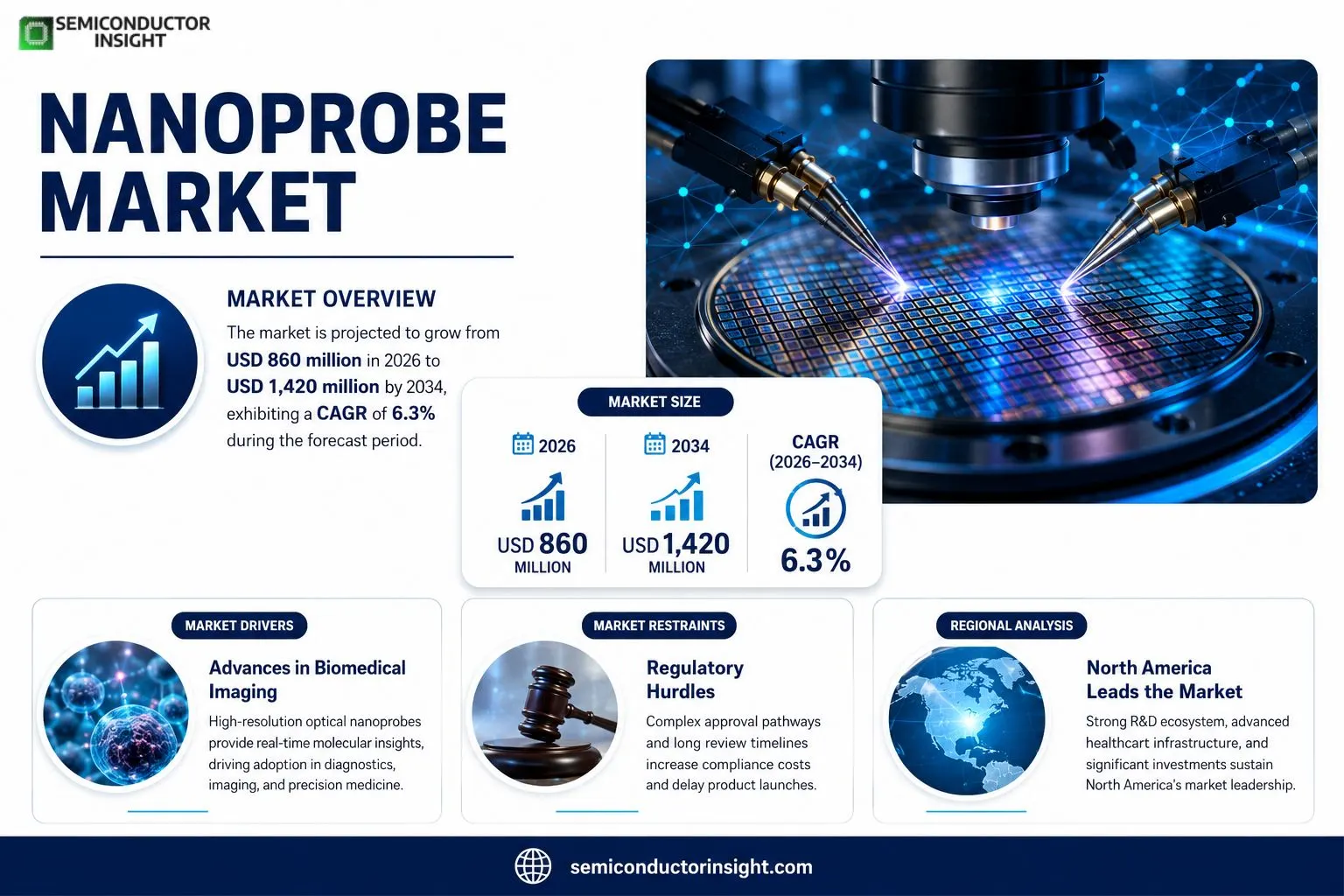
Nanoprobe Market size was valued at USD 820 million in 2025. The market will grow from USD 860 million in 2026 to USD 1,420 million by 2034, exhibiting a CAGR of 6.3 % during the forecast period.
Nanoprobes are nanoscale sensing devices that detect physical or chemical changes and convert them into measurable electrical or optical signals. They are typically fabricated through top‑down lithography, bottom‑up self‑assembly, or molecular self‑assembly techniques, enabling integration into optical, electrochemical or electromechanical sensor formats.The sector is gaining momentum because defense agencies are investing heavily in miniaturized detection systems, while healthcare providers seek rapid point‑of‑care diagnostics and environmental monitors demand high‑sensitivity pollutant tracking. Recent collaborationssuch as a February 2024 partnership between OMRON Corporation and a leading semiconductor firm on integrated optical nanoprobesillustrate how incumbents are expanding portfolios alongside newcomers like Oxonica Limited.
MARKET DRIVERS
Advances in Biomedical Imaging
The emergence of high‑resolution optical modalities has opened a niche for nanoprobes that can report molecular events in real time. Researchers now favor probes that emit in the near‑infrared window, because tissue scattering drops dramatically, allowing clinicians to visualize tumors with unprecedented clarity. This technical advantage translates into higher adoption rates within academic hospitals, where early‑stage trials are already leveraging multiphoton‑compatible nanoprobes.
Miniaturization of Sensor Platforms
Parallel progress in micro‑fabrication enables the embedding of nanoprobes onto flexible electronics. Manufacturers can now produce wafer‑scale arrays that cost less than $0.15 per unit, a price point that begins to rival conventional ELISA kits. The cost compression fuels interest from point‑of‑care providers who seek to replace bulkier laboratory workflows with bedside readouts.
➤ “The convergence of nanomaterial chemistry and silicon photonics is reshaping diagnostic economics.” – Senior Analyst, Life‑Science Forum
Because the same probe can serve imaging, therapy monitoring, and quantitative assay functions, customers view the technology as a single‑investment solution rather than a collection of disparate tools. This perception accelerates procurement cycles, especially in institutions pursuing integrated research‑clinical pipelines.
MARKET CHALLENGES
Regulatory Hurdles
Regulators continue to treat nanoprobes as hybrid products, demanding evidence for both device safety and pharmacological behavior. Submission dossiers often swell to over 3,000 pages, extending review timelines beyond 18 months in several jurisdictions. The uncertainty forces sponsors to allocate sizable contingency budgets, which can deter smaller innovators from entering the market.
Other Challenges
Manufacturing Consistency
Batch‑to‑batch variability in particle size distribution remains a pain point. Even minor deviations can alter optical cross‑section, leading to divergent assay readings across sites. Companies that invest early in inline metrology gain a competitive edge, but the capital outlay limits participation to well‑funded players.
Cost of Raw Materials
Precious‑metal cores such as gold or palladium are integral to many high‑performance nanoprobes. Recent commodity price spikes have lifted material costs by roughly 12 % year‑over‑year, pressuring margins and prompting a shift toward cheaper semiconductor alternatives where performance trade‑offs are still being quantified.
MARKET RESTRAINTS
Supply‑Chain Vulnerabilities
Shortages of high‑purity reagents have created bottlenecks for scaling production. Lead times for silica precursors now exceed six weeks, a delay that ripples through contract manufacturing agreements and jeopardizes time‑sensitive clinical studies.In addition, limited numbers of certified clean‑room facilities capable of handling nanoparticle synthesis constrain geographic diversification. Enterprises that rely on a single manufacturing hub face heightened exposure to geopolitical disruptions and natural‑disaster risks.Finally, the scarcity of skilled chemists familiar with colloidal stability adds a human‑resource dimension to the restraint. Recruitment cycles often stretch beyond four months, slowing down product launch pipelines.
MARKET OPPORTUNITIES
Theranostic Integration
Combining therapeutic payloads with diagnostic readouts positions nanoprobes as central components of next‑generation theranostics. Clinical trials in oncology are already reporting dose‑adjustment decisions based on real‑time nanoprobe fluorescence, which reduces overtreatment and shortens hospital stays. Vendors that can certify both drug‑release kinetics and imaging fidelity are poised to capture premium contracts from pharma partners.Point‑of‑care diagnostics represent another fertile segment. Mobile handheld readers paired with nanoscale fluorescence tags enable rapid pathogen detection in remote clinics, cutting turnaround times from days to minutes. This capability aligns with public‑health initiatives that prioritize rapid outbreak containment.Artificial‑intelligence–enhanced data interpretation further expands the addressable market. Machine‑learning models trained on nanoprobe signal patterns can flag subtle biomarker shifts invisible to the human eye. Investors are earmarking funds for platforms that fuse AI analytics with nanotechnology, anticipating a wave of subscription‑based services for hospitals and research institutions.
Nanoprobe Market Trends
Rising Adoption of Optical Nanosensors in Healthcare
Healthcare providers are increasingly turning to optical nanosensors to achieve real‑time biomarker detection. The capability to translate a molecular interaction into a luminous signal aligns with the push for point‑of‑care diagnostics that can be performed outside traditional laboratories. Manufacturers such as OMRON and Samsung Electronics have introduced compact probe platforms that incorporate self‑assembled nanostructures, enabling clinicians to monitor glucose, cardiac enzymes, and infection markers with unprecedented speed. This shift is not merely a product upgrade; it reflects a broader movement toward data‑driven treatment pathways, where early detection drives therapeutic decisions and reduces hospital stays. Companies that embed these probes into telehealth ecosystems stand to capture a growing slice of the revenue pool, as reimbursement models begin to reward outcomes rather than procedures.
Other Trends
Diversification into Automotive and Consumer Electronics
Beyond medical settings, nanoscale probes are gaining traction in automotive safety systems and wearable devices. Electrochemical and electromechanical variants provide the sensitivity required for gas leak detection in electric vehicles and for monitoring physiological stress in smart watches. The convergence of Internet‑of‑Things connectivity with nanosensor outputs creates a data‑rich environment attractive to OEMs seeking to differentiate their products through advanced driver‑assistance features. Meanwhile, consumer electronics firms are leveraging the low power consumption of these probes to extend battery life in health‑tracking earbuds and AR headsets. The expanding application base dilutes dependence on any single sector and encourages cross‑industry partnerships, which in turn accelerate the pace of innovation.
Geographic Shift Toward Asian Production Hubs
Production capacity in China and South Korea is outpacing that of North America, driven by government incentives and a mature semiconductor ecosystem. The ease of integrating nanofabrication lines with existing chip‑making facilities reduces time‑to‑market for new probe designs. As a result, Asian firms are securing a larger share of the supply chain, prompting U.S. and European players to reevaluate sourcing strategies. This realignment influences pricing dynamics and prompts western manufacturers to focus on high‑value services such as custom calibration and software analytics. For investors, the regional shift signals where future capital expenditures are likely to concentrate, shaping competitive positioning across the entire Nanoprobe Market.
COMPETITIVE LANDSCAPE
Key Industry Players
Nanoprobe Market Competitive Overview
The Nanoprobe market is dominated by a handful of multinational corporations that combine deep semiconductor expertise with extensive defense and healthcare portfolios. OMRON Corporation leverages its legacy in precision sensing to supply high‑volume optical probes for automotive and consumer electronics, while Lockheed Martin uses its defense contracts to accelerate development of rugged electromechanical probes for aerospace applications. Honeywell International Inc. and Texas Instruments Incorporated compete aggressively on electrochemical sensor platforms, differentiating through integrated firmware and scalable manufacturing lines that keep unit costs low. Samsung Electronics Co., Limited adds a strong silicon‑photonic capability, allowing it to capture emerging demand from wearable health devices. This core group controls roughly half of revenue, shaping pricing, standardization, and the pace of technology adoption across the sector.Beyond the top tier, a diverse set of niche innovators fills market gaps with specialized chemistries, bespoke packaging, or regional market knowledge. Oxonica Limited focuses on nanomaterial‑enhanced optical probes that deliver sub‑nanometer detection limits for environmental monitoring. DTect Innovation Pty. Limited and Systems for Research Corp. specialize in custom‑built probes for academic and government labs, often partnering with universities to co‑develop next‑generation assay formats. Beijing ALT Technology Ltd. Co. and TOYO Corporation serve the Asian OEM ecosystem, offering cost‑effective bulk solutions that cater to China’s expanding medical device industry. Smaller but technically agile firms such as NanoAndMore USA Inc., Ample Spring International Limited, Tiptek, LLC, and InterNano provide boutique servicesranging from rapid prototyping to low‑volume productionallowing start‑ups and niche end‑users to access advanced probe technologies without committing to large minimum orders. Their presence intensifies competitive pressure on the incumbents, encouraging continuous innovation and price rationalization.
List of Key Nanoprobe Companies Profiled
- OMRON Corporation
- Lockheed Martin Corporation
- Honeywell International Inc.
- Texas Instruments Incorporated
- Samsung Electronics Co., Limited
- Oxonica Limited
- DTect Innovation Pty. Limited
- Systems for Research Corp.
- Beijing ALT Technology Ltd. Co.
- TOYO Corporation
- NanoAndMore USA Inc.
- Ample Spring International Limited
- Tiptek, LLC
- InterNano
Segment Analysis:
| Segment Category | Sub-Segments | Key Insights |
| By Type |
|
Optical Sensor
|
| By Application |
|
Healthcare
|
| By End User |
|
Research Laboratories
|
| By Technology |
|
Bottom‑Up Assembly
|
| By Market Trend |
|
Integration with IoT
|
Regional Analysis: Nanoprobe Market
North America
Concentrated research clusters around Boston and San Diego accelerate prototype iteration, with labs leveraging interdisciplinary expertise to push probe sensitivity beyond conventional limits.
The FDA’s guidance on nanomaterial safety creates a predictable approval timeline, allowing companies to plan product rollouts with greater confidence.
Integrated pipelines linking semiconductor fabs to specialty chemical manufacturers reduce lead times for high‑purity nanomaterials critical to probe performance.
A steady flow of private equity and government grants underpins scale‑up activities, enabling start‑ups to transition from pilot runs to full‑scale manufacturing.
Europe
European nations benefit from coordinated research initiatives such as the Horizon Europe program, which earmarks funds for nanoscale diagnostics. Countries like Germany and the United Kingdom combine strong academic output with a growing network of med‑tech incubators, fostering rapid translation of nanoprobes into clinical trials. The European Medicines Agency’s harmonized approach simplifies cross‑border regulatory submissions, encouraging multinational consortia to pool resources. Health‑care providers increasingly demand point‑of‑care solutions that can integrate with existing electronic health‑record systems, prompting manufacturers to tailor probes for compatibility with regional data standards. This convergence of policy support and market demand positions Europe as a fertile ground for next‑generation probe technologies, albeit with a more fragmented funding landscape compared with North America.
Asia‑Pacific
The Asia‑Pacific region presents a dynamic mix of emerging economies and technology powerhouses. China’s aggressive investment in nanotechnology parks and Japan’s legacy in precision engineering create complementary strengths: scale and accuracy. Regional health ministries are adopting policies that prioritize early disease detection, opening avenues for nanoprobes that can be deployed in primary‑care settings. However, variances in regulatory maturity across the region require firms to adopt flexible compliance strategies. Companies that can navigate both fast‑moving markets like India and highly regulated environments such as South Korea stand to capture a broad customer base, especially as consumer awareness of personalized diagnostics rises.
South America
South America’s market evolution is anchored by Brazil’s expanding biotech sector and Argentina’s focus on university‑driven research. Public‑private partnerships are emerging to address endemic health challenges, encouraging the development of cost‑effective nanoprobes suited for low‑resource clinics. While the regulatory framework is still maturing, governments are introducing fast‑track pathways for diagnostics that address high‑burden diseases, creating an incentive for local manufacturers. Supply‑chain constraints persist, prompting firms to source raw nanomaterials from overseas, which influences pricing strategies. Nevertheless, the region’s growing emphasis on preventative health presents a long‑term growth trajectory for probe technologies adapted to regional disease profiles.
Middle East & Africa
In the Middle East & Africa, investment in health‑care infrastructure is accelerating, particularly in the Gulf Cooperation Council states where sovereign wealth funds allocate capital to advanced diagnostics. Collaborative research hubs linking UAE universities with European partners are generating early‑stage nanoprobes tailored for metabolic disorders prevalent in the region. African markets, while constrained by limited funding, are witnessing pilot projects funded by international NGOs that test affordable nanoprobes in rural settings. The regulatory environment is heterogeneous, compelling vendors to adopt region‑specific compliance roadmaps. As digital health initiatives gain momentum, nanoprobes that can integrate with tele‑medicine platforms are expected to become a strategic priority across the region.
Report Scope
This market research report provides a comprehensive analysis of the Nanoprobe Market , covering the forecast period 2026–2034. It offers detailed insights into market dynamics, technological advancements, competitive landscape, and key trends shaping the industry.
Key focus areas of the report include:
- Market Overview: The report begins with an overview outlining its current market scenario, key growth indicators, and industry transformation drivers. It discusses macroeconomic factors, demand–supply balance, regulatory landscape, and the strategic role of semiconductors in powering advancements across industries such as automotive, telecommunications, consumer electronics, and industrial automation.
- Market Size & Forecast: Historical data and future projections for revenue, unit shipments, and market value across major regions and segments.
- Segmentation Analysis: Detailed breakdown by product type, technology, application, and end-user industry to identify high-growth segments and investment opportunities.
- Regional Insights: Insights into market performance across North America, Europe, Asia-Pacific, Latin America, and the Middle East & Africa, including country-level analysis where relevant.
- Competitive Landscape: Profiles of leading market participants, including their product offerings, R&D focus, manufacturing capacity, pricing strategies, and recent developments such as mergers, acquisitions, and partnerships.
- Technology Trends & Innovation: Assessment of emerging technologies, integration of AI/IoT, semiconductor design trends, fabrication techniques, and evolving industry standards.
- Market Drivers & Restraints: Evaluation of factors driving market growth along with challenges, supply chain constraints, regulatory issues, and market-entry barriers.
- Stakeholder Insights: Insights for component suppliers, OEMs, system integrators, investors, and policymakers regarding the evolving ecosystem and strategic opportunities.
Primary and secondary research methods are employed, including interviews with industry experts, data from verified sources, and real-time market intelligence to ensure the accuracy and reliability of the insights presented.
FREQUENTLY ASKED QUESTIONS:
What is the current market size of Nanoprobe Market?
-> Nanoprobe Market was valued at USD million in 2024 and is projected to reach USD million by 2031, at a CAGR of % during the forecast period.
Which key companies operate in Nanoprobe Market?
-> Key players include OMRON Corporation, Lockheed Martin Corporation, Honeywell International Inc., Texas Instruments Incorporated, Samsung Electronics Co., Limited, Oxonica Limited, DTect Innovation Pty. Limited, Systems for Research Corp., Beijing ALT Technology Ltd. Co., TOYO Corporation, among others.
What are the key growth drivers?
-> Key growth drivers encompass the rising demand for nanoscale sensors in defense, environmental monitoring, and healthcare applications, advances in top‑down lithography and bottom‑up assembly techniques, and the expanding need for precise, real‑time signal conversion from physical quantities to digital data.
Which region dominates the market?
-> The United States market is estimated at USD million in 2025, while China is projected to reach USD million in the same year, indicating strong dominance of the Asia‑Pacific region in overall revenue growth.
What are the emerging trends?
-> Emerging trends include rapid growth of the Optical Sensor segment, which will reach USD million by 2036 with a % CAGR over the next ten years, increased integration of electrochemical and electromechanical sensors, and expanding applications in consumer electronics, automotive, aerospace, and defense sectors.

Get Sample Report PDF for Exclusive Insights
Report Sample Includes
- Table of Contents
- List of Tables & Figures
- Charts, Research Methodology, and more...
 Download Sample Report PDF