Mobile Smart Device DDIC Market Insights
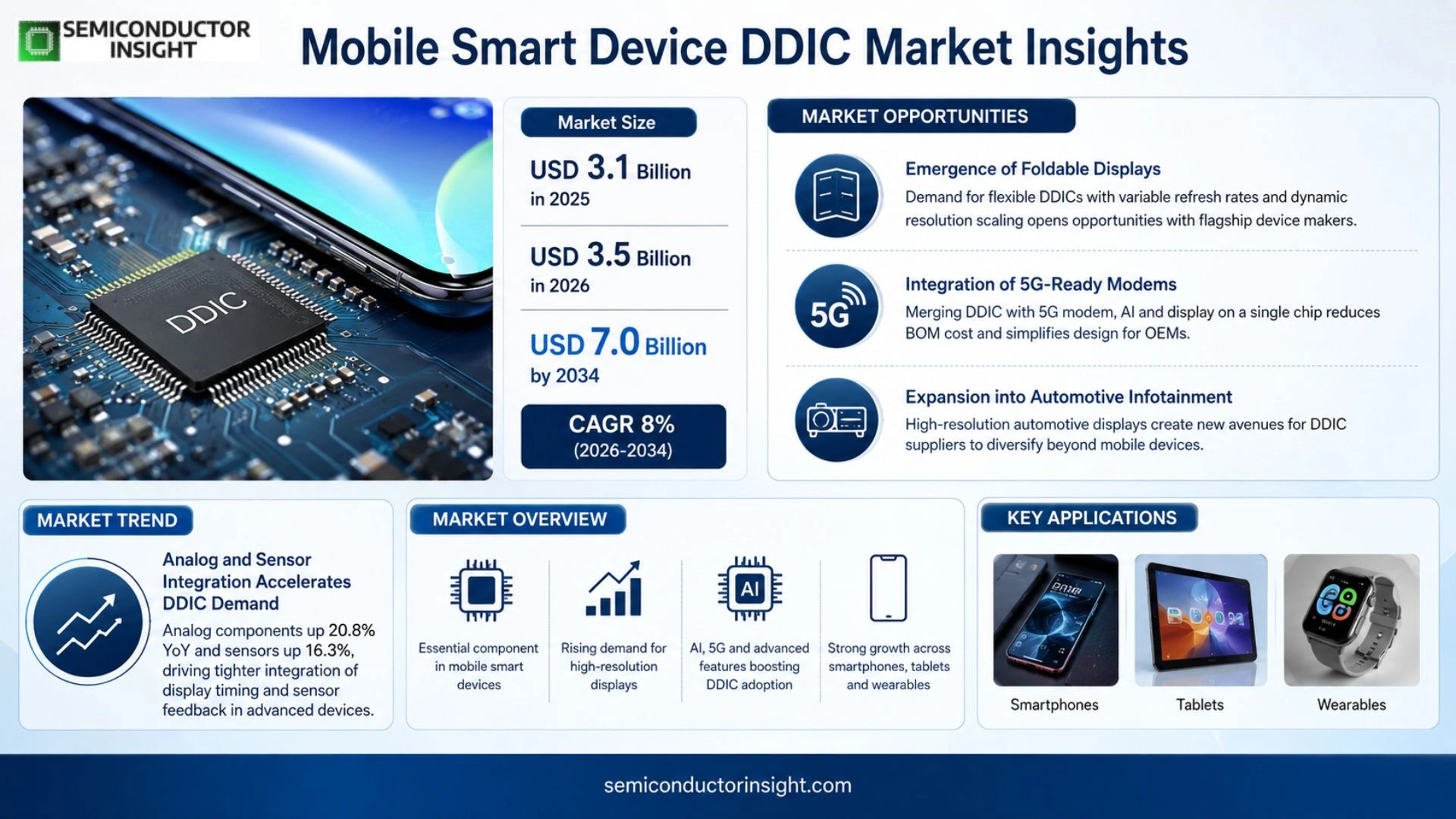
Global Mobile Smart Device DDIC market size was valued at USD 3.1 billion in 2025. The market is forecasted to rise from USD 3.5 billion in 2026 to USD 7.0 billion by 2034, delivering an implied CAGR of approximately 8 % over the forecast horizon.
Mobile Smart Device Display Driver Integrated Circuits (DDIC) are specialized semiconductor components that translate digital signals into precise voltage levels required to drive LCD and OLED panels in smartphones, wearables, tablets and laptops. These ICs manage pixel timing, brightness control and power sequencing, enabling high‑resolution visual output while optimizing energy consumption.
The sector is gaining momentum because consumer demand for higher refresh‑rate displays and ultra‑thin form factors pushes manufacturers toward more advanced DDIC solutions. Parallel advances in AI‑enhanced imaging and the rollout of 5G smartphones further stimulate component uptake. Leading suppliers such as Samsung LSI, Novatek, Himax and Synaptics are expanding their portfolios through joint development programs and fab capacity upgrades, positioning themselves to capture the growing addressable market.
MARKET DRIVERS
Proliferation of Edge‑AI Capabilities
Manufacturers are embedding dedicated digital signal processors into smartphones to accelerate AI inference directly on the device. This shift reduces reliance on cloud services, cuts latency, and improves privacy,attributes that end‑users now prioritize. Device makers that adopt these chips can differentiate product line‑ups while offering richer on‑device experiences such as real‑time translation and advanced photography.
Escalating Demand for High‑Resolution Imaging
The race to deliver 108 MP sensors and multi‑frame HDR processing has pressured chipset providers to supply more powerful DDIC (Display Driver IC) solutions. Higher pixel counts translate into heavier computational loads, prompting a surge in integrated display‑controller designs that combine graphics, video decoding, and AI functions in a single silicon footprint.
➤ “On‑device AI is no longer an optional feature; it is a baseline expectation for premium smartphones.”
Supply‑chain realignments, particularly the relocation of foundry capacity to regions with lower lead times, are also amplifying the pace at which new DDIC generations reach the market. Companies that can shorten development cycles stand to capture sizeable share gains.
MARKET CHALLENGES
Thermal Management Constraints
Integrating high‑performance DDICs alongside powerful application processors generates substantial heat. If not properly dissipated, thermal throttling can impair user experience, especially during intensive gaming or AI workloads. Design engineers must balance performance gains against the physical limits of smartphone form factors.
Other Challenges
Cost‑Pressure on Tier‑One OEMs
The premium segment demands cutting‑edge functionality, yet price sensitivity remains acute. Suppliers that cannot deliver cost‑effective DDIC solutions risk being bypassed in favor of more economical alternatives, even if those alternatives offer marginally lower performance.
Fragmented Software Ecosystem
A multitude of operating system versions and custom UI layers complicates driver compatibility. Software integration teams spend significant resources validating DDIC firmware across diverse device configurations, diverting focus from innovation.
MARKET RESTRAINTS
Regulatory Scrutiny on Power Consumption
Emerging regulations in the EU and Asia that target energy efficiency are tightening permissible power budgets for handheld devices. DDIC manufacturers must redesign architectures to meet stricter thresholds without sacrificing display quality, a task that can extend development timelines and inflate R&D expenses.
Supply‑Chain Volatility
Recent geopolitical tensions have exposed vulnerabilities in the semiconductor supply chain, leading to intermittent shortages of advanced silicon wafers. When component availability falters, production planners are forced to defer launch schedules, eroding market momentum for new Mobile Smart Device DDIC Market offerings.
MARKET OPPORTUNITIES
Emergence of Foldable Displays
Foldable form factors demand DDICs capable of handling variable refresh rates and dynamic resolution scaling. Early entrants that engineer flexible driver architectures can secure contracts with flagship manufacturers eager to differentiate their product lines, creating a lucrative niche within the Mobile Smart Device DDIC Market.
Integration of 5G‑Ready Modems
As 5G rollout matures, smartphones are consolidating modem, AI, and display functions onto unified silicon platforms. Companies that successfully merge DDIC capabilities with 5G modem blocks can offer single‑chip solutions that lower bill‑of‑materials costs and simplify board design,an attractive proposition for cost‑conscious OEMs.
Expansion into Automotive Infotainment
Beyond handheld devices, automotive dashboards are adopting high‑resolution touch displays that rely on robust DDICs. Leveraging existing expertise, DDIC suppliers can diversify revenue streams by targeting car manufacturers seeking to embed AI‑enhanced visual interfaces, thereby extending the reach of the Mobile Smart Device DDIC Market into a fast‑growing adjacent sector.
Mobile Smart Device DDIC Market Trends
Analog and Sensor Integration Accelerates DDIC Demand
The recent rebound in analog components, registering a 20.8 % year‑over‑year increase, signals a decisive shift for manufacturers of display driver integrated circuits. Sensors, which posted a 16.3 % rise, are being embedded in ever‑more sophisticated handsets and wearables, compelling DDIC suppliers to tighten the coupling between display timing and sensor feedback loops. This convergence elevates bill‑of‑materials costs but also creates pricing power for vendors that can deliver low‑latency, power‑efficient solutions. Companies that adapt their product roadmaps to this dual‑track demand are likely to capture stronger margins, while those that cling to legacy LCD‑centric designs risk marginalization as OEMs prioritize higher‑resolution, adaptive displays.
Other Trends
Regional Shifts Influence Supply Chain Strategies
While the Americas posted a robust 17 % revenue lift, the Asia‑Pacific region,still the largest contributor at $336.2 billion,experienced a 2 % contraction, reflecting waning consumer sentiment amid inflationary pressures. European sales grew 12.6 %, and Japan added a solid 10 % gain, underscoring pockets of resilience in mature markets. For the Mobile Smart Device DDIC Market, this mosaic of growth suggests a rebalancing of inventory allocations: firms may expand capacity in North America and Europe to hedge against Asian volatility, while simultaneously pursuing cost‑optimization initiatives in APAC to preserve competitiveness. The divergent trajectories also encourage diversification of supplier bases, reducing exposure to localized downturns.
Emergence of OLED Driver ICs Expands Application Scope
OLED driver ICs are carving out a larger share of the Mobile Smart Device DDIC Market as premium smartphones and wearables gravitate toward flexible, high‑contrast panels. Unlike LCD drivers, OLED solutions must manage per‑pixel current, demanding finer granularity in timing control and power management. Early adopters report noticeable improvements in battery endurance and color fidelity, prompting OEMs to earmark OLED‑compatible DDICs for upcoming product cycles. Vendors that have cultivated deep expertise in OLED driver architectures can command premium pricing and secure long‑term design‑win agreements, whereas competitors lagging in this arena may see their market relevance erode as the industry migrates away from legacy display technologies.
COMPETITIVE LANDSCAPE
Key Industry Players
Mobile Smart Device DDIC Competitive Overview
Samsung LSI continues to dominate the DDIC arena, leveraging its deep integration with flagship smartphone platforms and a supply chain that spans the entire value chain. Its ability to co‑engine display drivers alongside system‑on‑chip solutions gives it a pricing advantage and secures long‑term contracts with Tier‑1 OEMs. This market concentration forces smaller firms to specialize in niche interfaces or emerging form factors, such as foldable OLED panels, where flexibility and rapid iteration are paramount. The resulting oligopolistic structure means that strategic partnerships and joint R&D investments are the primary levers for gaining market share rather than sheer volume expansion.
Beyond the leading trio of Samsung LSI, Novatek, and Synaptics, a cohort of mid‑size innovators is reshaping the competitive set. Companies like Himax and Raydium Semiconductor focus on high‑resolution driver ICs for premium wearables, while Fitipower and Sitronix target cost‑sensitive tablet segments with mixed‑signal solutions. ILITEK and Magnachip have carved out a presence in automotive infotainment displays, exploiting the cross‑over between consumer and vehicle electronics. Meanwhile, newer entrants such as Viewtrix and Anapass are betting on advanced power‑management integration to differentiate their DDIC portfolios. The breadth of specialization underscores a market where differentiation hinges on technology depth, application‑specific performance, and the ability to align product roadmaps with rapidly evolving consumer expectations.
List of Key Mobile Smart Device DDIC Companies Profiled
- Samsung LSI
- Novatek
- Synaptics
- LX Semicon
- Himax
- Raydium Semiconductor
- Fitipower
- Sitronix
- ILITEK
- Magnachip
- FocalTech
- Anapass
- Viewtrix
- GalaxyCore
- SinoWealth
- Chipone
- Eswin
- Jadard Technology
Segment Analysis:
| Segment Category | Sub-Segments | Key Insights |
| By Type |
|
OLED Driver IC is emerging as the preferred technology for premium mobile experiences.
|
| By Application |
|
Smartphone remains the dominant application driver for DDIC innovation.
|
| By End User |
|
Consumer Electronics drives the bulk of DDIC adoption.
|
| By Technology |
|
Integrated Power Management is becoming a decisive factor in DDIC selection.
|
| By Integration |
|
System‑in‑Package (SiP) is reshaping the ecosystem for mobile displays.
|
Regional Analysis: Mobile Smart Device DDIC Market
Asia‑Pacific
Smartphone penetration has crossed a critical threshold, and users are now seeking devices that blend performance with AI‑enhanced features. The allure of seamless multitasking, augmented reality overlays, and on‑device analytics drives higher acceptance of DDIC components. Brands that embed intuitive interfaces and adaptive power management see stronger brand loyalty, compelling rivals to accelerate feature rollouts.
Proximity between fabrication plants in Taiwan, design hubs in South Korea, and assemblers in Vietnam compresses lead times. This geographic clustering enables rapid iteration on DDIC architectures, shielding the market from the latency that plagued earlier generations. However, geopolitically‑induced material sourcing constraints demand diversified supplier strategies.
Governments across the region are harmonizing data‑privacy statutes while encouraging IoT‑centric growth. Incentives for low‑power chip designs and penalties for non‑compliance with emerging standards shape product roadmaps, nudging firms toward more secure and energy‑efficient DDIC modules.
Tier‑1 silicon vendors leverage massive R&D budgets to deliver integrated platforms that bundle connectivity, processing, and security. Niche players counter by focusing on specialized sensor fusion or ultra‑low‑power footprints, creating a layered competitive fabric that rewards both scale and differentiation.
North America
In North America, enterprise adoption of Mobile Smart Device DDIC solutions outpaces consumer‑focused deployments. Corporate IT departments prioritize device‑level security and remote management to support increasingly hybrid workforces. The market therefore tilts toward platforms that integrate robust authentication mechanisms with over‑the‑air update capabilities. Regulatory scrutiny around data sovereignty compels vendors to host edge‑compute functions within U.S. borders, influencing architecture choices. Competitive pressure from domestic chipset manufacturers drives continuous performance gains, while end‑users demand longer battery life, prompting a focus on power‑efficient DDIC designs.
Europe
European markets exhibit a nuanced blend of consumer enthusiasm and stringent privacy mandates. The General Data Protection Regulation sets a high bar for data handling, encouraging manufacturers to embed privacy‑by‑design principles directly into DDIC firmware. Consumers in key countries such as Germany and France display a willingness to pay premium for devices that guarantee secure, localized processing. Meanwhile, the EU’s push for sustainable electronics spurs interest in low‑energy DDIC architectures that extend device lifecycles, reshaping supplier roadmaps toward greener solutions.
South America
South American adoption is driven by rising mobile broadband penetration and a growing middle class seeking feature‑rich smartphones. However, price sensitivity remains acute, forcing vendors to balance advanced DDIC capabilities with cost‑effective component selections. Regional carriers are experimenting with network‑sliced services, creating niche opportunities for DDIC modules that can dynamically adapt to varying latency and bandwidth conditions. Local manufacturers are beginning to co‑develop customized solutions that reflect regional usage patterns, such as high‑resolution video streaming and mobile payments.
Middle East & Africa
The Middle East & Africa region presents a divergent landscape where wealth‑driven demand in Gulf states coexists with emerging markets in Sub‑Saharan Africa. In affluent markets, premium devices equipped with cutting‑edge DDIC features are common, driven by a cultural premium on the latest technology. Conversely, African nations prioritize ruggedness and battery endurance, leading to a market for simplified DDIC designs that excel in low‑resource environments. Infrastructure projects focused on smart cities and digital health are catalyzing demand for secure, interoperable device ecosystems, positioning the Mobile Smart Device DDIC Market for a gradual but steady expansion across the region.
Report Scope
This market research report provides a comprehensive analysis of the Mobile Smart Device DDIC Market , covering the forecast period 2026–2034. It offers detailed insights into market dynamics, technological advancements, competitive landscape, and key trends shaping the industry.
Key focus areas of the report include:
- Market Overview: The report begins with an overview outlining its current market scenario, key growth indicators, and industry transformation drivers. It discusses macroeconomic factors, demand–supply balance, regulatory landscape, and the strategic role of semiconductors in powering advancements across industries such as automotive, telecommunications, consumer electronics, and industrial automation.
- Market Size & Forecast: Historical data and future projections for revenue, unit shipments, and market value across major regions and segments.
- Segmentation Analysis: Detailed breakdown by product type, technology, application, and end-user industry to identify high-growth segments and investment opportunities.
- Regional Insights: Insights into market performance across North America, Europe, Asia-Pacific, Latin America, and the Middle East & Africa, including country-level analysis where relevant.
- Competitive Landscape: Profiles of leading market participants, including their product offerings, R&D focus, manufacturing capacity, pricing strategies, and recent developments such as mergers, acquisitions, and partnerships.
- Technology Trends & Innovation: Assessment of emerging technologies, integration of AI/IoT, semiconductor design trends, fabrication techniques, and evolving industry standards.
- Market Drivers & Restraints: Evaluation of factors driving market growth along with challenges, supply chain constraints, regulatory issues, and market-entry barriers.
- Stakeholder Insights: Insights for component suppliers, OEMs, system integrators, investors, and policymakers regarding the evolving ecosystem and strategic opportunities.
Primary and secondary research methods are employed, including interviews with industry experts, data from verified sources, and real-time market intelligence to ensure the accuracy and reliability of the insights presented.
FREQUENTLY ASKED QUESTIONS:
What is the current market size of Mobile Smart Device DDIC Market?
-> Mobile Smart Device DDIC market is forecasted to rise from USD 3.5 billion in 2026 to USD 7.0 billion by 2034, delivering an implied CAGR of approximately 8 %
Which key companies operate in Mobile Smart Device DDIC Market?
-> Key players include Samsung LSI, Novatek, Synaptics, LX Semicon, Himax, Raydium Semiconductor, Fitipower, Sitronix, ILITEK, Magnachip, FocalTech, Anapass, Viewtrix, GalaxyCore, SinoWealth, Chipone, Eswin, Jadard Technology.
What are the key growth drivers?
-> Growth is driven by strong demand for analog, sensors, and logic components, rising consumer electronics adoption, AI‑enabled devices, and increasing integration of driver ICs in smartphones and wearables.
Which region dominates the market?
-> Asia‑Pacific remains the largest region, with sales of USD 336.2 billion in 2022, despite a 2.0% decline year‑on‑year, followed by the Americas (USD 142.1 billion) and Europe (USD 53.8 billion).
What are the emerging trends?
-> Emerging trends include a shift toward OLED Driver ICs, heightened focus on power‑efficiency, and the integration of driver ICs into smart wearables and IoT devices.
Get Sample Report PDF for Exclusive Insights
Report Sample Includes
- Table of Contents
- List of Tables & Figures
- Charts, Research Methodology, and more...
 Download Sample Report PDF