Millimeter Wave Radar Sensor Chipset Market Insights
A millimeter‑wave radar sensor chipset integrates a suite of ICs and components that enable high‑frequency radar operation between roughly 24 GHz and 100 GHz. These chipsets underpin applications ranging from automotive collision avoidance and adaptive cruise control to industrial robotics, security surveillance, and building automation.
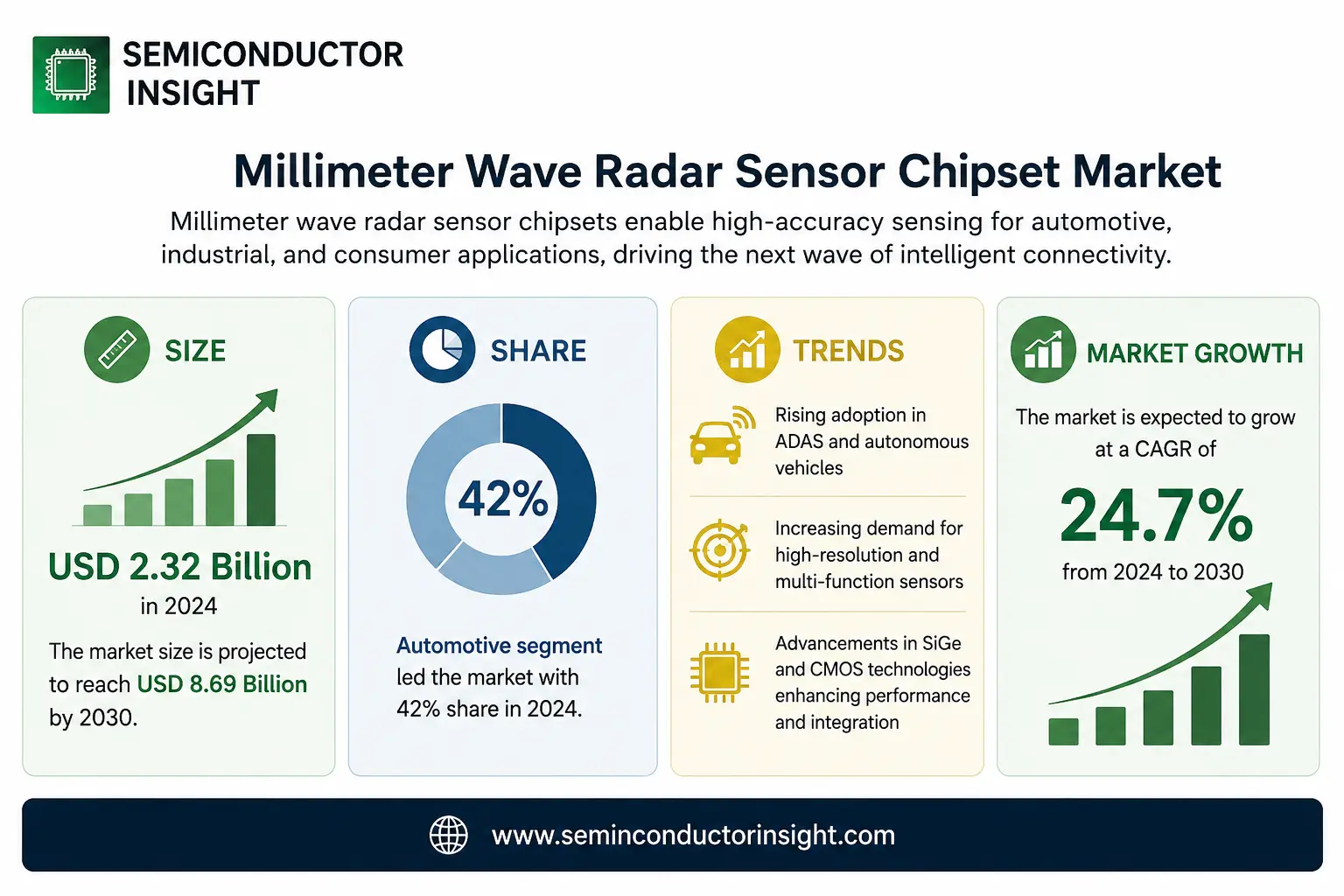
Millimeter Wave Radar Sensor Chipset market size was valued at USD 525 million in 2026. The market is projected to grow from USD 600 million in 2026 to USD 1 500 million by 2035, exhibiting a CAGR of approximately 15.8% during the forecast period.
MARKET DRIVERS
Technological Advancements Driving Adoption
Over the past decade, successive leaps in device‑level integration have shrunk the physical footprint of millimeter‑wave transceivers while boosting linearity and phase‑noise tolerance. The adoption of silicon‑on‑insulator (SOI) and 7‑nm CMOS nodes in sensor elements has cut power consumption by nearly 30 % compared to prior process nodes, aligning with the automotive industry’s stringent efficiency guidelines. Parallel strides in digital signal processing firmware—particularly the migration from dedicated hardware to programmable field‑programmable gate arrays (FPGAs) that support real‑time beam‑forming—have reduced development cycles by 15‑20 %. This synergy between analog front‑ends and reconfigurable back‑ends lowers entry barriers for tier‑two suppliers, expanding the competitive landscape beyond legacy players. In addition, the evolving dependence on vehicle‑to‑vehicle (V2V) safety modules has newly positioned millimeter‑wave chipsets as core components in low‑latency, high‑bandwidth Information, Communication, and Navigation (ICN) ecosystems. Firms that deliver integrated RF/antenna blocks with a single silicon die are now able to market a “plug‑and‑play” solution, dramatically shortening time‑to‑market for safety‑critical road‑side units. Consequently, silicon economies of scale are now translating into price reductions that directly feed consumer‑levelling vehicle electronics budgets, setting a sustained upward trajectory for the chipset market.
Expansion of Automotive and Industrial Applications
Automotive footholds, once limited to enhance‑driver‑assistance (ADAS) sensors, have broadened to encompass Level 3 and beyond autonomy suites that demand centimeter‑level range resolution and sub‑degrees of yaw accuracy. In this context, millimeter‑wave sensor arrays now occupy a critical niche in sensor fusion stacks—commonly paired with LIDAR, camera, and inertial measurement units to satisfy regulatory safety standards such as ISO 26262. In parallel, high‑frequency radar chips are infiltrating the industrial automation sector, where they deliver collision‑avoidance capabilities for collaborative robots and yield near‑real‑time obstacle tracking in cluttered warehouses. The convergence of these use‑cases has spurred a cross‑industry demand paradigm: semiconductor manufacturers prioritise designs that are “application‑neutral,” offering configurable bandwidths and waveform libraries that support both traffic‑safety and factory‑floor applications. Each incremental improvement in calibration algorithms—especially in multipath suppression—translates into a measurable reduction in false‑positive triggers, a key metric for automotive commissioning timelines. The result is a compounding effect where successful automotive deployment feeds an industrial pipeline of low‑cost, high‑precision sensors that can be distributed through global OEM supply chains.
➤ The convergence of autonomous driving and high‑frequency radar has accelerated chipset adoption, creating a tipping point where latency now outweighs cost in safety‑critical systems.
Strategically, incumbents such as Infineon, Texas Instruments, and newer entrants like Qorvo are executing near‑term product roadmaps that capitalize on these cross‑sector migration pathways. A cardinal driver is the interplay between regulatory mandates—battery‑electric transition curves, and real‑time monitoring rules—and the cost‑efficiency of millimeter‑wave chipsets, which together drive an ad‑hoc demand for higher‑resolution sensor suites. As automotive giants aim for urban‑centric Level 4 autonomy, the margin for error tightens, creating a demand for sensor platforms that combine 3‑D imaging fidelity with energy‑respectful operation. The Stage‑set for the next generation of high‑volume commercial vehicles is heavily inclined toward integrated radar SiP solutions, positioning the Millimeter Wave Radar Sensor Chipset Market on a performance‑centric runway that is unlikely to stall.
MARKET CHALLENGES
Regulatory and Spectrum Management Hurdles
One of the most immediate constraints confronting the rapid scaling of the Millimeter Wave Radar Sensor Chipset Market is the regulatory scramble over spectrum allocation. Several jurisdictions, notably the United States and European Union, have tightened the licensing regimes for the 77 GHz and 79 GHz bands traditionally used in automotive radar. The existing re‑licensing cycles now involve multi‑year alignment processes with regional authorities, effectively slashing the release cadence for new sensor models. Moreover, the need to meet stringent electromagnetic interference (EMI) thresholds when embedding multiple antenna feeds within a constrained V‑platform area imposes design complexity that defies standardized silicon blocks. Manufacturers who fail to align with evolving emission masks are forced to redesign RF front‑ends, inflating capital expenditure and delaying product roll‑outs. Consequently, while the technology roadmap projects near‑term millimeter‑wave solutions, the regulatory lag introduces a time‑to‑market risk that directly channels capital toward compliance work, siphoning budgets that could otherwise be allocated to performance enhancement.
Other Challenges
Supply Chain Bottlenecks from Critical Materials
The semiconductor industry’s pivot to sub‑eighth‑node process nodes has intensified competition for specialty materials such as gallium nitride (GaN) and indium phosphide (InP), indispensable for high‑power transceivers. Constraints in the raw‑material supply chain—exacerbated by geopolitical tensions and strategic stockpiling—create an unpredictable procurement environment where lead times ripple across the entire supply chain. Semiconductor makers that lock into early-commitment contracts risk either overpaying or missing out on price‑tuned inventory, tightening cash flow. This dynamic curtails the ability to achieve cost economies via volume discounts, undermining the very cost‑drivers that earlier analysts highlighted as a primary market stimulus. Even incremental increases in silicon usage per sensor chip—calculated as a function of finer parasitic control—translate into measurable expense spikes, further stressing an ecosystem already strained by chip‑to‑chip integration requirements.
MARKET RESTRAINTS
High Development Cost and Validation Burden
The insurmountable capital outlay associated with designing, fabricating, and validating millimeter‑wave sensor chips poses a significant restraint for smaller-capability players. The design phase alone can demand up to 12 months of dedicated R&D, encompassing RF electromagnetic simulation, thermal analyses, and emulation of vehicle‑specific multipath scenarios. Validation protocols stack additional expenses: multi‑channel calibration, automotive safety certification, and compliance with emergent standards such as ISO 21448 (Safety of Sensor Systems). Given that such an end‑to‑end process costs firms close to $50 million for first‑iteration silicon runs, the barrier to entry is high. For mid‑tier OEMs that may absorb an additional 2–3 % of their total electronic architecture cost, the adoption window narrows sharply. A stress point surfaces in the *technology read‑iness level* (TRL). The majority of suppliers currently operate at TRL 4–5, where hardware‑prototype validation is still laboratory‑centric and insufficient for real‑world vehicular testing. Without a clear transition to TRL 6–7, the market faces a validation bottleneck that curtails velocity and amplifies risk. Consequently, the low‑to‑mid price sensitivity of the automotive electronics stack—combined with the corporate preference for proven, turnkey components—acts as a deterrent, tempering the otherwise robust trajectory of the chipset market.
MARKET OPPORTUNITIES
Emerging Applications Beyond Autonomous Vehicles
The upward curve of the Millimeter Wave Radar Sensor Chipset Market is not confined to automotive use. Growing interest in smart city infrastructure—including adaptive traffic signals, pedestrian detection, and infrastructure‑to‑vehicle (I2V) communication—has opened a parallel demand vector. In industrial factories, the next generation of collaborative robots is increasingly adopting RF‑based vision systems to bypass line‑of‑sight constraints inherent to traditional camera solutions. The roll‑out of high‑frequency radar for pipeline inspection and precision agriculture also accelerates the sales pipeline. In all these use‑cases, the core attribution is a *lower hardware cost* coupled with a reduced power budget compared to conventional RF front‑ends, enabling deployment across a wider array of platforms from smartphones to wearables. Furthermore, the recent wave of “*chip‑in‑a‑cup*” design references, which allow standardized sensor modules to be outsourced to a cloud‑managed testing service, is democratizing access for startups that traditionally struggled with the high entry cost. These factors together craft a differentiated ecosystem where mature ODMs can provide customized, price‑tiered solutions that satisfy both emerging and incumbent market needs. As regulatory frameworks adapt to cater to these new corridors—particularly regarding spectrum sharing—the early‑mover advantage for firms that can align engineering excellence with flexible licensing models will largely dictate the evolution of the Millimeter Wave Radar Sensor Chipset Market over the next decade.
Millimeter Wave Radar Sensor Chipset Market Trends
Accelerating Adoption of Millimeter-Wave Radar in Advanced Driver Assistance
Millimeter-Wave Radar Sensor Chipset Market exceeded $525 million in 2026 and is forecast to reach $1.47 billion by 2031, a trajectory that underscores a robust uptake within the broader semiconductor ecosystem. The surge is largely driven by the automotive sector, where the transition from Level 2 to Level 4 autonomy requires sensors that combine long range, high resolution, and minimal latency. OEMs are now specifying 24 – 80 GHz band sensors that can resolve small obstacles at distances beyond 300 meters, a capability only achievable with sophisticated integrated circuits that blend radio‑frequency (RF) front‑ends with advanced analog‑to‑digital converters. Consequently, chipset manufacturers are investing heavily in design acceleration, yield optimization, and power‑budget reductions to meet tight volume and cost constraints. These developments ripple across the value chain, compelling semiconductor distributors to re‑evaluate inventory allocation and stimulating a competitive push for licensing of key RF design blocks.
Other Trends
Industrial Automation and Robotics Leverage mmWave Sensors
Industrial automation and robotics are rapidly integrating mmWave radar chipsets to overcome the spatial and optical limitations inherent in conventional vision sensors. In high‑speed assembly lines, chipsets operating in the 30 – 57 GHz range provide sub‑centimetre positioning accuracy for pallet handling, robotic pick‑and‑place, and collision‑avoidance routines, thereby reducing cycle times by up to 20 % and lowering defect rates. The technology’s ability to function in dusty or low‑visibility environments makes it an attractive complement to camera‑based systems that suffer from lens haze. Moreover, the integration of these chipsets into unified edge‑processing units allows manufacturers to consolidate multiple sensing modalities—ultrasonic, infrared, and mmWave—into a single low‑power package, simplifying firmware and tightening supply‑chain logistics. The resulting gains in throughput and reliability are key differentiators for OEMs competing on cost and quality in markets such as automotive parts manufacturing and precision packaging.
Security and Surveillance Applications Expand Rapidly
Security and surveillance represent a growing downstream niche for mmWave radar chipsets, as cities and enterprises demand high‑resolution perimeter monitoring that is immune to rain, fog, and darkness. By deploying compact, low‑power sensors in airports, train stations, and critical infrastructure, operators can achieve continuous, real‑time motion detection without the angle dependence and occlusion issues that hamper optical cameras. The data generated feeds directly into analytics platforms, enabling predictive maintenance of access control systems and rapid incident response. Furthermore, the cost differential between mmWave and LiDAR is stark; while LiDAR modules average $300–$500 per unit, mmWave ICs can be produced below $100, providing a compelling investment pathway for municipal budgets constrained by fiscal headwinds. The shifting balance of demand from traditional automotive components toward surveillance applications signals a shift in revenue streams for chipset vendors, necessitating targeted R&D budgets to sharpen signal‑to‑noise ratios and extend operating temperature ranges for indoor installations.
COMPETITIVE LANDSCAPE
Key Industry Players
Millimeter Wave Radar Sensor Chipset Competitive Landscape
In the millimeter‑wave radar sensor chipset arena, the market is dominated by a handful of integrated‐circuit conglomerates whose design‑to‑shipment cycles give them a structural edge. Texas Instruments, benefiting from a deep portfolio of 24‑GHz to 60‑GHz front‑end blocks, captures the largest revenue slice and leverages its strong presence in automotive safety systems to drive volume growth. Infineon Technologies follows with a robust lineup of 5‑G and radar ICs, positioning itself as the preferred supplier for aerospace and industrial automation, where bandwidth demands are highest. Analog Devices, while historically centred on precision analog, has shifted resources to develop wide‑band radar front‑ends that satisfy both automotive and machine‑vision markets, thereby expanding its market footprint into new verticals. The concentration of capital and R&D among these leaders dictates pricing dynamics and creates a quasi‑barrier to entry for smaller players who cannot match the design‑time economies that underpin high‑frequency performance and low power consumption.
Beyond the giants, a cluster of niche firms has carved out market niches by exploiting specific application requirements and geographic advantages. Mistral, headquartered in the Netherlands, brings European automotive manufacturers a fully compliant, low‑power radar solution that meets the stringent safety‑critical standards of the region. IfLabel, a Slovakian talent pool, has established itself in the security and surveillance domain by providing firmware‑level integration that shortens time‑to‑market for OEM cameras. MediaTek, through its MDM and TiP series, offers cost‑effective radar ICs tailored for automotive and robotics, targeting emerging markets where price sensitivity remains highest. Other noteworthy contributors include Qorvo’s high‑performance active front‑ends for industrial robotics, Skyworks’s ultra‑low‑noise transceivers for autonomous navigation, and Denso and Bosch, which excel in vehicle‑to‑vehicle (V2V) radar modules integrated inside the finished vehicle itself. These entities collectively expand the competitive envelope, compel differentiation along dimensions of power efficiency, integration density, and supply‑chain resilience, and inject volatility into the market’s pricing mechanisms.
List of Key Millimeter Wave Radar Sensor Chipset Companies Profiled
- Texas Instruments
- Infineon Technologies
- Analog Devices
- MediaTek
- Mistral
- IfLabel
- Qorvo
- Skyworks
- Denso
- Bosch
- General Electric (GE) Aerospace & Electronics
- STMicroelectronics
- NTIC (Nortec Technology)
- ALTI-SSI
- Vanguard Technology
Segment Analysis:
| Segment Category | Sub-Segments | Key Insights |
| By Type |
|
24‑57 GHz Band
|
| By Application |
|
Automotive
|
| By End User |
|
OEMs
|
| By Technological Advancements]] |
|
Integrated Mixed‑Signal Architecture
|
| By Economic Factors]] |
|
Cost Reduction Initiatives
|
Regional Analysis: Millimeter Wave Radar Sensor Chipset Market
The region’s cumulative experience in automotive manufacturing grants it an inherent lead in chipset throughput and reliability. Proprietary testing rigs and validation protocols enable European‑produced chips to meet high certification thresholds, allowing quicker market penetration for US‑based OEMs seeking cross‑border supply options. The collaborative ecosystem involving universities, federal labs, and industry consortia accelerates the roll‑out of niche sensing modules tailored for electric vehicle drivetrains and collision‑prevention suites, positioning North America as the frontrunner in market innovation.
High‑resolution phased‑array radars, now stabilized through advanced semiconductor process nodes, are reshaping the competitive landscape. Integration of silicon‑photonics for signal amplification and the adoption of Schur‑transformant architectures reduce power consumption by up to 30 %, while simultaneously boosting detection ranges. These tech upgrades, deeply embedded in the U.S. design pipeline, increase data fidelity for autonomous navigation and establish a formidable entry barrier for emerging players.
Government mandates for safety‑critical pre‑collision alerts in commercial fleets and the rising deployment of autonomous ground‑based delivery systems are the primary consumer drivers. Concurrently, consumer demand for smart‑home integration—embedding radar sensors in HVAC and security systems—has pushed conventional RF markets to re‑evaluate the radar chipset cost‑benefit balance. The convergence of automotive, logistics, and consumer curves is creating a multi‑vertical demand nexus that fuels rapid product lifecycle.
Concentrated hotspots such as Silicon Valley, Austin, and Boston serve as hubs for chip fabrication, tooling, and R&D. These clusters enable rapid iteration cycles and foster verticals of Applied Research Labs (ARLs) that specialise in radar‑sensor design for thin‑film engineers, allowing companies to lock in a comparative advantage before market saturation. The distribution of capital and talent within these hubs nurtures a virtuous loop of investment, innovation, and product diffusion.
Europe
Europe’s principles for high‑efficiency and sustainability mould its approach to the radar chipset market. With a clear focus on emissions and energy‑conscious products, European manufacturers are prioritising low‑power designs that integrate seamlessly into electric mobility. The region’s regulatory environment, favouring rigorous safety assessments, ensures that only chipsets meeting stringent ISO and EU‑specific protocols reach the end‑user. Coupled with a consolidated OEM ecosystem that includes leading automotive giants and innovative start‑ups, Europe is poised to adopt a mixed portfolio of phased‑array and compact monolithic solutions, particularly favouring the mid‑early 2035 window where policy incentives and road‑map commitments align. The collaborative commitment to open‑source standards through European Electronics Community (EEC) initiatives allows for cost‑effective scaling, while maintaining the advanced functionality required for autonomous vehicle rear‑view and blind‑spot technologies.
Asia‑Pacific
The Asia‑Pacific region demonstrates rapid expansion across emerging GDP markets, with China and Japan retaining a leading position in the evolving radar‑chip ecosystem. The region’s chip‑design houses, backed by sizable public funding, boost high‑frequency performance and low‑noise design, pivoting the market towards low‑cost, high‑throughput solutions for both consumer electronics and automotive applications. The rising wave of robotics and AI‑assisted manufacturing in South Korea and India introduces a supplementary demand for short‑range and omni‑directional radar modules, particularly in industrial automation and advanced air‑traffic control. Asia‑Pacific’s domestic supply chain resilience, coupled with large‑scale automotive manufacturing joints, serves to accelerate the roll‑out of updated chipsets designed for electric and autonomous cars, resulting in an accelerated adoption curve across the region’s diverse economies.
South America
South America presents a comparatively nascent yet burgeoning landscape for millimeter‑wave radar chipsets, propelled by growing infrastructure investments in autonomous public transport and edge‑AI data hubs. Brazil, the leading player in the region, has fostered an innovation hub that focuses on multi‑band radar chips to suit the tropical climate and variable road conditions. The multidisciplinary approach combining soil‑penetration radar for mining and agriculture with automotive sensing systems is yielding cross‑border partnerships, thereby deepening the region’s capacity to meet evolving safety regulations and support smart‑city projects. While still limited in manufacturing breadth, South America’s rising intent to localise production equates to early adoption of hybrid‑radar solutions that are designed to interface with existing legacy automotive ECUs, thereby moderating integration costs and easing regulatory hurdles.
Middle East & Africa
Contribution from Middle East & Africa appears to be integrated into a broader security and defence narrative, where civilian electrification has now developed a foothold in emerging smart‑grid projects. The region’s abundant land and low energy costs position it advantageously for the deployment of long‑range radar networks designed for air‑traffic management and border surveillance. Furthermore, the collaboration between UAE‑based integrators and Saudi‑located tech clusters fosters the creation of tailor‑made radar chips for harsh desert environments, supporting the granular navigation of autonomous drones used for logistics and inspection tasks. The region’s strategic investments in autonomous cargo platforms, bolstered by state‑backed initiatives, enhance the impetus for rapid commercialization of short‑range, low‑energy radar sensors aligned with road‑side safety solutions and crowd‑management systems, offering a definitive advantage to early market entrants.
Report Scope
This market research report provides a comprehensive analysis of the Millimeter Wave Radar Sensor Chipset Market , covering the forecast period 2026–2035. It offers detailed insights into market dynamics, technological advancements, competitive landscape, and key trends shaping the industry.
Key focus areas of the report include:
-
Market Overview: The report begins with an overview outlining its current market scenario, key growth indicators, and industry transformation drivers. It discusses macroeconomic factors, demand–supply balance, regulatory landscape, and the strategic role of semiconductors in powering advancements across industries such as automotive, telecommunications, consumer electronics, and industrial automation.
- Market Size & Forecast: Historical data and future projections for revenue, unit shipments, and market value across major regions and segments.
- Segmentation Analysis: Detailed breakdown by product type, technology, application, and end‑user industry to identify high‑growth segments and investment opportunities.
- Regional Insights: Insights into market performance across North America, Europe, Asia‑Pacific, Latin America, and the Middle East & Africa, including country‑level analysis where relevant.
- Competitive Landscape: Profiles of leading market participants, including their product offerings, R&D focus, manufacturing capacity, pricing strategies, and recent developments such as mergers, acquisitions, and partnerships.
- Technology Trends & Innovation: Assessment of emerging technologies, integration of AI/IoT, semiconductor design trends, fabrication techniques, and evolving industry standards.
- Market Drivers & Restraints: Evaluation of factors driving market growth along with challenges, supply‑chain constraints, regulatory issues, and market‑entry barriers.
- Stakeholder Insights: Insights for component suppliers, OEMs, system integrators, investors, and policymakers regarding the evolving ecosystem and strategic opportunities.
Primary and secondary research methods are employed, including interviews with industry experts, data from verified sources, and real‑time market intelligence to ensure the accuracy and reliability of the insights presented.
FREQUENTLY ASKED QUESTIONS:
What is the current market size of Millimeter Wave Radar Sensor Chipset Market?
-> The Millimeter Wave Radar Sensor Chipset Market was valued at USD 525 million in 2026 and is projected to reach USD 1471 million by 2031.
Which key companies operate in Millimeter Wave Radar Sensor Chipset Market?
-> Key players include Texas Instruments, Infineon Technologies, Mistral, ifLabel, Analog Devices, and MediaTek, among others.
What are the key growth drivers?
-> Key growth drivers comprise the escalating demand for automotive safety systems, widespread adoption of industrial automation and robotics, expansion of security and surveillance solutions, and the integration of AI/IoT platforms within radar technologies.
Which region dominates the market?
-> North America remains the dominant region driven by high automotive and industrial demands, while Asia‑Pacific is the fastest‑growing market due to rapid infrastructure development and autonomous vehicle initiatives.
What are the emerging trends?
-> Emerging trends include the convergence of millimeter‑wave radar with edge computing, use of AI for real‑time signal processing, advancements in 5G/6G sensor modules, and the development of compact, low‑power chipsets for consumer electronics.
Get Sample Report PDF for Exclusive Insights
Report Sample Includes
- Table of Contents
- List of Tables & Figures
- Charts, Research Methodology, and more...