Key Statistics
Key Takeaways
- Circular MCPs remain the dominant product format, accounting for more than 70% of the 2025 market because round detector geometries are deeply established in image intensifiers, scientific instruments and legacy vacuum-tube architectures. Rectangular and custom-format plates are expanding faster where larger active areas, tiled detector assemblies or instrument-specific geometries justify bespoke processing.
- Night vision devices are the largest application because image intensifier tubes use an MCP to multiply photoelectrons before they reach the phosphor screen. Military modernization, border surveillance and low-light imaging therefore translate directly into demand for high-gain, low-noise plates with long operating life and stable response.
- Scientific research and space instrumentation are the strongest high-value growth areas. NASA’s LEXI instrument used a microchannel plate detector on the Moon in 2025, while MCP-based detectors continue to serve ultraviolet, X-ray, particle and time-of-flight instruments where fast timing, low dark count and single-event sensitivity are more important than unit cost.
- Asia Pacific is the largest regional market with roughly 40% share, supported by defense-electronics investment, photonics manufacturing and scientific-instrument demand across China, Japan and India. Europe follows through precision photonics, particle physics and space research, while North America remains important for defense, national laboratories and advanced detector development.
- Manufacturing complexity is the core structural restraint. MCP production requires tight control of pore diameter, length-to-diameter ratio, bias angle, channel wall properties, resistive coatings and secondary-emission behavior. Yield losses increase sharply when pore uniformity or surface chemistry drifts across large plates, protecting established suppliers with proprietary process know-how.
- Lead-free and ALD-functionalized MCP architectures are widening the addressable market. Incom’s borosilicate capillary approach and atomic-layer-deposition coatings allow larger, customizable geometries and reduce dependence on conventional lead-glass formulations, creating opportunities in large-area photodetectors, neutron imaging and long-life scientific systems.
Microchannel Plates (MCP) and MCP Detectors Market Overview
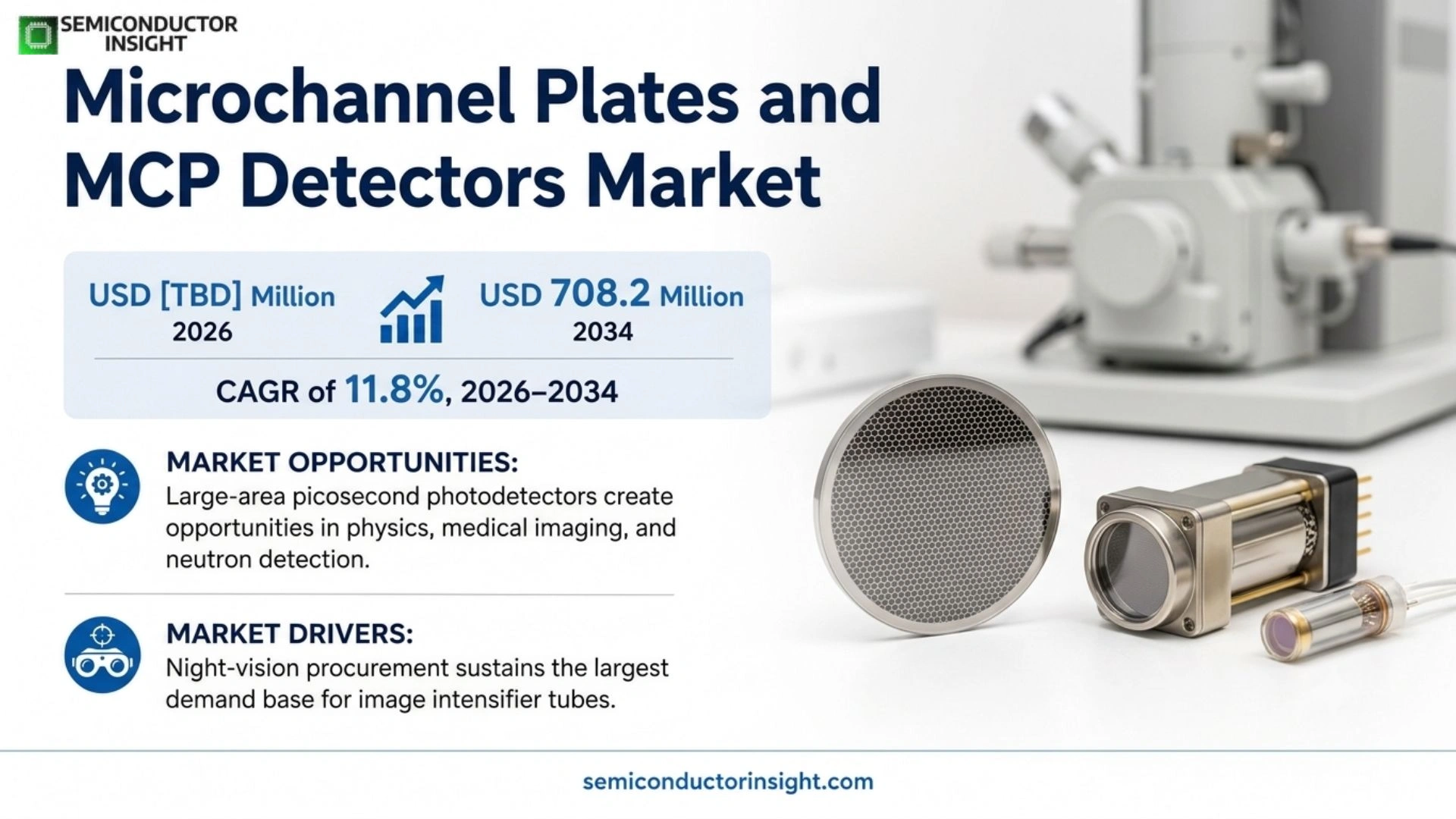
Microchannel Plates and MCP Detectors Market was valued at approximately USD 260.4 million in 2025 and is projected to reach approximately USD 708.2 million by 2034, representing a 11.8% CAGR during 2026–2034. Asia Pacific held the largest regional position at about 40% in 2025, supported by defense, scientific imaging and photonics manufacturing, while North America and Europe remain critical centers for high-performance detector development.
A microchannel plate is a compact electron multiplier formed from millions of microscopic channels running through a glass or capillary substrate. When an electron, ion or photon-generated electron enters a channel under high voltage, repeated collisions with the channel wall release secondary electrons and create an avalanche. The resulting gain allows very weak particle or photon signals to be converted into detectable electrical or optical outputs with fast timing, high spatial resolution and low background noise.
MCP detectors are therefore used where conventional solid-state sensors cannot easily match the combination of gain, timing and event sensitivity. Important systems include image intensifier tubes for night vision, X-ray and ultraviolet imagers, mass spectrometers, electron microscopes, particle-physics detectors, neutron imaging systems and specialized medical instruments. Incom’s current ALD-GCA MCP platform, for example, supports sizes up to 20 cm by 20 cm with customizable pore size, geometry and resistance, showing how modern production is moving beyond traditional small circular lead-glass plates.
The technology is also becoming more application-specific. Conventional lead-glass MCPs remain well established, but newer products use atomic layer deposition, alternative glass compositions, optimized photocathodes and detector packages designed around time-of-flight, high-rate photon counting or neutron conversion. Exosens’ PhotonPix module combines an MCP-PMT architecture with sub-15-picosecond timing and burst count rates above 200 MHz, illustrating how detector value increasingly comes from the complete module and readout rather than the plate alone.
Market growth is strongest where the detector solves a problem that solid-state alternatives still handle poorly. Space and scientific applications need radiation tolerance, photon counting and low dark rate; defense systems need low-light amplification and compact form factors; time-of-flight instruments need extremely fast response; neutron imaging needs efficient conversion without sacrificing spatial resolution. These requirements support premium pricing and long qualification cycles, making technical differentiation more important than commodity-scale manufacturing volume.
Segment Analysis: By Type
By type, the market is segmented into Circular MCP, Rectangular MCP and Others. Circular plates remain the largest segment because they fit the established cylindrical geometry of many image intensifier tubes, vacuum detectors and scientific instruments. Rectangular and custom shapes are gaining importance where designers need larger active areas, tiled assemblies, square imaging formats or instrument-specific mechanical layouts.
| Type | Technical role | Market position |
|---|---|---|
| Circular MCP | Circular plates are the standard format for many image intensifier, photomultiplier and analytical detector assemblies. Their geometry matches established vacuum-tube housings and allows well-understood electric-field control. Standard, high-gain and low-noise variants differ in pore size, aspect ratio, surface treatment and channel resistance according to the required gain, timing and lifetime. | Largest segment in 2025 with more than 70% share. The installed base of round night-vision and scientific detectors gives this format substantial qualification inertia. Growth remains healthy because existing systems are upgraded to higher gain, lower noise and longer life even where the mechanical format does not change. |
| Rectangular MCP | Rectangular plates are used where the imaging plane is naturally square or where several plates must tile with limited dead area. Large-area scientific imagers, particle detectors and custom space instruments can benefit from rectangular or square MCP formats that reduce unused area and align more efficiently with downstream readout electronics. | Fast-growing geometry segment. Demand increases with large-area and tiled detector systems, especially where researchers want more active area without scaling a single circular tube. Manufacturing is more demanding because maintaining pore uniformity and flatness across wider formats directly affects gain uniformity and detector yield. |
| Others | This category includes curved MCPs, custom outlines, specialized stacks and application-specific configurations. Curved plates can support ion optics and mass-spectrometry geometries, while custom stacks can be optimized for gain, timing, lifetime or directional response. Incom specifically markets curved MCPs for space-flight mass spectrometry and customizable resistance and bias-angle designs. | A smaller but high-value segment. Customers typically order these products for scientific, aerospace, analytical or defense programs where detector geometry is part of the instrument architecture. Volumes are lower than standard circular plates, but engineering content and qualification requirements support stronger unit pricing. |
Detector stack configuration and gain architecture
MCPs are often used as a single plate, a chevron pair or a Z-stack depending on required gain and noise. A chevron configuration places two plates with opposing bias angles so electrons leaving the first plate enter the second efficiently while suppressing ion feedback. Incom’s 20 cm square LAPPD uses a chevron pair of large-area ALD MCPs and achieves gain above 10 million, showing why stack configuration is a core design variable rather than a simple packaging choice.
Segment Analysis: By Application
By application, the market is segmented into Night Vision Devices, Experimental Physics, Medical Diagnosis and Others. Night vision is the largest commercial application because military and surveillance image intensifiers rely directly on MCP gain. Experimental physics and space instrumentation generate lower unit volumes but much higher technical value because timing resolution, low background and custom geometry can determine the performance of an entire instrument.
| Application | Demand characteristics |
|---|---|
| Night Vision Devices | Largest application. Image intensifier tubes convert incoming photons to electrons at the photocathode, multiply those electrons inside the MCP and convert them back to visible light at the phosphor screen. Defense customers therefore value high gain, low halo, low noise, long life and shock resistance. Procurement is closely linked to military modernization, border surveillance and specialized law-enforcement programs. |
| Experimental Physics | Particle, nuclear and high-energy physics use MCP detectors for single-event detection, picosecond-scale timing and position-sensitive measurements. Large-area photodetectors such as Incom’s LAPPD address collider, neutrino and nuclear-physics applications. Research customers prioritize timing, active area, low dark count and custom readout compatibility, creating a technically demanding but relatively price-insensitive segment. |
| Medical Diagnosis | MCP-based detectors support specialized X-ray, fluorescence, PET and high-speed biomedical imaging where low-light sensitivity or fast timing is required. Commercial adoption depends on whether the MCP provides a clinically meaningful signal-to-noise or timing advantage relative to CMOS, scintillator or photomultiplier alternatives. Qualification and cost keep the segment smaller than defense, but advanced imaging and photon-counting techniques create selective growth opportunities. |
| Others | Other applications include time-of-flight mass spectrometry, electron microscopy, neutron imaging, residual gas analysis, ultraviolet astronomy, non-destructive testing and industrial inspection. Exosens’ Neutronic[i] platform shows how MCP technology is extending into on-site neutron radiography, while Photonis time-of-flight detectors remain important in analytical instruments that require very fast ion detection. |
Regional Analysis
Asia Pacific is the largest market, Europe is a major precision-photonics and research region, and North America remains strategically important for defense and advanced scientific detectors. Regional demand is shaped by different mechanisms: Asia combines manufacturing and defense procurement, Europe combines CERN-scale research and specialist detector production, and North America combines national laboratories, military imaging, space programs and large-area detector innovation.
How does regional demand differ across the MCP and MCP detector market?
The market is unusually sensitive to where the end instrument is designed and qualified because MCPs are not commodity photodetectors. A defense image intensifier, space X-ray telescope or mass spectrometer can require a specific pore size, active area, photocathode, readout and lifetime profile. Regional engineering relationships therefore matter. Suppliers that can support local qualification, export-control compliance and long program lifecycles often hold an advantage even when their manufacturing cost is higher than an offshore alternative.
| Region | Position | Growth outlook | Demand profile | What decides supplier selection |
|---|---|---|---|---|
| Asia Pacific | Largest – ~40% | High | Defense, imaging and manufacturing led | Cost-performance, local defense qualification, manufacturing scale, detector lifetime and local engineering support |
| Europe | Second – ~30% | Moderate to high | Scientific research, space and precision photonics led | Timing performance, custom geometry, low noise, export compliance and specialist engineering |
| North America | Third – ~27% | High-value growth | Defense, national labs, space and large-area detector R&D led | Trusted supply, lead-free technology, timing, active area and long-term program support |
| Middle East & Africa | Emerging | Moderate from small base | Border security, defense and industrial inspection led | Availability, export approvals, ruggedness and systems-integration support |
| South America | Developing | Moderate from small base | Aerospace, research and industrial inspection led | Imported detector access, funding cycles, service support and instrument compatibility |
Key Microchannel Plate Manufacturers and Competitive Landscape
Competition is concentrated because reproducible MCP manufacturing requires specialized glass processing, microcapillary drawing, reduction or coating steps, vacuum compatibility, precision metrology and detector-integration expertise. The most defensible positions are built around stable gain, low dark count, long operational life, large usable area and the ability to customize pore size, channel geometry and detector stacks for a specific instrument.
The market separates into high-volume image-intensifier supply and lower-volume, higher-value scientific detector work. Defense customers prioritize qualified supply, low-light performance and long production continuity. Scientific customers prioritize geometry, timing and integration flexibility. This segmentation reduces direct price competition across the whole market because a supplier optimized for night-vision tubes may not automatically meet the requirements of a large-area particle detector or ultra-fast single-photon system.
Manufacturing technology is also a source of differentiation. Conventional lead-glass MCPs remain widely deployed, while ALD-coated borosilicate capillary arrays allow suppliers to tune resistance and secondary-emission materials independently of the substrate. Large-area MCPs, custom curved plates and specialized MCP-PMT modules therefore create opportunities for innovation without requiring every company to compete in the same standard product categories.
Key Industry Players
- Hamamatsu Photonics K.K.
- North Night Vision Technology Co., Ltd.
- PHOTONIS Technologies S.A.S. / Exosens
- Incom, Inc.
- Baspik
- Tectra GmbH
- Topag Lasertechnik GmbH
- Photek Limited
- Burle Technologies
Microchannel Plate Production Capacity Analysis
MCP production capacity is structurally limited by specialized process capability rather than by conventional semiconductor wafer capacity. Production begins with suitable glass or capillary arrays, followed by drawing, slicing, etching, chemical reduction or atomic-layer-deposition functionalization, electrode formation, cleaning and electrical conditioning. Each step can affect pore diameter, open-area ratio, resistance, secondary-electron yield and background count, so effective capacity is measured in qualified detector-grade output rather than gross plate area.
Large-area and custom MCPs are especially yield-sensitive. Incom’s ability to manufacture plates up to 20 cm by 20 cm demonstrates the scale possible with capillary-array and ALD methods, but maintaining gain uniformity and low background across that area is materially harder than producing small circular plates. As customers seek tiled photodetectors or larger scientific imagers, suppliers must add metrology, coating uniformity and high-voltage conditioning capacity rather than simply increase furnace or cutting throughput.
Defense production adds another layer of capacity discipline because image intensifier programs may require secure supply, long-term process control and export-compliant manufacturing. Scientific and space programs create the opposite challenge: small volumes but highly customized plates and detector assemblies. Suppliers that can flex between repeatable standard production and engineering-intensive custom work are better positioned to serve both markets without allowing small programs to disrupt high-volume defense output.
Microchannel Plates and MCP Detectors Market Dynamics
The market is expanding because low-light imaging, space science, particle physics, neutron imaging and analytical instrumentation all require very high sensitivity and fast event detection. Growth is restrained by manufacturing cost, specialized process know-how, export controls and competition from solid-state detectors. The strongest opportunities lie in large-area MCPs, single-photon modules, neutron imaging, time-of-flight detection and lead-free or ALD-based plate architectures that improve lifetime and geometry flexibility.
MARKET DRIVERS
Drivers Impact Analysis*
| Market Factor | Directional Impact on CAGR Forecast* | Commercial Mechanism |
|---|---|---|
| Defense and night-vision modernization | +2.5 to +3.4 percentage points | Image intensifier tubes use MCPs as the gain stage, so military low-light procurement directly increases demand for qualified high-gain plates and detector tubes. |
| Scientific, space and particle-detection investment | +1.8 to +2.6 percentage points | X-ray, UV, neutron and high-energy physics instruments require fast timing, low background and single-event sensitivity that support premium MCP demand. |
| Single-photon and time-of-flight applications | +1.2 to +1.9 percentage points | MCP-PMT modules and ion detectors capture value in LIDAR, quantum science, mass spectrometry and lifetime imaging where picosecond timing matters. |
Night-vision procurement sustains the largest installed demand base
Image intensifier tubes rely on an MCP to multiply the photoelectrons generated at the photocathode before the signal reaches the phosphor screen. Higher gain, lower noise and longer lifetime therefore improve the usable performance of night-vision systems directly. Military modernization and border-surveillance programs create repeat demand because intensifier tubes have defined service lives and must remain qualified to specific ruggedness, halo, gain and environmental requirements.
Space and scientific instruments reward unique detector physics
MCPs retain strong value where instruments need photon counting, high spatial resolution, fast timing and low dark rate without cryogenic cooling. NASA’s LEXI instrument used an 80 mm round MCP detector to capture X-ray images from the lunar surface in 2025, demonstrating that the technology remains mission-relevant even as solid-state imaging improves. Scientific programs also accept custom geometry and higher unit pricing when detector performance determines mission capability.
Time-of-flight and single-photon detection broaden commercial use
Mass spectrometers, fluorescence-lifetime systems, LIDAR and quantum experiments require precise arrival-time measurement. Photonis’ PhotonPix module offers timing below 15 ps and burst count rates above 200 MHz, while Exosens maintains MCP-based time-of-flight products for ion detection. Such modules turn MCP technology into a complete high-performance detector solution, increasing value capture through photocathode, packaging, readout and electronics integration.
ALD-functionalized plates improve lifetime and design flexibility
Atomic layer deposition separates the mechanical capillary substrate from the resistive and secondary-emission coatings, giving designers greater control over operational parameters. Incom’s ALD-GCA approach supports low background, customizable resistance, multiple pore sizes and large flat or curved geometries. This architecture expands the market into applications that conventional lead-glass plates handle less efficiently and supports environmental or lifetime requirements that favor lead-free materials.
MARKET RESTRAINTS
Restraints Impact Analysis*
| Market Factor | Directional Impact on CAGR Forecast* | Commercial Mechanism |
|---|---|---|
| High process complexity and yield sensitivity | −1.4 to −2.0 percentage points | Pore uniformity, coating consistency, resistance and secondary emission must remain tightly controlled, keeping qualified manufacturing concentrated among specialists. |
| Solid-state detector substitution | −0.8 to −1.2 percentage points | CMOS, SiPM and other semiconductor sensors continue improving in applications that do not need extreme gain or picosecond timing. |
| Export controls and dual-use restrictions | −0.5 to −0.9 percentage points | High-performance night-vision and detector products can face licensing, end-user screening and geographic sales limits that lengthen commercial cycles. |
Detector-grade yield is difficult to scale
An MCP contains millions of channels that must have consistent geometry and surface behavior. Defects that would be insignificant in ordinary glass products can create local gain variation, excess noise or breakdown under high voltage. Large-area plates multiply this challenge. As a result, production cost remains high and new entrants need substantial process learning before they can deliver the uniformity required by defense, space or scientific customers.
Solid-state alternatives are improving in mainstream imaging
CMOS sensors, avalanche photodiodes, silicon photomultipliers and other semiconductor technologies continue to improve sensitivity, speed and integration. Where an application does not require the extreme gain, radiation behavior, vacuum compatibility or event timing of an MCP, a solid-state detector can offer lower voltage, simpler electronics and easier mass production. MCP suppliers therefore need to focus on performance spaces where the technology retains a clear system-level advantage.
Dual-use status complicates global sales
Night-vision and high-performance detector technologies can be subject to export-control rules because they have military and strategic uses. Suppliers must screen end users, manage product classifications and comply with geographic restrictions. These requirements increase administrative cost and can delay shipments, particularly for customized scientific systems whose technical specifications overlap with controlled defense capability.
MARKET OPPORTUNITIES
Large-area picosecond photodetectors
Large-area MCP photodetectors create opportunities in neutrino physics, collider experiments, medical imaging and neutron detection. Incom’s 20 cm square LAPPD demonstrates a practical route to combining large active area with very fast timing and high gain. Suppliers that improve tiling, photocathode uniformity and readout integration can expand the total active area of next-generation experiments while reducing the number of individual detector modules.
On-site neutron imaging
Exosens’ Neutronis platform uses the MCP-based Neutronic[i] detector to move high-resolution neutron radiography closer to industrial and laboratory users rather than requiring every sample to be shipped to a national facility. If commercialized broadly, this creates demand from aerospace, additive manufacturing, batteries and non-destructive testing, where neutron contrast can reveal hydrogen-rich materials and structures that X-rays do not show well.
Quantum optics and single-photon science
Quantum communication, photon entanglement, fluorescence lifetime imaging and advanced LIDAR all reward very low dark count and picosecond timing. MCP-PMT modules can address these applications directly. The opportunity is strongest for integrated products that combine high-quantum-efficiency photocathodes, stable MCP gain and easy-to-use electronics, because researchers increasingly prefer deployable modules rather than building custom vacuum detector assemblies.
Lead-free and customizable detector architectures
Environmental requirements and performance customization create a pathway for borosilicate and ALD-based MCPs. Independent control of resistance and secondary-emission coatings allows suppliers to optimize gain, lifetime and background for a specific application. This can differentiate new architectures from legacy lead-glass plates while opening custom curved and rectangular geometries that are difficult to manufacture with traditional processes.
Microchannel Plate Supply Chain Analysis
The MCP supply chain has four tightly linked stages: specialty glass or capillary substrate production, channel formation and functionalization, detector assembly and vacuum packaging, and final instrument integration. Value capture rises downstream because performance depends on the interaction of plate geometry, photocathode, electrodes, high-voltage design and readout electronics. A low-cost plate that cannot meet the complete detector’s gain, timing or background requirement has little commercial value.
Stage 1 – Specialty glass and capillary substrates
Upstream material quality affects every later process. Conventional MCPs use specially formulated glass that can be chemically processed to create conductive channel walls, while newer architectures use borosilicate capillary arrays and ALD coatings. Diameter uniformity, wall thickness, flatness and thermal stability determine how consistently the finished plate can be etched and biased. Suppliers with proprietary glass know-how therefore control an important qualification point in the value chain.
Stage 2 – Microchannel formation and surface functionalization
The core manufacturing stage creates millions of channels with a controlled diameter, length-to-diameter ratio and bias angle. Conventional processes rely on chemical treatment and reduction of lead glass, while ALD methods deposit separate resistive and emissive layers. Small variations alter gain and dark count. This stage captures substantial process intellectual property and is the main reason qualified MCP production remains concentrated among a limited number of manufacturers.
Stage 3 – Detector assembly and readout integration
Plates are stacked, paired with photocathodes or conversion layers and connected to anodes or electronic readouts. Chevron stacks increase gain and suppress ion feedback, while detector housings must maintain vacuum integrity and high-voltage isolation. Scientific systems may add delay-line, cross-strip or pixel readouts. The value of the assembled detector can therefore be several times the value of the plate because it includes vacuum engineering, calibration and signal-processing expertise.
Stage 4 – OEM qualification and program support
The final customer integrates the detector into night-vision optics, space instruments, mass spectrometers, microscopes or medical systems. Qualification may include shock, vibration, radiation, thermal cycling, gain mapping and lifetime testing. Once the detector is validated, switching suppliers can require significant redesign, creating sticky relationships. Long-term availability and controlled process changes are especially important in military, space and scientific programs that operate for many years.
Recent Developments in the Microchannel Plates and MCP Detectors Market
Exosens presented the Neutronic[i] thermal-neutron detector and Neutronis imaging system at ASNT 2025. The platform uses patented microchannel-plate technology to deliver high-efficiency, high-resolution neutron imaging in a laboratory-scale system. The development broadens MCP demand into non-destructive testing and industrial imaging, where bringing neutron radiography on site can reduce sample logistics, turnaround time and confidentiality concerns.
NASA reported that the LEXI telescope on Firefly Aerospace’s Blue Ghost Mission 1 successfully captured X-ray images to study interactions between the solar wind and Earth’s magnetic field. LEXI uses a round MCP detector, demonstrating current operational demand for MCPs in space-based soft X-ray imaging where photon counting, low background and compact non-cryogenic operation are valuable.
Photonis, part of Exosens, launched PhotonPix at Photonics West 2025. The plug-and-play MCP-PMT module provides an 8 mm sensitive area, burst count rates above 200 MHz, dark count as low as 20 counts per second and timing resolution below 15 picoseconds. The product targets LIDAR, photon entanglement and lifetime imaging, increasing MCP value through integrated packaging and electronics.
Exosens announced a £1 million investment with Space Park Leicester under the Meteor program to advance space research and innovation. The collaboration builds on more than two decades of Photonis detector work with the University of Leicester and supports continued development of detector technologies for space missions, reinforcing a high-value scientific market for MCP-based X-ray and photon detection.
Exosens announced a partnership to distribute the LINCam time-correlated single-photon imaging camera. The system uses a Photonis position-sensitive MCP-PMT detector to deliver picosecond time resolution and accurate spatial information for fluorescence lifetime imaging, quantum optics and materials research. The launch shows how MCP components are increasingly embedded in turnkey scientific instruments rather than sold only as standalone plates.
REPORT SCOPE & SEGMENTATION
| Study Period | 2020–2034 |
| Base Year | 2025 |
| Estimated Year | 2026 |
| Forecast Period | 2026–2034 |
| Historical Period | 2020–2025 |
| Market Size 2025 | USD 260.4 Million |
| Market Size 2034 | USD 708.2 Million |
| Growth Rate | CAGR of 11.8% from 2026–2034 |
| Largest Market 2025 | Asia Pacific – approximately 40% |
| Unit | Value (USD Million) and units |
| Segmentation | By Type, By Application, By End User and By Region |
| By Type | Circular MCP · Rectangular MCP · Others |
| By Application | Night Vision Devices · Experimental Physics · Medical Diagnosis · Others |
| By End User | Defense and Military · Healthcare · Research Institutions · Industrial · Others |
| By Region | North America · Europe · Asia Pacific · South America · Middle East & Africa |
| Companies Profiled | Hamamatsu Photonics K.K. · North Night Vision Technology Co., Ltd. · PHOTONIS Technologies S.A.S. / Exosens · Incom, Inc. · Baspik · Tectra GmbH · Topag Lasertechnik GmbH · Photek Limited · Burle Technologies |
| Customization Scope | Country, regional, product-geometry, detector-stack, application and supplier-level customization can be added for defense, analytical, scientific, medical and space-program requirements. |
Frequently Asked Questions
What is the size of the microchannel plates and MCP detectors market in 2025?
The global market was valued at approximately USD 260.4 million in 2025. Demand comes primarily from night-vision devices, scientific detectors, medical imaging, time-of-flight mass spectrometry, particle physics, neutron imaging and specialized industrial instruments where high gain, low background and very fast response justify the cost of MCP technology.
What is the projected MCP market size by 2034?
The market is projected to reach approximately USD 708.2 million by 2034, representing a 11.8% CAGR during 2026–2034. Growth is supported by defense modernization, scientific instrumentation, single-photon detection, neutron imaging and new large-area or ALD-functionalized MCP architectures.
Which region leads the market?
Asia Pacific is the largest regional market with about 40% share in 2025. China contributes major defense and imaging demand, Japan has deep photonics and detector manufacturing capability, and India is expanding space, defense and scientific research programs that use specialized photon and particle detectors.
Which MCP type is largest?
Circular MCPs account for more than 70% of market demand because round formats are deeply established in image intensifiers, vacuum tubes and scientific detector housings. Rectangular and custom geometries are growing faster in large-area, tiled and instrument-specific applications.
Which application is the largest?
Night vision devices are the largest application because image intensifier tubes use the MCP as the electron multiplication stage between the photocathode and phosphor screen. Military and surveillance programs therefore generate substantial repeat demand for qualified, low-noise and long-life MCP products.
Why do scientific instruments still use MCPs instead of only solid-state detectors?
MCPs provide a distinctive combination of photon or particle gain, high spatial resolution, picosecond-to-nanosecond timing, low dark count, radiation tolerance and vacuum compatibility. These characteristics remain valuable in ultraviolet, X-ray, neutron, time-of-flight and high-energy physics instruments where ordinary imaging sensors may not meet event-detection or timing requirements.
What is ALD MCP technology?
ALD MCP technology uses atomic layer deposition to apply resistive and secondary-emission coatings to a capillary substrate. This allows suppliers to tune electrical properties independently of the glass structure. Incom uses ALD-functionalized borosilicate capillary arrays to manufacture large, customizable MCPs with low background and long gain stability.
What are the main market restraints?
The main restraints are complex manufacturing, yield sensitivity, specialized materials, high operating voltage, export controls and improving solid-state alternatives. Large-area plates are particularly difficult because pore geometry, resistance and coating uniformity must remain consistent across the entire active surface.
Which companies are profiled in the report?
The report profiles Hamamatsu Photonics, North Night Vision Technology, PHOTONIS Technologies / Exosens, Incom, Baspik, Tectra, Topag Lasertechnik, Photek and Burle Technologies. These suppliers span defense image intensification, scientific detectors, custom plates and large-area MCP technologies.
What is the strongest long-term opportunity?
The strongest opportunities are large-area picosecond photodetectors, single-photon modules, time-of-flight detection, on-site neutron imaging and lead-free ALD MCPs. These applications allow suppliers to capture more value through detector integration, custom geometry and performance differentiation rather than competing only on standard plate price.

Get Sample Report PDF for Exclusive Insights
Report Sample Includes
- Table of Contents
- List of Tables & Figures
- Charts, Research Methodology, and more...
 Download Sample Report PDF