Metal Oxide Gas Sensors Market Insights
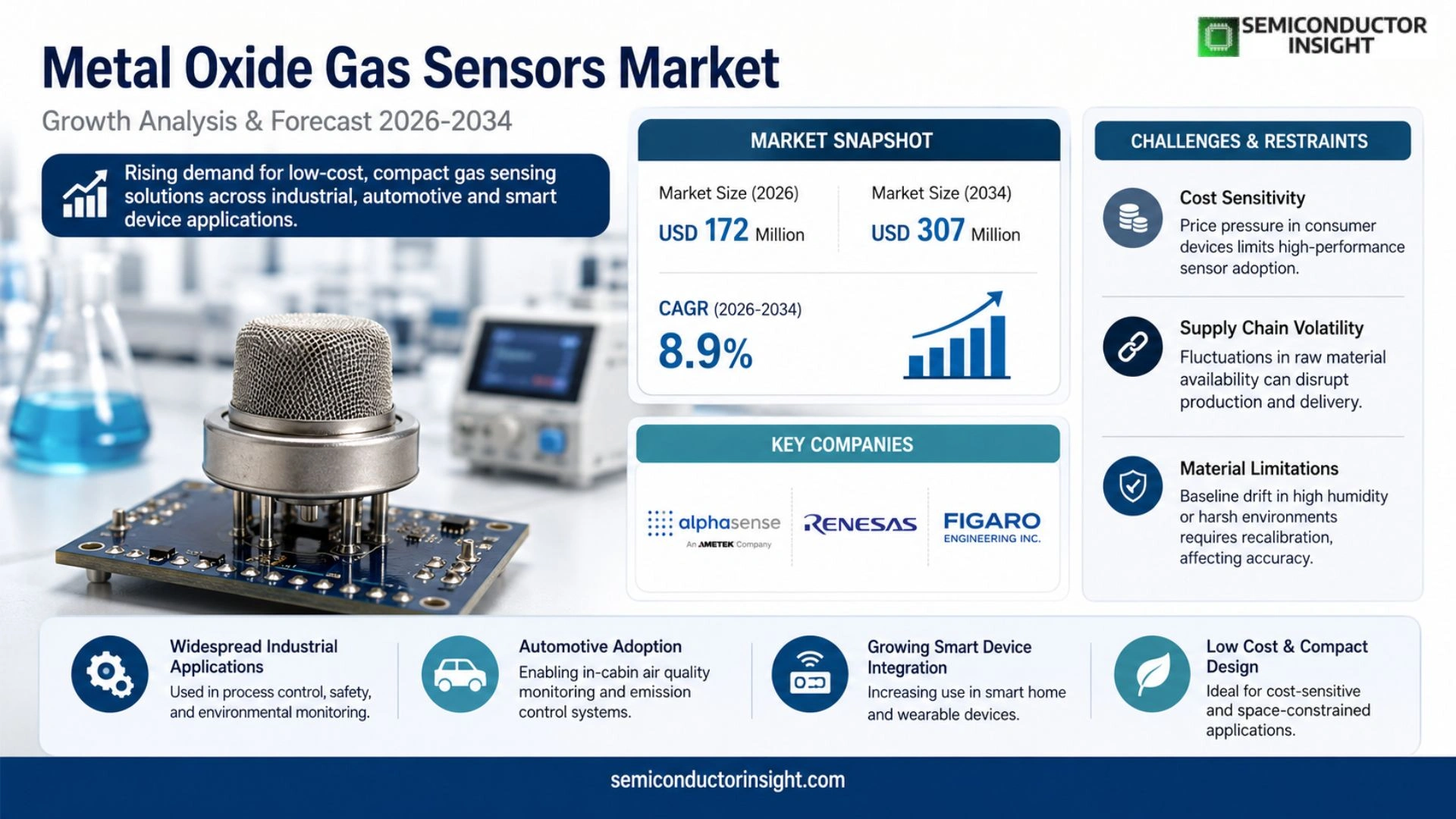
Global Metal Oxide Gas Sensors market size was valued at USD 172 million in 2026. The market is projected to reach USD 307 million by 2034, exhibiting a CAGR of 8.9 % during the forecast period.
MOS sensors detect the concentration of diverse gases by measuring the resistance change of the metal‑oxide layer when target molecules adsorb onto its surface.
The upward trend stems from stricter air‑quality legislation worldwide, growing adoption of IoT‑enabled smart‑home appliances, and heightened emphasis on emissions control in automotive and industrial sectors. While manufacturers such as Alphasense (AMETEK), Renesas, and Figaro broaden their portfolios through miniaturized designs, limited availability of high‑purity metal‑oxide powders introduces supply‑side pressure that could temper expansion.
MARKET DRIVERS
Industrial Automation Demand
The surge in automated assembly lines has sharpened the need for sensors that can detect combustible and toxic gases instantly. Manufacturers are favouring high‑temperature stability and rapid response times, characteristics where metal‑oxide devices excel. As production cycles shorten, downtime caused by gas leaks becomes financially untenable, prompting firms to embed these sensors directly into control systems.
Environmental Regulations
Stricter emission limits across Europe and North America are compelling industrial operators to monitor volatile organic compounds more rigorously. Compliance audits now reference real‑time data, and metal‑oxide technology offers a cost‑effective path to meet these benchmarks without sacrificing durability. Companies that adopt early gain a reputational edge in sustainability reporting.
➤ “Sensor reliability at elevated temperatures is no longer a differentiator,it’s a baseline expectation for competitive plants.”
The convergence of tighter safety standards and the push for leaner production creates a fertile environment for Metal Oxide Gas Sensors Market, encouraging both OEMs and end‑users to allocate budget toward next‑generation sensing solutions.
MARKET CHALLENGES
Cost Sensitivity in Consumer Devices
Smart home air‑quality monitors and wearable health gadgets demand ultra‑low price points. While metal‑oxide sensors are inherently inexpensive, the ancillary electronics needed for signal conditioning can inflate overall system cost. This price pressure forces developers to balance performance against affordability, often limiting sensor deployment to entry‑level products.
Other Challenges
Supply Chain Volatility
Fluctuations in the availability of high‑purity metal precursors and ceramics have introduced lead times that can disrupt quarterly production schedules. End users seeking predictable delivery must now incorporate buffer inventories, which erodes the cost advantage of these sensors.
MARKET RESTRAINTS
Material Limitations
Metal‑oxide layers are prone to baseline drift when exposed repeatedly to high humidity or aggressive chemical environments. Engineers often need to implement periodic recalibration routines, adding operational overhead. In sectors where absolute accuracy is paramount,such as petrochemical leak detection,this limitation can deter adoption in favour of more stable alternatives.
MARKET OPPORTUNITIES
Integration with IoT Platforms
Edge‑computing gateways now support native protocols for sensor data ingestion, enabling continuous monitoring across distributed assets. When paired with cloud analytics, metal‑oxide gas sensors can feed predictive maintenance models, turning a traditional safety device into a revenue‑generating data source. Vendors that develop plug‑and‑play modules stand to capture a growing slice of Metal Oxide Gas Sensors Market.
Metal Oxide Gas Sensors Market Trends
Smart Home Integration Elevates Sensor Demand
Metal Oxide Gas Sensors Market is seeing a convergence of sensing technology with consumer electronics, especially as manufacturers embed detection modules into smart home hubs. This integration enables continuous monitoring of indoor air quality, carbon monoxide, and volatile organic compounds without requiring separate devices. Suppliers benefit from reduced bill of materials, while end‑users gain streamlined user experiences. The trend reflects broader industry pressure to deliver compact, low‑power solutions that can be updated over‑the‑air, aligning sensor capabilities with IoT platforms. As households adopt voice‑activated assistants, sensor data becomes a valuable input for automated ventilation and alarm systems, elevating the relevance of metal‑oxide based units over legacy electrochemical alternatives.
Other Trends
Transition‑Metal Oxide Materials
The shift toward transition‑metal oxide chemistries is reshaping product roadmaps. By leveraging the catalytic activity of compounds such as tin‑dioxide and tungsten‑oxide, manufacturers achieve lower detection thresholds for gases like nitrogen dioxide and ammonia. These materials also exhibit faster response and recovery cycles, a characteristic increasingly demanded by industrial safety applications. Companies are investing in nanostructuring techniques,nanowires, porous films,to enhance surface area and improve selectivity. Consequently, the product mix is moving away from bulk ceramic elements toward engineered nano‑architectures, which command premium pricing but open new avenues for differentiated offerings.
Regional Consolidation in North America and Asia
Geographic concentration of production and R&D activities is intensifying in North America and Asia, creating distinct competitive clusters. In the United States, sensor firms collaborate closely with semiconductor foundries to adopt advanced lithography, shortening time‑to‑market for next‑generation devices. Across China and South Korea, government incentives for smart city initiatives translate into large‑scale procurement contracts, encouraging domestic manufacturers to scale capacity and refine supply chains. This regional focus generates economies of scale that pressure smaller players, prompting consolidation through strategic acquisitions. For market participants, the implication is clear: aligning with regional ecosystems,whether through joint development agreements or localized manufacturing,offers a pathway to secure market share while mitigating exposure to global trade volatility.
COMPETITIVE LANDSCAPE
Key Industry Players
Metal Oxide Gas Sensors – Competitive Landscape Overview
The market is anchored by a handful of global firms that command the majority of revenue and shape pricing dynamics. Alphasense (AMETEK) leverages its extensive distribution network and deep R&D budget to supply a broad portfolio ranging from low‑power IoT modules to high‑temperature industrial units. Renesas Electronics, with its semiconductor heritage, integrates MOS sensor cores into system‑on‑chip solutions that appeal to automotive and consumer electronics manufacturers seeking a single‑chip approach. Figaro Engineering, a long‑standing specialist, differentiates through application‑specific chemistry libraries that enable precise detection of toxic gases in safety‑critical environments. Sensirion AG distinguishes itself by pairing sensor accuracy with advanced digital interfaces, positioning the company as a preferred partner for smart‑home and wearable devices. SGX Sensortech rounds out the top tier by focusing on ruggedized designs for outdoor monitoring, securing contracts with municipal and environmental agencies. The concentration of these players creates a competitive hierarchy where scale, integration capabilities, and technology breadth dictate market leadership.
Beyond the core group, a diverse set of regional and niche manufacturers adds depth to the ecosystem. Shanghai Zhuorui has rapidly built a reputation in the Chinese industrial sector by offering cost‑effective sensors tailored to local emission standards. Cubic Sensor & Instrument targets precision instrumentation markets with custom calibration services, attracting research institutions. Bosch Sensortec capitalizes on its automotive heritage to deliver high‑reliability sensors for emission control systems. TDK Corporation and AMS AG bring expertise in miniaturized packaging, enabling the proliferation of sensors in wearables and portable health monitors. Honeywell International leverages its safety‑systems portfolio to embed MOS sensors in building‑automation solutions. STMicroelectronics and Texas Instruments embed metal‑oxide sensing functions within broader analog‑digital converter families, widening adoption in mixed‑signal designs. Melexis and NXP Semiconductors focus on automotive and industrial IoT use cases, emphasizing low‑power operation and robust communication protocols. This blend of large and specialized firms ensures steady innovation while offering customers a spectrum of price‑performance options.
List of Key Metal Oxide Gas Sensors Companies Profiled
- Alphasense (AMETEK)
- Renesas Electronics
- Figaro Engineering
- Sensirion AG
- SGX Sensortech
- Shanghai Zhuorui
- Cubic Sensor & Instrument
- Bosch Sensortec
- TDK Corporation
- AMS AG
- Honeywell International
- STMicroelectronics
- Texas Instruments
- Melexis
- NXP Semiconductors
Segment Analysis:
| Segment Category | Sub-Segments | Key Insights |
| By Type |
|
Transition‑metal Oxides dominate because they offer robust surface reactivity and stable operation across diverse environments.
|
| By Application |
|
Environmental Monitoring is the leading application owing to heightened regulatory focus on air quality and growing demand for real‑time pollution tracking.
|
| By End User |
|
Automotive stands out as the primary end‑user segment driven by the integration of gas sensors for cabin air quality management and emissions control.
|
| By Sensor Functionality |
|
High Sensitivity drives market preference as it enables detection of trace gas concentrations critical for safety and health applications.
|
| By Market Trend |
|
IoT Integration emerges as the leading trend, linking sensors to cloud platforms for advanced analytics and remote management.
|
Regional Analysis: Metal Oxide Gas Sensors Market
Asia‑Pacific
Manufacturers across the region are integrating metal‑oxide sensors into predictive‑maintenance platforms, seeking to pre‑empt equipment failures. The shift from scheduled to condition‑based upkeep improves uptime, prompting OEMs to embed sensors directly onto production lines rather than as after‑market add‑ons.
Stringent emission standards are compelling auto makers to adopt more sophisticated exhaust monitoring solutions. Metal‑oxide sensors, prized for their durability, are being calibrated to detect a broader spectrum of pollutants, enabling tighter compliance without sacrificing engine performance.
The proliferation of connected home ecosystems creates a fertile environment for low‑cost, battery‑friendly gas sensors. Companies are bundling these components with voice‑assistant platforms, translating air‑quality awareness into tangible purchasing decisions.
Government programs that reward energy efficiency and pollution reduction are spurring R&D investment. Funding schemes often prioritize technologies that can be deployed at scale, reinforcing the region’s leadership in sensor innovation.
North America
North America remains a robust market for metal‑oxide sensing solutions, anchored by deep R&D capabilities and a mature automotive sector. Companies leverage the region’s sophisticated testing infrastructure to accelerate time‑to‑market, while energy‑utility players adopt sensors for grid‑health monitoring. Although regulatory frameworks are well‑established, the emphasis has shifted toward integrating sensors into IoT platforms that provide real‑time analytics, fostering new revenue streams for service‑oriented business models.
Europe
In Europe, Metal Oxide Gas Sensors Market is shaped by stringent environmental legislation and a strong emphasis on circular‑economy principles. Manufacturers focus on designing sensors with extended lifespans and recyclable materials to meet policy expectations. The region’s high‑precision industrial sectors, such as semiconductor fabrication, demand ultra‑sensitive detection capabilities, driving niche product development that often spills over into broader consumer applications.
South America
South America’s sensor adoption is accelerating as governments prioritize air‑quality monitoring in rapidly urbanizing centers. Local manufacturers are forming joint ventures with Asian suppliers to gain technology transfer, reducing cost barriers for domestic markets. The region’s expanding petrochemical industry also creates a steady demand for reliable detection of volatile organic compounds, positioning metal‑oxide sensors as a core component of safety protocols.
Middle East & Africa
The Middle East & Africa exhibit a heterogeneous landscape where oil‑rich economies invest in advanced monitoring for refinery safety, while emerging markets focus on low‑cost indoor‑air solutions for public health. Strategic partnerships with multinational sensor firms enable knowledge sharing, accelerating the deployment of rugged devices capable of withstanding harsh climatic conditions that are typical across the region.
Report Scope
This market research report provides a comprehensive analysis of the Metal Oxide Gas Sensors Market , covering the forecast period 2026–2034. It offers detailed insights into market dynamics, technological advancements, competitive landscape, and key trends shaping the industry.
Key focus areas of the report include:
- Market Overview: The report begins with an overview outlining its current market scenario, key growth indicators, and industry transformation drivers. It discusses macroeconomic factors, demand–supply balance, regulatory landscape, and the strategic role of semiconductors in powering advancements across industries such as automotive, telecommunications, consumer electronics, and industrial automation.
- Market Size & Forecast: Historical data and future projections for revenue, unit shipments, and market value across major regions and segments.
- Segmentation Analysis: Detailed breakdown by product type, technology, application, and end-user industry to identify high-growth segments and investment opportunities.
- Regional Insights: Insights into market performance across North America, Europe, Asia-Pacific, Latin America, and the Middle East & Africa, including country-level analysis where relevant.
- Competitive Landscape: Profiles of leading market participants, including their product offerings, R&D focus, manufacturing capacity, pricing strategies, and recent developments such as mergers, acquisitions, and partnerships.
- Technology Trends & Innovation: Assessment of emerging technologies, integration of AI/IoT, semiconductor design trends, fabrication techniques, and evolving industry standards.
- Market Drivers & Restraints: Evaluation of factors driving market growth along with challenges, supply chain constraints, regulatory issues, and market-entry barriers.
- Stakeholder Insights: Insights for component suppliers, OEMs, system integrators, investors, and policymakers regarding the evolving ecosystem and strategic opportunities.
Primary and secondary research methods are employed, including interviews with industry experts, data from verified sources, and real-time market intelligence to ensure the accuracy and reliability of the insights presented.
FREQUENTLY ASKED QUESTIONS:
What is the current market size of Metal Oxide Gas Sensors Market?
-> Metal Oxide Gas Sensors Market was valued at USD 172 million in 2026 and is expected to reach USD 307 million by 2034, growing at a CAGR of 8.9% during the forecast period.
Which key companies operate in Metal Oxide Gas Sensors Market?
-> Key players include Alphasense (AMETEK), Renesas, Figaro, Sensirion, SGX Sensortech, Shanghai Zhuorui, Cubic Sensor and Instrument, among others.
What are the key growth drivers?
-> Key growth drivers include rising demand for environmental monitoring, smart‑home and IoT applications, and the need for low‑power, high‑sensitivity MOS sensors that detect gases via resistance changes.
Which region dominates the market?
-> Asia dominates the market, driven by rapid industrialization and strong adoption of sensor technologies, with China being a significant contributor.
What are the emerging trends?
-> Emerging trends include expansion of the transition‑metal oxides segment, integration of sensors with AI/IoT platforms, and development of ultra‑low‑power sensor designs for wearable and portable applications.
Get Sample Report PDF for Exclusive Insights
Report Sample Includes
- Table of Contents
- List of Tables & Figures
- Charts, Research Methodology, and more...
 Download Sample Report PDF