Medical Wireless Charging (Qi Medical) Receiver IC Market Insights
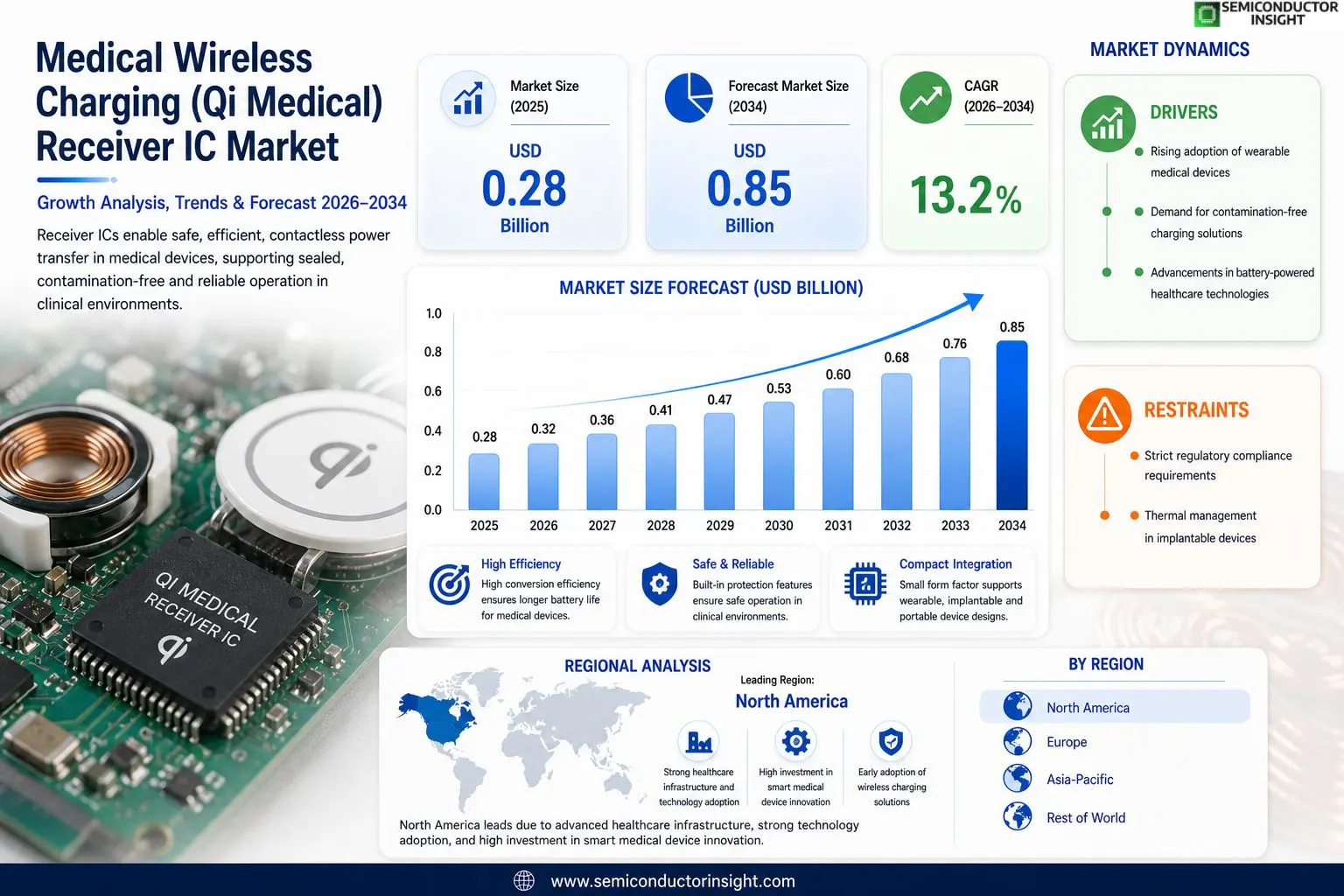
Global Medical Wireless Charging (Qi Medical) Receiver IC market size was valued at USD 0.28 billion in 2025. The market is projected to grow from USD 0.32 billion in 2026 to USD 0.85 billion by 2034, exhibiting a CAGR of 13.2% during the forecast period.
Medical Wireless Charging (Qi Medical) Receiver ICs are specialized semiconductor components designed to enable safe, efficient, and contactless power transfer in medical devices. These receiver integrated circuits convert electromagnetic energy from a compatible transmitter into usable electrical power for batteries or direct operation of equipment, while adhering to stringent medical safety standards and the Qi wireless power specification adapted for healthcare applications.
The market is experiencing steady growth due to several factors, including the rising adoption of portable and wearable medical devices, increasing demand for contamination-free charging solutions in clinical environments, and advancements in battery-powered healthcare technologies. Furthermore, the shift toward sealed, waterproof device designs for infection control has accelerated integration of wireless charging capabilities. However, challenges such as regulatory compliance for medical-grade components and ensuring electromagnetic compatibility with sensitive diagnostic equipment remain important considerations for manufacturers.
Additionally, growing investments in remote patient monitoring and home healthcare solutions are contributing to market expansion. Initiatives by key players continue to drive innovation in this niche. For instance, developments in high-efficiency, low-heat receiver ICs have supported deployment in wearable monitors, implantable devices, and hospital-grade portable equipment. Texas Instruments, STMicroelectronics, and NXP Semiconductors are some of the key players that operate in the market with dedicated portfolios addressing medical wireless power requirements.
MARKET DRIVERS
Growing Demand for Sealed and Sterilizable Medical Devices
Medical Wireless Charging (Qi Medical) Receiver IC Market is propelled by the increasing adoption of wireless power transfer in portable and implantable medical devices. These receiver ICs enable completely sealed enclosures, eliminating physical connectors that can harbor contaminants and complicate sterilization processes in clinical environments.
Rise of Wearable and Implantable Health Monitoring Solutions
Advancements in low-power electronics have accelerated the integration of compact Qi Medical receiver ICs into wearables, patient monitors, and implantable devices. This supports continuous operation for chronic disease management while enhancing patient mobility and comfort by removing the need for frequent battery replacements or wired connections.
➤ The healthcare segment for wireless charging ICs is experiencing robust expansion due to requirements for contamination-resistant and highly reliable power delivery systems.
Receiver ICs optimized for Qi-compliant protocols deliver the efficiency and safety features, such as foreign object detection and thermal protection, essential for medical-grade applications, driving steady market expansion as hospitals and home care settings prioritize cord-free solutions.
MARKET CHALLENGES
Regulatory Compliance and Safety Certification
Developing Medical Wireless Charging (Qi Medical) Receiver ICs demands rigorous adherence to medical standards including ISO 13485 and FDA guidelines, which extend development timelines and increase costs compared to consumer-grade solutions.
Other Challenges
Electromagnetic Interference Management
Receiver ICs must minimize potential interference with sensitive medical equipment like pacemakers or monitoring systems while maintaining efficient power transfer, requiring advanced shielding and protocol optimizations.
Thermal and Efficiency Constraints in Tissue Environments
For implantable applications, managing heat dissipation and achieving acceptable power transfer efficiency through biological tissues remains technically demanding, limiting widespread deployment in deeper implants.
MARKET RESTRAINTS
Limited Power Transfer Range and Alignment Sensitivity
In Medical Wireless Charging (Qi Medical) Receiver IC Market, inductive coupling technologies face inherent constraints in power delivery distance and precise alignment requirements. These factors restrict usability in dynamic clinical settings or for freely moving patients, slowing broader adoption.
High Development Costs for Medical-Grade Components
Stringent biocompatibility, long-term reliability testing, and specialized semiconductor fabrication for low-power, high-safety receiver ICs elevate production costs, acting as a barrier for smaller manufacturers entering the specialized medical segment.
MARKET OPPORTUNITIES
Expansion into Implantable and Home Healthcare Devices
Medical Wireless Charging (Qi Medical) Receiver IC Market presents significant potential through deeper integration in next-generation implants and remote patient monitoring systems. Innovations in miniaturized, high-efficiency receiver ICs can support battery-free or extended-life designs, improving patient outcomes and reducing surgical interventions for battery replacement.
Advancements in Qi2 and Multi-Protocol Support
Evolving standards and hybrid wireless power solutions open avenues for receiver ICs that combine Qi compatibility with enhanced safety features tailored for medical use. This enables manufacturers to address diverse applications from hospital bedside equipment to wearable therapeutics, capturing incremental market share in a sector valuing reliability and seamless integration.
Medical Wireless Charging (Qi Medical) Receiver IC Market Trends
Advancements in Qi-Compliant Receiver ICs for Enhanced Medical Device Integration
Medical Wireless Charging (Qi Medical) Receiver IC Market continues to evolve as manufacturers prioritize safe and efficient contactless power solutions for healthcare equipment. These specialized receiver integrated circuits play a critical role in converting electromagnetic energy from Qi-compatible transmitters into stable electrical power while meeting rigorous medical safety and electromagnetic compatibility requirements. Growing adoption of portable and wearable medical devices has driven steady demand for compact, high-efficiency receiver ICs that support sealed, waterproof designs essential for infection control in clinical settings.
Other Trends
Rising Demand for Contamination-Free Charging in Clinical Environments
In hospital and clinical environments, the need to minimize infection risks has accelerated the integration of wireless charging capabilities into medical devices. Receiver ICs enable completely sealed device housings without exposed ports, facilitating easier sterilization and reducing contamination points. This trend is particularly evident in portable diagnostic tools, patient monitors, and wearable health trackers where reliable power delivery without physical connections enhances usability and hygiene standards.
Focus on High-Efficiency and Low-Heat Designs for Wearables and Implantables
Developments in high-efficiency, low-heat receiver ICs have supported broader deployment across wearable monitors, portable hospital-grade equipment, and certain implantable applications. Key industry players such as Texas Instruments, STMicroelectronics, and NXP Semiconductors maintain dedicated portfolios that address the unique power, thermal, and regulatory demands of medical wireless power systems. These ICs incorporate advanced features like foreign object detection and adaptive rectification to ensure safe operation near sensitive diagnostic equipment.Additionally, the expansion of remote patient monitoring and home healthcare solutions has contributed to sustained interest in Medical Wireless Charging (Qi Medical) Receiver IC technologies. Manufacturers continue to refine solutions that balance power efficiency with compliance to medical-grade standards, enabling longer operational times for battery-powered devices while maintaining electromagnetic compatibility. As the ecosystem matures, ongoing innovation in receiver IC architectures aims to improve spatial freedom and energy transfer consistency across diverse medical use cases.
COMPETITIVE LANDSCAPE
Key Industry Players
Medical Wireless Charging (Qi Medical) Receiver IC Market
Medical Wireless Charging (Qi Medical) Receiver IC Market features a concentrated competitive landscape dominated by established semiconductor leaders with proven expertise in wireless power transfer technologies. Texas Instruments stands out as a leading player, offering robust Qi-compliant receiver IC solutions such as the BQ51013A series that support efficient, low-heat power conversion suitable for portable and wearable medical devices while meeting stringent safety and electromagnetic compatibility requirements in clinical settings.Other significant players include specialized semiconductor firms addressing the unique demands of medical-grade applications, such as regulatory compliance, low electromagnetic interference, and integration into sealed, contamination-resistant designs. Companies like STMicroelectronics, NXP Semiconductors, and Infineon Technologies provide dedicated or adaptable receiver IC portfolios that enable reliable contactless charging for hospital-grade equipment, remote patient monitors, and emerging home healthcare solutions.
List of Key Medical Wireless Charging (Qi Medical) Receiver IC Companies Profiled
- Texas Instruments
- Texas Instruments
- STMicroelectronics
- NXP Semiconductors
- Infineon Technologies
- Renesas Electronics
- Analog Devices
- Qualcomm Technologies
- Microchip Technology
- ROHM Semiconductor
- ON Semiconductor
- Toshiba Corporation
- Resonant Link Medical
- Powermat Technologies
- ABLIC Inc.
Segment Analysis:
| Segment Category | Sub-Segments | Key Insights |
| By Type |
|
Multi-Mode Receiver ICs represent the leading segment in Medical Wireless Charging (Qi Medical) Receiver IC Market. These ICs offer enhanced flexibility by supporting both standard Qi protocols and proprietary medical adaptations, enabling seamless integration across diverse device ecosystems. Their design prioritizes robust foreign object detection and thermal management to maintain operational safety in sensitive clinical settings. Manufacturers favor multi-mode solutions for their ability to handle variable alignment tolerances while ensuring electromagnetic compatibility with diagnostic equipment. This versatility supports innovation in sealed, waterproof enclosures critical for infection control protocols. |
| By Application |
|
Wearable Health Monitors emerge as the leading application segment. These devices benefit significantly from wireless charging through improved patient mobility and continuous operation without interruption from cable connections. Receiver ICs in this category emphasize compact footprints and low-heat generation to ensure comfort during extended wear. The technology facilitates seamless data collection in remote patient monitoring scenarios while upholding stringent biocompatibility and safety standards. Integration of advanced power management features allows for optimized energy harvesting, supporting longer battery life in compact form factors essential for ambulatory care. |
| By End User |
|
Hospitals and Clinics constitute the leading end-user segment. In these high-stakes environments, wireless charging receiver ICs enable contamination-free power delivery, reducing infection risks associated with traditional connectors. The technology supports rapid device turnaround and enhances workflow efficiency by allowing equipment to charge on dedicated pads without physical handling. Receiver ICs tailored for this setting incorporate enhanced shielding to prevent interference with nearby sensitive medical instrumentation. This contributes to overall hygiene protocols and supports the deployment of portable, always-ready diagnostic and therapeutic tools throughout busy clinical workflows. |
| By Power Range |
|
Low Power Receiver ICs lead this segment due to their suitability for battery-constrained medical applications. These ICs deliver precise, efficient energy transfer with minimal thermal output, which is vital for devices in direct contact with patients or implanted systems. Their design focuses on high conversion efficiency and compact integration to minimize device size and weight. Low power solutions excel in maintaining stable operation for continuous monitoring tasks while adhering to rigorous medical safety certifications. This enables reliable performance in wearables and small portables where space and heat dissipation are primary constraints. |
| By Integration Level |
|
System-on-Chip Solutions are the leading category in integration level. These highly integrated receiver ICs combine power conversion, protocol communication, and safety features into a single compact package, streamlining device design for medical manufacturers. The approach reduces component count and board space while enhancing overall system reliability in demanding healthcare applications. Advanced SoC designs incorporate sophisticated thermal and electromagnetic management to meet stringent regulatory requirements. This level of integration accelerates time-to-market for innovative portable and wearable medical technologies while maintaining the exceptional safety margins required in clinical and home care environments. |
Regional Analysis: Medical Wireless Charging (Qi Medical) Receiver IC Market
North America
Advances in compact semiconductor architecture are driving the adoption of Qi-based receiver ICs across North American medical devices. Manufacturers are prioritizing low-heat, high-efficiency chip designs suited for sensitive clinical environments. This trend supports broader integration of embedded wireless charging components within monitoring sensors, portable diagnostic tools, and clinical wearables.
North America’s strict medical device regulatory framework strongly influences design requirements for Qi Medical Receiver ICs. Vendors are focusing on meeting certification expectations related to electromagnetic safety, thermal stability, and biocompatibility. This regulatory emphasis encourages innovation in compliant wireless power transfer technologies.
Hospitals across the region are rapidly embracing wireless charging infrastructure to support cable-free workflows and reduce equipment maintenance. This adoption is strengthening demand for Qi-compatible receiver ICs in infusion devices, monitoring systems, and sterilization-sensitive instruments, enhancing device mobility and uptime.
Collaboration between semiconductor firms, medical device manufacturers, and digital health companies is accelerating product development cycles. These partnerships enable the creation of optimized Qi Medical receiver ICs tailored for specialized clinical applications, improving performance and facilitating smoother integration into advanced diagnostic and therapeutic devices.
Europe
Europe demonstrates steady growth in Medical Wireless Charging (Qi Medical) Receiver IC Market, supported by consistent investments in hospital modernization and stringent product quality requirements. European healthcare providers increasingly prioritize cable-free solutions that enhance sterility, safety, and device handling efficiency. The region also benefits from active cross-border R&D projects emphasizing wireless power standardization and medical-grade semiconductor innovation. As digital health adoption expands and clinical facilities shift toward connected ecosystems, the demand for Qi-compatible receiver ICs in patient monitoring devices, rehabilitation equipment, and portable diagnostics continues to strengthen.
Asia-Pacific
Asia-Pacific is emerging as a high-potential market driven by accelerating expansion in medical electronics manufacturing and strong government support for healthcare modernization. Countries across the region are heavily investing in portable and home-care devices, which increasingly incorporate Qi-based wireless charging features. The presence of leading semiconductor fabrication hubs enhances production efficiency and speeds adoption of integrated charging modules. Growing awareness of patient comfort, combined with rising demand for compact and affordable medical devices, continues to expand opportunities for regional suppliers of advanced receiver IC components.
South America
South America’s market growth is influenced by gradual improvements in healthcare infrastructure and rising interest in modernized medical technologies. Hospitals and clinics are beginning to integrate wireless-compatible diagnostic and monitoring tools, creating emerging demand for Qi Medical receiver ICs that offer reliability and cost-efficiency. While adoption is slower compared to other regions, increasing procurement of portable medical equipment and the rise of telehealth-driven devices support future expansion. Local distributors and manufacturers are focusing on competitive pricing and regional partnerships to enhance technology accessibility.
Middle East & Africa
The Middle East & Africa region is experiencing incremental adoption of wireless-powered medical equipment, driven by ongoing healthcare investments in urban centers and specialized clinics. Demand for Qi-based receiver ICs is growing as medical facilities adopt cable-free equipment designed to improve workflow efficiency and reduce contamination risks. Although market development varies widely by country, increasing attention to advanced patient monitoring, mobile medical tools, and sterilization-friendly device architectures is helping establish a foundation for broader acceptance of wireless charging technologies. The region continues to attract global suppliers seeking long-term expansion opportunities.
Report Scope
This market research report provides a comprehensive analysis of the Medical Wireless Charging (Qi Medical) Receiver IC Market , covering the forecast period 2026–2034. It offers detailed insights into market dynamics, technological advancements, competitive landscape, and key trends shaping the industry.
Key focus areas of the report include:
- Market Overview: The report begins with an overview outlining its current market scenario, key growth indicators, and industry transformation drivers. It discusses macroeconomic factors, demand–supply balance, regulatory landscape, and the strategic role of semiconductors in powering advancements across industries such as automotive, telecommunications, consumer electronics, and industrial automation.
- Market Size & Forecast: Historical data and future projections for revenue, unit shipments, and market value across major regions and segments.
- Segmentation Analysis: Detailed breakdown by product type, technology, application, and end-user industry to identify high-growth segments and investment opportunities.
- Regional Insights: Insights into market performance across North America, Europe, Asia-Pacific, Latin America, and the Middle East & Africa, including country-level analysis where relevant.
- Competitive Landscape: Profiles of leading market participants, including their product offerings, R&D focus, manufacturing capacity, pricing strategies, and recent developments such as mergers, acquisitions, and partnerships.
- Technology Trends & Innovation: Assessment of emerging technologies, integration of AI/IoT, semiconductor design trends, fabrication techniques, and evolving industry standards.
- Market Drivers & Restraints: Evaluation of factors driving market growth along with challenges, supply chain constraints, regulatory issues, and market-entry barriers.
- Stakeholder Insights: Insights for component suppliers, OEMs, system integrators, investors, and policymakers regarding the evolving ecosystem and strategic opportunities.
Primary and secondary research methods are employed, including interviews with industry experts, data from verified sources, and real-time market intelligence to ensure the accuracy and reliability of the insights presented.
FREQUENTLY ASKED QUESTIONS:
What is the current market size of Medical Wireless Charging (Qi Medical) Receiver IC Market?
-> Medical Wireless Charging (Qi Medical) Receiver IC Market was valued at USD 0.28 billion in 2025 and is expected to reach USD 0.85 billion by 2034, exhibiting a CAGR of 13.2%.
Which key companies operate in Medical Wireless Charging (Qi Medical) Receiver IC Market?
-> Key players include Texas Instruments, STMicroelectronics, and NXP Semiconductors, among others.
What are the key growth drivers?
-> Key growth drivers include rising adoption of portable and wearable medical devices, demand for contamination-free charging solutions, advancements in battery-powered healthcare technologies, and growth in remote patient monitoring.
Which region dominates the market?
-> North America and Europe currently represent major markets due to strong adoption of advanced medical technologies, while Asia-Pacific is emerging rapidly with increased investment in healthcare infrastructure.
What are the emerging trends?
-> Emerging trends include development of high-efficiency, low-heat receiver ICs, integration into wearable and implantable devices, and adoption of sealed waterproof device designs for infection control.

Get Sample Report PDF for Exclusive Insights
Report Sample Includes
- Table of Contents
- List of Tables & Figures
- Charts, Research Methodology, and more...
 Download Sample Report PDF