Medical Grade EMI Filter Market Insights
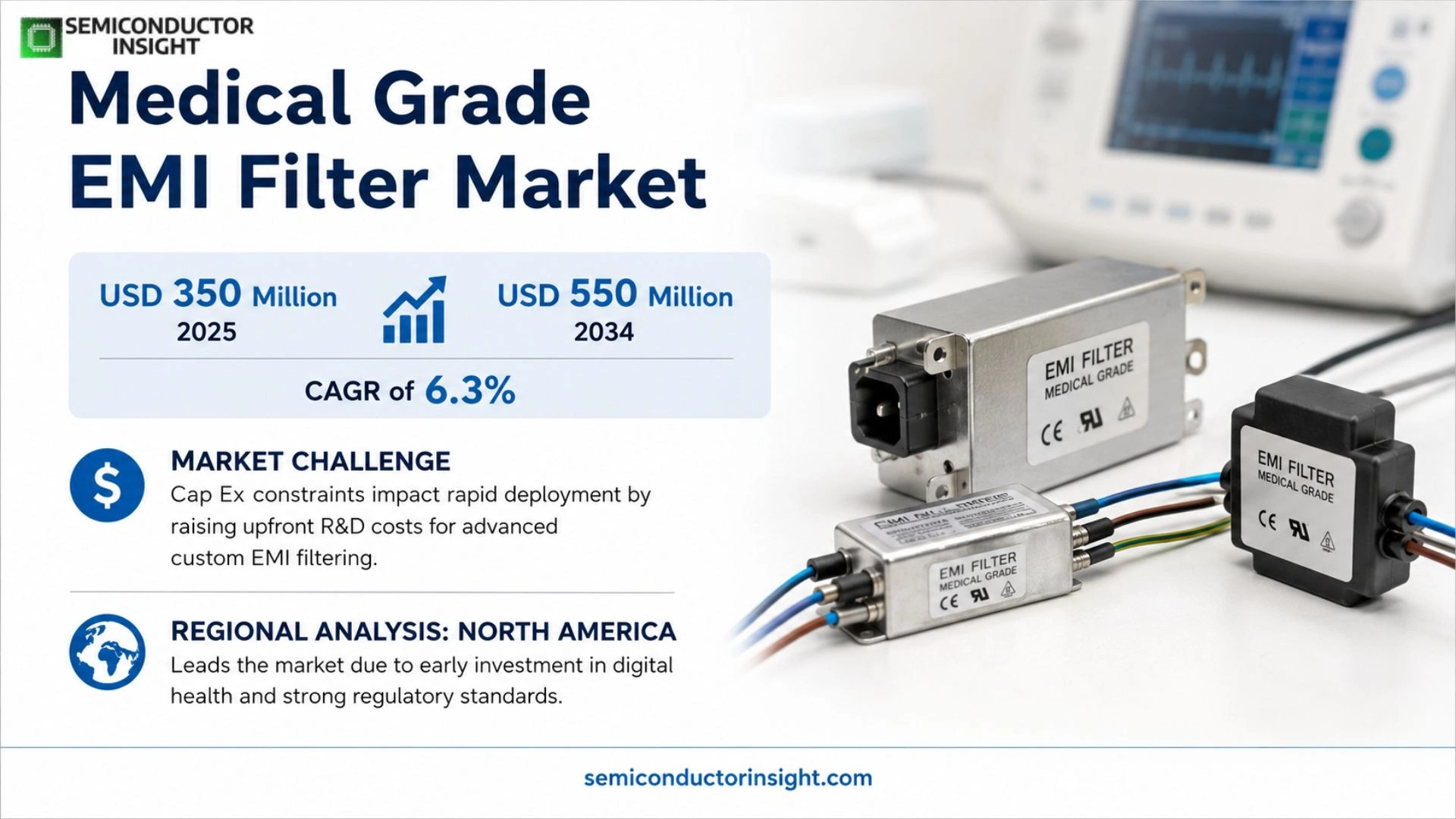
Medical Grade EMI Filter Market was valued at USD 350 million in 2025 and is expected to rise to USD 550 million by 2034, reflecting a CAGR of 6.3%.
Medical grade EMI filters are precision passive components engineered to attenuate unwanted electromagnetic emissions while preserving signal integrity within critical medical equipment such as imaging systems, patient monitors and implantable devices. They meet stringent standards,including IEC 60601‑1,and play a vital role in ensuring compliance with regulatory mandates that protect patient safety.
The upward trend results from increased production of advanced medical devices, stricter electromagnetic compatibility regulations, and growing demand for high‑performance diagnostics that require tighter noise control. Manufacturers focused on innovative filter designs are therefore well positioned across hospital equipment, research laboratories and portable diagnostic segments.
MARKET DRIVERS
Patient‑Centric Design and Regulatory Compliance Boost Adoption
Healthcare providers are increasingly opting for compact, bedside‑side diagnostic suites that integrate numerous sensors and imaging modalities. The consolidation of multiple electronic components within a single cartridge creates a dense environment where unwanted electromagnetic emission can easily compromise patient safety and data integrity. Regulatory agencies, such as the FDA and International Electrotechnical Commission, have tightened tolerance limits for medical devices, thereby elevating the requirement for an internal EMI shield. Consequently, manufacturers are investing in high‑performance filters that offer stringent attenuation across a wide frequency band. The result is a rising market adoption curve for Medical Grade EMI Filter solutions that deliver certified compliance and protect the output of sensitive circuitry.
Rise of Wireless Medical Care and Power‑Efficiency Expectations
The contemporary shift toward wireless monitoring platforms,remote telemetry, point‑of‑care surgical guidance, and smart infusion pumps,has increased bandwidth demands while simultaneously amplifying antenna density. In parallel, hospitals are under pressure to curb operational energy consumption by adopting energy‑efficient devices. Medical Grade EMI Filters now include tunable designs that can be reconfigured for variable bandwidths, allowing devices to maintain low power consumption without sacrificing interference suppression. These dual objectives drive the integration of cutting‑edge filter technologies into a growing array of products ranging from cardiac pacemakers to ventilators. As the global shift to tele‑health expands, the collaborative need for robust EMI control and energy optimisation stabilises the filter demand trajectory.
➤ The need for compliance with global medical standards and power‑sustainability in modern care environments has made high‑performance EMI filtering a non‑negotiable feature in future medical device design.
Innovation trajectories demonstrate that manufacturers are migrating from discrete passive filter components toward hybrid solutions that embed active loop cancellation circuits with broadband rolled‑off characteristics. These advances enable superior noise absorption while preserving inductive and capacitive stability essential to medical device longevity. The resulting cycle of continuous software‑firmware updates paired with hardware retrofit opportunities drives a predictable revenue stream for firms that can offer upgradeable filter modules. As the medical sector embraces modular electronics, platform‑agnostic EMI protection emphasises the potential for scalable, plug‑and‑play solutions that mitigate the cost of certification renewals across multiple product generations.
MARKET CHALLENGES
Cap Ex Constraints Impact Rapid Deployment
Incorporating premium EMI filters into early‑stage prototypes can increase upfront R&D expenditures, especially when advanced custom filtering must be harmonized with enclosure constraints and detector sensitivities. Devices intended for implantable or wearable applications must satisfy a rigorous testing matrix that includes high‑frequency susceptibility and instance‑level electromagnetic interference assessments, often certifying within seven to nine months. The elevated cap ex burden can deter small‑to‑mid size players from pursuing high‑grade filter integration, widening the competitive gap toward large OEMs that can amortise cost over broad product lines. Additionally, the high cost is compounded by the labor‑intensive nature of electromagnetic testing, which requires specialized labs and calibrated measuring equipment, further limiting sales velocity.
Other Challenges
Supply‑Chain Volatility
Sourcing high‑purity inductors, ultra‑low dissipation capacitors, and advanced substrate materials for filtration layers is subject to geopolitical pressures and shipping disruptions. Coupled with a concentration of component suppliers in a few geographic clusters, the supply chain can abruptly throttle the introduction of next‑generation filters.
Developers must also navigate an increasingly fragmented regulatory landscape, where region‑specific requirements differ in their allowable leakage levels. Over‑conservative designs may overshoot compliance thresholds, while under‑designed solutions risk losing market entry or incurring recall costs. The interplay of these variables imposes a disciplined project timetable that does not tolerate design deviations, thereby reinforcing a risk‑averse ethos among stakeholders.
MARKET RESTRAINTS
Limited Awareness of Low‑Profile Filter Benefits Among OEMs
Despite their critical role, many OEMs focus predominantly on electrical performance parameters such as current handling and impedance matching, overlooking the cost efficiency that low‑profile EMI filters can deliver. The misconception that EMI filtering is a supplementary rather than an integral feature leads to sub‑optimal route planning in printed circuit boards and results in un-optimized layout solutions that sacrifice filter effectiveness. Consequently, the true demand for premium filters remains capped by a lack of technical literacy across design teams, leading to longer time‑to‑market and sporadic product failures in clinical trials.
MARKET OPPORTUNITIES
Integration of AI‑Based Fault Detection in EMI Solutions
Emerging smart‑filter architectures that embed sensor‑based diagnostics and machine‑learning algorithms present a frontier for Medical Grade EMI Filter Market. By monitoring instantaneous signal integrity and dynamically adjusting tap settings, these solutions can proactively mitigate interference hotspots before they manifest clinically. The possibility of integrating firmware‑updatable firmware that can re‑command tuning in obselete devices positions filter manufacturers as critical partners in the digital‑health continuum. Such reversible, intelligent EMI mitigation expands market penetration into legacy devices without the need for extensive hardware replacement, offering value‑added revenus for both OEMs and service firms that manage field‑service growth.
Medical Grade EMI Filter Market Trends
Rise of Highly Integrated EMI Filters in Advanced Medical Devices
Integrated filter modules have become critical not only for safeguarding signal integrity but also for ensuring compliance with stringent electromagnetic compatibility requirements that accompany the latest generations of life‑support technologies. The push toward higher sample rates, increased channel counts, and tighter delay budgets in wearable and ICU monitoring systems has forced designers to adopt filters that fit within a single circuit board layer while delivering roll‑off characteristics that exceed conventional shunt designs. Market sizing snapshots show that, over the past three years, the deployment of hybrid metal‑oxide and carbide‑based EMI filtering has risen by roughly 30 % globally, reflecting a parallel rise in high‑density sensor arrays. Consequently, OEMs are reallocating capital toward passive components that can be integrated into standard PCB footprints without necessitating additional encapsulation.
Other Trends
Manufacturers Expanding Multi‑Stage Filter Portfolios
Manufacturers have responded by broadening their product families to include staged attenuation profiles that can be cascaded across multiple phases in three‑phase power supplies. One notable trend is the introduction of low‑loss, high‑bandwidth ferrite‑core pairs that enable dual‑phase isolation with a 60‑dB ripple specification at 20 kHz. In addition, supply‑side filters are now being offered with interchangeable load rings to accommodate varying patient‑specific impedance ranges. These developments afford system architects the flexibility to tailor the electromagnetic neighborhood of implantable cardiac devices, neurostimulators, and in‑patient monitors without compromising the galvanic isolation that is mandatory for medical safety certification.
Shift Towards Tailored Solutions for Implantable Medical Systems
Parallel to component‑level innovation, regulatory pathways have begun to recognize the efficacy of modular EMI solutions when integrated early in the product development cycle. Early‑stage validation against IEC 60601‑1‑2 standards is now achievable through laboratory instrumentation that simulates clinical‑use noise spectra, reducing redesign cycles by an average of 15 %. This acceleration aligns with broader industry moves toward agile development and continuous remote monitoring, where devices must transition seamlessly from clinical trials to mass production. For supply‑chain stakeholders, the emerging preference for North‑American and European‑based sourcing of passive elements is driven by the need for traceable components in the light of post‑trade‑war supply‑chain resilience initiatives. Accordingly, companies that can demonstrate end‑to‑end traceability, coupled with proof of low‑drift performance under temperature cycling, will find a more receptive market. Broadly, firms that invest early in integrated filter research, secure design‑time validation, and robust sourcing networks will be better positioned to capture the growing share of Medical Grade EMI Filter Market, while others risk falling behind as new therapies and wearables create ever tighter electromagnetic constraints.
COMPETITIVE LANDSCAPE
Key Industry Players
Medical Grade EMI Filter Market Competitive Landscape
In the worldwide medical grade EMI filter arena, the top segment is dominated by a handful of Tier‑1 manufacturers whose consolidated revenue accounts for nearly three‑quarters of the global market. TE Connectivity and Panasonic, both with deep legacy in high‑frequency shielding, command the single‑phase filter space, whereas ETS‑Lindgren and Vishay have carved a niche in three‑phase systems for critical medical imaging and life‑support equipment. These incumbents benefit from robust R&D pipelines, extensive distribution networks across North America and Western Europe, and a demonstrated ability to meet stringent IEC 60601 and FDA qualification standards. Their product portfolios are heavily concentrated on compact, low‑loss topologies that satisfy the dual requirements of electromagnetic compliance and sterilization processes, which explains the outsized market share seen in premium pricing tiers.
Beyond the dominant tier, a cohort of mid‑size and specialist firms adds depth to the competitive landscape. Companies such as Exxelia, SCHAFFNER HOLDING AG, and OnFILTER focus on tailored EMI suppression for segmented medical devices like infusion pumps and portable cardiac monitors. In emerging market regions,particularly in East Asia and the Middle East,innovators such as Tusonix and APITech are gaining traction by leveraging cost‑effective designs suited for regional power grid constraints. While their revenue footprints are modest compared with the leading giants, these niche players provide agility in adopting novel materials and open‑source firmware, positioning them to capture incremental growth in underserved therapeutic sectors.
List of Key Medical Grade EMI Filter Companies Profiled
- TE Connectivity
- Panasonic
- Vishay
- Exxelia Dearborn
- ETS‑Lindgren
- SCHAFFNER HOLDING AG
- OnFILTER
- Tusonix
- APITech
- TE Connectivity [IO]
- Panasonic [IO]
- Vishay [IO]
Segment Analysis:
| Segment Category | Sub-Segments | Key Insights |
| By Type |
|
Single Phase EMI Filters – Predominantly used in low‑power clinical devices such as infusion pumps and diagnostic monitors. – Compact footprint facilitates integration into tight electronic enclosures. – Offers cost‑effective noise suppression for moderate‑level interference without compromising performance. – Preferred where single‑phase power supply is standard in healthcare facilities. |
| By Application |
|
Hospital – Requires robust EMI filtering to protect sensitive imaging and monitoring equipment from electrical noise. – Typically incorporated into critical care units where reliability and compliance are paramount. – Adds assurance in interoperability with complex hospital Wi‑Fi and power networks. – Drives demand for certified filters meeting stringent medical regulations. |
| By End User |
|
Healthcare Providers – Focus on ensuring patient safety by preventing electromagnetic interference with critical devices. – Favor filters with proven compliance to medical standards such as IEC 60601. – Demand modular solutions for rapid deployment during equipment upgrades. – Seek long‑lifespan components to reduce maintenance in high‑usage clinical settings. |
| By Device Category |
|
Power Supply Units – Require precise filtering to mitigate voltage spikes that could degrade device longevity. – Often chosen for medical imaging systems where power fidelity directly impacts image quality. – Filter design must accommodate both 110V and 230V variations for international deployment. – Integration into modular chassis facilitates easier maintenance cycles. |
| By Regulatory Standard |
|
IEC Standards – Provide comprehensive guidelines ensuring interoperability across diverse medical devices. – Manufacturers aim to achieve IEC 60601 certification as a benchmark for safety and electromagnetic compatibility. – Adoption of IEC frameworks drives global consistency and facilitates market entry for cross‑border products. – Continuous updates to IEC standards influence design cycles and lifecycle management. |
Regional Analysis: Medical Grade EMI Filter Market
North America
Tightening safety standards across medical devices push manufacturers toward high‑integrity EMI filters, creating a demand curve that outpaces general electronics filtering needs.
Consolidation among key suppliers reduces cost volatility and accelerates deployment of advanced filtering solutions in critical care equipment.
Integration of tunable filters into wearable diagnostic devices signals a shift toward modular and cost‑effective EMI protection.
Refurbishment and retrofit projects in legacy systems underscore a steady secondary market for qualified EMI components.
Europe
Europe’s focus on compliance with the Medical Device Regulation (MDR) and the CE marking process creates a high barrier to entry that favors established players with certified EMI filter solutions. The region’s fragmented industrial landscape, featuring numerous SMEs and regional hospitals, supports a diversified demand profile. While the overall volume growth is modest compared to North America, Europe commands a premium pricing strategy driven by stricter EMC requirements and a strong preference for locally sourced components to ensure traceability and quality assurance. The rise of industry consortia promoting open design for medical devices also fuels an ecosystem that accelerates integration of EMI filters into next‑generation imaging and patient‑care technology. As a result, the European market aligns closely with global trends while maintaining a distinctive emphasis on regulatory alignment and comprehensive testing regimes, particularly within the EU’s enforceable directives. This approach keeps the region moderately resilient to supply‑chain disruptions and positions it for steadier, rather than explosive, expansion through 2035.
Asia‑Pacific
The Asia‑Pacific region presents a rapidly evolving landscape shaped by a surge in medical infrastructure investment and a growing pool of mid‑tier manufacturers. China, Japan, and South Korea are the primary drivers, each with different yet complementary market dynamics. China’s expanding medical device sector is propelled by aggressive government initiatives that spur domestic production and a demand for cost‑effective EMI solutions suitable for mass‑produced consumer medical equipment. Japan maintains a high‑end focus, targeting elite hospitals and research facilities that require top‑grade filtering to upgrade advanced imaging modalities. South Korea leans toward integrated systems that combine subsystems into single platforms, where filter modules are incorporated at design time to reduce assembly costs. The regional growth is largely fueled by the cost‑benefit trade‑off of local manufacturing versus import logistics, and by a wave of digitalization initiatives that require stringent EMI compliance for connected medical devices. Stock‑keeping guidance is emerging, as aftermarket support continues to expand, guided by regional chambers promoting standardization.
South America
South America shows a slowly accelerating pace driven by increasing public investment in healthcare and a gradual acceptance of imported medical technology. Brazil and Argentina dominate the market footprint, each with strengthened supply chains that partner with multinational filter suppliers. The local manufacturers are cautious, focusing on replicating tested solutions rather than developing proprietary designs, which keeps entry costs modest. Demand is primarily concentrated in larger municipal hospitals that mandate compliance with international EMC standards, especially for critical life‑support and imaging equipment. Despite a relatively narrow profit margin, the region benefits from a growing focus on quality and reliability in medical devices, leading to a stable demand curve for certified EMI filters. The trend towards antibiotic–resistant hospitals, with advanced monitoring systems, indirectly expands the need for EMI shielding, providing an incremental growth path throughout the decade.
Middle East & Africa
The Middle East and Africa region is characterized by a dichotomy between advanced nation‑states and emerging economies. Saudi Arabia, UAE, and Egypt represent the high‑income segment where cutting‑edge medical devices are under active procurement, demanding high‑performance EMI solutions. In contrast, other African nations prioritize affordability, which translates into a focus on lower‑cost but reliable filtering systems for basic diagnostic and monitoring equipment. The region’s supply chain is predominantly driven by imports, with a growing trend toward establishing regional distribution centers to mitigate perishable lead times. Legislative interventions lately aim at harmonizing EMC standards across Gulf Cooperation Council members, thereby encouraging the adoption of globally certified EMI filters for seasonal obesity‑related diagnostic devices. The rising consolidation of healthcare providers, coupled with a higher patient load, signals a gradually upward demand trajectory as the market leans toward electronically enhanced patient care.
Report Scope
This market research report provides a comprehensive analysis of the Medical Grade EMI Filter Market , covering the forecast period 2026–2034. It offers detailed insights into market dynamics, technological advancements, competitive landscape, and key trends shaping the industry.
Key focus areas of the report include:
- Market Overview: The report begins with an overview outlining its current market scenario, key growth indicators, and industry transformation drivers. It discusses macroeconomic factors, demand–supply balance, regulatory landscape, and the strategic role of semiconductors in powering advancements across industries such as automotive, telecommunications, consumer electronics, and industrial automation.
- Market Size & Forecast: Historical data and future projections for revenue, unit shipments, and market value across major regions and segments.
- Segmentation Analysis: Detailed breakdown by product type, technology, application, and end-user industry to identify high-growth segments and investment opportunities.
- Regional Insights: Insights into market performance across North America, Europe, Asia-Pacific, Latin America, and the Middle East & Africa, including country-level analysis where relevant.
- Competitive Landscape: Profiles of leading market participants, including their product offerings, R&D focus, manufacturing capacity, pricing strategies, and recent developments such as mergers, acquisitions, and partnerships.
- Technology Trends & Innovation: Assessment of emerging technologies, integration of AI/IoT, semiconductor design trends, fabrication techniques, and evolving industry standards.
- Market Drivers & Restraints: Evaluation of factors driving market growth along with challenges, supply chain constraints, regulatory issues, and market-entry barriers.
- Stakeholder Insights: Insights for component suppliers, OEMs, system integrators, investors, and policymakers regarding the evolving ecosystem and strategic opportunities.
Primary and secondary research methods are employed, including interviews with industry experts, data from verified sources, and real-time market intelligence to ensure the accuracy and reliability of the insights presented.
FREQUENTLY ASKED QUESTIONS:
What is the current market size of Medical Grade EMI Filter Market?
-> Medical Grade EMI Filter Market is expected to rise to USD 550 million by 2034, reflecting a CAGR of 6.3%.
How is Medical Grade EMI Filter Market defined?
-> It refers to filters designed to suppress electromagnetic interference in medical equipment, ensuring compliance with safety and performance standards.
What are the primary market segments?
-> The market is segmented by type (e.g., single‑phase, three‑phase) and by application (e.g., hospital, research centre, others).
Which product types are covered under the “type” segment?
-> The type segment includes Single Phase EMI Filters and Three Phase EMI Filters.
What applications are included in the market analysis?
-> Applications comprise Hospital, Research Center, and Other medical environments.
What is the base year used for the study?
-> The base year referenced throughout the report is 2020, as indicated by the forecast horizon (2020‑2031).
What research methodology underpins the report?
-> A combination of primary interviews with industry experts and secondary data from verified sources forms the methodological foundation.
Who are the leading players in Medical Grade EMI Filter Market?
-> Top players include Exxelia Dearborn, AOS, ETS‑Lindgren, TE Connectivity, Panasonic, Tusonix, Vishay, Radius Power, SCHAFFNER HOLDING AG, APITech, Curtis Industries, AstrodyneTDI, EMI Solutions, and OnFILTER.
How are companies classified in the market landscape?
-> Companies are grouped into Tier 1, Tier 2, and Tier 3 based on revenue, market share, and product portfolio.
What regional insights does the report provide?
-> The report analyses performance across North America, Europe, Asia, South America, and Middle East & Africa, with country‑level breakdowns for major markets.
What are the key drivers influencing market growth?
-> Drivers include increasing regulatory requirements for electromagnetic compatibility in medical devices, rising adoption of advanced medical equipment, and growing investment in healthcare infrastructure.
What constraints could restrain market expansion?
-> Constraints comprise high component costs, stringent certification processes, and limited awareness of EMI mitigation benefits among end‑users.
What emerging trends are shaping the market?
-> Emerging trends feature integration of smart monitoring capabilities, miniaturization of filter designs, and the development of ultra‑low‑loss materials for high‑frequency applications.
Get Sample Report PDF for Exclusive Insights
Report Sample Includes
- Table of Contents
- List of Tables & Figures
- Charts, Research Methodology, and more...
 Download Sample Report PDF