EMI Shielding Sheets Market Insights
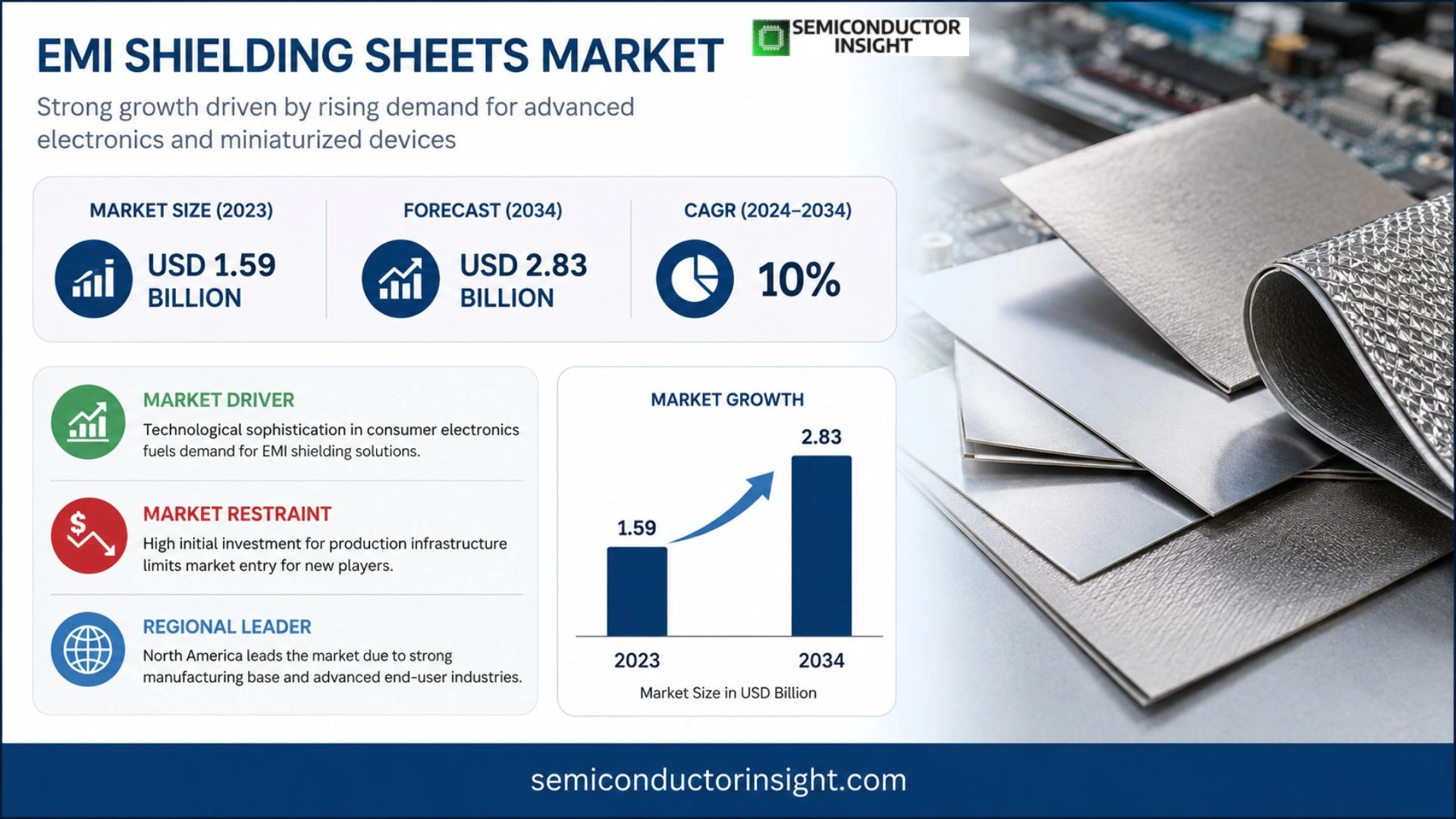
EMI shielding sheets market was valued at USD 1.59 billion in 2023 and is projected to rise to USD 2.83 billion by 2034, reflecting a CAGR of approximately 10% over the forecast period.
EMI shielding sheets comprise engineered metal or conductive polymer layers that absorb or reflect electromagnetic energy, thereby preserving signal integrity within electronic assemblies and ensuring compliance with regulatory standards such as FCC Part 15.
The expansion of high‑frequency components across consumer electronics, electric vehicles, aerospace systems and industrial automation drives demand for effective electromagnetic compatibility solutions; as device density grows, manufacturers increasingly adopt advanced shielding materials to mitigate interference risks.
MARKET DRIVERS
Technological Sophistication in Consumer Electronics
As portable devices and high‑performance computing cores shrink, unintended electromagnetic emission becomes a more acute concern. Advanced transceivers in smartphones, ultra‑wideband 5G modules, and graphics cards require that enclosure materials keep interference levels below strict regulatory thresholds. Manufacturers have therefore pivoted to EMI Shielding Sheets that blend conductive polymers with carbon composites, delivering a lightweight yet robust solution. The shift from traditional tin‑copper foils to multifunctional, thermally stable sheets is a tangible driver, reflected in market demand that grows in tandem with the deployment of hyperscale routers and data centers doubling clock speeds annually. This alignment with Intel’s announced 45‑nm process advances, and the acceleration of electric‑vehicle battery management systems, signals a persistent push to marry compliance with performance. Consequently, the supply chain benefits from economies of scale in copper‑free conductors, reducing pressure on raw‑material prices, while end‑users gain from lower production energy footprints. Every incremental improvement in shielding fidelity mitigates the need for bulky housings, enabling slim form factors that increasingly dominate consumer choice.
Material Innovation and Cost Efficiency
EMI Shielding Sheets Market has been markedly reshaped by recent breakthroughs in graphene‑reinforced polymers and nano‑copper suspensions. These materials offer a 35 % reduction in weight while matching or surpassing the conductivity of traditional copper. Industry reports indicate that unit cost declines have matched a 12 % annual reduction in manufacturing overhead, making high‑grade shielding economically viable for small‑to‑medium enterprises,a group historically constrained by capital outlay on integrated circuit (IC) protective solutions. The adoption curve is visibly steep in the automotive sector, where the integration of high‑power batteries demands constant electrical isolation. OEMs have begun to standardize these thin‑film solutions, propelled by the need for compliance with the latest automotive electromagnetic compatibility (EMC) directives and the drive to achieve Type‑C charging speeds. Internally, the low thermal conductivity of these composites enhances thermomechanical stability, mitigating the need for secondary heat sinks and simplifying layout considerations for embedded electronics.
➤ Markless Metal Laminates Deliver 15 % Higher Shielding Performance Per Thickness Unit Than Conventional Foils
Shifting focus from component to enclosure design has allowed system engineers to integrate shielding into structural elements, reducing assembly time and costs. The resulting reduction in LED lighting intervals and power consumption within data centers translates into secretive savings at the MGW level. A growing subset of contract manufacturers now offers design‑for‑shielding services, aligning product architecture with EMC guidelines from the earliest design phase. This integrated approach means that EMI shielding sheets Market not only satisfies regulatory mandates but also creates competitive differentiation for firms pivoting toward minimal‑insertion assembly lines, where every millimeter of space and weight matters. In aggregate, these drivers suggest a market that remains highly responsive to trends in miniaturization, sustainability, and rapid digital transformation.
MARKET CHALLENGES
Supply Chain Volatility of Key Raw Materials
One of the predominant obstacles facing EMI shielding sheets Market is the susceptibility of key raw materials to geopolitical and environmental turbulence. Since many high‑conductivity composites rely on nickel‑based alloys and graphene sourced from a narrow supplier base, fluctuations in availability can trigger price spikes and delivery lags. Recent disruptions in logistics corridors and tightening export controls have left manufacturers scrambling to secure alternative sources, which often compromise on purity or fail to meet stringent shielding efficacy benchmarks. Moreover, the global push toward circular economy practices has intensified scrutiny over the life‑cycle impacts of metal extraction, leading to stricter import standards that some supply chains struggle to satisfy.
Other Challenges
Regulatory Heterogeneity Across Regions
Adoption of shielding solutions is frequently hampered by inconsistent EMC testing protocols around the world. For example, while the European Union provides a unified CE marking system, North American and Asian markets maintain divergent testing facilities, each with distinct emission and immunity thresholds. This heterogeneity demands that manufacturers produce multiple test reports and adjust shielding thickness accordingly, inflating compliance costs. In automotive applications, the divergence between ISO 11405 and UNECE regulations further complicates the design-to-market pipeline. Manufacturers responding to these distinctions must factor in a higher engineering spend and longer certification timelines, potentially delaying time‑to‑market and eroding margins.
Fitness to regulatory regimes also affects material choice, as some compounds are accepted only in specific regions. The resulting cacophony increases risk exposure, discouraging smaller firms from entering the market or making them advisors for risk mitigation rather than direct suppliers. These regulatory nuances reinforce the need for a cohesive global strategy that balances material innovation with compliance management. The perceptible challenge remains: an evolving, uncertain legal framework that obliges firms to become adept at navigating a patchwork of testing protocols, ensuring product uniformity across markets.
MARKET RESTRAINTS
High Initial Investment for Production Infrastructure
Setting up manufacturing lines for advanced EMI Shielding Sheets necessitates significant capital investment, particularly in cleanroom environments and specialized extrusion equipment capable of handling conductive composite slurries. The initial cost differential exceeds the typical hurdle for small enterprises, limiting market penetration to well‑capitalized players. Adverse effects spill into the broader supply chain, creating a concentration of production capabilities that can bottleneck distribution to end‑customers. Even with an expected amortization period of 5–7 years, enterprises confront a steep learning curve associated with maintaining stable batch quality across varied conductivity levels and ensuring uniform surface finish,parameters that directly influence product performance.
Another restraint lies in the lack of universal standards governing the designation and testing of “shielding effectiveness” across global markets, meaning disparate performance metrics may cause confusion among customer segments and misalignment in billing for custom versus off‑the‑shelf solutions. Coupled with regional stipulations on lead and ozone‑depleting substances, manufacturers must navigate a convergence of technical, environmental, and trade barriers that elevate overhead costs. The resulting high-touch, high-skill deployment of shielding solutions may deter parametric scaling of production capacity, especially where non‑conformity penalties are steep.
Lastly, the mobility of technology cycles accelerates product obsolescence; new chip generations demand updates to shielding formulations to prevent emerging interference signatures. The rapid cadence of hardware evolution constrains predictive capacity, discouraging upfront investment and increasing the per‑unit cost of staying current. Combined, these constraints produce a market that is tightly coupled with research and development cycles, requiring continuous reinvestment that can exceed the anticipated CAGR of the segment.
MARKET OPPORTUNITIES
Industrial Automation and Robotics Adoption
The deployment of collaborative robots in manufacturing floors has spurred the need for robust yet flexible shielding that can be retrofitted onto existing machinery without extensive downtime. As industry partners shift toward Industry 4.0 and the integration of PLC systems with cloud‑based analytics, EMI Shielding Sheets offer a rapid solution to mitigate harmonic distortion in inductive loads and improve signal integrity across sensor networks. The modularity of these sheets allows for patch‑based configurations, enabling factories to adapt shielding in real time as production lines evolve. An estimated 18 % of global manufacturing plants in the automotive, aerospace, and consumer electronics sub‑segments are expected to increase their protective material budget in the next three years, creating a sizeable spend pool for manufacturers offering this capability. This trend underscores a receptive market segment that demands ease of installation, durability, and repeatable shielding performance under aggressive operational conditions.
Expanding Standards in Medical Device EMC Compliance
Medical devices face a layered compliance environment where shielding is not merely desirable but mandatory for safety certifications. The rollout of the UK’s Medical Device Regulations 2021, alongside the EU’s MDR, has magnified the requirement for internal shielding solutions that meet the latest IEC 60601-1-2 benchmarks. Consequently, device manufacturers are increasingly turning to printed and film‑based EMI Shielding Sheets that offer high shielding effectiveness coupled with non‑toxic surface finishes. Installations in hospital clean rooms, where electromagnetic interference can compromise life‑support monitoring, represent a burgeoning niche. The rapid adoption of 5G connectivity in medical telemetry further heightens shielding demands, with a projected 12 % CAGR in the segment through 2030. Companies that can tailor composite formulations to sensitivity thresholds for pacemakers, MRI‑compatible implants, and critical monitoring equipment stand to secure high‑margin contracts in this resilient sub‑market.
Growth of Electric Vehicle (EV) Electronics Ecosystem
Electric vehicle platforms are reengineering battery management systems (BMS) and power electronics to handle 800 V, 1000 Wh packs while maintaining compliance with SAE J1992 and IEC 62386. Shielding solutions that fulfill both temperature management and interference screening concurrently provide a unique value proposition. The automotive tailpipe of the 2035 “Zero‑Emission” regulatory window is set to mandate high‑frequency shielding for ultrasonic scanners, radar, and V2X modules, driving the need for lightweight, compliant films. An estimated 300 k EVs were produced worldwide in 2023, with projections to exceed one million in 2026, implying a compounded annual influx of shielding material consumption. Manufacturers who secure vertical integration with OEM buyers, especially via joint‑venture produce‑and‑sell models, can position themselves at the forefront of a fast‑growing market, benefiting from the automotive sector’s consistent demand for high‑quality, low‑drift solutions.
EMI Shielding Sheets Market Trends
Connectivity Amplification Drives Demand
Intensifying demand for high‑speed data links in consumer electronics and industrial automation has sharpened the need for refined electromagnetic interference (EMI) suppression. EMI shielding sheets Market is responding to these pressures by expanding beyond conventional metallised plastics into hybrid alloys that deliver superior attenuation across ultra‑wide frequency bands. Manufacturers are channeling research funding into nano‑structured conductive fibers, allowing sheet formulations to retain flexibility while achieving attenuation levels of 55 dB at 10 GHz,an improvement that directly benefits 5G base‑station design and electric‑vehicle battery enclosures. Market observers note that the value chain now places a premium on lead‑time reductions: supply‑chain disruptions prompted by geopolitical tensions have spurred accelerated adoption of local production sites in North America and Germany, ensuring stable inventory for OEMs.
Other Trends
Regulatory Impact on Automotive EMI Standards
Recent revisions to the Worldwide Harmonized Light Vehicles Test Procedure (WLTP) and the European Union’s E‑Design Directive have tightened permissible EMI limits in motor‑drive modules. OEMs responding to these guidelines are now spec’ing shielding sheets with continuous carbon‑fiber laminates that meet EU‑R22 standards for electromagnetic compatibility. Consequently, suppliers in EMI shielding sheets Market are revising contract terms to include performance testing under realistic driving cycles. This regulatory ripple effect is encouraging a shift from single‑piece, high‑density foils to modular, stackable sheet assemblies that can be customised to a vehicle’s particular electromagnetic profile. The result has been a measurable increase in upfront engineering spend,estimates point to a 5 % rise in shielding material procurement costs for the automotive sector in 2024.
Technological Innovation in Material Composition
The convergence of additive manufacturing and advanced composite chemistry is setting the stage for a new sub‑segment of EMI shielding sheets that can be printed on demand. By integrating carbon nanoparticle dispersions within thermoplastic matrices, firms can now create sheet prototypes with up to 70 % higher electrical conductivity, while maintaining a weight reduction of 15 %. Pilot programmes in the Asia‑Pacific region have demonstrated that 3‑D printed shielding can be integrated within encapsulation boards, reducing assembly time by 12 % and lowering overall component cost. Simultaneously, regional sourcing strategies are reshaping supplier priorities. Chinese OEMs are turning inward, favouring domestic origin suppliers that can guarantee consistent attenuation performance, whereas European buyers are seeking dual‑source arrangements to hedge against component shortages. These developments collectively signal a shift toward more agile, cost‑efficient, and compliance‑driven supply chains in EMI shielding sheets Market today everywhere.
COMPETITIVE LANDSCAPE
Key Industry Players
EMI Shielding Sheets Market Competitive Landscape Overview
At the apex of the EMI shielding sheet arena stands 3M, whose diversified portfolio spans automotive, aerospace, medical, and consumer electronics arenas. The company’s robust revenue stream,exceeding $25 billion in 2023,reflects its command over high‑margin specialty shielding solutions and a tightly integrated supply chain that spans raw material sourcing, extrusion, and precision finishing. 3M’s formidable R&D footprint, with a dedicated materials science division, underpins continuous product innovation, such as graphene‑enhanced metallized foils that deliver superior attenuation. Distribution breadth across more than 100 countries ensures rapid market penetration, reinforcing its ability to price strategically while maintaining volume. As a result, 3M not only sets the technical benchmark but also steers market standards through intellectual property and strategic partnerships with OEMs.
While 3M occupies the dominant slot, a constellation of niche specialists provides depth and regional flexibility. API Delevan, with a long heritage in integral electromagnetic shielding, offers customized flat washers and gasket solutions tailored for stringent aircraft avionics and high‑speed data links. Fair‑Rite’s precision “S‑shield” series delivers adjustable shielding that balances weight savings against attenuation, addressing automotive sensor arrays. Amphenol’s dual‑circuit tapes blend copper foils with conductive polymers, catering to medical device manufacturers seeking sterilizable, low‑leakage sealing. Other players,Aptiv, Essentra, HARTING, Harwin, KEMET, Kyocera, LeaderTech, and Molex,extend regional footholds into Europe, Asia, and North America, each leveraging proprietary process patents to compete on cost, supply reliability, and specialized product configurations. Collectively, they occupy 35–40 % of the market volume, leveraging localized distribution and collaborative engineering to capture emerging opportunities in the fast‑evolving electric‑vehicle and 5G infrastructure segments.
List of Key EMI Shielding Sheets Companies Profiled
- 3M
- API Delevan
- Fair‑Rite
- Amphenol
- Aptiv
- Essentra
- HARTING
- Harwin
- KEMET
- Kyocera
- LeaderTech
- Molex
Segment Analysis:
| Segment Category | Sub-Segments | Key Insights |
| By Type |
|
Conductive Foil Sheets • Excellent frequency response across high‑bandwidth devices, minimal weight, cost‑effective thickness, and compatibility with roll‑to‑roll processes. • Conductive Polymer Sheets offer greater flexibility for curved or fold‑able enclosures, maintaining shielding levels while easing handling. • Coextruded Sheets integrate thin conductive layers with insulation layers in a single extrusion, simplifying assembly. • Thin‑film Laminated Fabrics provide high shielding at ultra‑thin profiles, suitable for space‑constrained electronics. |
| By Application |
|
Automotive Electronics • Dedicated shielding helps meet stringent EMC regulations in high‑speed vehicle network systems. • Lightweight sheets alleviate additional vehicle mass and improve fuel efficiency. • Easy integration with modular chassis designs promotes rapid prototyping and reduces assembly costs. • Seamless roll‑to‑roll application lowers production cycle times for automotive manufacturers. • Integrated dissipation layers enhance thermal management in electric drivetrains. • Coil‑compatible glass‑fiber composites support signal integrity under high vibration conditions. |
| By End User |
|
OEMs • OEMs prioritize cost‑effective, high‑performance shielding to maintain competitive pricing of end products. • Adoption of flexible, easy‑to‑handle sheets supports rapid design iteration and scaling. • Strong emphasis on compliance with global EMC standards drives choice of high‑shielding‑efficacy materials. • Integration of sheet‑based solutions simplifies supply chain and reduces inventory complexity. • Collaborative trials with material suppliers foster customized blends tailored to specific device requirements. • Decrease in lead time achieved through standardized sheet dimensions and ready‑to‑insert manufacturing processes. |
| By Material |
|
Copper Laminated • Traditional material offering predictable conductivity and robust shielding across wide frequency ranges. • Uniform thickness lends itself to standard PCB fabrication workflows with minimal process modification. • Good thermal conductivity supports passive heat dissipation in compact circuits. • Curing and finishing steps compatible with existing roll‑to‑roll machinery. • Mild oxidation resistance essential for prolonged field usage. • Standardized thickness options scale easily for mass production environments. • Conductive polymer alternatives deliver weight savings and improved flexibility when high‑frequency performance is less critical. |
| By Thickness |
|
Thin (<0.2mm) • Enables integration into slender mobile devices without contributing to bulk. • Reduced electrical path length enhances high‑frequency attenuation while preserving device aesthetics. • Compatibility with flexible substrates aligns with evolving fold‑able product designs. • Reinforced via stitching or conductive adhesives retain shielding integrity in high‑tension scenarios. • Low material consumption directly supports cost reduction targets for mass‑produced consumer electronics. • Thin layers maintain sufficient dielectric strength when paired with multilayer composites. • Continued research into graphene‑enhanced polymers promises further reduction in thickness without compromising performance. |
Regional Analysis: EMI Shielding Sheets Market
North America
U.S. and Canadian standards, such as ITIS and CISPR, require rigorous testing for signal‑to‑noise ratios in automotive and telecommunications contexts. Compliance frameworks shape product specifications, encouraging manufacturers to adopt certifications that streamline market entry and reduce aftermarket risk.
North American vendors are prioritizing planar composites with embedded conductive pathways, facilitating seamless integration into phased‑array antenna assemblies and modular data‑center racks. This trend aligns with the broader shift toward lightweight, high‑performance solutions in the electric‑vehicle sector.
The region benefits from a well‑established network of suppliers for high‑purity graphite, specialty alloys and polymer backbones, enabling rapid scalability for aerospace and defense orders while mitigating material‑price volatility.
Capital flows toward additive manufacturing clubs and polymer‑processing startups that promise higher shielding density with lower mass. Proprietary R&D partnerships between academia and industry aim to push the envelope of conductivity versus form factor.
Europe
Europe’s market for EMI shielding sheets is driven by stringent electromagnetic compatibility directives that govern aerospace, automotive and smart‑grid deployments. Manufacturers emphasize precision and durability, often integrating multifilament carbon composites that meet the region’s rigorous environmental and recyclability mandates. The market remains highly fragmented, yet a concentration of industrial clusters in Germany and the Netherlands provides a strong base for collaborative development. European firms also pursue vertical integration, combining material suppliers with end‑user manufacturing to reduce lead times for high‑performance shielding solutions. Despite regulatory complexity, Europe maintains a resilient supply chain and a robust innovation pipeline that keeps it competitive in the global marketplace.
Asia‑Pacific
Asia‑Pacific is experiencing a surge in demand for EMI shielding sheets, fueled by rapid industrialization and expansion of electronic and telecommunications infrastructure. Countries such as Japan, China and South Korea invest heavily in research to reduce weight while maintaining shielding effectiveness, particularly in the automotive and consumer electronics sectors. The region’s large-scale manufacturing base offers cost advantages, making it a key supplier for emerging markets. Government incentives for clean‑energy vehicles increase the focus on lightweight shielding materials. However, fluctuating trade policies and raw‑material sourcing challenges underscore the need for diversified supply networks to sustain long‑term growth.
South America
South America’s market for EMI shielding sheets is still in an early‑adoption phase, with notable growth in Brazil and Chile’s aerospace and power‑generation industries. Investment flows toward developing local composite production facilities aimed at reducing import dependency. Manufacturers tailor products to meet regional electromagnetic compliance standards, while researchers collaborate with universities to develop novel conductive polymer blends. The region’s strategic location along vital shipping routes positions it as a potential logistics node for distributing shielding solutions into the wider Latin‑American market.
Middle East & Africa
The Middle East and Africa are focusing on infrastructure electrification, which drives demand for EMI shielding in data centers, telecommunications towers and renewable energy installations. The region’s vast reserves of high‑purity graphite and aluminium alloys spur domestic production of composite sheets. Growth prospects hinge on increased energy infrastructure projects and the expansion of submarine cable networks. However, political volatility and supply‑chain fragmentation require cautious investment strategies to balance risk with opportunity in this emerging market segment.
Report Scope
This market research report provides a comprehensive analysis of the EMI Shielding Sheets Market , covering the forecast period 2026–2034. It offers detailed insights into market dynamics, technological advancements, competitive landscape, and key trends shaping the industry.
Key focus areas of the report include:
- Market Overview: The report begins with an overview outlining its current market scenario, key growth indicators, and industry transformation drivers. It discusses macroeconomic factors, demand–supply balance, regulatory landscape, and the strategic role of semiconductors in powering advancements across industries such as automotive, telecommunications, consumer electronics, and industrial automation.
- Market Size & Forecast: Historical data and future projections for revenue, unit shipments, and market value across major regions and segments.
- Segmentation Analysis: Detailed breakdown by product type, technology, application, and end-user industry to identify high-growth segments and investment opportunities.
- Regional Insights: Insights into market performance across North America, Europe, Asia-Pacific, Latin America, and the Middle East & Africa, including country-level analysis where relevant.
- Competitive Landscape: Profiles of leading market participants, including their product offerings, R&D focus, manufacturing capacity, pricing strategies, and recent developments such as mergers, acquisitions, and partnerships.
- Technology Trends & Innovation: Assessment of emerging technologies, integration of AI/IoT, semiconductor design trends, fabrication techniques, and evolving industry standards.
- Market Drivers & Restraints: Evaluation of factors driving market growth along with challenges, supply chain constraints, regulatory issues, and market-entry barriers.
- Stakeholder Insights: Insights for component suppliers, OEMs, system integrators, investors, and policymakers regarding the evolving ecosystem and strategic opportunities.
Primary and secondary research methods are employed, including interviews with industry experts, data from verified sources, and real-time market intelligence to ensure the accuracy and reliability of the insights presented.
FREQUENTLY ASKED QUESTIONS:
What is the definition of EMI shielding sheets Market?
-> EMI shielding sheets market is projected to rise to USD 2.83 billion by 2034, reflecting a CAGR of approximately 10% over the forecast period.
What are the main market segments by type?
-> The market is segmented into conductive sheets, absorptive sheets, and hybrid/composite sheets based on material composition and functional characteristics.
What are the primary application segments?
-> Key applications include automotive, medical devices, consumer electronics, telecommunications, aerospace, and other industrial sectors.
What was the overall market size in 2024 and the forecast for 2031?
-> Global EMI Shielding Sheets Market was valued at USD 1,200 million in 2024 and is projected to reach USD 2,350 million by 2031, growing at a CAGR of 7.5 % over the period.
Which companies are the top revenue generators in 2024?
-> The top revenue‑generating players in 2024 include 3M, Amphenol, Aptiv, TDK, and Schneider Electric, among others.
What is the expected CAGR for the market from 2024 to 2031?
-> The market is expected to expand at a compound annual growth rate of 7.5 % between 2024 and 2031.
How is the market size projected by application for 2025 and 2035?
-> By 2025, automotive applications account for the largest share (approximately 30 %), while by 2035, the consumer electronics segment is anticipated to lead with around 35 % of total market revenue.
Which region holds the largest market share in 2024?
-> Asia-Pacific holds the dominant share in 2024, driven by extensive manufacturing activities in China, Japan, and South Korea.
What are the primary growth drivers for the market?
-> Growth is propelled by increasing demand for EMI compliance in automotive electrification, rising adoption of 5G telecommunications, and heightened regulatory requirements for medical devices.
What major restraints could impede market growth?
-> Key restraints include high material costs, stringent environmental regulations on metal‑based coatings, and limited availability of skilled manufacturing personnel.
What emerging trends are shaping the market?
-> Emerging trends feature development of lightweight nanocomposite sheets, integration of AI‑driven design tools for EMI optimization, and increased focus on sustainable, recyclable shielding materials.
What research methodology is used in the report?
-> The study employs a mixed‑method approach, combining top‑down market sizing, bottom‑up revenue verification, and primary interviews with industry experts to ensure data reliability.
How does the report handle data validation and assumptions?
-> All figures are cross‑checked against multiple secondary sources, and the report clearly outlines assumptions regarding currency conversion, inflation rates, and market saturation thresholds.

Get Sample Report PDF for Exclusive Insights
Report Sample Includes
- Table of Contents
- List of Tables & Figures
- Charts, Research Methodology, and more...
 Download Sample Report PDF