LTE Cat 1 bis (4G IoT) Module Chipset Market Insights
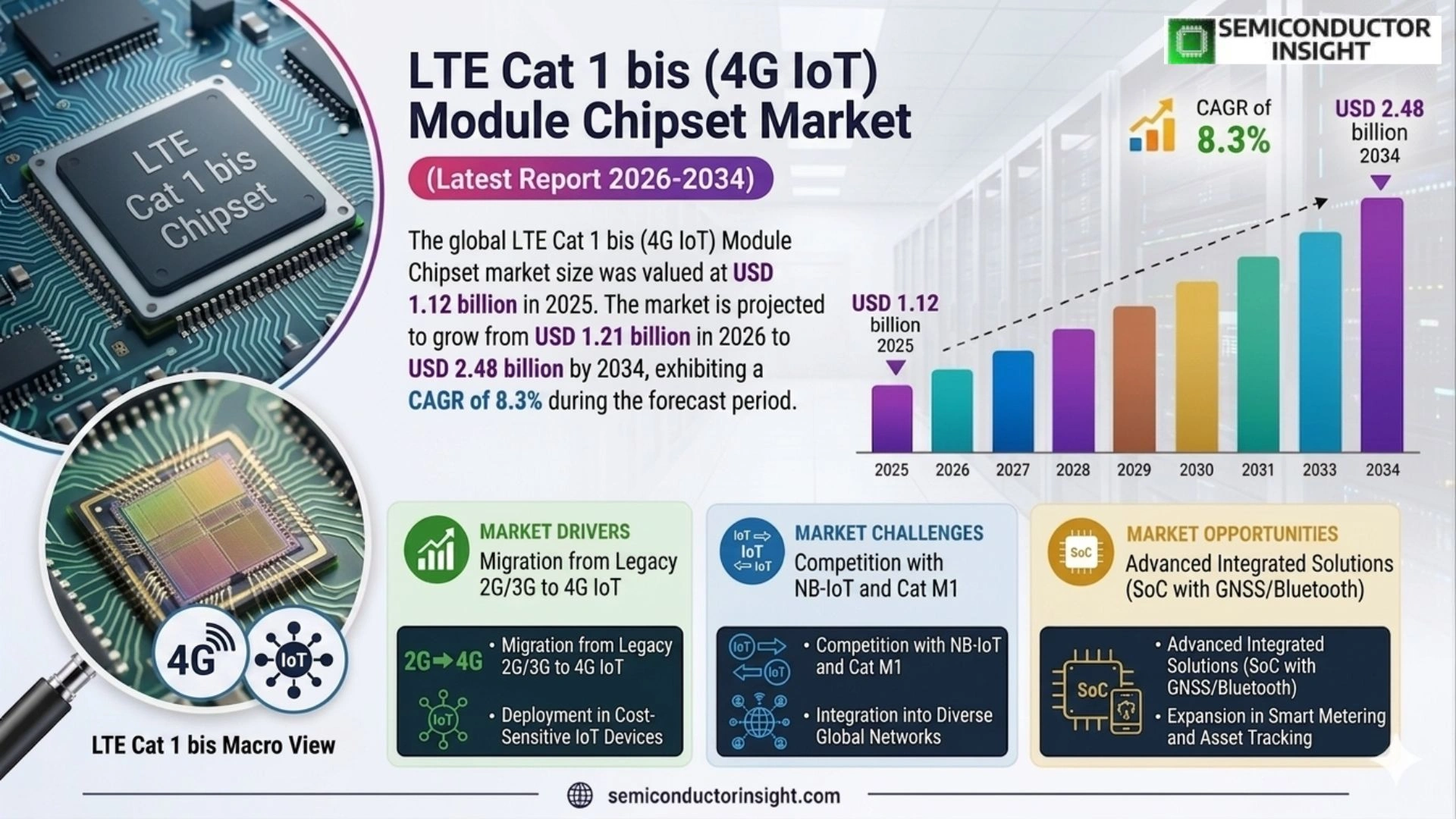
LTE Cat 1 bis (4G IoT) Module Chipset Market size was valued at USD 1.12 billion in 2025. The market is projected to grow from USD 1.21 billion in 2026 to USD 2.48 billion by 2034, exhibiting a CAGR of 8.3% during the forecast period.
LTE Cat 1 bis module chipsets are single-antenna, cost-optimized 4G IoT chipsets designed to support low-to-medium data rate applications across cellular IoT networks. Introduced as a simplified evolution of LTE Cat 1, the Cat 1 bis standard eliminates the requirement for a second receive antenna, enabling more compact, power-efficient module designs. These chipsets are widely deployed in applications such as smart metering, asset tracking, wearables, point-of-sale terminals, industrial monitoring, and vehicle telematics, where reliable connectivity and moderate throughput are essential.
The market is witnessing strong momentum driven by the accelerating global rollout of IoT deployments, rising demand for cost-effective cellular connectivity solutions, and the ongoing migration from 2G and 3G legacy networks to 4G LTE infrastructure. Furthermore, the widespread adoption of LTE Cat 1 bis as a preferred connectivity standard for mid-tier IoT devices , owing to its balance between performance, power consumption, and module cost , is reinforcing market expansion. Leading chipset vendors including Qualcomm Technologies, Inc., MediaTek Inc., and Unisoc Technologies Co., Ltd. are actively expanding their portfolios to address growing demand across diverse industry verticals.
MARKET DRIVERS
Surging Demand for Cost-Effective IoT Connectivity Accelerating LTE Cat 1 bis Module Adoption
The LTE Cat 1 bis (4G IoT) Module Chipset Market is experiencing robust growth driven by the widespread need for reliable, low-cost cellular connectivity across IoT deployments. Unlike its predecessor Cat 1, the Cat 1 bis standard operates on a single antenna, significantly reducing hardware complexity and bill-of-materials costs while maintaining downlink speeds of up to 10 Mbps and uplink speeds of up to 5 Mbps. This makes it a compelling solution for mid-tier IoT applications that require more throughput than LPWAN technologies such as NB-IoT or LTE-M, yet do not justify the cost and power overhead of LTE Cat 4 or higher. Industries including smart metering, asset tracking, fleet management, and point-of-sale terminals are actively transitioning toward Cat 1 bis-enabled modules as network operators sunset 2G and 3G infrastructure globally.
Global 2G/3G Network Sunset Creating Structural Migration Opportunity
A defining catalyst for the LTE Cat 1 bis module chipset market is the accelerating retirement of legacy 2G and 3G networks across North America, Europe, and parts of Asia-Pacific. Mobile network operators are reallocating spectrum from these aging networks to expand 4G LTE and 5G coverage, leaving millions of connected devices without a supported network. This has created a structural replacement cycle that is directly benefiting Cat 1 bis module and chipset vendors. Enterprises operating legacy M2M infrastructure are compelled to migrate to LTE-based alternatives, and Cat 1 bis presents the most cost-aligned upgrade path given its single-antenna design, reuse of existing 4G spectrum, and broad operator support across FDD and TDD bands.
➤ The global installed base of 2G and 3G IoT connections undergoing mandatory migration represents a multi-hundred-million unit replacement opportunity for LTE Cat 1 bis module and chipset suppliers through 2028, with transportation, utilities, and industrial automation sectors leading procurement volumes.
Additionally, the proliferation of smart city initiatives, connected health monitoring devices, and industrial automation platforms is reinforcing demand for 4G IoT module chipsets with stable latency and broad geographic coverage. Governments across Southeast Asia, the Middle East, and Latin America are investing in national IoT frameworks that specify LTE as the minimum connectivity standard, further anchoring Cat 1 bis as a preferred technology tier. Chipset vendors such as Qualcomm, MediaTek, and UNISOC are responding with highly integrated single-chip solutions that reduce module footprint and power consumption, making Cat 1 bis modules increasingly viable for battery-operated field devices.
MARKET CHALLENGES
Intensifying Price Competition Among Module Vendors Compressing Margins Across the Value Chain
Despite strong demand fundamentals, the LTE Cat 1 bis module chipset market faces significant margin pressure stemming from aggressive pricing strategies adopted by Chinese module manufacturers. Vendors including Quectel, SIMCom, and Fibocom have scaled production volumes to a degree that has substantially driven down average selling prices for Cat 1 bis modules. While this benefits end-users and accelerates adoption, it creates a challenging competitive environment for smaller chipset and module vendors who lack the economies of scale to compete on price alone. Differentiation through software integration, carrier certifications, and regional technical support is becoming increasingly critical but also more costly to maintain, particularly for companies targeting multi-regional deployments across diverse regulatory environments.
Other Challenges
Fragmented Band and Certification Requirements
One of the persistent operational challenges in the LTE Cat 1 bis (4G IoT) module chipset market is the fragmented landscape of LTE frequency bands and regional certification mandates. A module certified for deployment in one geography may require hardware re-spins or additional regulatory approvals to operate in another, increasing time-to-market and development costs. North America, Europe, Japan, and Australia each maintain distinct band plans and operator-specific approval processes, forcing vendors to maintain multiple SKUs and certification pipelines simultaneously.
Supply Chain Volatility and Semiconductor Component Dependencies
The broader semiconductor supply chain disruptions experienced since 2021, while moderating, continue to influence procurement planning within the 4G IoT module chipset segment. Lead times for specialized RF components, power management ICs, and memory chips remain variable, creating inventory management challenges for module assemblers. Customers in critical infrastructure and industrial IoT sectors, who require long-term product availability commitments, are pressing vendors for extended lifecycle guarantees that not all suppliers are currently positioned to offer.
MARKET RESTRAINTS
Emergence of 5G RedCap Posing a Forward-Looking Substitution Threat to Cat 1 bis Deployments
A notable restraint on long-term investment within the LTE Cat 1 bis (4G IoT) module chipset market is the growing commercial momentum of 5G Reduced Capability (RedCap), also known as NR-Light, which is being positioned by the 3GPP standardization body and leading chipset vendors as a next-generation alternative for mid-tier IoT applications. RedCap is designed to offer a comparable cost and complexity profile to Cat 1 bis while delivering improved spectral efficiency, lower latency, and native 5G feature support including network slicing. As 5G standalone networks expand coverage , particularly in high-density urban and industrial zones , enterprise procurement teams are beginning to reassess whether new IoT platform investments should target Cat 1 bis or provision directly for RedCap readiness, introducing a degree of design freeze hesitation in certain verticals.
Power Consumption Constraints Limiting Deployment in Unmanaged Battery-Operated Environments
While Cat 1 bis achieves meaningful power savings compared to higher LTE categories through its simplified single-antenna architecture, it still consumes considerably more power than LPWAN alternatives such as NB-IoT and LTE-M, which are specifically optimized for deep-sleep duty cycling. This constrains the LTE Cat 1 bis module chipset market in applications requiring multi-year battery autonomy from small-form-factor power sources, such as remote environmental sensors, underground utility meters, and portable medical monitoring devices. In these use cases, LPWAN technologies maintain a structural advantage, and Cat 1 bis modules are typically excluded from the competitive evaluation, effectively capping the addressable market for chipset and module vendors targeting the lowest-power IoT tier.
MARKET OPPORTUNITIES
Expanding Industrial IoT and Smart Infrastructure Deployments Opening High-Volume Procurement Channels
The LTE Cat 1 bis (4G IoT) module chipset market is positioned to benefit substantially from accelerating investment in industrial IoT platforms, smart grid modernization, and connected transportation infrastructure. Manufacturing facilities adopting Industry 4.0 architectures require cellular connectivity for mobile robots, predictive maintenance sensors, and real-time quality control systems that operate in environments where Wi-Fi coverage is inconsistent. Cat 1 bis modules offer the combination of LTE reliability, manageable power consumption, and cost efficiency that makes them technically and economically viable for these deployments at scale. Smart grid operators are similarly evaluating Cat 1 bis as a primary communications layer for advanced metering infrastructure (AMI) and distribution automation, particularly in regions where utility-grade private LTE networks are being established.
Emerging Markets Representing an Underpenetrated Growth Frontier for 4G IoT Module Chipset Vendors
Developing economies across Sub-Saharan Africa, South and Southeast Asia, and Latin America present a significant and currently underpenetrated growth opportunity for the LTE Cat 1 bis module chipset market. In these regions, 4G LTE infrastructure investment is outpacing both 2G retirement timelines and 5G rollout schedules, making Cat 1 bis the de facto standard for new IoT connectivity deployments over the medium term. Applications such as agricultural monitoring, mobile financial services terminals, connected healthcare devices in remote clinics, and fleet telematics for logistics operators are driving initial procurement volumes. Chipset vendors that establish early partnerships with regional module assemblers and secure carrier approvals in these markets stand to capture durable, high-volume supply relationships as IoT penetration rates scale from nascent levels toward those seen in mature economies.
Integration of GNSS, Wi-Fi, and Bluetooth Into Multi-Mode Cat 1 bis Chipsets Unlocking New Application Verticals
A growing product development trend among leading LTE Cat 1 bis (4G IoT) chipset vendors is the integration of multi-mode radio capabilities , combining cellular Cat 1 bis with GNSS positioning, Bluetooth Low Energy, and Wi-Fi scanning functions within a single system-on-chip or highly compact module. This convergence reduces the component count and PCB footprint for device designers while enabling location-aware, context-rich IoT applications that were previously cost-prohibitive at scale. Use cases including real-time vehicle tracking with geofencing, indoor-outdoor asset management, and connected wearables for workforce safety monitoring are directly enabled by this integration approach. As platform-level integration deepens, chipset vendors that offer comprehensive multi-mode solutions with unified software development environments and pre-certified module reference designs will command stronger design-win rates and greater customer stickiness across the broader 4G IoT module chipset market.
LTE Cat 1 bis (4G IoT) Module Chipset Market Trends
Accelerating Migration from 2G/3G Legacy Networks to 4G LTE Infrastructure
One of the most defining trends shaping the LTE Cat 1 bis (4G IoT) Module Chipset Market is the ongoing global migration away from 2G and 3G legacy network infrastructure. As telecom operators across North America, Europe, and Asia-Pacific continue to sunset aging cellular networks, enterprises and device manufacturers are increasingly transitioning their IoT deployments to 4G LTE-based solutions. LTE Cat 1 bis chipsets have emerged as a preferred migration target due to their single-antenna architecture, which simplifies hardware design while delivering reliable mid-tier connectivity. This network transition is compelling industries such as smart metering, industrial monitoring, and asset tracking to re-evaluate their connectivity strategies and standardize on LTE Cat 1 bis as a future-proof alternative.
Other Trends
Rising Adoption in Smart Metering and Utility Applications
The LTE Cat 1 bis (4G IoT) Module Chipset Market is experiencing significant traction within the smart metering and utility management sector. Utility operators globally are deploying advanced metering infrastructure that requires reliable, low-to-medium data rate cellular connectivity , a profile that LTE Cat 1 bis chipsets address effectively. The cost-optimized design of these chipsets, combined with their compatibility with existing 4G LTE networks, makes them well-suited for large-scale smart grid and water metering deployments where millions of endpoints require sustained connectivity over extended operational lifespans.
Expanding Role in Vehicle Telematics and Fleet Management
Vehicle telematics and fleet management represent another high-growth application area driving demand within the LTE Cat 1 bis (4G IoT) Module Chipset Market. The need for continuous, real-time location tracking, diagnostics, and remote monitoring in commercial fleets is accelerating adoption of Cat 1 bis-based modules. These chipsets offer an optimal balance between throughput performance and power efficiency, making them suitable for always-connected telematics units. Leading automotive Tier-1 suppliers and fleet technology providers are increasingly integrating LTE Cat 1 bis chipsets into their next-generation telematics control units.
Competitive Portfolio Expansion by Leading Chipset Vendors
The competitive landscape of the LTE Cat 1 bis (4G IoT) Module Chipset Market is being actively shaped by strategic portfolio expansions from established semiconductor vendors. Companies including Qualcomm Technologies, Inc., MediaTek Inc., and Unisoc Technologies Co., Ltd. are broadening their Cat 1 bis chipset offerings to address diverse industry verticals and regional network requirements. This intensifying vendor activity is fostering innovation in areas such as power consumption optimization, compact form factors, and enhanced protocol support, ultimately enabling module manufacturers to deliver more cost-competitive and feature-rich solutions across point-of-sale terminals, wearables, and industrial IoT applications.
COMPETITIVE LANDSCAPE
Key Industry Players
LTE Cat 1 bis (4G IoT) Module Chipset Market: Competitive Dynamics and Leading Innovators Shaping the Global Cellular IoT Connectivity Ecosystem
Global LTE Cat 1 bis (4G IoT) Module Chipset Market is characterized by a moderately consolidated competitive landscape, with a handful of dominant semiconductor and chipset vendors commanding significant market share alongside a growing number of regional and specialized players. Qualcomm Technologies, Inc. remains a prominent force in the broader cellular IoT chipset space, leveraging its extensive intellectual property portfolio, global carrier relationships, and advanced process node expertise to deliver high-performance, power-efficient solutions tailored for mid-tier IoT deployments. MediaTek Inc. has equally established a formidable presence, with its NB-IoT and LTE Cat 1 bis chipset lines gaining strong traction across smart metering, asset tracking, wearables, and point-of-sale terminal applications. Unisoc Technologies Co., Ltd. (formerly Spreadtrum Communications) has emerged as a particularly aggressive competitor in the cost-sensitive segment, capitalizing on its deep manufacturing relationships and competitive pricing strategy to secure design wins among module makers targeting high-volume industrial and consumer IoT verticals. The market is further shaped by the accelerating global sunset of 2G and 3G legacy networks, which is compelling device manufacturers to migrate toward LTE Cat 1 bis as a preferred connectivity standard, intensifying competition among chipset vendors to offer the most compact, cost-optimized, and energy-efficient silicon solutions.
Beyond the tier-one vendors, several niche and regionally significant players are actively shaping the competitive contours of the LTE Cat 1 bis module chipset ecosystem. HiSilicon Technologies (a Huawei subsidiary) has developed cellular IoT chipsets deployed primarily within the Chinese domestic market, while Sequans Communications S.A. has carved out a specialized position with its Monarch and Calliope chipset platforms, targeting LPWA and Cat 1 bis applications for European and North American enterprise IoT deployments. Nordic Semiconductor and u-blox AG, while broader in their wireless connectivity portfolios, maintain relevant competitive positioning through module-level integration and reference designs built around third-party Cat 1 bis silicon. Chinese module manufacturers such as Quectel Wireless Solutions, SIMCom Wireless Solutions, and Fibocom Wireless Inc. , though primarily module integrators , exert significant downstream influence on chipset vendor selection and market share dynamics. As the market is projected to grow from USD 1.21 billion in 2026 to USD 2.48 billion by 2034 at a CAGR of 8.3%, competitive intensity is expected to escalate, with vendors differentiating on multi-band support, integrated GNSS capabilities, functional safety certifications, and total cost of ownership for IoT device makers.
List of Key LTE Cat 1 bis (4G IoT) Module Chipset Companies Profiled
- Qualcomm Technologies, Inc.
- MediaTek Inc.
- Unisoc Technologies Co., Ltd.
- Sequans Communications S.A.
- HiSilicon Technologies Co., Ltd. (Huawei)
- Nordic Semiconductor ASA
- u-blox AG
- Quectel Wireless Solutions Co., Ltd.
- SIMCom Wireless Solutions Co., Ltd.
- Fibocom Wireless Inc.
- Telit Communications PLC
- Sierra Wireless (Semtech Corporation)
- Thales Group (Cinterion)
- MeiG Smart Technology Co., Ltd.
- Cheerzing Communication (Shanghai) Technology Co., Ltd.
Segment Analysis:
| Segment Category | Sub-Segments | Key Insights |
| By Type |
|
Integrated LTE Cat 1 bis Chipsets dominate the type landscape, reflecting the market’s overarching demand for compact and cost-optimized connectivity solutions.
|
| By Application |
|
Smart Metering & Utilities represents a leading application vertical for LTE Cat 1 bis module chipsets, underpinned by the global push toward smart grid modernization and intelligent utility infrastructure.
|
| By End User |
|
Automotive & Transportation stands as a prominent end-user segment, driven by the accelerating integration of connected vehicle technologies and the growing regulatory emphasis on embedded cellular telematics across global markets.
|
| By Frequency Band |
|
Multi-Band Chipsets are emerging as the preferred choice across diverse deployment environments, reflecting the complexity of global cellular network infrastructure and operator spectrum strategies.
|
| By Deployment Mode |
|
Embedded Deployment leads the deployment mode segment as device manufacturers increasingly integrate LTE Cat 1 bis chipsets directly into product designs during the original manufacturing stage to optimize form factor, reliability, and total system cost.
|
Regional Analysis: LTE Cat 1 bis (4G IoT) Module Chipset Market
Asia-Pacific
China’s role in the LTE Cat 1 bis (4G IoT) Module Chipset Market extends far beyond consumption. A robust ecosystem of chipset designers, module manufacturers, and ODM partners enables rapid product iteration and aggressive pricing. Government mandates promoting domestic IoT adoption and smart infrastructure further accelerate the deployment of LTE Cat 1 bis modules across utility, logistics, and healthcare verticals, giving Chinese vendors a formidable competitive advantage in global supply.
India and Southeast Asian nations represent some of the fastest-growing sub-markets within the LTE Cat 1 bis (4G IoT) Module Chipset Market. Network operators in these countries are actively retiring legacy 2G infrastructure, creating immediate replacement demand for LTE Cat 1 bis-based modules. Rising adoption in agricultural IoT, financial inclusion devices, and urban mobility solutions is accelerating chipset consumption across these high-population, digitally transforming economies.
Japan and South Korea contribute premium-segment demand to the Asia-Pacific LTE Cat 1 bis (4G IoT) Module Chipset Market. Both nations emphasize high-reliability, low-power IoT connectivity for industrial automation, precision healthcare monitoring, and connected vehicle platforms. Their strong R&D cultures and deep enterprise IoT adoption ensure consistent demand for advanced LTE Cat 1 bis chipsets with enhanced performance and security features.
Across Asia-Pacific, government-led smart city programs and national IoT strategies are creating structural demand for LTE Cat 1 bis (4G IoT) module chipset deployments. Subsidized connectivity programs, regulatory frameworks encouraging IoT standardization, and public-private partnerships in transportation, energy, and public safety are aligning to generate a long-term, policy-supported growth trajectory that distinguishes Asia-Pacific from all other global regions.
North America
North America represents a mature yet strategically significant region in the LTE Cat 1 bis (4G IoT) Module Chipset Market. The United States leads regional adoption, supported by widespread LTE network coverage and a technologically sophisticated enterprise base eager to transition IoT deployments from aging 2G and 3G infrastructure to more capable, power-efficient LTE Cat 1 bis solutions. Key verticals driving demand include fleet management, smart energy metering, connected health devices, and retail automation. Major network carriers have established clear timelines for legacy network sunsetting, compelling device manufacturers to prioritize LTE Cat 1 bis module chipset integration. Canada mirrors this trend with growing smart grid and precision agriculture deployments. The region’s relatively high per-unit value and emphasis on security-compliant, carrier-certified modules distinguish North American demand withGlobal LTE Cat 1 bis (4G IoT) Module Chipset Market landscape.
Europe
Europe occupies a prominent position in the LTE Cat 1 bis (4G IoT) Module Chipset Market, characterized by strong regulatory alignment and a mature industrial IoT ecosystem. The European Union’s emphasis on connected infrastructure, energy efficiency directives, and digital single market initiatives creates a favorable policy environment for LTE Cat 1 bis adoption across utilities, transportation, and manufacturing. Western European nations including Germany, France, and the United Kingdom are at the forefront, deploying LTE Cat 1 bis module chipsets in smart metering, predictive maintenance platforms, and connected logistics. The region also benefits from robust GSMA and ETSI standardization frameworks that streamline module certification and interoperability. Eastern European markets are progressively adopting LTE Cat 1 bis solutions as network modernization programs expand coverage, creating incremental growth opportunities within the broader European LTE Cat 1 bis (4G IoT) Module Chipset Market.
South America
South America presents an evolving growth opportunity within the LTE Cat 1 bis (4G IoT) Module Chipset Market, albeit at a more measured pace compared to leading regions. Brazil anchors regional demand as the largest economy and most advanced telecom market, with operators progressively deploying LTE networks that support Cat 1 bis module integration across agriculture, logistics, and financial services. Government-backed programs to expand broadband connectivity and modernize public infrastructure are gradually creating fertile ground for IoT adoption. Colombia, Argentina, and Chile are also emerging as secondary markets as enterprise awareness of LTE Cat 1 bis capabilities grows. Challenges related to economic volatility, import duties on electronic components, and uneven network coverage in rural areas temper near-term growth, but the long-term trajectory for the LTE Cat 1 bis (4G IoT) Module Chipset Market in South America remains constructive.
Middle East & Africa
The Middle East & Africa region represents a nascent but increasingly important segment of Global LTE Cat 1 bis (4G IoT) Module Chipset Market. Gulf Cooperation Council nations, led by the UAE and Saudi Arabia, are investing heavily in smart city infrastructure, digital government services, and connected energy systems, creating immediate and scalable demand for LTE Cat 1 bis module chipsets. National Vision programs across the Gulf are embedding IoT connectivity as a foundational element of economic diversification strategies. In Africa, South Africa and Nigeria lead adoption, with growing interest in LTE Cat 1 bis solutions for asset tracking, financial inclusion devices, and agricultural monitoring. While infrastructure gaps and affordability constraints remain considerations across sub-Saharan Africa, the region’s rapid mobile network expansion and youthful, digitally engaged population signal meaningful long-term participation in the LTE Cat 1 bis (4G IoT) Module Chipset Market through 2034.
Report Scope
This market research report provides a comprehensive analysis of the LTE Cat 1 bis (4G IoT) Module Chipset Market, covering the forecast period 2026–2034. It offers detailed insights into market dynamics, technological advancements, competitive landscape, and key trends shaping the industry.
Key focus areas of the report include:
- Market Overview: The report begins with an overview outlining its current market scenario, key growth indicators, and industry transformation drivers. It discusses macroeconomic factors, demand–supply balance, regulatory landscape, and the strategic role of semiconductors in powering advancements across industries such as automotive, telecommunications, consumer electronics, and industrial automation.
- Market Size & Forecast: Historical data and future projections for revenue, unit shipments, and market value across major regions and segments.
- Segmentation Analysis: Detailed breakdown by product type, technology, application, and end-user industry to identify high-growth segments and investment opportunities.
- Regional Insights: Insights into market performance across North America, Europe, Asia-Pacific, Latin America, and the Middle East & Africa, including country-level analysis where relevant.
- Competitive Landscape: Profiles of leading market participants, including their product offerings, R&D focus, manufacturing capacity, pricing strategies, and recent developments such as mergers, acquisitions, and partnerships.
- Technology Trends & Innovation: Assessment of emerging technologies, integration of AI/IoT, semiconductor design trends, fabrication techniques, and evolving industry standards.
- Market Drivers & Restraints: Evaluation of factors driving market growth along with challenges, supply chain constraints, regulatory issues, and market-entry barriers.
- Stakeholder Insights: Insights for component suppliers, OEMs, system integrators, investors, and policymakers regarding the evolving ecosystem and strategic opportunities.
Primary and secondary research methods are employed, including interviews with industry experts, data from verified sources, and real-time market intelligence to ensure the accuracy and reliability of the insights presented.
FREQUENTLY ASKED QUESTIONS:
What is the current market size of LTE Cat 1 bis (4G IoT) Module Chipset Market?
-> Global LTE Cat 1 bis (4G IoT) Module Chipset Market size was valued at USD 1.12 billion in 2025. The market is projected to grow from USD 1.21 billion in 2026 to USD 2.48 billion by 2034, exhibiting a CAGR of 8.3% during the forecast period.
Which key companies operate in LTE Cat 1 bis (4G IoT) Module Chipset Market?
-> Key players include Qualcomm Technologies, Inc., MediaTek Inc., and Unisoc Technologies Co., Ltd., among others, who are actively expanding their portfolios to address growing demand across diverse industry verticals.
What are the key growth drivers?
-> Key growth drivers include the accelerating global rollout of IoT deployments, rising demand for cost-effective cellular connectivity solutions, and the ongoing migration from 2G and 3G legacy networks to 4G LTE infrastructure. The widespread adoption of LTE Cat 1 bis as a preferred connectivity standard for mid-tier IoT devices , owing to its balance between performance, power consumption, and module cost , is also reinforcing market expansion.
Which region dominates the market?
-> Asia-Pacific is the fastest-growing region driven by large-scale IoT deployments and expanding 4G LTE infrastructure, while North America and Europe remain significant markets owing to advanced telecommunications ecosystems and strong industrial IoT adoption.
What are the emerging trends?
-> Emerging trends include the deployment of single-antenna, cost-optimized 4G IoT chipsets, growing use of LTE Cat 1 bis modules in smart metering, asset tracking, wearables, point-of-sale terminals, industrial monitoring, and vehicle telematics, and increased adoption of compact, power-efficient module designs enabled by the elimination of the second receive antenna requirement.

Get Sample Report PDF for Exclusive Insights
Report Sample Includes
- Table of Contents
- List of Tables & Figures
- Charts, Research Methodology, and more...
 Download Sample Report PDF