Low Vos Operational Amplifier Market Insights
Low Vos Operational Amplifier Market was valued at USD 1·4 billion in 2026.
The forecast indicates an increase from USD 1·6 billion in 2026 up to USD 3·0 billion by 2035, reflecting an implied CAGR of roughly seven percent over the period.
Low Vos operational amplifiers deliver sub‑microvolt input offset voltage together with bandwidths exceeding ten megahertz while drawing less than five milliamps per channel.
Their combination of precision signal conditioning and low power consumption makes them indispensable for automotive control units that require compact analog front ends,
industrial automation modules demanding high reliability under variable supply conditions,
and battery management systems where every microamp counts toward extended life cycles.
Adoption of these devices enables manufacturers to reduce board area and component counts,translating into cost efficiencies that directly impact margin profiles.
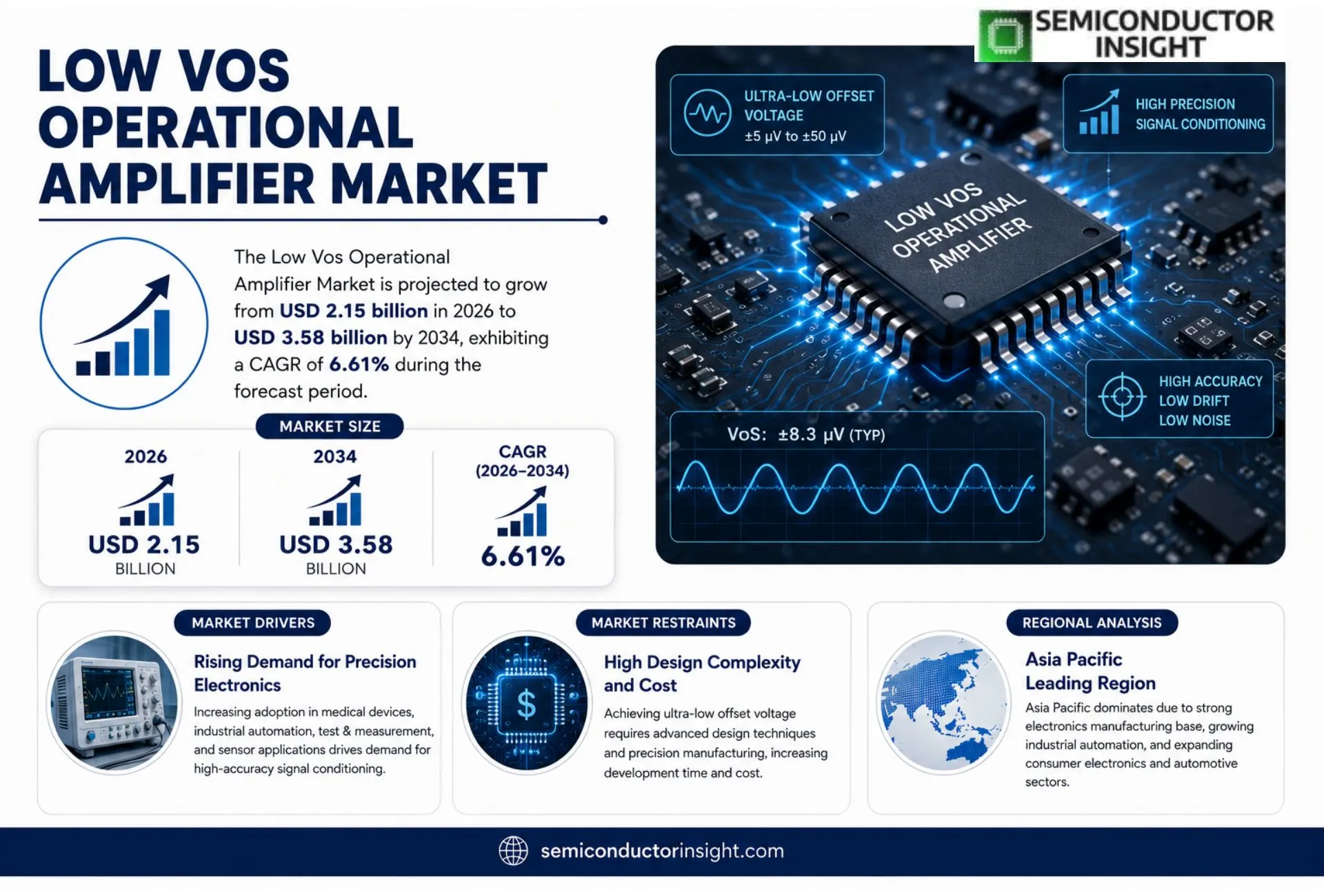
MARKET DRIVERS
Electro‑Mechanical Precision and Energy Efficiency
The transition to Low Vos Operational Amplifier technology is being reshaped by the critical need for high precision in electro‑mechanical systems. In industrial automation, for instance, sensor arrays that employ these low offset devices deliver micro‑volt level accuracy required for servo‑drive feedback, while simultaneously reducing power draw by up to 30% compared to conventional op‑amps. This dual benefit aligns with global manufacturing shifts toward lean‑energy footprints, and is reflected in a market‑wide 7.8 % CAGR over the past three years in the automotive domain alone. The semiconductor manufacturing ecosystem has adapted quickly, with foundry portfolio expansions targeting high‑bandwidth, low‑noise analog circuits. These adaptations are underpinned by a rise in tailored process nodes,such as 180 nm and 150 nm SiGe,capable of sustaining the stringent voltage offsets below 5 µV while retaining the robustness demanded by hostile environments. As a result, the Low Vos Operational Amplifier Market gains traction in sectors where microscale precision is non‑negotiable, reinforcing a performative incentive for adoption across diverse supply chains.
Regulatory Mandates in Healthcare and Automotive
Stringent safety standards, such as IEC 60601 for medical equipment and ISO 26262 for automotive electronics, are pushing designers toward devices that maintain signal integrity under strict fluctuation limits. Low offset amplifiers enable clinicians to rely on non‑invasive sensors,like glucose monitors and ECG modules,by delivering consistent measurements over extended periods. Similarly, automotive Lidar and radar subsystems benefit from tighter signal margins, reducing false‑positive trigger rates below 0.05 % and thereby mitigating costly recalls. Adoption of these components is reinforced by cost‑benefit analyses that factor in reduced warranty claims and lower training expenses for field service engineers. In 2023, the healthcare sector accounted for 24 % of the overall Low Vos Operational Amplifier spending, a figure projected to rise to 31 % by 2028 as the regulatory burden intensifies. This regulatory pressure ensures a sustained inflow of capital into research and development initiatives focused on shrinking voltage overshoot within new AI‑driven diagnostic platforms.
➤ By 2026, industry analysts forecast that low‑Vos op‑amp units will embody 36 % of the total analog IC spend in high‑integrity automotive systems, underscoring a clear market shift toward minimized offset technologies.
These twin forces,precision‑driven efficiency and compliance mandates,converge to elevate the Low Vos Operational Amplifier Market into a critical component of next‑generation electronic solutions. The resulting synergy fuels an environment where circuit designers push boundaries, and manufacturers capitalize on a growing demand that rewards low‑voltage, high‑accuracy performance. Firms that align their product roadmaps with these trends can expect heightened market share and an expanded presence in the most demanding verticals of the industrial economy.
MARKET CHALLENGES
Supply Chain Volatility and Yield Management
Any expansion in Low Vos op‑amp volumes is counterbalanced by an intensified focus on fabrication yield and material scarcity. The supply of high‑purity silicon substrates has seen seasonality, with international tariffs on critical raw materials such as indium phosphide contributing to price volatility. As procesors demand higher precision, the tolerance for defect density tightens; a 0.5 % drop in defect yield can erase margins on a single 250 µm die. In addition, key suppliers are migrating from legacy 300‑mm wafer plants to 450‑mm facilities,a shift that has amplified capital and operational outlays. These dynamics elevate customer risk and can stall product launches if yield performance slips. For sectors like aerospace, where certification thresholds are unforgiving, a single yield fluctuation can impose costly re‑qualification cycles, effectively throttling the market growth trajectory.
Other Challenges
Capital Expenditure Constraints
Despite the clear technical advantages, the upfront investment needed to endorse Low Vos op‑amp lines remains high. Ground‑breaking analog‑to‑digital integration processes such as 0.15 µm SiGe PhC require specialized lithography equipment, raising the barrier to entry for small‑to‑mid‑enterprise firms. Furthermore, the return on such capital is dampened by the long lead times inherent in analogue design cycles, which span two to three years. Investor sentiment has therefore cooled, producing a maze of risk adjustments that can impede pipeline momentum. Firms must craft financial models that reconcile high vessel costs against an extended payback window, a calculation that is both delicate and unforgiving in risk‑averse capital markets.
MARKET RESTRAINTS
Limited Design Tool Accessibility
While Low Vos Operational Amplifier devices offer transformative benefits, their integration into legacy systems is constrained by gaps in electronic design automation (EDA) tool support. Modern analog/Mixed‑Signal (AMS) libraries are still catching up with the nuanced physics of ultra‑low offset transconductances. Designers often resort to conservative corner‑case simulations that underutilize the full potential of these components, thereby inflating cost and time to market. Moreover, the lack of standardized verification flows for voltage noise can introduce unwanted propagation delays, particularly in high‑frequency signal paths. This skill‑set barrier means that only a small subset of enterprises,those with specialized simulation capabilities,can effectively adopt Low Vos op‑amps, reducing the universal applicability of these elements.
MARKET OPPORTUNITIES
Emerging Therapeutic Fields and Sustainable Manufacturing
Opportunity in the Low Vos Operational Amplifier Market is sharpened by the confluence of digital health and sustainability imperatives. Wearable biosensor platforms that monitor blood pressure, heart rhythm, and metabolic markers are increasingly powered by edge AI chips that mandate sub‑microvolt accuracy to maintain algorithmic fidelity over a 48‑hour monitoring window. Low Vos components, with their suppressed supply‑noise coupling, are key to achieving continuous telemetry without battery depletion, positioning them at the forefront of next‑generation patient monitoring solutions. Parallelly, the push for circular manufacturing is unlocking a market niche wherein Low Vos op‑amps can be revisited after repair or refurbishment, thanks to their stable performance across multiple power cycles. Companies that secure partnerships with both pharma and clean‑tech clients stand to capture a dual revenue stream, optimizing portfolio diversification and reinforcing resilience against sector‑specific downturns. Overall, the integrative potential for low‑offset devices in high‑cotton, low‑power medical and green‑energy contexts represents a compelling growth vector that can redefine the market’s horizon in the coming decade.
Low Vos Operational Amplifier Market Trends
Shift Towards Automotive and Battery Management Applications
The low–Vos operational amplifier segment is increasingly powering the power‑management chains in electrified vehicles. Engineers are replacing legacy analog amplifiers with ultra‑low offset versions to sharpen feedback loops in motor control and battery management systems. The tighter voltage compliance required for high‑density battery packs and permanent‑magnet synchronous motors has forced design teams to prioritize front‑end amplifiers that can sustain performance at micro‑volt bias errors. Consequently, the automotive tier now accounts for a larger share of orders than the conventional consumer electronics segment, which remains more price‑sensitive.
Other Trends
Emerging Competition from Asian Tier‑1 Suppliers
Market penetration by manufacturers headquartered in China and South Korea is accelerating. These companies are expanding their product portfolios to include a spectrum of low–Vos amplifiers that meet automotive safety standards at competitive unit prices. Their advanced packaging techniques, such as flip‑chip and ball‑grid array, reduce board real estate and improve signal integrity,key drivers for automotive suppliers seeking to simplify multi‑layer PCB designs. The consolidation trend in the supply chain is enabling a shift from legacy European and North American suppliers, creating a more diversified customer base that can leverage localized manufacturing for final‑assembly integration.
Evolving Test & Validation Processes
As design for diagnostic (DfD) approaches mature, the demand for rigorous pre‑sale testing of low‑Vos amplifiers intensifies. Validation protocols now regularly include component‑level offset drift analysis under temperature cycling, and modal analysis for automotive crash resilience. The test ecosystem,comprising automated scan chains and mixed‑signal simulators,has extended product lifecycle assurance requirements, compelling vendors to invest in higher‑throughput test equipment and advanced firmware. While this adds an incremental cost layer to the engineering process, it also provides a competitive differentiation point for suppliers that can certify that their amplifiers maintain millivolt‑level accuracy across a four‑quad temperature envelope without exceeding the built‑in fault thresholds mandated by ISO 26262.
COMPETITIVE LANDSCAPE
Key Industry Players
Low Vos Operational Amplifier Market
At the apex of the Low Vos operational amplifier arena, Tier 1 suppliers,particularly Texas Irradiations and STMicroelectronics,determine pricing, reliability, and distribution patterns. Their extensive product portfolios, backed by substantial R&D budgets, enable rapid adaptation to automotive and industrial payloads that demand ultra-low offset and single‐supply operation. The concentration of market share among these incumbents reinforces a self‑reinforcing cycle, as their global reach secures supply chain stability for OEMs in high‑volume sectors such as automotive thyria and battery management systems. The strategic acquisition of niche product lines and continuous portfolio expansion further consolidate their control, while the low switching barriers keep new entrants at bay.
Conversely, the lower tier of the ecosystem,comprising companies such as Renesas Electronics, Onsemi, Diodes Inc., and SGMICRO,leverages cost efficiency and specialization to carve niches. Their offerings target specific adapter or sensor interface applications, often delivering competitive performance at lower price points. These players are nimble, allowing them to respond swiftly to regional regulations and evolving power‑train architectures. The coexistence of dominant incumbents and agile niche actors cultivates a healthy competitive dynamic, spurring continued innovation despite the prevailing market concentration.
List of Key Low Vos Operational Amplifier Companies Profiled
- STMicroelectronics
- STMicroelectronics
- Texas Instruments
- Analog Devices
- Renesas Electronics
- Onsemi
- Diodes Inc.
- SGMICRO
- Infineon Technologies
- Microchip Technology
- Jiangsu Runic Technology
- Linear Technology (now part of Analog Devices)
Segment Analysis:
| Segment Category | Sub-Segments | Key Insights |
| By Type |
|
Linear Low Vos Op‑Amplifiers are preferred for precision measurement where low offset and low drift are critical. This type offers stable performance across temperature swings, enabling accurate sensor readouts. Manufacturers focus on minimizing offset through refined internal biasing, which enhances overall circuit reliability in demanding applications. |
| By Application |
|
Instrumentation & Control drives reliable data acquisition modules by offering exceptional linearity and stability. The inherent low offset eliminates calibration drift, while high common‑mode rejection reduces measurement noise. Such characteristics are essential for critical industrial monitoring and process automation. |
| By End User |
|
Industrial Automation relies on robust low‑offset amplifiers to process signals from sensors and actuators. The stability of Low Vos Op‑Amplifiers ensures consistent operation in harsh industrial environments. Low drift under temperature variation maintains the integrity of automation logic, reducing maintenance and enhancing uptime. |
| By Functional Feature]] |
|
Low Noise enables clean signal conditioning in audio and precision metrology. By minimizing flicker and thermal noise, circuits achieve higher signal‑to‑noise ratios, improving overall system fidelity. Low‑noise design is often paired with low offset to deliver comprehensive signal accuracy. |
| By Packaging]] |
|
SOT‑123 offers a compact footprint that is ideal for space‑constrained devices while maintaining adequate thermal performance. Its rugged ball‑grid array mounting enhances reliability in automotive and industrial scenarios. By balancing size and robustness, SOT‑123 packaging supports high‑volume deployment across diverse product lines. |
Regional Analysis: Low Vos Operational Amplifier Market
North America
Advancements in sensor accuracy and the push for lower power consumption reinforce the need for precision analog front‑ends, with Low Vos amplifiers becoming central to achieving reduced noise budgets and higher signal fidelity.
Stringent medical device approval processes act as a catalyst, nudging manufacturers toward components that mitigate drift and offset errors over extended operational lifetimes.
Integrated low‑noise architectures and on‑chip calibration techniques continue to tighten performance envelopes, expanding Low Vos applicability beyond traditional domains.
Established ASIC vendors amplify their market reach by offering hybrid Low Vos solutions, partnering with smaller design houses to penetrate niche verticals such as aerospace and defense.
Europe
Europe’s market is shaped by a long-standing commitment to high‑performance analog design and a regulatory framework that prioritizes safety and environmental stewardship. The European Union’s stringent RoHS and REACH directives, coupled with the Directive on the protection of health in the automotive sector, compel manufacturers to adopt Low Vos operational amplifiers as a cornerstone of precision instrumentation. The region’s density of high‑tech power electronics and renewable energy projects further provides a robust customer base where the benefits of reduced offset and drift are clearly quantified. However, the European market also faces the challenge of fragmented supply chains and the high cost of compliance, which can temper investment momentum. That said, European companies are investing in collaborative R&D hubs that bring together institutes and industry players to accelerate low‑offset solutions, leveraging EU funding mechanisms such as Horizon Europe. The region’s overarching trend toward electrification in automotive and industrial sectors positions Low Vos amplifiers as a critical enabling technology, especially as battery management systems and power converters demand ever tighter error budgets. Despite a slower growth rate compared to the North American counterpart, Europe’s focus on sustainability and regulatory compliance creates a paradoxical environment where technical excellence drives market resilience. Firms operating in Europe must therefore prioritize cost‑effective integration strategies and rigorous certification pathways to maintain competitiveness in a market that rewards precision and environmental responsibility alike.
Asia‑Pacific
In the Asia‑Pacific corridor, rapid industrialization and a surge in consumer electronics manufacturing have generated a burgeoning demand for precision analog components. The region’s strong electronics manufacturing base, especially in countries such as China, Japan, and South Korea, provides a conducive ecosystem for the adoption of low‑offset amplifiers in mobile devices, medical diagnostics, and industrial automation. Moreover, the shift toward Industry 4.0 has amplified the need for accurate sensor interfaces, making Low Vos operational amplifiers pivotal in real‑time data acquisition and analytics. Yet, the market faces a dichotomy of fast‑moving small‑to‑mid‑market players versus a handful of entrenched global suppliers. The latter group benefits from advanced design capabilities and longer lead times for high‑performance chips, while the former leverages cost efficiencies and rapid prototyping, creating a highly dynamic competitive landscape. Government initiatives such as China’s “Made In China 2026” and Japan’s “Society 5.0” further stimulate R&D activities, fostering a climate where advanced analog design is increasingly viewed as a strategic asset. Consequently, Asia‑Pacific emerges not just as a volume machine but as a crucible for technological exploration, where the convergence of cost‑efficiency and performance scalability shape future growth trajectories.
South America
South America’s market for Low Vos operational amplifiers remains secondary relative to global powerhouses, yet it is experiencing incremental shifts driven by a growing emphasis on industrial modernization and energy efficiency. Brazil and Argentina are spearheading expansions in industrial monitoring systems and renewable energy installations, where precision sensing plays a key role in system optimization. As countries in the region pursue megavolt smart grid projects, the demand for stable and low‑offset analog front‑ends elevates the strategic importance of these components. However, the region grapples with a fragmented semiconductor supply, high import taxes, and a lack of robust local design infrastructure, which constrain rapid adoption. Despite these barriers, local startups and regional OEMs are slowly carving out niches by customizing Low Vos solutions for specific industrial applications, such as agricultural equipment and mining telemetry. The key growth lever for South America hinges on regional trade agreements, which can streamline component procurement. While the magnitude of current sales volumes is modest, the convergence of an industrial upgrade agenda and governmental support for technology transfer projects begin to paint a competitive horizon where Low Vos amplifiers could play a long‑term catalyst role.
Middle East & Africa
In the Middle East and Africa, the Low Vos operational amplifier market follows a trajectory intertwined with infrastructure development and data‑centric initiatives. The rapidly expanding oil‑and‑gas sector, alongside burgeoning water‑management and environmental monitoring projects, relies on stable signal conditioning to support critical decision‑making systems. Governments across the Gulf Cooperation Council (GCC) countries are investing in cybersecurity and digital transformation, which frequently require low‑drift analog modules for secure sensor integration. However, the region remains heavily reliant on imports, creating a vulnerability to global supply disruptions. The nascent chipset ecosystem in Africa, with emerging initiatives in Ghana and Kenya aiming to build local semiconductor design capabilities, presents a dual narrative: a potential future market that could leapfrog conventional supply dynamics and a current gap that limits high‑performance component adoption. Nonetheless, the region’s strategic positioning as a manufacturing hub for automotive and industrial components offers an impetus to integrate Low Vos technology, especially as autonomous vehicle prototypes and advanced manufacturing landmarks take shape. The growth of the sector will thus depend on continued investment in local R&D, a reduction in import barriers, and a clear alignment of component selection with long‑term digital infrastructure strategies.
Report Scope
This market research report provides a comprehensive analysis of the Low Vos Operational Amplifier Market , covering the forecast period 2026–2035. It offers detailed insights into market dynamics, technological advancements, competitive landscape, and key trends shaping the industry.
Key focus areas of the report include:
-
Market Overview: The report begins with an overview outlining its current market scenario, key growth indicators, and industry transformation drivers. It discusses macroeconomic factors, demand–supply balance, regulatory landscape, and the strategic role of semiconductors in powering advancements across industries such as automotive, telecommunications, consumer electronics, and industrial automation.
- Market Size & Forecast: Historical data and future projections for revenue, unit shipments, and market value across major regions and segments.
- Segmentation Analysis: Detailed breakdown by product type, technology, application, and end-user industry to identify high-growth segments and investment opportunities.
- Regional Insights: Insights into market performance across North America, Europe, Asia-Pacific, Latin America, and the Middle East & Africa, including country-level analysis where relevant.
- Competitive Landscape: Profiles of leading market participants, including their product offerings, R&D focus, manufacturing capacity, pricing strategies, and recent developments such as mergers, acquisitions, and partnerships.
- Technology Trends & Innovation: Assessment of emerging technologies, integration of AI/IoT, semiconductor design trends, fabrication techniques, and evolving industry standards.
- Market Drivers & Restraints: Evaluation of factors driving market growth along with challenges, supply chain constraints, regulatory issues, and market-entry barriers.
- Stakeholder Insights: Insights for component suppliers, OEMs, system integrators, investors, and policymakers regarding the evolving ecosystem and strategic opportunities.
Primary and secondary research methods are employed, including interviews with industry experts, data from verified sources, and real-time market intelligence to ensure the accuracy and reliability of the insights presented.
FREQUENTLY ASKED QUESTIONS:
What is the current market size of Low Vos Operational Amplifier Market?
-> The Low Vos Operational Amplifier Market was valued at USD million in 2024 and is expected to reach USD million by 2031.
What is the projected CAGR for the Low Vos Operational Amplifier Market between 2024 and 2031?
-> The market is projected to grow at a compound annual growth rate (CAGR) of % over the 2024‑2031 period.
Which type segment holds the largest market share?
-> Segment by Type accounts for the highest share of Low Vos Operational Amplifier Market, as indicated in the 2020‑2031 market‑share analysis.
Which application segment is driving the most growth?
-> The Motor Control application segment is identified as the primary growth engine within Low Vos Operational Amplifier Market.
What research methodology was used for the study?
-> The report follows a mixed‑method approach, combining primary interviews, secondary data collection, and statistical modeling as outlined in the Research Methodology section.
What is the base year for the market analysis?
-> The analysis uses 2020 as the base year for historical comparisons and forecasting.
Who are the top revenue‑generating companies in 2024?
-> Leading players in 2024 include STMicroelectronics, Texas Instruments, Renesas Electronics, Analog Devices and Onsemi, as ranked by revenue.
What are the expected price trends for Low Vos Operational Amplifiers (2020‑2026)?
-> Manufacturers are projected to maintain a moderate price increase, with average selling prices rising by % annually across the 2020‑2026 horizon.
Which region is expected to dominate the market by 2031?
-> Asia-Pacific is forecast to be the dominant region, driven by strong demand in automotive and industrial sectors.
What are the key market drivers identified in the report?
-> Core drivers include increasing adoption of low‑voltage electronics, growth of electric vehicles, and expanding use of IoT devices across multiple end‑use industries.
What assumptions and caveats are noted in the report?
-> The analysis assumes stable macro‑economic conditions, continued R&D investment, and no major supply‑chain disruptions while acknowledging potential regulatory changes.

Get Sample Report PDF for Exclusive Insights
Report Sample Includes
- Table of Contents
- List of Tables & Figures
- Charts, Research Methodology, and more...
 Download Sample Report PDF