Lithium Niobate Phase Modulator Market Insights
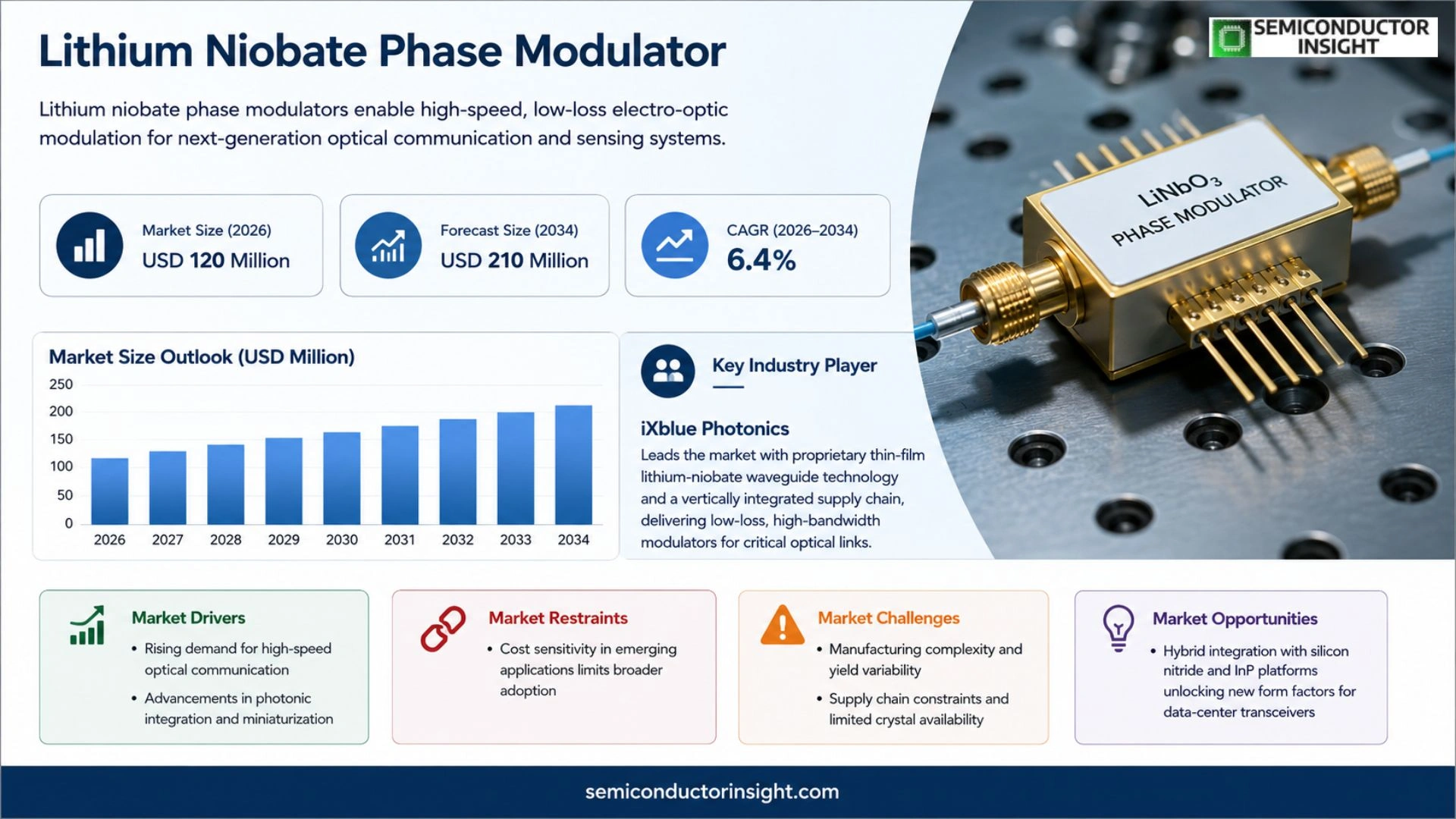
Lithium Niobate Phase Modulator market is projected to grow from USD 120 million in 2026 to USD 210 million by 2034, exhibiting a CAGR of 6.4% during the forecast period.
Lithium niobate phase modulators are electro‑optic components that convert electrical signals into precise optical phase shifts using the strong Pockels effect of LiNbO₃ crystals. They are integral to high‑speed fiber‑optic communication systems, microwave photonic links, and emerging quantum photonics platforms because of their low insertion loss, wide bandwidth, and temperature stability.
The market expansion reflects rising capital expenditure on next‑generation telecom infrastructure, growing adoption of coherent optical transceivers, and increasing research funding for photonic integration. Moreover, advances in thin‑film lithium niobate technology have lowered production costs and opened new applications in data‑center interconnects. Leading manufacturers such as iXblue Photonics, EOSPACE, Thorlabs, Optilab and Shiweitong Science & Technology Co are scaling capacity and launching diversified product portfolios, which further fuels demand across both established and emerging segments.
MARKET DRIVERS
Advances in Integrated Photonics
The emergence of silicon‑photonic platforms has lowered the cost of packaging and increased the demand for high‑performance electro‑optic components. Within this ecosystem, the Lithium Niobate Phase Modulator Market benefits from the material’s unrivaled bandwidth and low drive voltage, enabling tighter integration of optical transceivers. Companies that can embed LiNbO₃ devices directly onto silicon chips are securing a competitive edge, prompting suppliers to accelerate production cycles.
Growth of 5G and Coherent Optical Networks
Deployments of 5G infrastructure and the shift toward coherent detection in long‑haul fiber networks have heightened the need for precise phase control. Lithium niobate modulators deliver the linearity required for high‑order modulation formats such as 64‑QAM, which directly translates into higher spectral efficiency. This technical fit has motivated network operators to replace legacy bulk‑optic solutions with compact LiNbO₃ modules.
➤ “The ability to achieve sub‑volt Vπ while maintaining low insertion loss positions lithium niobate as the de‑facto choice for next‑generation photonic circuits.”
Beyond telecom, emerging lidar and quantum‑communication prototypes rely on fast, low‑noise phase modulation. The cross‑sector relevance of lithium niobate is expanding the addressable market, prompting OEMs to diversify their product roadmaps around the Lithium Niobate Phase Modulator Market.
MARKET CHALLENGES
Manufacturing Complexity and Yield Variability
Fabricating waveguide structures on lithium niobate requires precision dicing, proton exchange, or annealed ion‑implantation steps. Small deviations in process parameters can lead to propagation losses that erode device performance, making consistent high‑volume output elusive. Manufacturers must invest heavily in process control, which elevates capital expenditures and compresses margins.
Other Challenges
Supply Chain Constraints
The scarcity of high‑purity lithium niobate crystals, coupled with limited global sources, introduces lead‑time uncertainty. When demand spikes, buffer inventories dwindle, forcing end‑users to delay project timelines or seek alternative materials.
MARKET RESTRAINTS
Cost Sensitivity in Emerging Applications
While lithium niobate offers superior electro‑optic performance, its unit price remains higher than that of polymer‑based or silicon‑photonic modulators. For cost‑driven segments such as consumer‑grade Lidar, buyers often prioritize price over marginal gains in bandwidth, limiting broader adoption of the Lithium Niobate Phase Modulator Market in those niches.
MARKET OPPORTUNITIES
Hybrid Integration with Emerging Materials
Research collaborations are demonstrating successful heterogeneous integration of thin‑film lithium niobate onto silicon nitride and InP platforms. This hybrid approach promises to combine the low‑loss waveguiding of silicon nitride with the high Vπ‑efficiency of LiNbO₃, unlocking new form factors for data‑center transceivers. Companies that can commercialize such hybrid modules are poised to capture a sizeable share of the evolving Lithium Niobate Phase Modulator Market.
Lithium Niobate Phase Modulator Market Trends
Shift Toward Sub‑10 GHz Modulation Solutions
The Lithium Niobate Phase Modulator Market is seeing increasing adoption of sub‑10 GHz devices as telecom operators prioritize cost‑effective links for data‑center interconnects. Lower‑frequency designs benefit from reduced drive power requirements and simpler packaging, which translates into shorter time‑to‑market for new infrastructure. Manufacturers are responding by fine‑tuning the electro‑optic coefficient of lithium niobate crystals, enabling higher conversion efficiency without resorting to exotic waveguide geometries. This trend eases supply‑chain constraints because standard silicon‑compatible electrode processes can be reused, allowing OEMs to scale volumes while keeping unit costs competitive. End‑users gain a more predictable performance envelope, which supports incremental upgrades rather than wholesale equipment replacement.
Other Trends
Emergence of High‑Power, Wide‑Band Designs for 30‑40 GHz Applications
At the opposite end of the frequency spectrum, the Lithium Niobate Phase Modulator Market is addressing the demand for high‑bandwidth radio‑frequency front‑ends in aerospace and defense. Engineers are leveraging periodically poled lithium niobate structures to achieve broader phase‑shift bandwidths while maintaining linearity under high power densities. This approach mitigates the thermal management challenges that traditionally limited operation above 30 GHz. As radar and electronic‑warfare systems require faster pulse shaping, vendors are offering modular packages that integrate driver amplifiers directly onto the crystal substrate, shortening signal paths and reducing insertion loss. The result is a more resilient solution that can survive harsh environments without sacrificing modulation depth.
Strategic Consolidation Among Key Suppliers
Recent years have witnessed a series of alliances and minority‑stake investments among the leading players in the Lithium Niobate Phase Modulator Market. By aligning research initiatives, smaller firms gain access to advanced lithography facilities, while larger incumbents acquire niche IP that accelerates product diversification. This collaborative model shortens development cycles for next‑generation modulators that target emerging photonic‑integrated‑circuit platforms. Customers benefit from a more coherent supply chain, where design specifications are harmonized across multiple product lines, reducing the engineering effort required for system integration. Ultimately, the consolidation reshapes competitive dynamics, shifting the emphasis from isolated product launches to coordinated ecosystem growth.
COMPETITIVE LANDSCAPE
Key Industry Players
Lithium Niobate Phase Modulator Market – Competitive Overview
iXblue Photonics retains a decisive lead in the high‑performance segment, leveraging its proprietary thin‑film lithium‑niobate waveguide technology to deliver low‑loss, high‑bandwidth modulators that dominate defence‑grade optical links. The firm’s extensive IP portfolio, combined with a vertically integrated supply chain that includes in‑house wafer processing and packaging, has translated into a market share that eclipses most rivals. This concentration around a few technically advanced suppliers reflects the steep entry barriers associated with crystal growth, precision etching, and RF‑optimized electrode design, which in turn shape pricing power and long‑term customer lock‑in.
Beyond the top tier, a diverse cohort of specialist manufacturers such as EOSPACE, Thorlabs, Optilab, Shiweitong Science & Technology, AFR, Crystrong Photonics and Conquer broaden the competitive field by targeting niche applications,ranging from quantum‑photonic experiments to telecom‑grade coherent transceivers. These players differentiate through modular form‑factors, customized drive circuitry, or cost‑effective bulk‑material solutions, thereby creating pockets of price competition and fostering incremental innovation. Their agility in responding to regional procurement demands,particularly in China and Europe,adds a layer of geographical fragmentation that larger incumbents must account for in their go‑to‑market strategies.
List of Key Lithium Niobate Phase Modulator Companies Profiled
- iXblue Photonics
- EOSPACE
- Thorlabs
- Optilab
- Shiweitong Science & Technology Co
- AFR
- Crystrong Photonics
- Conquer
- Gooch & Housego
- Fujitsu
- Mitsubishi Electric
- NTT Electronics
- Huber+Suhner
- Sumitomo Electric
- Viavi Solutions
Segment Analysis:
| Segment Category | Sub-Segments | Key Insights |
| By Type |
|
Below 10 GHz
|
| By Application |
|
Optical Fiber Communication
|
| By End User |
|
Telecom Operators
|
| By Frequency Stability |
|
High Stability
|
| By Integration Level |
|
Fully Integrated PIC
|
Regional Analysis: Lithium Niobate Phase Modulator Market
Asia-Pacific
The bulk of wafer processing resides in semiconductor parks across Taiwan and Singapore, where precision lithography aligns with regional talent pipelines. This concentration trims production overhead and accelerates new‑design qualification cycles, a decisive factor for OEMs chasing time‑to‑market.
Government subsidies for photonic R&D in Japan and Korea lower capital barriers for startups, fostering a vibrant pool of niche innovators that feed larger system developers with bespoke modulation solutions.
Beyond telecom, defense contractors in the region are experimenting with lithium niobate devices for secure satellite links, expanding the market’s addressable end‑use spectrum and prompting cross‑industry collaborations.
Universities in Singapore and Hong Kong produce a steady stream of photonics graduates, bolstering the R&D workforce and enabling rapid iteration of modulation formats tailored to emerging standards.
North America
The United States retains a strong foothold in high‑value system integration, yet its manufacturing footprint lags behind Asia‑Pacific. Industry consensus points to a strategic shift: firms are forging supply‑chain alliances with East Asian fabs to offset domestic capacity gaps. Concurrently, defense agencies prioritize lithium niobate modulators for secure, low‑latency communications, creating a niche demand that sustains specialty suppliers. The market narrative here emphasizes partnership over outright production, with a focus on intellectual property protection and regulatory compliance for defense contracts.
Europe
European stakeholders view the Lithium Niobate Phase Modulator Market through the lens of sustainability and standards harmonization. The EU’s commitment to green telecom infrastructure drives investments in energy‑efficient photonic components, where lithium niobate’s low insertion loss is a selling point. Moreover, collaborative frameworks such as the Photonics12 initiative pool resources across Germany, France, and the Netherlands, enabling joint prototyping that shortens development timelines for datacenter interconnects and rail signaling systems.
South America
In South America, market momentum is modest but gaining purpose as national broadband expansions reach remote locales. Countries like Brazil are evaluating lithium niobate modulators for ruggedized fiber links that endure tropical climates. Procurement strategies favor long‑term service agreements with established Asian manufacturers, balancing cost considerations with the need for reliable performance in emerging metro networks.
Middle East & Africa
The Middle East & Africa region is at an early adoption stage, yet strategic telecom projects in the Gulf and South Africa signal a budding appetite for high‑capacity optical links. Investment plans often bundle lithium niobate modulators with broader smart‑city initiatives, where low‑power, high‑speed connectivity underpins IoT deployments. Local firms are increasingly looking to partner with Asian OEMs to import expertise while nurturing homegrown engineering talent for future scale‑up.
Report Scope
This market research report provides a comprehensive analysis of the Lithium Niobate Phase Modulator Market , covering the forecast period 2026–2034. It offers detailed insights into market dynamics, technological advancements, competitive landscape, and key trends shaping the industry.
Key focus areas of the report include:
- Market Overview: The report begins with an overview outlining its current market scenario, key growth indicators, and industry transformation drivers. It discusses macroeconomic factors, demand–supply balance, regulatory landscape, and the strategic role of semiconductors in powering advancements across industries such as automotive, telecommunications, consumer electronics, and industrial automation.
- Market Size & Forecast: Historical data and future projections for revenue, unit shipments, and market value across major regions and segments.
- Segmentation Analysis: Detailed breakdown by product type, technology, application, and end-user industry to identify high-growth segments and investment opportunities.
- Regional Insights: Insights into market performance across North America, Europe, Asia-Pacific, Latin America, and the Middle East & Africa, including country-level analysis where relevant.
- Competitive Landscape: Profiles of leading market participants, including their product offerings, R&D focus, manufacturing capacity, pricing strategies, and recent developments such as mergers, acquisitions, and partnerships.
- Technology Trends & Innovation: Assessment of emerging technologies, integration of AI/IoT, semiconductor design trends, fabrication techniques, and evolving industry standards.
- Market Drivers & Restraints: Evaluation of factors driving market growth along with challenges, supply chain constraints, regulatory issues, and market-entry barriers.
- Stakeholder Insights: Insights for component suppliers, OEMs, system integrators, investors, and policymakers regarding the evolving ecosystem and strategic opportunities.
Primary and secondary research methods are employed, including interviews with industry experts, data from verified sources, and real-time market intelligence to ensure the accuracy and reliability of the insights presented.
FREQUENTLY ASKED QUESTIONS:
What is the current market size of Lithium Niobate Phase Modulator Market?
-> Lithium Niobate Phase Modulator market is projected to grow from USD 120 million in 2026 to USD 210 million by 2034, exhibiting a CAGR of 6.4%
Which key companies operate in Lithium Niobate Phase Modulator Market?
-> Key players include iXblue Photonics, EOSPACE, Thorlabs, Optilab, Shiweitong Science & Technology Co, AFR, Crystrong Photonics, Conquer, among others.
What are the key growth drivers?
-> Key growth drivers include increasing demand for high‑speed optical fiber communication, expansion of radio‑frequency applications, and ongoing advancements in photonic integration technologies.
Which region dominates the market?
-> Regional dominance information is not specified in the provided data.
What are the emerging trends?
-> Emerging trends include the development of broadband lithium‑niobate modulators, integration of lithium niobate on silicon platforms, and focus on compact, low‑power photonic devices.

Get Sample Report PDF for Exclusive Insights
Report Sample Includes
- Table of Contents
- List of Tables & Figures
- Charts, Research Methodology, and more...
 Download Sample Report PDF