Lithium Battery Charging Protection Integrated Circuit (IC) Market Insights
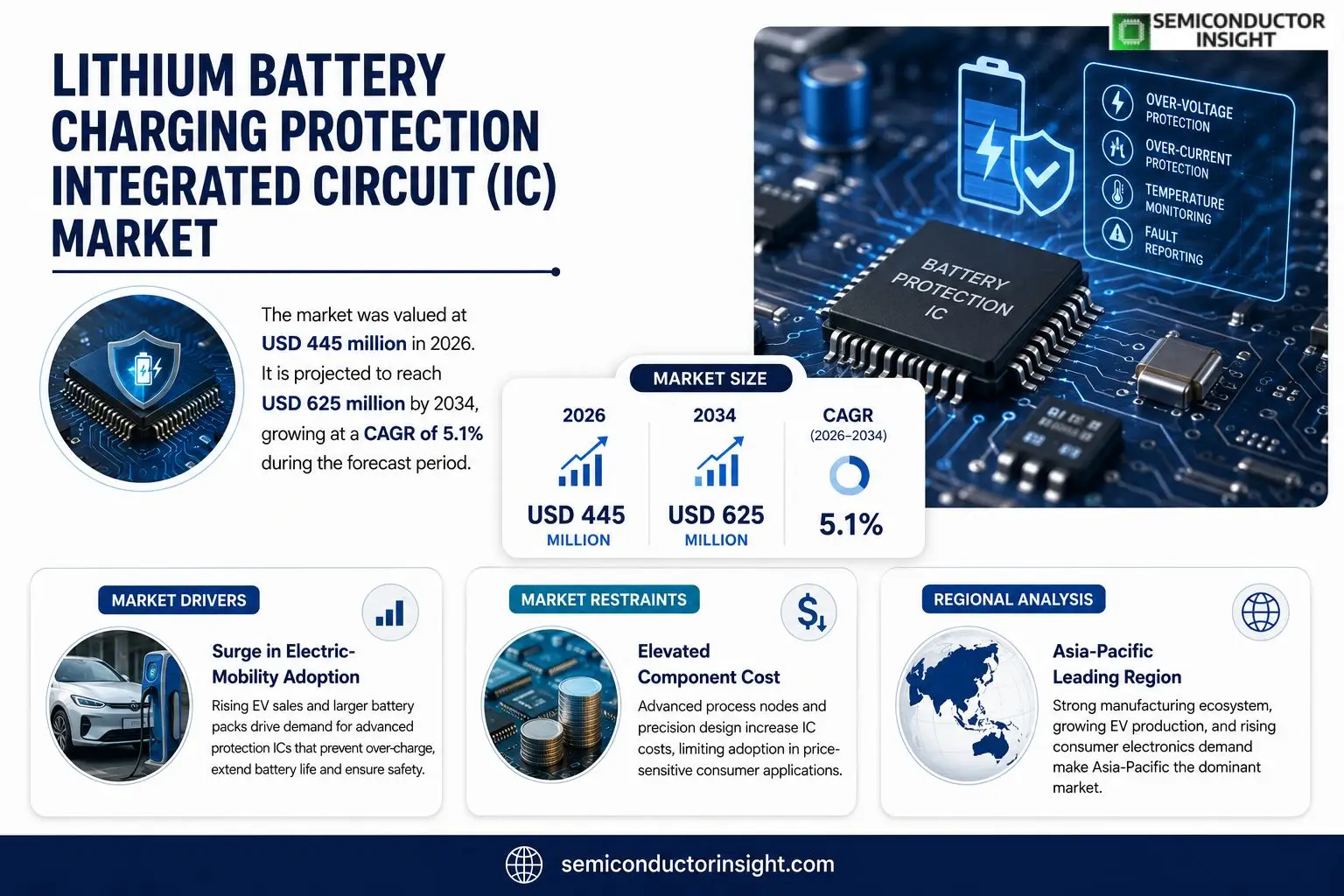
Lithium Battery Charging Protection Integrated Circuit (IC) market size was valued at USD 445 million in 2026. Forecasts indicate growth reaching USD 625 million by 2034, reflecting a CAGR of 5.1 % over the period.
Lithium Battery Charging Protection Integrated Circuits are specialized semiconductor devices that continuously monitor battery voltage during charging cycles. When an over‑voltage condition is detectedoften within millivolt accuracythe IC triggers an internal power MOSFET to disconnect the charger, thereby preventing over‑charging and extending cell lifespan. Additional functions such as temperature sensing and fault signaling make these ICs indispensable across consumer electronics, automotive power‑train modules, and industrial equipment.
MARKET DRIVERS
Surge in Electric‑Mobility Adoption
The acceleration of electric‑vehicle (EV) sales across North America, Europe and Asia has forced OEMs to prioritize safety at the cell level. Integrated protection ICs now sit at the heart of every charging architecture, preventing over‑charge, over‑discharge and short‑circuit events that could otherwise damage high‑energy packs. This shift translates into a steady influx of design contracts for suppliers that can deliver compact, low‑loss solutions.
Expansion of Portable‑Electronics Portfolio
Smartphones, wearables and power‑tool manufacturers are embedding larger lithium cells to meet consumer expectations for runtime. As battery capacities climb, the margin for error shrinks, prompting designers to adopt more sophisticated protection ICs that can operate within tighter voltage windows while maintaining high efficiency. The result is a broadened addressable market beyond automotive applications.
➤ “Safety‑grade protection ICs have become a non‑negotiable component in modern lithium‑ion designs.”
Regulatory bodies in the EU and the US have tightened certification criteria, making compliance a decisive competitive factor. Companies that embed Lithium Battery Charging Protection Integrated Circuit (IC) Market expertise into early‑stage product development gain faster time‑to‑market and lower redesign costs, reinforcing the upward momentum.
MARKET CHALLENGES
Thermal Management Complexity
High‑current fast‑charging regimes generate localized heat pockets that stress protection circuitry. Designers must balance thermal dissipation against silicon area, often resorting to multi‑chip solutions that inflate bill‑of‑materials. This engineering tug‑of‑war slows product cycles and raises development expenditures.
Other Challenges
Supply Chain Volatility
Fluctuations in semiconductor fab capacity and raw‑material price spikes force manufacturers to hold larger safety stocks, eroding margins and complicating demand‑forecast accuracy.
MARKET RESTRAINTS
Elevated Component Cost
The advanced process nodes required for ultra‑low‑leakage protection ICs carry a premium. End‑users in price‑sensitive consumer segments often defer adoption in favor of legacy solutions, limiting overall market penetration despite technical superiority.
MARKET OPPORTUNITIES
Smart Integration with Battery‑Management Systems
Emerging BMS platforms that leverage AI‑based state‑of‑charge prediction are seeking tightly coupled protection ICs capable of real‑time communication. Vendors that can embed programmable safety thresholds and telemetry within a single footprint stand to capture a sizable share of next‑generation EV and IoT device designs, fueling growth in Lithium Battery Charging Protection Integrated Circuit (IC) Market.
Lithium Battery Charging Protection Integrated Circuit (IC) Market Trends
Precision Over‑charge Detection Fuels Adoption
The market’s trajectory is being shaped by the circuit’s ability to pinpoint an over‑charge condition within millivolt tolerances. Manufacturers that embed such fine‑grained voltage monitoring into their ICs are seeing stronger acceptance in smartphones and wearables, where a single excess volt can impair battery lifespan. This technical advantage translates into reduced warranty claims and longer product refresh cycles, prompting OEMs to prioritize suppliers that guarantee that level of precision. As a result, the segment’s revenue is climbing steadily, reflecting a clear alignment between product reliability concerns and the differentiation offered by a high‑resolution protection IC. Cost analysis shows that the incremental silicon area required for high‑resolution monitoring adds less than 5% to bill‑of‑materials, a margin most OEMs accept in exchange for extended warranty periods. Looking ahead, the convergence of fast‑charging standards with precise protection circuitry is expected to become a decisive factor in product road‑maps.
Other Trends
Demand from Consumer Electronics
Portable devices continue to dominate the demand pool, yet the growth is no longer driven solely by unit volume. End‑users increasingly scrutinize safety certifications, prompting brands to source ICs that comply with stringent international standards. Parallel to this, the surge in ultra‑thin form‑factor gadgets has created pressure on chip designers to shrink footprint without sacrificing protection performance. Companies that successfully integrate protection logic into a single die are capturing a larger share of contracts from flagship product lines, thereby reinforcing the market’s shift toward more integrated solutions. In addition, emerging regulatory frameworks in the European Union mandate over‑charge protection thresholds tighter than 0.1 V, pushing suppliers to certify their designs across multiple jurisdictions. These compliance demands are especially pronounced in the fast‑growing markets of Southeast Asia, where consumer adoption of premium wearables is accelerating.
Shift Toward Multi‑String Protection in Automotive Systems
Automotive electrification introduces battery packs that consist of multiple series strings, each requiring independent oversight. Suppliers that extend protection capabilities beyond single‑string architectures are positioning themselves to meet the safety regulations of next‑generation electric vehicles. This evolution is prompting design teams to reevaluate thermal management and fault isolation strategies, because a fault in one string must be isolated quickly to prevent cascading failures. Firms that can deliver modular, multi‑string IC portfolios are seeing a surge in pilot projects with Tier‑1 automotive partners, suggesting a durable revenue stream as vehicle architectures become more complex. Regional supply considerations are also reshaping vendor selection; manufacturers with fabs located in Asia are able to shorten lead times, a crucial advantage as automotive OEMs compress development cycles. Consequently, the competitive landscape is tilting toward players that can combine multi‑string functionality with agile production capabilities.
COMPETITIVE LANDSCAPEKey Industry Players
Competitive Overview of Lithium Battery Charging Protection IC Market
The market is anchored by a few powerhouses that have translated scale into deep design‑win relationships with major OEMs. Texas Instruments commands a sizeable share thanks to its extensive portfolio that couples precision voltage detection with integrated MOSFET drivers, a combination prized by automotive and consumer‑electronics manufacturers seeking compact, high‑reliability solutions. Analog Devices leverages its analog‑signal expertise to deliver highly accurate over‑charge detection blocks, positioning itself as the go‑to supplier for premium‑grade devices where tolerance margins are tight. ON Semiconductor, with its heritage in automotive safety components, has built a niche around ruggedized protection ICs that satisfy the stringent qualification regimes of electric‑vehicle battery packs. Collectively, these firms shape a market structure where high‑volume production, robust IP libraries, and entrenched engineering support create barriers to entry for smaller entrants.Beyond the tier‑one manufacturers, a diverse cohort of specialized companies adds depth to the competitive set. RICOH Electronic Devices and ABLIC focus on single‑string protection circuits optimized for portable electronics, capitalizing on low‑power footprints. Mitsumi Electric and Seiko Instruments have cultivated strong relationships in the industrial‑equipment segment, offering multi‑string architectures that support modular battery designs. HYCON Technology and Htsemi bring niche innovations in voltage‑threshold calibration, attracting niche OEMs that prioritize custom safety parameters. Foshan Blue Rocket Electronics, while less visible ly, supplies cost‑effective solutions to emerging markets, illustrating how price competitiveness can secure volume in rapidly growing regions. Diodes Incorporated rounds out the field with a broad catalog that spans both consumer and automotive applications, underscoring the value of a one‑stop catalog for design teams.
List of Key Lithium Battery Charging Protection Integrated Circuit Companies Profiled
- Texas Instruments
- Analog Devices
- ON Semiconductor
- Diodes Incorporated
- RICOH Electronic Devices
- ABLIC
- Mitsumi Electric
- HYCON Technology
- Seiko Instruments
- Foshan Blue Rocket Electronics
- Htsemi
- Texas Instruments
Segment Analysis:
| Segment Category | Sub-Segments | Key Insights |
| By Type |
|
Single String Protection is emerging as the preferred choice because it delivers precise voltage monitoring for individual cell strings, enabling tighter control over charge termination.
|
| By Application |
|
Consumer Electronics drives the narrative through relentless demand for portable power.
|
| By End User |
|
Portable Devices remain the core end‑user segment, influencing design priorities.
|
| By Architecture |
|
Integrated Power Management is gaining traction as system designers seek consolidated solutions.
|
| By Functionality |
|
Over‑Voltage Protection continues to be the cornerstone of protection strategies.
|
Regional Analysis: Lithium Battery Charging Protection Integrated Circuit (IC) Market
Asia‑Pacific
OEMs in the region are integrating protection ICs directly into battery management modules, shortening wiring complexity and improving fault detection latency. The shift reflects a strategic emphasis on safety certifications that align with regional emission standards, encouraging suppliers to tailor solutions for specific vehicle architectures.
High‑end smartphones and emerging wearable devices rely on compact protection ICs to sustain longer charge cycles. Manufacturers are favoring chips that combine voltage regulation with predictive thermal management, a combination that supports slimmer form factors demanded by Asian consumers.
Automation firms are embedding protection ICs within power‑tool controllers and unmanned warehouse robots. The emphasis is on fault‑tolerant designs that can endure harsh temperature swings, a requirement shaped by the region’s diverse climatic zones.
Recent revisions to safety directives in China and Japan mandate real‑time monitoring of charge parameters, prompting OEMs to adopt ICs that meet tighter compliance thresholds and enabling local vendors to differentiate through certification expertise.
North America
The North American market is shaped by a mature automotive ecosystem that values incremental safety enhancements. Tier‑one suppliers are leveraging domestically sourced protection ICs to satisfy both federal safety guidelines and the evolving expectations of fleet operators. In the consumer sector, premium device manufacturers prioritize silicon that delivers precise over‑current handling, an attribute that aligns with the region’s high‑price, high‑performance product positioning. Industry consortia focused on battery safety are catalyzing cross‑company collaboration, encouraging the development of standards that could influence supplier roadmaps across the continent.
Europe
European stakeholders combine stringent emissions legislation with a strong push for circular economy practices. Automakers are increasingly demanding protection ICs that not only safeguard cells but also support diagnostic data export for recycling processes. Energy‑storage projects in Germany and the Nordics favor ICs capable of long‑term reliability under variable grid conditions. The regulatory environment, characterized by proactive safety directives, is prompting manufacturers to embed more sophisticated fault‑isolation features directly into chip architecture.
South America
In South America, nascent electric‑mobility initiatives are driving interest in affordable protection ICs that can be integrated into locally assembled battery packs. Governments are offering incentives for renewable‑energy storage, creating a modest yet growing demand for reliable charge‑protection solutions. OEMs are experimenting with region‑specific thermal profiles, reflecting the diverse climates across the continent, and this experimentation is prompting localized customization of IC firmware.
Middle East & Africa
The Middle East & Africa region presents a unique blend of high‑temperature operating environments and emerging infrastructure projects. Utilities expanding solar‑to‑storage capacity are selecting protection ICs that can tolerate prolonged exposure to heat while maintaining precise voltage thresholds. In the automotive sphere, luxury vehicle importers are beginning to specify safety‑grade ICs to align with brand expectations, signaling an early stage of market maturation that could accelerate with further policy support.
Report Scope
This market research report provides a comprehensive analysis of the Lithium Battery Charging Protection Integrated Circuit (IC) Market , covering the forecast period 2026–2034. It offers detailed insights into market dynamics, technological advancements, competitive landscape, and key trends shaping the industry.
Key focus areas of the report include:
- Market Overview: The report begins with an overview outlining its current market scenario, key growth indicators, and industry transformation drivers. It discusses macroeconomic factors, demand–supply balance, regulatory landscape, and the strategic role of semiconductors in powering advancements across industries such as automotive, telecommunications, consumer electronics, and industrial automation.
- Market Size & Forecast: Historical data and future projections for revenue, unit shipments, and market value across major regions and segments.
- Segmentation Analysis: Detailed breakdown by product type, technology, application, and end-user industry to identify high-growth segments and investment opportunities.
- Regional Insights: Insights into market performance across North America, Europe, Asia-Pacific, Latin America, and the Middle East & Africa, including country-level analysis where relevant.
- Competitive Landscape: Profiles of leading market participants, including their product offerings, R&D focus, manufacturing capacity, pricing strategies, and recent developments such as mergers, acquisitions, and partnerships.
- Technology Trends & Innovation: Assessment of emerging technologies, integration of AI/IoT, semiconductor design trends, fabrication techniques, and evolving industry standards.
- Market Drivers & Restraints: Evaluation of factors driving market growth along with challenges, supply chain constraints, regulatory issues, and market-entry barriers.
- Stakeholder Insights: Insights for component suppliers, OEMs, system integrators, investors, and policymakers regarding the evolving ecosystem and strategic opportunities.
Primary and secondary research methods are employed, including interviews with industry experts, data from verified sources, and real-time market intelligence to ensure the accuracy and reliability of the insights presented.
FREQUENTLY ASKED QUESTIONS:
What is the current market size of Lithium Battery Charging Protection Integrated Circuit (IC) Market?
-> Lithium Battery Charging Protection Integrated Circuit (IC) Market was valued at USD 445 million in 2026 and is expected to reach USD 625 million by 2034, growing at a CAGR of 5.1% during the forecast period.
Which key companies operate in Lithium Battery Charging Protection Integrated Circuit (IC) Market?
-> Key players include Analog Devices, ON Semiconductor, RICOH Electronic Devices, Texas Instruments, Diodes Incorporated, ABLIC, Mitsumi Electric, HYCON Technology, Seiko Instruments, Foshan Blue Rocket Electronics, Htsemi.
What are the primary growth drivers for this market?
-> Growth is driven by the rising adoption of lithium‑ion batteries in consumer electronics, increasing demand for over‑charge protection in electric vehicles, and the expanding IoT ecosystem that requires reliable power management solutions.
Which region dominates Lithium Battery Charging Protection Integrated Circuit (IC) Market?
-> Asia-Pacific leads the market, owing to strong manufacturing bases in China, Japan, and South Korea, as well as rapid growth of consumer electronics and EV production in the region.
What emerging trends are shaping the market?
-> Emerging trends include integration of ultra‑precise over‑voltage detection circuits, development of single‑chip protection solutions for multi‑cell packs, and increasing focus on low‑power consumption designs for wearables and IoT devices.
Get Sample Report PDF for Exclusive Insights
Report Sample Includes
- Table of Contents
- List of Tables & Figures
- Charts, Research Methodology, and more...
 Download Sample Report PDF