LIN Transceiver Market Insights
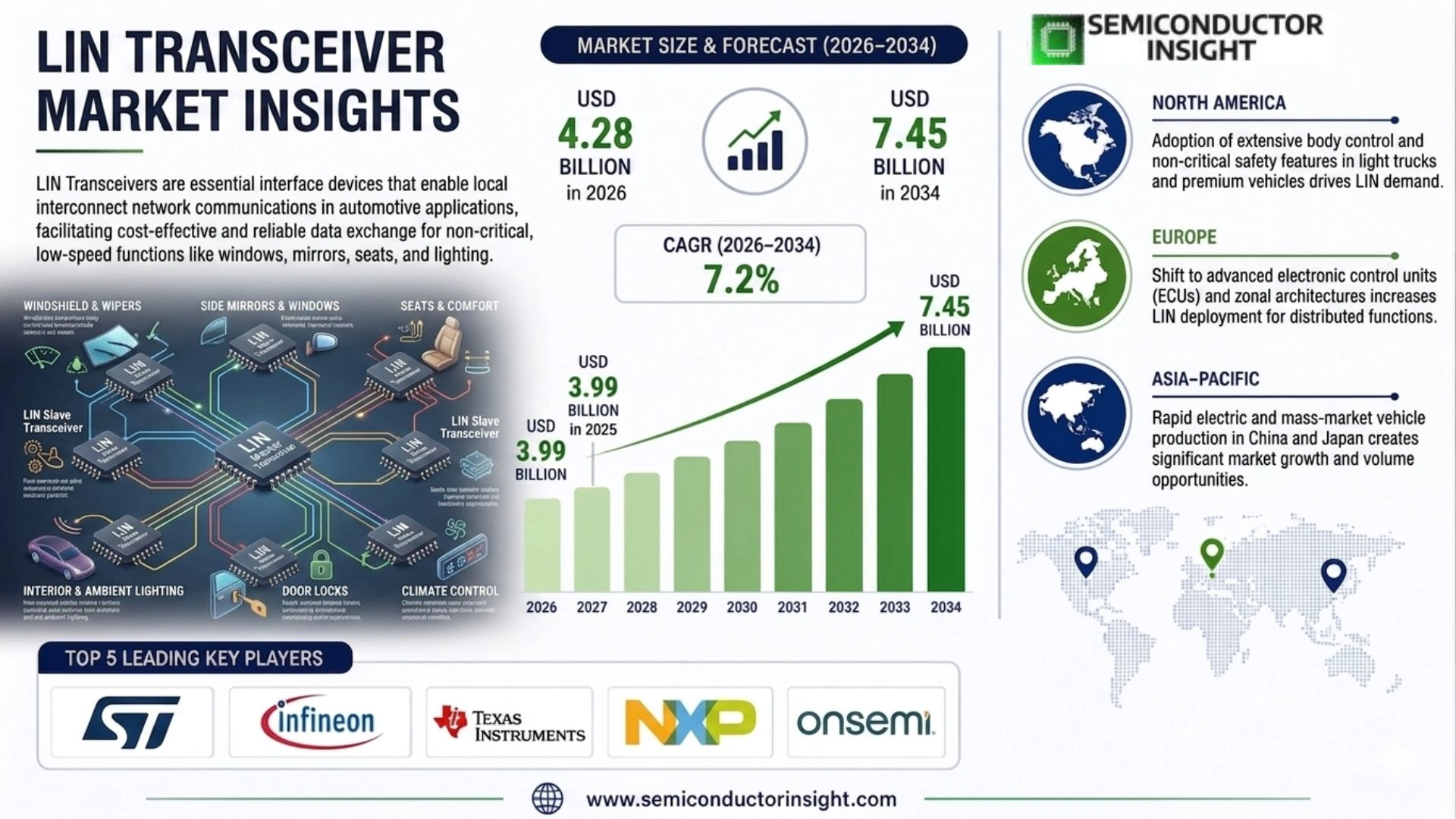
LIN Transceiver Market size was valued at USD 3.99 billion in 2025. The market is projected to grow from USD 4.28 billion in 2026 to USD 7.45 billion by 2034, exhibiting a CAGR of 7.2% during the forecast period.
LIN transceivers serve as essential interface components for the Local Interconnect Network (LIN) protocol, a low-cost, single-wire serial communication system widely deployed in automotive electronics. These devices facilitate reliable data exchange between microcontrollers and the LIN bus, enabling efficient networking of sensors, actuators, and control modules where high-speed performance is not critical.
The market is experiencing steady growth driven by the increasing integration of electronic features in vehicles, rising demand for cost-effective body electronics solutions, and the expansion of vehicle production globally. LIN technology complements higher-speed protocols like CAN by providing economical connectivity for non-critical subsystems such as door modules, seat controls, steering wheels, climate systems, and lighting applications. Furthermore, advancements in vehicle electrification and the proliferation of advanced driver assistance features continue to support broader adoption of LIN networks.
Key players continue to innovate with enhanced transceiver solutions featuring improved electromagnetic compatibility, lower power consumption, and multi-channel capabilities. NXP Semiconductors, Texas Instruments, STMicroelectronics, Infineon Technologies, and Microchip Technology maintain strong positions through extensive product portfolios tailored for automotive-grade reliability and performance. Ongoing industry initiatives focus on supporting software-defined vehicle architectures while maintaining the simplicity and cost advantages that make LIN transceivers indispensable in modern automotive designs.
MARKET DRIVERS
Rising Integration of Electronics in Modern Vehicles
LIN Transceiver Market is experiencing robust growth driven by the increasing number of electronic control units (ECUs) in passenger and commercial vehicles. LIN transceivers provide a cost-effective, single-wire communication solution for non-critical body functions such as seat controls, window lifts, and HVAC systems, enabling reliable data exchange at lower costs compared to higher-speed protocols.
Expansion of Electric and Connected Vehicles
Growing adoption of electric vehicles (EVs) and connected car technologies is accelerating demand for LIN transceivers. These components support efficient management of auxiliary systems in EVs, including battery management interfaces and comfort features, while aligning with the shift toward software-defined vehicles that require scalable, low-power networking solutions. Market projections indicate steady expansion supported by these automotive megatrends.
➤ LIN transceivers continue to play a vital role in hybrid network architectures, complementing CAN and Ethernet buses for optimized vehicle communication.
Advancements in LIN technology, including improved electromagnetic compatibility and integration with system basis chips, further propel market growth by enhancing overall system efficiency and reducing development complexity for automakers.
MARKET CHALLENGES
Competition from Higher-Speed Protocols
LIN Transceiver Market faces notable challenges from alternative communication protocols like CAN, FlexRay, and Ethernet, which offer superior bandwidth and functionality for advanced applications. As vehicles incorporate more data-intensive features, LIN’s low-speed nature can limit its applicability in certain high-performance segments.
Other Challenges
Integration Complexity
Complex integration with existing vehicle electronics and software systems requires specialized expertise, often extending development timelines and increasing costs for manufacturers.
Supply Chain and Regulatory Pressures
Ongoing semiconductor supply chain disruptions combined with stringent automotive safety and environmental regulations pose additional hurdles, impacting production scalability and compliance efforts across the industry.
MARKET RESTRAINTS
Limited Bandwidth and Speed Constraints
A primary restraint LIN Transceiver Market is the protocol’s inherent limitation to low-speed, low-bandwidth communication, typically up to 20 kbps. This restricts its use in applications demanding higher data rates, pushing automakers toward hybrid or alternative networking solutions in more sophisticated vehicle architectures.
High Development and Compliance Costs
Rising costs associated with advanced feature integration, raw materials, and adherence to evolving regulatory standards continue to restrain broader market penetration, particularly among smaller manufacturers or in cost-sensitive vehicle segments. These factors necessitate continuous investment in R&D to maintain competitiveness.
MARKET OPPORTUNITIES
Advancements in Vehicle Electrification and ADAS
Significant opportunities exist LIN Transceiver Market through the rapid electrification of vehicles and integration into advanced driver assistance systems (ADAS). LIN transceivers enable cost-effective connectivity for sensors and actuators in safety and comfort applications, supporting the development of smarter, more efficient automotive platforms.
Emergence of Software-Defined and Connected Vehicles
The transition to software-defined vehicles and rising demand for connected mobility solutions open new avenues for innovative LIN transceiver designs with enhanced power efficiency, multi-channel capabilities, and better diagnostic features. Expansion in emerging markets and aftermarket services further contributes to long-term growth potential.
Trends
Growing Integration in Automotive Body Electronics
LIN Transceiver Market continues to expand as automakers increasingly incorporate electronic features across vehicle platforms. LIN transceivers serve as essential interface components for the Local Interconnect Network protocol, enabling reliable single-wire serial communication for non-critical subsystems. These devices efficiently connect sensors, actuators, and control modules in applications where high-speed data transfer is unnecessary, providing a cost-effective complement to faster protocols like CAN.
Vehicle manufacturers are leveraging LIN technology for door modules, seat controls, steering wheel functions, climate control systems, and lighting applications. This approach supports broader networking while maintaining simplicity and reducing overall system costs. The rising global vehicle production, combined with consumer demand for enhanced comfort and convenience features, drives steady adoption of LIN-based solutions in modern automotive designs.
Other Trends
Advancements in Vehicle Electrification
Electrification trends are reshaping automotive architectures, creating new opportunities for LIN transceivers. As vehicles incorporate more electric components and advanced driver assistance systems, LIN networks provide economical connectivity for supporting functions. Transceiver manufacturers are responding with innovations focused on improved electromagnetic compatibility, reduced power consumption, and enhanced multi-channel capabilities to meet the reliability standards required in electrified powertrains and electronic control units.
Support for Software-Defined Vehicle Architectures
Industry initiatives are advancing software-defined vehicle concepts while preserving the core advantages of LIN technology. LIN transceivers enable efficient data exchange between microcontrollers and the LIN bus, supporting modular designs that facilitate over-the-air updates and flexible feature implementation. This balance of simplicity and performance positions LIN solutions as indispensable elements in next-generation automotive electronics.
Evolution of Key Player Strategies
Leading semiconductor companies continue to strengthen their positions LIN Transceiver Market through targeted product development. NXP Semiconductors, Texas Instruments, STMicroelectronics, Infineon Technologies, and Microchip Technology offer extensive portfolios designed for automotive-grade reliability. These firms emphasize features such as robust electromagnetic performance and low-power operation to address evolving requirements in body electronics and comfort systems.
The competitive landscape reflects ongoing efforts to optimize transceiver solutions for diverse vehicle platforms. Manufacturers are focusing on integration capabilities that allow seamless operation within mixed-protocol environments, ensuring LIN transceivers remain relevant as automotive networks grow more complex. This strategic innovation supports sustained market momentum amid broader industry shifts toward connected and electrified mobility solutions.
Overall, LIN Transceiver Market demonstrates resilience through its focus on practical, cost-efficient networking solutions that align with current automotive priorities. Continued emphasis on performance improvements and application-specific designs will likely support further integration across global vehicle production in the coming years.
COMPETITIVE LANDSCAPE
Key Industry Players
LIN Transceiver Market Competitive Analysis
LIN Transceiver Market is led by a select group of semiconductor giants with deep expertise in automotive networking solutions. NXP Semiconductors stands out as a dominant player, offering a comprehensive portfolio of LIN transceivers known for superior electromagnetic compatibility, low power consumption, and robust automotive-grade reliability. The market structure features a moderately concentrated competitive landscape where leading firms leverage extensive R&D capabilities, strong OEM relationships, and broad product lines to maintain significant market shares, while addressing the growing demands of vehicle electrification and body electronics applications.
Other significant players carve out niches through specialized innovations in multi-channel designs, enhanced integration, and cost-optimized solutions for specific vehicle subsystems. Companies such as Infineon Technologies, STMicroelectronics, and Texas Instruments continue to strengthen their positions by developing transceivers that support software-defined vehicle architectures and meet stringent industry standards for performance and efficiency. This dynamic environment fosters ongoing technological advancements in LIN protocol implementations across global automotive supply chains.
List of Key LIN Transceiver Companies Profiled
- NXP Semiconductors
- Texas Instruments
- STMicroelectronics
- Infineon Technologies
- Microchip Technology
- Renesas Electronics
- ON Semiconductor
- Analog Devices
- Melexis
- ROHM Semiconductor
- Maxim Integrated
- Elmos Semiconductor
- Diodes Incorporated
Segment Analysis:
| Segment Category | Sub-Segments | Key Insights |
| By Type |
|
Smart LIN Transceivers lead the segment due to their integrated diagnostic capabilities and enhanced fault detection features that improve system reliability in complex automotive networks. These solutions offer superior electromagnetic compatibility and support seamless integration with microcontrollers for advanced body control applications. Their ability to handle multiple LIN nodes efficiently makes them ideal for modern vehicle architectures focused on cost optimization without compromising performance. Manufacturers prioritize these for applications requiring real-time monitoring and low power operation during vehicle idle states. |
| By Application |
|
Body Electronics represent the dominant application area as LIN transceivers excel in connecting non-critical subsystems such as door locks, window controls, and mirror adjustments. This segment benefits from the protocol’s cost-effectiveness for high-volume, low-bandwidth communication needs. The transceivers enable simplified wiring harnesses and reduced overall vehicle weight while maintaining robust data exchange between various electronic control units. Their deployment supports greater customization of interior features and contributes to improved user comfort and convenience features across vehicle models. |
| By End User |
|
Passenger Vehicles constitute the primary end-user segment owing to the extensive use of LIN networks in everyday comfort and convenience systems. LIN transceivers facilitate reliable communication in densely packed electronic environments typical of modern cars. Their adoption helps manufacturers balance sophisticated feature integration with stringent cost targets. The technology’s maturity and proven reliability make it a preferred choice for high-volume production models where consistent performance in varying environmental conditions is essential for long-term vehicle durability and customer satisfaction. |
| By Channel Configuration |
|
Multi-Channel LIN Transceivers are gaining prominence for their ability to manage several LIN sub-networks simultaneously through a single device. This configuration reduces component count and simplifies electronic control unit design significantly. They provide excellent scalability for vehicles incorporating expanding arrays of smart sensors and actuators. Enhanced versions support independent baud rate settings per channel, offering flexibility in system architecture while ensuring signal integrity across distributed modules. Their use promotes more efficient space utilization on printed circuit boards in compact automotive electronics assemblies. |
| By Feature Set |
|
High EMC Protection feature sets lead due to the demanding electromagnetic environment in automotive applications. These transceivers incorporate advanced filtering and protection mechanisms to ensure uninterrupted communication despite electrical noise from motors, switches, and other high-power components. The robust design supports extended operational life and reduces warranty claims related to communication failures. Integration of such features allows LIN networks to coexist harmoniously with higher-speed protocols like CAN within the same vehicle platform, delivering overall system stability and supporting the trend toward more electrified and electronically dense vehicle designs. |
Regional Analysis: LIN Transceiver Market
Asia-Pacific’s position as a global automotive powerhouse directly influences LIN Transceiver Market dynamics. Dense clusters of vehicle assembly plants require efficient, economical communication buses for door modules, lighting controls, and seat adjustments. Local suppliers continuously refine transceiver integration to support increasing electronic content in vehicles while maintaining affordability for mass-market models.
The region demonstrates strong momentum toward incorporating LIN transceivers in next-generation vehicle platforms. Emphasis on functional safety and energy management in electric vehicles drives demand for robust LIN solutions that operate seamlessly alongside CAN and Ethernet networks, enabling sophisticated body control applications.
Established semiconductor fabrication and packaging facilities across Asia-Pacific enhance supply chain stability for LIN transceivers. Regional players invest in vertical integration strategies, reducing dependency on external sources and ensuring consistent availability of components critical for automotive Tier-1 suppliers.
Collaborative R&D initiatives between universities, government labs, and industry foster advancements in low-power LIN transceiver variants. This environment supports customization for harsh operating conditions typical in diverse Asian climates, strengthening product reliability and market competitiveness.
North America
North America maintains a significant presence LIN Transceiver Market through its advanced automotive research and development centers. The region emphasizes integration of LIN technology in premium vehicles and commercial fleets, focusing on reliability, cybersecurity features, and compliance with strict safety regulations. Leading automakers invest in upgrading electronic architectures where LIN transceivers provide efficient communication for non-critical subsystems. Strong collaboration between semiconductor innovators and vehicle manufacturers accelerates development of specialized solutions suited to autonomous and connected vehicle platforms prevalent in the United States and Canada.
Europe
Europe exhibits mature demand for LIN Transceiver Market solutions, supported by its legacy of automotive engineering excellence and stringent environmental standards. German, French, and Italian manufacturers incorporate LIN networks extensively in body electronics and comfort systems. The region’s focus on sustainable mobility encourages optimization of transceiver designs for reduced power consumption in electric vehicles. Regulatory frameworks promoting vehicle safety and emissions control indirectly support steady adoption of cost-effective LIN technology as part of broader networking strategies across luxury and volume vehicle segments.
South America
South America represents an emerging market for LIN Transceiver Market expansion, with Brazil and Argentina leading automotive production activities. Growing local vehicle manufacturing and increasing electronic content in entry-level models create opportunities for LIN-based communication networks. Economic development and rising consumer demand for modern features drive gradual technology adoption. Regional players focus on adapting global LIN transceiver solutions to meet local cost sensitivities and operating conditions, supported by foreign investments in production facilities that incorporate these components.
Middle East & Africa
The Middle East and Africa region shows developing potential LIN Transceiver Market, primarily linked to expanding automotive assembly operations and aftermarket demand. Countries in the Gulf Cooperation Council invest in smart mobility initiatives, creating avenues for LIN technology in vehicle electronics. Infrastructure development and rising vehicle ownership rates support incremental growth. Market participants emphasize durable, heat-resistant transceiver designs suitable for extreme climatic conditions while aligning with international automotive standards to facilitate technology integration across diverse regional vehicle platforms.
Report Scope
This market research report provides a comprehensive analysis of the LIN Transceiver Market , covering the forecast period 2026–2034. It offers detailed insights into market dynamics, technological advancements, competitive landscape, and key trends shaping the industry.
Key focus areas of the report include:
- Market Overview: The report begins with an overview outlining its current market scenario, key growth indicators, and industry transformation drivers. It discusses macroeconomic factors, demand–supply balance, regulatory landscape, and the strategic role of semiconductors in powering advancements across industries such as automotive, telecommunications, consumer electronics, and industrial automation.
- Market Size & Forecast: Historical data and future projections for revenue, unit shipments, and market value across major regions and segments.
- Segmentation Analysis: Detailed breakdown by product type, technology, application, and end-user industry to identify high-growth segments and investment opportunities.
- Regional Insights: Insights into market performance across North America, Europe, Asia-Pacific, Latin America, and the Middle East & Africa, including country-level analysis where relevant.
- Competitive Landscape: Profiles of leading market participants, including their product offerings, R&D focus, manufacturing capacity, pricing strategies, and recent developments such as mergers, acquisitions, and partnerships.
- Technology Trends & Innovation: Assessment of emerging technologies, integration of AI/IoT, semiconductor design trends, fabrication techniques, and evolving industry standards.
- Market Drivers & Restraints: Evaluation of factors driving market growth along with challenges, supply chain constraints, regulatory issues, and market-entry barriers.
- Stakeholder Insights: Insights for component suppliers, OEMs, system integrators, investors, and policymakers regarding the evolving ecosystem and strategic opportunities.
Primary and secondary research methods are employed, including interviews with industry experts, data from verified sources, and real-time market intelligence to ensure the accuracy and reliability of the insights presented.
FREQUENTLY ASKED QUESTIONS:
What is the current market size of LIN Transceiver Market?
-> LIN Transceiver Market was valued at USD 3.99 billion in 2025 and is expected to reach USD 7.45 billion by 2034.
Which key companies operate LIN Transceiver Market?
-> Key players include NXP Semiconductors, Texas Instruments, STMicroelectronics, Infineon Technologies, and Microchip Technology, among others.
What are the key growth drivers?
-> Key growth drivers include increasing integration of electronic features in vehicles, rising demand for cost-effective body electronics solutions, and the expansion of vehicle production globally.
Which region dominates the market?
-> Asia-Pacific is the fastest-growing region due to high vehicle production volumes, while Europe remains a dominant market with strong automotive innovation focus.
What are the emerging trends?
-> Emerging trends include enhanced electromagnetic compatibility, lower power consumption solutions, multi-channel capabilities, and support for software-defined vehicle architectures.

Get Sample Report PDF for Exclusive Insights
Report Sample Includes
- Table of Contents
- List of Tables & Figures
- Charts, Research Methodology, and more...
 Download Sample Report PDF