LED Stage Illumination Market Insights
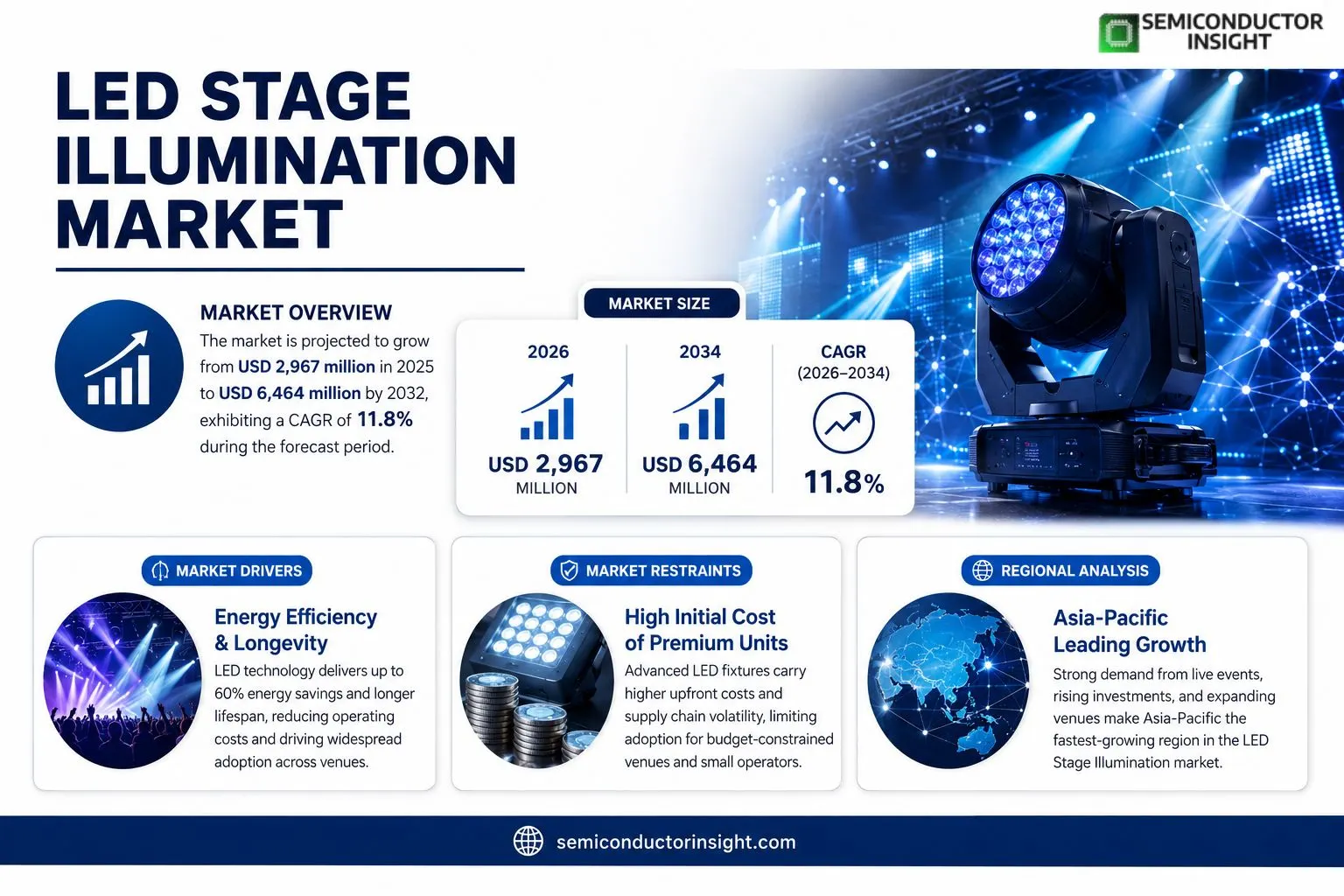
LED Stage Illumination market size was valued at USD 2,967 million in 2025 and is projected to reach USD 6,464 million by 2032, exhibiting a CAGR of 11.8% during the forecast period.
LED Stage Illumination refers to stage lighting instruments that use light‑emitting diodes (LEDs) as a light source. It is employed in performances, events and film productions to deliver basic lighting, color rendering, character modeling, beam effects, pattern projection, strobe or special effects and atmosphere creation. Typical fixtures include fixed units and moving‑head intelligent lights, and they are commonly controlled via DMX/RDM, Art‑Net or sACN networks.The market is expanding because LED technology offers superior energy efficiency and long service life while programmable networking meets the demand for flexible show design. Growth is further supported by the resurgence of live entertainment in North America, Europe and especially the Asia‑Pacific region. Recent product launches from manufacturers such as Martin, ROBE and Chauvet illustrate competitive pressure; for example, in March 2024 Martin introduced a new high‑output moving head that combines pixel‑mapping LEDs with an integrated thermal management system.
MARKET DRIVERS
Energy Efficiency Gains
The shift from conventional discharge lamps to solid‑state sources has trimmed power consumption by up to 60 % in many touring productions. Operators now cite lower electricity bills and reduced cooling loads as primary reasons for adopting LED Stage Illumination Market solutions, allowing venues to reinvest savings into higher‑quality designs.
Advancements in Control Systems
Integration of DMX‑512 over Ethernet and the rise of wireless protocols have turned lighting rigs into modular, software‑driven platforms. This flexibility shortens setup times, mitigates human error, and makes it feasible for smaller crews to execute complex cues, thereby expanding the addressable client base beyond traditional large‑scale venues.
➤ “The ability to program intricate scenes from a tablet has redefined how quickly a show can be adapted for different audiences.” – Senior Lighting Designer
Combined, these technical improvements create a feedback loop: lower operating costs stimulate demand, which fuels further innovation, reinforcing the momentum of LED Stage Illumination Market.
MARKET CHALLENGES
Cost of High‑Performance Units
Top‑tier LED fixtures command premium pricing that can exceed traditional fixtures by 30‑40 %. For budget‑constrained theaters, the upfront outlay remains a barrier, even though lifecycle expenses are lower.
Other Challenges
Supply Chain Volatility
Recent semiconductor shortages have elongated lead times for driver modules, causing project delays and forcing some integrators to revert to legacy inventory.Additionally, the rapid pace of firmware updates requires ongoing staff training, adding a hidden cost that many small venues underestimate.
MARKET RESTRAINTS
Regulatory Hurdles
Local lighting codes in several jurisdictions still reference obsolete efficacy thresholds, obliging manufacturers to submit additional certification paperwork for LED units. The administrative burden slows market entry for innovative products.
Heat‑Dissipation Constraints
Although LEDs generate less heat than traditional lamps, high‑output fixtures packed into compact housings can approach thermal limits, necessitating advanced heat‑sink designs that increase unit weight and cost.
MARKET OPPORTUNITIES
Smart Integration with Event Management Platforms
Embedding lighting control APIs into broader event‑software ecosystems enables synchronized audio‑visual experiences and data‑driven performance analytics. Early adopters are already leveraging these insights to personalize show elements for premium ticket holders, unlocking new revenue streams within LED Stage Illumination Market.
Expansion into Live‑Streaming Productions
Growth of hybrid events drives demand for fixtures that balance on‑stage impact with broadcast‑grade color accuracy. Manufacturers that certify their LEDs for video‑friendly output can tap into a rapidly growing niche that sits at the intersection of entertainment and corporate communication.
LED Stage Illumination Market Trends
Networked Control Adoption Accelerates
LED Stage Illumination Market is witnessing a decisive shift toward fully networked lighting rigs. Integration of DMX/RDM, Art‑Net and sACN protocols enables designers to program complex cues from a single console, slashing rig‑down time and reducing on‑site labor. In 2025, production reached roughly 2.9 million units while capacity stood near 3.8 million, creating a comfortable supply buffer for the surge in demand from touring crews and rental houses. Clients now expect instant colour changes and precise beam shaping, capabilities that are only practicable through digital networking. As venues prioritize operational efficiency, manufacturers are embedding smarter drivers and Ethernet‑ready modules directly into fixtures, turning each luminaire into a connected node within the broader show infrastructure.
Other Trends
Modular Fixture Architecture Gains Traction
Modularity has become a differentiator for vendors competing in LED Stage Illumination Market. By separating optics, power modules and motion mechanics, producers can replace a single component rather than the entire unit, trimming long‑term maintenance costs. This approach aligns with the business models of rental firms that must keep inventory turnover low while guaranteeing high reliability for consecutive shows. Moreover, modular designs simplify upgrades; a newer LED array can be swapped into an existing housing, offering a cost‑effective path to higher lumen output and richer colour palettes without a complete system overhaul.
Asia‑Pacific Shows the Highest Uptake
Regional data indicate that the Asia‑Pacific segment is outpacing other markets in both unit sales and revenue generation. Large‑scale festivals, government‑backed cultural initiatives and a proliferation of multi‑purpose arenas have driven venue owners to invest heavily in programmable lighting solutions. The combination of lower production costs in the region and a burgeoning middle‑class audience eager for immersive experiences creates a fertile environment for suppliers. Companies that can navigate local distribution channels and offer localized support services are better positioned to capture this expanding slice of LED Stage Illumination Market, especially as the region’s live‑event calendar grows richer each year.
COMPETITIVE LANDSCAPE
Key Industry Players
LED Stage Illumination – Competitive Overview
Martin Professional remains the benchmark for high‑end touring rigs, leveraging a broad portfolio that spans moving‑head spotlights, wash fixtures, and atmospheric effects. Its dominance stems from an aggressive R&D pipeline that integrates ultra‑fast DMX/RDM protocols and high‑density LED arrays, allowing it to command premium pricing while sustaining sizable margins. The market architecture reflects a tiered landscape: a handful of multinational OEMs control the bulk of revenue, while a network of regional specialists supplies niche or cost‑sensitive segments. This bifurcation pressures incumbents to expand service contractsmaintenance, firmware upgrades, and spare‑parts logisticsto lock in recurring income streams.Beyond the flagship brands, a vibrant cohort of mid‑size manufacturers fuels product diversity. Companies such as Golden Sea, EK Lights, and ACME focus on modular designs for rental fleets, emphasizing rapid setup and durability. In Asia, firms like Beijing Xingguang Film &TV and Yajiang Photoelectric Equipment capitalize on localized supply chains to offer competitive unit costs, especially for indoor venue applications. Emerging challengers such as Light Sky and Guangzhou Dasen Lighting experiment with hybrid optical engines that blend pixel‑mapping with traditional lens optics, targeting the growing demand for immersive, programmable environments in themed entertainment parks.
List of Key LED Stage Illumination Companies Profiled
- Martin Professional
- ROBE
- Chauvet
- Vari‑Lite (Signify)
- Electronic Theatre Controls (ETC)
- Osram
- Golden Sea
- EK Lights
- ACME
- GTD Lighting
- Beijing Xingguang Film &TV
- Yajiang Photoelectric Equipment
- CKC Lighting
- PR Lighting
- Fine Art
- Light Sky
- Guangzhou Dasen Lighting
- Nightsun
- Hi‑Ltte
- Yingfeng Lighting
- SanHe Lighting Technology
Segment Analysis:
| Segment Category | Sub-Segments | Key Insights |
| By Type |
|
Moving Head Intelligent Lights
|
| By Application |
|
Performance Venues
|
| By End User |
|
Touring Concerts
|
| By Technology Architecture |
|
Pixel‑Mapping LED Fixtures
|
| By Market Positioning |
|
High‑End Touring
|
Regional Analysis: LED Stage Illumination Market
North America
Production houses are integrating high‑density pixel arrays that enable intricate visual narratives. The shift toward DMX‑over‑Ethernet protocols reduces latency, allowing designers to synchronize lighting with audio and video streams more fluidly than ever before.
Energy‑efficiency standards imposed by state bodies encourage venues to retire incandescent fixtures. Compliance audits now reference LED performance metrics, nudging operators toward solutions that meet both safety and sustainability benchmarks.
Domestic component sourcing has been reinforced after recent disruptions. Manufacturers are diversifying silicon wafer suppliers, which stabilizes lead times for critical driver chips used in dimming modules.
Clients increasingly demand color‑mixing capabilities that replicate natural light. This preference fuels R&D into multi‑chip designs that deliver broader spectral coverage without expanding the fixture footprint.
Europe
European festivals and opera houses are embracing LED stage illumination for its adaptability to historic venues where heat load is a critical concern. Designers value the compactness of modern modules, which can be concealed within heritage architecture without compromising aesthetic integrity. Moreover, EU energy directives reward installations that demonstrably lower consumption, prompting venue owners to prioritize LED upgrades during capital refurbishment cycles. Collaborative projects across borders also spread best‑practice standards, ensuring that emerging markets in Eastern Europe quickly align with Western design expectations.
Asia‑Pacific
The Asia‑Pacific region exhibits a rapid maturation of its live‑event sector, fueled by burgeoning middle‑class audiences and government incentives for cultural programming. Large‑scale concerts in megacities demand lighting that can handle extreme ambient conditions, and LED solutions meet that need with robust thermal management. Local manufacturers are scaling production to capture price‑sensitive markets, while major international brands set up regional design studios to tailor content for diverse cultural aesthetics. This hybrid approach cultivates a competitive landscape where cost efficiency and creative flexibility coexist.
South America
In South America, the growth of outdoor festivals and urban cultural precincts has spotlighted the cost‑benefit profile of LED stage illumination. Operators appreciate the reduced logistics of lighter fixtures, which translate into lower freight expenses on continent‑wide tours. At the same time, regional trade agreements are easing tariff barriers, allowing importers to introduce cutting‑edge products without prohibitive price tags. As audiences become more visually sophisticated, promoters are allocating larger shares of budgets to lighting designs that can deliver immersive experiences.
Middle East & Africa
The Middle East & Africa market is shaped by a mix of high‑visibility marquee events and emerging entertainment hubs. In the Gulf, extravagant productions leverage LED’s ability to produce vivid colour gradients against desert backdrops, while African nations are witnessing a surge in community theatre that benefits from the affordability and durability of LED fixtures. Energy‑cost considerations remain paramount, especially in regions where power supply can be intermittent; LED’s low draw and rapid warm‑up time provide operational resilience that traditional lamps cannot match. Collaborative training programmes are beginning to raise local expertise, ensuring that the market’s technical proficiency keeps pace with equipment upgrades.
Report Scope
This market research report provides a comprehensive analysis of the LED Stage Illumination Market , covering the forecast period 2026–2034. It offers detailed insights into market dynamics, technological advancements, competitive landscape, and key trends shaping the industry.
Key focus areas of the report include:
- Market Overview: The report begins with an overview outlining its current market scenario, key growth indicators, and industry transformation drivers. It discusses macroeconomic factors, demand–supply balance, regulatory landscape, and the strategic role of semiconductors in powering advancements across industries such as automotive, telecommunications, consumer electronics, and industrial automation.
- Market Size & Forecast: Historical data and future projections for revenue, unit shipments, and market value across major regions and segments.
- Segmentation Analysis: Detailed breakdown by product type, technology, application, and end-user industry to identify high-growth segments and investment opportunities.
- Regional Insights: Insights into market performance across North America, Europe, Asia-Pacific, Latin America, and the Middle East & Africa, including country-level analysis where relevant.
- Competitive Landscape: Profiles of leading market participants, including their product offerings, R&D focus, manufacturing capacity, pricing strategies, and recent developments such as mergers, acquisitions, and partnerships.
- Technology Trends & Innovation: Assessment of emerging technologies, integration of AI/IoT, semiconductor design trends, fabrication techniques, and evolving industry standards.
- Market Drivers & Restraints: Evaluation of factors driving market growth along with challenges, supply chain constraints, regulatory issues, and market-entry barriers.
- Stakeholder Insights: Insights for component suppliers, OEMs, system integrators, investors, and policymakers regarding the evolving ecosystem and strategic opportunities.
Primary and secondary research methods are employed, including interviews with industry experts, data from verified sources, and real-time market intelligence to ensure the accuracy and reliability of the insights presented.
FREQUENTLY ASKED QUESTIONS:
What is the current market size of LED Stage Illumination Market?
-> LED Stage Illumination Market was valued at USD 2,967 million in 2025 and is expected to reach USD 6,464 million by 2032, at a CAGR of 11.8% during the forecast period.
Which key companies operate in LED Stage Illumination Market?
-> Key players include Martin, ROBE, Chauvet, Osram, Vari‑Lite (Signify), Electronic Theatre Controls (ETC), Golden Sea, EK Lights, ACME, GTD Lighting, Beijing Xingguang Film & Tv, Yajiang Photoelectric Equipment, CKC Lighting, PR Lighting, Fine Art, Light Sky, Guangzhou Dasen Lighting, Nightsun, Hi‑Ltte, Yingfeng Lighting, SanHe Lighting Technology.
What are the key growth drivers?
-> Key growth drivers include energy efficiency and longevity of LED technology, increasing adoption of programmable and networked control systems, resurgence of live entertainment and events, and rapid expansion in the Asia‑Pacific region.
Which region dominates the market?
-> Asia‑Pacific is the fastest‑growing region, while Europe remains a dominant market in terms of established installations.
What are the emerging trends?
-> Emerging trends include advanced DMX/RDM and Art‑Net networking, integration of intelligent moving‑head fixtures, and development of hybrid optical engine and pixel‑mapping LED technologies.
Get Sample Report PDF for Exclusive Insights
Report Sample Includes
- Table of Contents
- List of Tables & Figures
- Charts, Research Methodology, and more...
 Download Sample Report PDF