Laser Noise Eater Market Insights
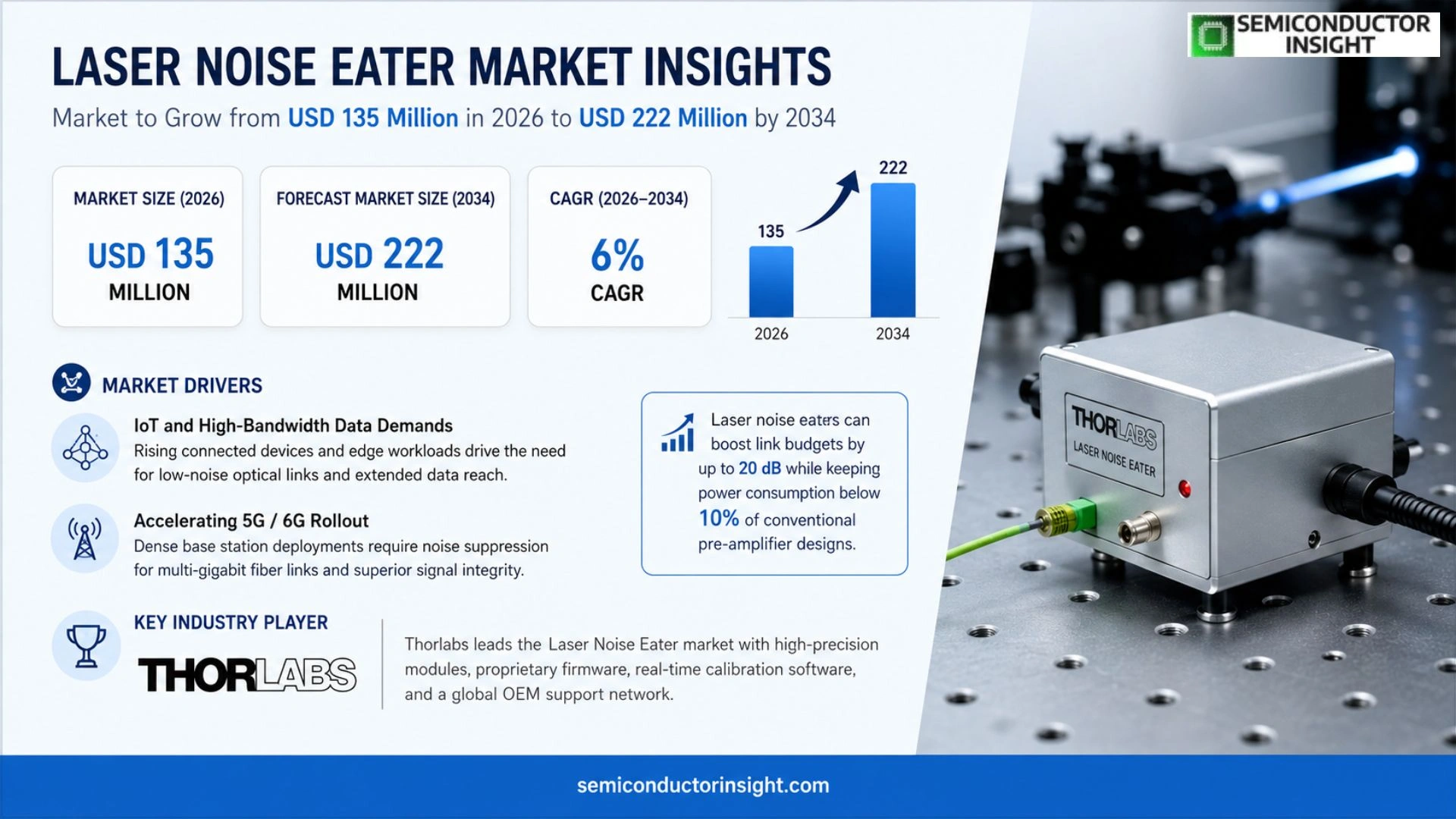
Laser Noise Eater market is projected to grow from USD 135 million in 2026 to USD 222 million by 2034, exhibiting a CAGR of approximately 6% during the forecast period.
A noise eater is a device engineered to suppress intensity fluctuations within laser beams by employing an electrically controllable attenuator that modulates optical power according to real‑time measurements of either the input or output signal via fast photodiodes; this feedback/feedforward mechanism stabilises laser output and markedly reduces intensity noise.
MARKET DRIVERS
IoT and High‑Bandwidth Data Demands
Currently, the proliferation of connected endpoints and edge‑processing workloads has heightened the demand for uncompromised data rates across optical links. Laser Noise Eater modules mitigate intensity noise in high‑power semiconductor lasers, thereby extending usable reach and maintaining signal integrity in sub‑1‑Gbps and 10‑Gbps links that serve these data‑intensive ecosystems.
Accelerating 5G / 6G Rollout
Telecom operators are investing in ultra‑dense base‑station deployments to meet 5G and early 6G bandwidth targets. Laser Noise Eater Market benefits as manufacturers look to suppress amplified spontaneous emission in key‑node lasers, maintaining eye diagrams and reducing error vectors over multi‑gigabit fiber across macro‑cell and micro‑cell arrays.
➤ Laser noise eaters can boost link budgets by up to 20 dB while keeping power consumption below 10 % of conventional pre‑amplifier designs
Beyond telecom, data‑center operators are adopting noise‑reduction hardware to increase spine‑core reliability, allowing clusters to surpass 400 Tbps of peak throughput while reducing thermal footprints. This convergence of edge and core networking strategies positions Laser Noise Eater Market for continued relevance.
MARKET CHALLENGES
Capital Intensity and Long Deployment Cycles
The high‑precision optics, on‑chip digital signal processors, and rigorous testing protocols inflate capital spend, and integration into existing infrastructure demands multi‑month commissioning periods that delay ROI realization for many beneficiaries.
Other Challenges
Supply Chain Constraints
Component shortages in micro‑photolithography and rare‑earth alloys have compressed lead times, preventing vendors from scaling production to meet surging demand without additional investment in alternative suppliers.
MARKET RESTRAINTS
Regulatory Compliance Challenges
National and international standards governing laser safety, electromagnetic compatibility, and fiber‑optic emissions impose strict testing and certification pathways. Non‑compliance can delay time‑to‑market and incur costly redesigns, which dampens the willingness of smaller players to enter the space.
MARKET OPPORTUNITIES
Emerging Applications in Biomedical Imaging
Precision laser sources in endoscopic and optical coherence tomography setups now seek noise‑reduced illumination to enhance contrast and depth resolution. Early adopters are integrating Laser Noise Eater modules to lower shot noise, which directly translates into sharper diagnostic images and reduced patient exposure times.
Laser Noise Eater Market Trends
Modern Power Stabilisation Drives Adoption
High‑precision laser applications in communications, defense, and industrial automation now require power stability that surpasses conventional passive measures. Laser Noise Eater, as a core component of Laser Noise Eater Market, actively attenuates intensity fluctuations via feedback or feedforward loops. An electronically controlled attenuator reacts to real‑time power measurements, reducing laser output jitter to sub‑per‑mille levels. Shrinking sensor and modulation technology has lowered implementation costs, broadening the technology’s reach. Vendors are now offering modular units that fit within existing photonic layouts, easing integration timelines and mitigating supply‑chain delays.
Other Trends
Accelerating Photonic Integration
Miniaturisation of control electronics and the rise of silicon‑photonics platforms have accelerated the embedding of noise‑eating modules into photonic integrated circuits. This convergence lowers per‑unit cost and increases reliability, which drives uptake in high‑density data‑center optics and next‑generation coherent communication systems. The trend aligns with the broader shift towards component‑on‑chip solutions, where laser power conditioning is handled alongside modulation and routing functions.
Expanding Remote Sensing Use Cases
Remote sensing and atmospheric profiling now rely on stable laser sources to achieve accurate altitude and velocity measurements. The integration of laser noise eaters into laser‑radar and LiDAR systems mitigates range and sensitivity errors caused by intensity flicker. As automotive, aerospace, and environmental monitoring markets mature, the appetite for repeatable, low‑noise laser output is rising, positioning noise‑eating technology as a value‑adding add‑on for precision instrumentation.
Consolidation of Supplier Chains
Laser Noise Eater Market has attracted attention from established photonic component manufacturers, leading to a wave of acquisitions and strategic partnerships. Companies with strong IP portfolios in adaptive optics are acquiring specialist noise‑eating innovators to broaden their optical‑electronics offering. This consolidation improves access to critical raw materials, tightens development cycles, and creates a more resilient deployment pipeline. For prospects, this dynamic means that suppliers will be better positioned to meet stringent performance specifications required by ultra‑stable laser systems in mission critical environments.
COMPETITIVE LANDSCAPE
Key Industry Players
Laser Noise Eater Market – Competitive Landscape Analysis
Thorlabs occupies the upper echelon of Laser Noise Eater value chain. The company has invested heavily in custom electronics, delivering high‑precision feedback and feedforward modules that can be integrated directly into laser heads used in biomedical imaging, spectroscopy and industrial metrology. With a presence in more than 30 countries and a dedicated channel for OEMs, Thorlabs secures a significant share of the projected 194‑million‑dollar 2031 market by packaging its products with proprietary firmware, real‑time calibration software and an extensive service network. This combination gives the firm pricing leverage, allowing it to maintain healthy margins while simultaneously reducing total cost of ownership for end‑users,a critical selling point in defense, semiconductor and high‑power laser sectors that prioritize reliability. The concentration of sales power creates a consolidated competitive structure that raises entry barriers, consequently protecting Thorlabs’ R&D pipeline and incremental innovation cycle. The firm’s robust domestic manufacturing base across North America and Europe provides low lead times and resilience against global supply shocks, reinforcing its market leadership.
Conoptics, TEM‑Messtechnik, Quantum Technology, and Anesto supply Noise‑Eater kits that focus on narrowband applications: 850‑nm telecoms, sub‑MHz frequency combs for atomic clocks, and space‑qualified links. By keeping designs modular and targeting niche physics laboratories, these players exploit specialized firmware upgrades and support that large incumbents typically do not offer. Their growth is further buoyed by regional policies promoting domestic laser‑component manufacturing in China and Japan, where cost‑competitive alternatives are prized. Moreover, several of these firms participate in government‑funded research initiatives, embedding their technology in national science agendas and ensuring a pipeline of new contracts. Though individually smaller, collectively they provide a diversity of solutions that push the broader market toward fourth‑generation stabilization techniques based on adaptive optics and machine‑learning control loops. This fragmentation, while beneficial for users, compels larger OEMs to revisit cost structures and partnership models to stay competitive.
List of Key Laser Noise Eater Companies Profiled
- Thorlabs
- Conoptics
- TEM‑Messtechnik
- Quantum Technology
- Anesto
- VSL
- EDL
- S2laser
- LiRX Optics
- ZEMO
- OPTRONIX
- SPOSS
Segment Analysis:
| Segment Category | Sub-Segments | Key Insights |
| By Type |
|
Electronic Feedforward Loop offers rapid attenuation adjustments based on input power metrics, fostering intuitive stabilization in high‑speed diagnostic environments. – Enables near real‑time correction of laser intensity spikes – Reduces error propagation in fiber‑optic sensing systems – Facilitates scalable integration within compact photonic modules |
| By Application |
|
Research & Development drives demand for noise‑reducer precision, encouraging iterative testing in spectrometer calibration and quantum communication assays. – Provides consistent baseline stability for experimental setups – Enhances reproducibility of high‑resolution measurements – Supports the transition to fully integrated photonic chips |
| By End User |
|
Academia emphasizes rigorous noise suppression for fundamental research, driving innovations in low‑noise photodiode integration and calibration protocols. – Prioritizes reliability in long‑term beam experiments – Supports funding proposals that require high‑stability laser sources – Catalyzes cross‑disciplinary collaborations between optics and computing |
| By Technology |
|
Integrated Photonic Chips align with industry momentum towards miniaturization, offering low‑size‑footprint, high‑bandwidth solutions for real‑time noise compensation. – Enables monolithic integration with laser diodes – Reduces packaging costs and improves thermal management – Opens avenues for consumer‑grade optical sensing devices |
| By Market Maturity |
|
Emerging Markets present opportunities for early adoption, as evolving infrastructure seeks cost‑effective noise reduction for burgeoning quantum and telecom projects. – Encourages participation in pilot trials – Provides a platform for joint ventures with local firms – Drives local capacity building in precision optics |
Regional Analysis: Laser Noise Eater Market
North America
Active noise cancellation integrated with machine‑learning algorithms is becoming standard in North American laser workshops, allowing dynamic adjustment to acoustic profiles and reducing unintended material stress. These advancements translate into measurable productivity gains that align with cost containment goals.
Stricter occupational safety guidelines have made laser noise control a compliance necessity, turning regulatory pressure into a growth lever for suppliers that can demonstrate measurable noise‑reduction performance.
Concentration of high‑precision firms in the Pacific Northwest fosters cross‑industry collaboration, accelerating the diffusion of noise‑eating solutions from aerospace to biomedical tech.
By embedding noise‑reduction tech into real‑time diagnostic dashboards, companies reduce downtime and the risk of costly shutdowns, offering an attractive ROI to procurement teams.
Europe
Europe’s laser‑noise‑eater landscape is shaped largely by its stringent environmental and occupational health directives. The region’s diverse industrial base,from cutting‑edge aerospace to high‑precision medical device manufacturing,drives the demand for acoustic control solutions that fit within existing safety frameworks. European firms are leveraging open‑source acoustic modeling platforms to accelerate go‑to‑market speeds, although the regulatory-laden environment can lead to longer certification cycles. Partnerships between equipment vendors and acoustics specialists are becoming more common, as companies seek to embed noise‑eating technology directly into laser apparatus, thereby shifting the cost burden from post‑installation retrofits to integrated design. The European appetite for sustainable manufacturing also nudges manufacturers toward noise suppression solutions that reduce energy waste by eliminating unnecessary heating due to acoustic vibrations. Ultimately, Europe’s growth trajectory hinges on its ability to translate regulatory compliance into a competitive advantage for precision laser applications.
Asia-Pacific
Asia‑Pacific presents a unique blend of high‑growth manufacturing hubs and rapid adoption of digital twins in laser operations. The sheer volume of semiconductor fabs and electronics factories in countries like South Korea, Japan, and China provides a critical mass that renders noise control one of the cost‑saving levers for production optimization. The region’s emphasis on smart‑city infrastructure, particularly in Seoul and Shanghai, has spurred the integration of noise‑eating devices with IoT platforms, enabling real‑time acoustic monitoring and predictive maintenance. However, fragmented market entry regulations and varying safety standards across countries pose challenges for global suppliers. Collaboration between regional technology vendors and multinational OEMs is emerging as a strategic approach to standardize compliance and streamline deployment, positioning the Asia‑Pacific footprint as a catalyst for global market expansion.
South America
South America’s laser‑noise‑eater market is currently in a nascent stage, but the region is capitalizing on the expansion of mixed‑use manufacturing parks in Brazil, Argentina, and Chile. Investment in high‑tech capabilities, coupled with the need to comply with evolving safety norms, is driving early adopters to seek cost‑efficient noise suppression. Knowledge transfer from North American suppliers and the adoption of modular noise‑eater systems that can be locally customized are accelerating adoption. While infrastructure costs remain a hurdle, the region’s policy incentives for industrial modernization are beginning to offset barriers, suggesting a steady upward trajectory in the coming years.
Middle East & Africa
The Middle East and Africa present an evolving canvas for laser noise‑eater penetration, as regional economies diversify away from hydrocarbons toward high‑value manufacturing and research. Large infrastructure projects, such as the development of advanced optics facilities in the UAE and emerging tech corridors in South Africa, are creating demand for acoustic control to protect sensitive equipment. In countries where laser usage is expanding in medical and defense applications, the necessity for safety‑compliant noise suppression is increasingly recognized. Market entrants are exploring partnerships with local distributors to navigate regulatory landscapes and establish supply chains that can support rapid scaling, indicating early growth potential, albeit at a modest pace.
Report Scope
This market research report provides a comprehensive analysis of the Laser Noise Eater Market , covering the forecast period 2026–2034. It offers detailed insights into market dynamics, technological advancements, competitive landscape, and key trends shaping the industry.
Key focus areas of the report include:
- Market Overview: The report begins with an overview outlining its current market scenario, key growth indicators, and industry transformation drivers. It discusses macroeconomic factors, demand–supply balance, regulatory landscape, and the strategic role of semiconductors in powering advancements across industries such as automotive, telecommunications, consumer electronics, and industrial automation.
- Market Size & Forecast: Historical data and future projections for revenue, unit shipments, and market value across major regions and segments.
- Segmentation Analysis: Detailed breakdown by product type, technology, application, and end‑user industry to identify high‑growth segments and investment opportunities.
- Regional Insights: Insights into market performance across North America, Europe, Asia-Pacific, Latin America, and the Middle East & Africa, including country‑level analysis where relevant.
- Competitive Landscape: Profiles of leading market participants, including their product offerings, R&D focus, manufacturing capacity, pricing strategies, and recent developments such as mergers, acquisitions, and partnerships.
- Technology Trends & Innovation: Assessment of emerging technologies, integration of AI/IoT, semiconductor design trends, fabrication techniques, and evolving industry standards.
- Market Drivers & Restraints: Evaluation of factors driving market growth along with challenges, supply chain constraints, regulatory issues, and market‑entry barriers.
- Stakeholder Insights: Insights for component suppliers, OEMs, system integrators, investors, and policymakers regarding the evolving ecosystem and strategic opportunities.
Primary and secondary research methods are employed, including interviews with industry experts, data from verified sources, and real‑time market intelligence to ensure the accuracy and reliability of the insights presented.
FREQUENTLY ASKED QUESTIONS:
What is the current market size of Laser Noise Eater Market?
-> Laser Noise Eater market is projected to grow from USD 135 million in 2026 to USD 222 million by 2034, exhibiting a CAGR of approximately 6%
Which key companies operate in Laser Noise Eater Market?
-> Key players include Thorlabs, Conoptics, TEM‑Messtechnik, and Quantum Technology, among others.
What are the key growth drivers?
-> Key growth drivers include increasing demand in communication equipment and data centers, digital transformation, AI technology adoption, and the accelerated development of new energy vehicle markets.
Which region dominates the market?
-> Asia‑Pacific is the fastest‑growing region, while Europe remains a significant market.
What are the emerging trends?
-> Emerging trends include advanced noise‑reduction technologies, integrated feedforward and feedback control systems, and innovations in laser stabilization techniques.

Get Sample Report PDF for Exclusive Insights
Report Sample Includes
- Table of Contents
- List of Tables & Figures
- Charts, Research Methodology, and more...
 Download Sample Report PDF